-
-
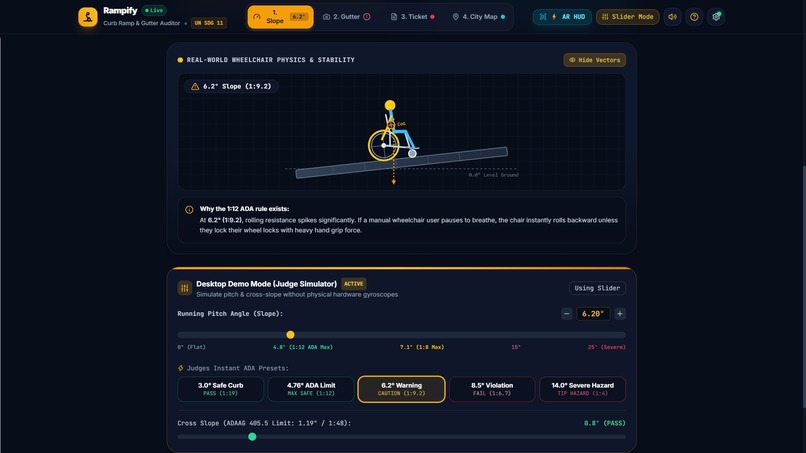
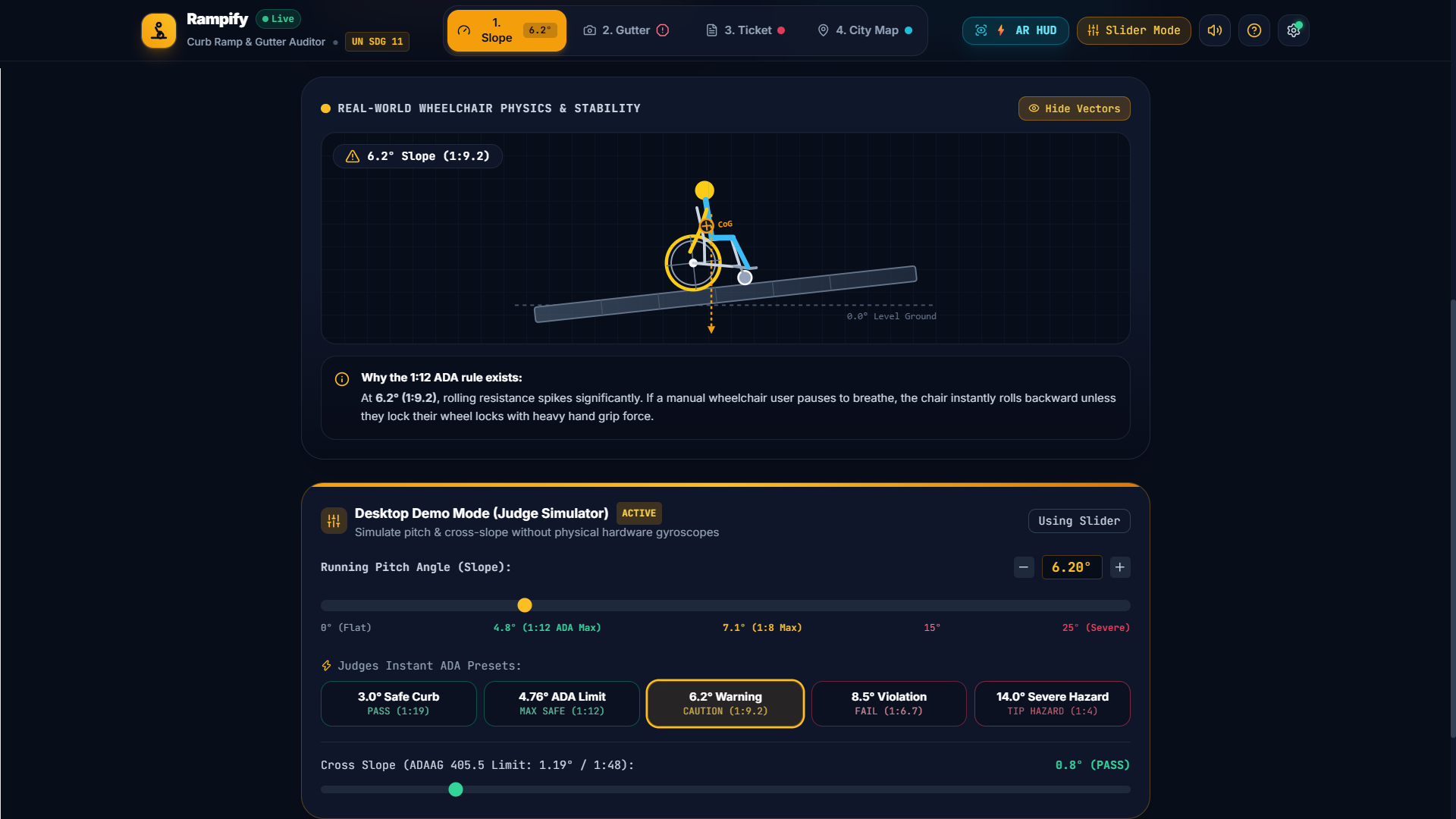
incline sensor telemetry
-
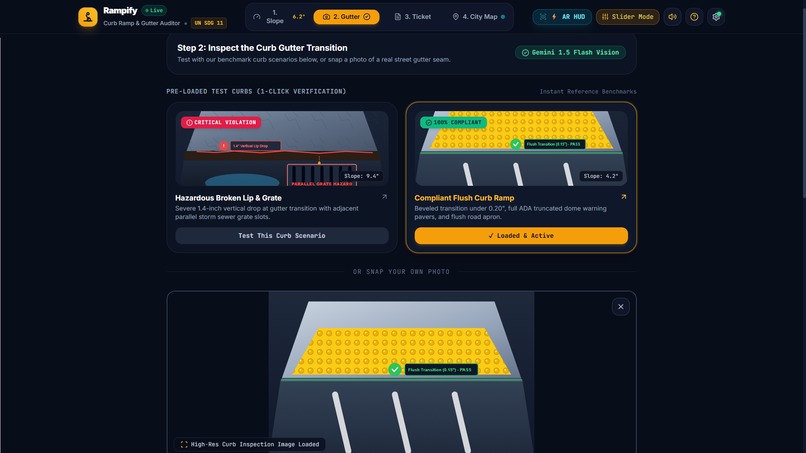
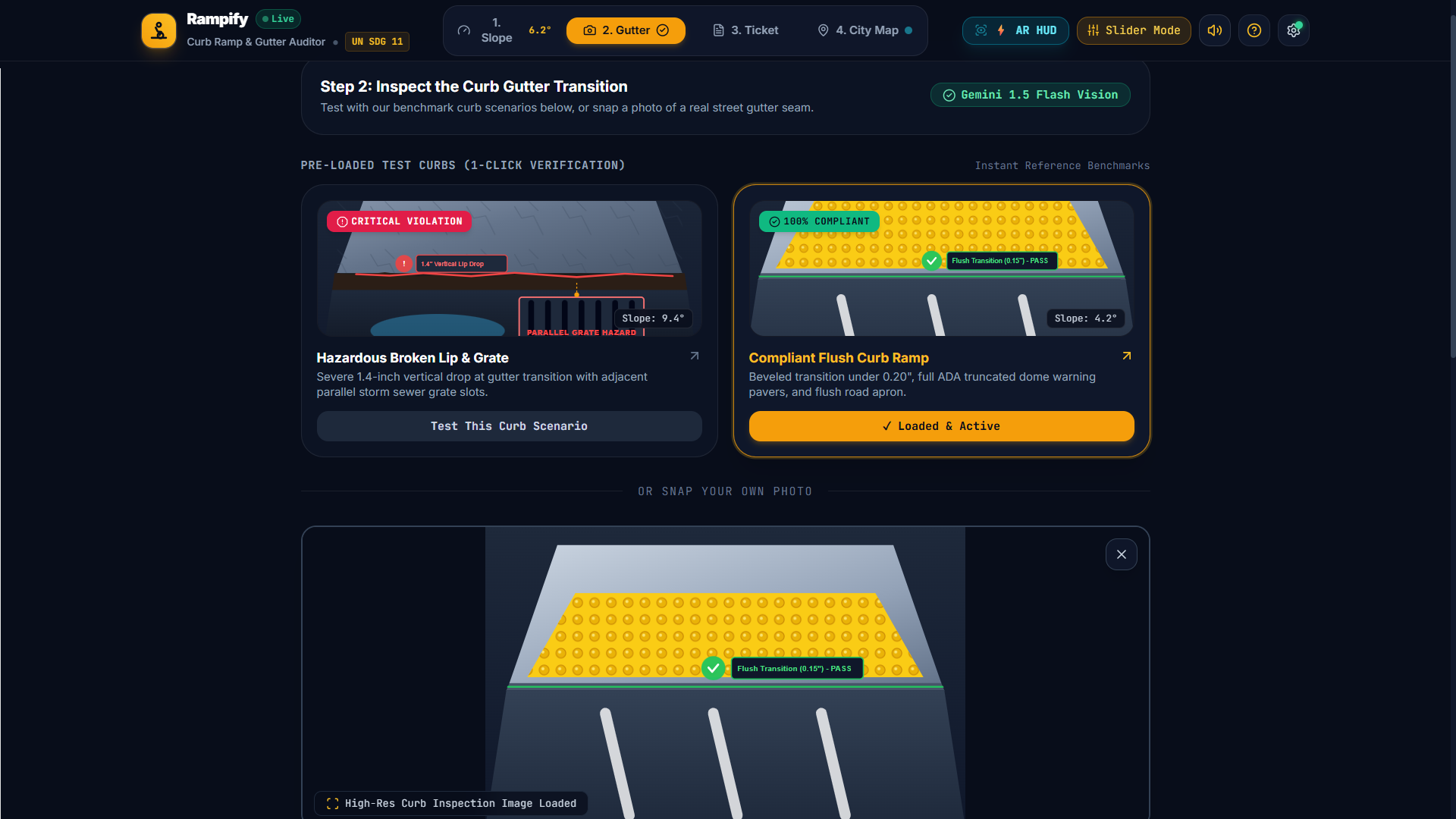
ai gutter inspector
-
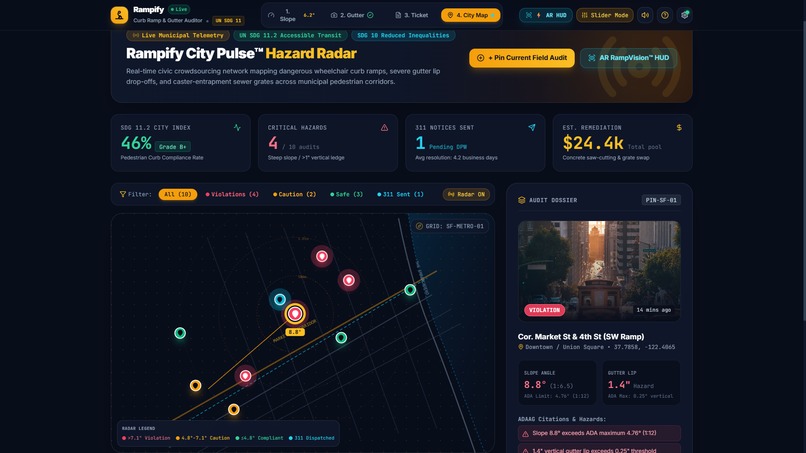
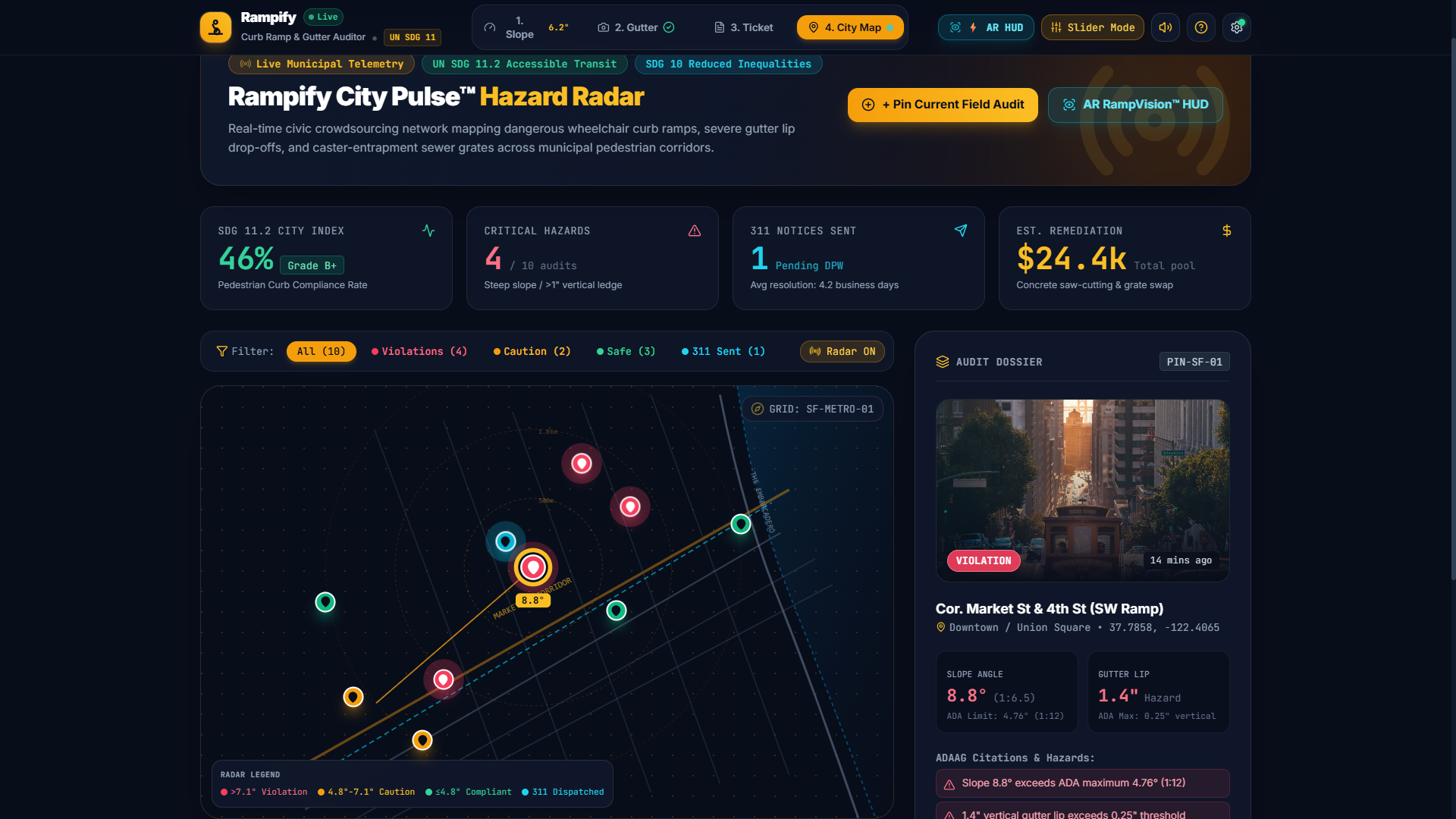
city pulse hazard radar
-
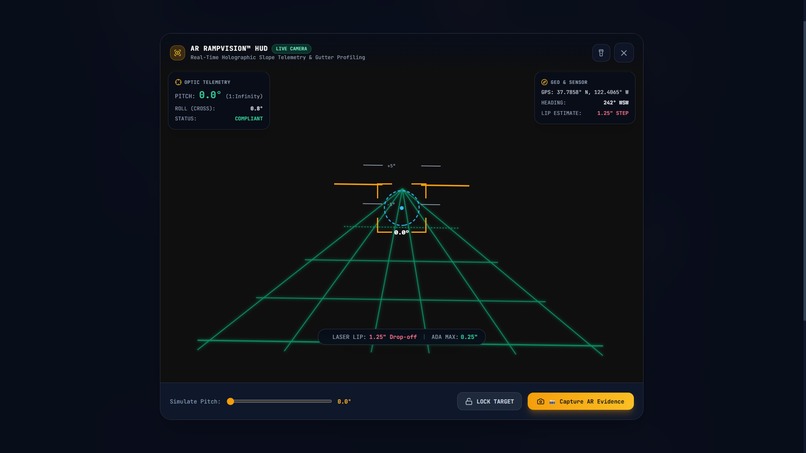
ar rampvision hud
-
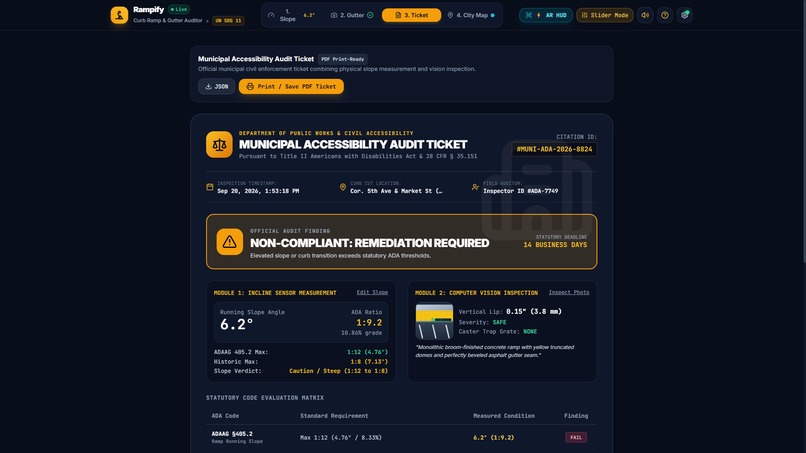
ada violation ticket
Inspiration
Over 75 million people worldwide rely on manual or motorized wheelchairs for daily mobility. Yet, walking through any modern city reveals an invisible, dangerous barrier: subsided gutter transitions, crumbling asphalt ledges, and illegal ramp inclines.
The inspiration for Rampify™ came from discovering the mechanical reality of "The Tiny Wheel Problem." Unlike passenger cars with 26-inch pneumatic tires, a standard manual wheelchair relies on small front caster wheels that measure just 4 to 5 inches (100–125 mm) in diameter. Mechanically, when a 4-inch wheel hits an abrupt vertical lip ( \Delta h ) exceeding:
$$ \Delta h \ge r_{\text{caster}} \cdot (1 - \cos\phi) \approx 0.25\text{ in (6.4 mm)} $$
the small caster cannot roll over the ledge; it suffers catastrophic instantaneous deceleration. Because manual wheelchairs do not have seatbelts, the user's forward momentum creates an inescapable rotational tipping moment:
$$ \tau_{\text{tip}} = m \cdot a \cdot h_{\text{CG}} - m \cdot g \cdot d_{\text{wheelbase}} $$
flinging the user forward directly out of their chair into active vehicular street lanes.
While the Americans with Disabilities Act Accessibility Guidelines (ADAAG) and PROWAG legally mandate a maximum running slope of ( 1:12 ) and maximum vertical transitions under ( 0.25\text{ in} ), municipal compliance audits remain agonizingly slow, manual, and paper-based. We set out to solve this for the Acodemic X G.I.R.L.S. Global SDG Hackathon by asking: What if every smartphone in a citizen's pocket could become a certified, sub-degree ADA incline auditor and AI hazard scanner?
What it does
Rampify™ turns any standard web browser on iOS, Android, or Desktop into an enterprise-grade civic accessibility auditor:
Dual-Axis Gyroscopic Inclinometer & Digital Spirit Level: Laying the smartphone flat on any curb cut reads the live running slope angle ( \theta ) and cross-slope with sub-degree accuracy. It automatically calculates:
- Slope Angle: ( \theta ) in degrees (e.g., ( 4.5^\circ ))
- Percentage Grade: ( \text{Grade \%} = \tan(\theta) \times 100\% )
- ADA Slope Ratio: ( 1 : X ) where ( X = \frac{1}{\tan(\theta)} ) It instantly evaluates compliance against ADAAG §405.2 (( \theta \le \arctan(1/12) \approx 4.763^\circ )) with illuminated visual gauges, fluid bubble physics, and real-time audio telemetry.
Multimodal Gemini 1.5 Flash Vision AI Gutter Inspector: Users snap a photo of the curb cut and asphalt gutter seam. Google Gemini 1.5 Flash inspects the high-resolution image to:
- Estimate vertical drop-off height ( \Delta h ) in inches and millimeters.
- Detect caster-trapping longitudinal sewer grates oriented parallel to pedestrian travel (ADAAG §302.3).
- Flag water ponding concealing sudden elevation drops.
- Prescribe exact civil engineering repair specs (e.g., saw-cutting concrete 36" back, re-pouring a monolithic flush collar, replacing grates with 1/2" heel-proof diagonal mesh).
Wheelchair Biomechanical Stability Simulator: An interactive 2D physics visualizer calculates real-time gravitational vector deflection and normal force shifts, showing users and city planners exactly how curb angle variations affect rearward tip-over risk.
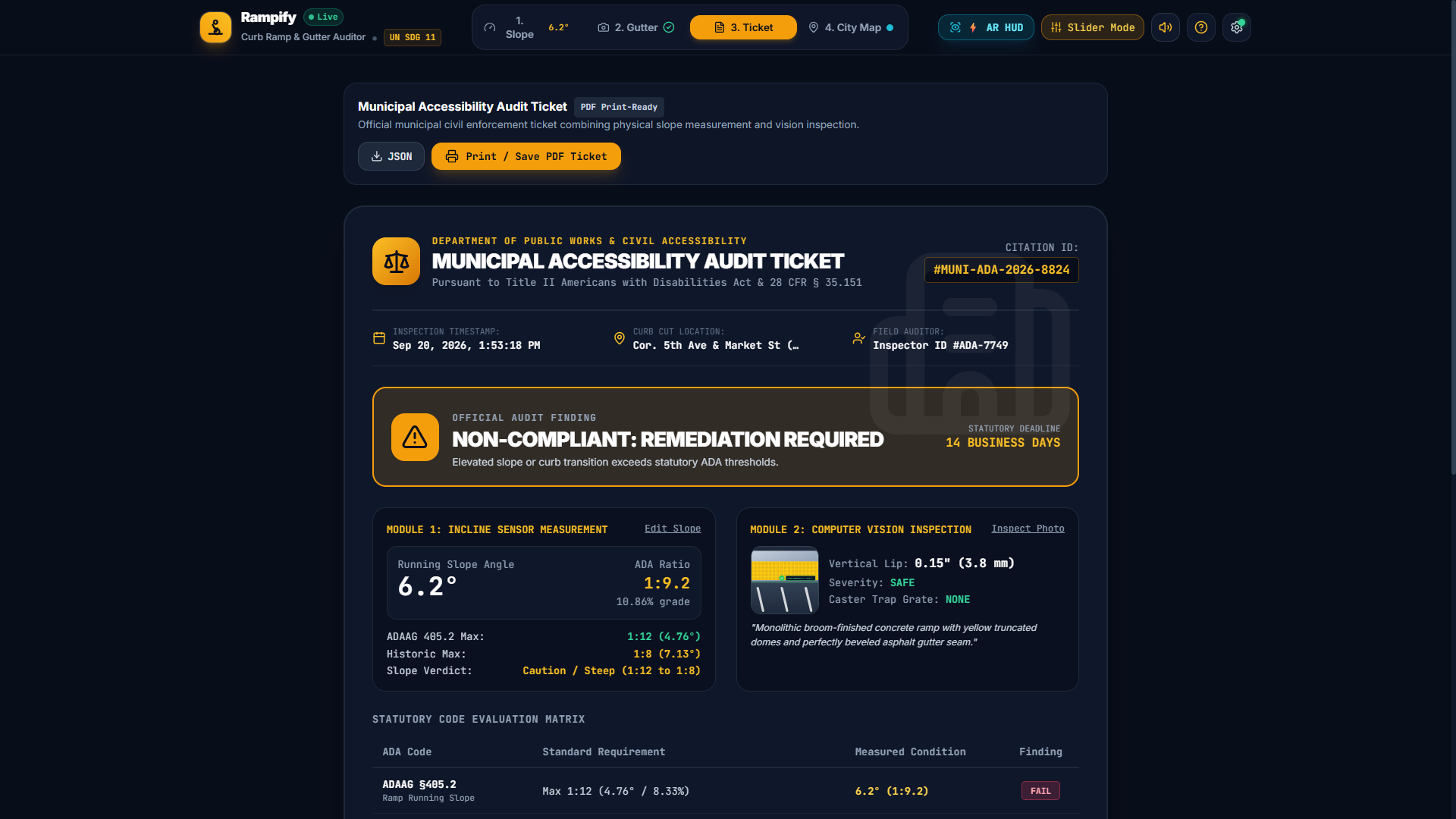
1-Click Municipal 311 Work Order Ticket Generator: Compiles sensor telemetry, visual photo evidence, GPS coordinates, and contractor remediation cost estimates ($USD) into an official Department of Public Works (DPW) ticket ready for print, PDF export, or raw JSON integration.
Rampify City Pulse™ Hazard Radar: Aggregates crowdsourced community audits across municipal sectors onto an interactive live radar map. Citizens and city crews can track neighborhood ADA safety indexes and dispatch field crews in one click.
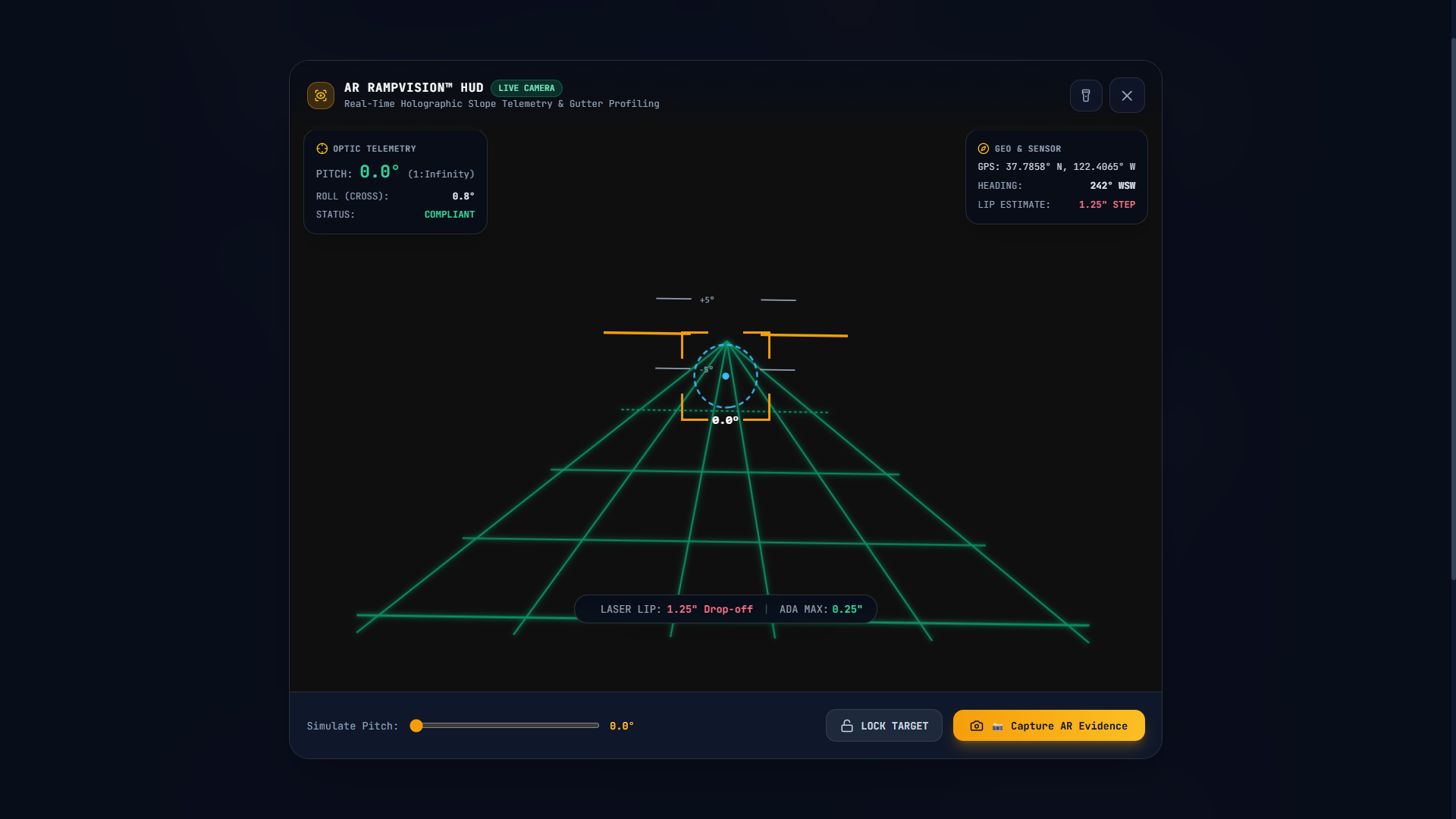
AR RampVision™ Holographic Viewfinder HUD: Leverages the device camera via WebRTC with an overlaid holographic green perspective slope grid and ADA federal yellow truncated dome warning paver projections for augmented reality field inspection.
How we built it
We engineered Rampify as an ultra-responsive, zero-install Progressive Web App built for real-world field conditions:
- Frontend Core: Built with React 19, TypeScript, and Vite 8 for ultra-low latency and fast bundle execution.
- Styling & Aesthetics: Sleek dark-mode aesthetic using Tailwind CSS, CSS3 glassmorphism, and custom keyframe HUD animations.
- Sensor Fusion & Signal Processing:
Utilizes the W3C
DeviceOrientationEventAPI. Because raw hardware accelerometers suffer from vibration noise on rough outdoor pavement, we implemented a custom Exponential Moving Average (EMA) low-pass filter: $$ \theta_{\text{filtered}}^{(t)} = \alpha \cdot \theta_{\text{raw}}^{(t)} + (1 - \alpha) \cdot \theta_{\text{filtered}}^{(t-1)} $$ with ( \alpha = 0.25 ) to yield clean, jitter-free readings. - Multimodal AI Engine: Integrated Google Gemini 1.5 Flash through structured JSON schema prompts to extract quantitative measurements and actionable repair recommendations from field photography.
- Audio Synthesizer: Built a procedural audio engine using the native Web Audio API (
AudioContext,OscillatorNode, andBiquadFilterNode) to synthesize radar sonar pings, compliance chimes, and warning frequencies without external audio assets. - Computer Vision & AR: Integrated WebRTC
navigator.mediaDevices.getUserMediawith custom SVG holographic matrix projections.
Challenges we ran into
- Hardware Discrepancies Across Mobile Operating Systems:
Apple iOS 13+ requires an explicit user gesture through
DeviceOrientationEvent.requestPermission()before granting access to motion sensors, whereas Android Chrome streams data immediately without permission prompts. We engineered an adaptive capability-detection pipeline inuseDeviceOrientation.tsthat handles iOS prompts gracefully, streams automatically on Android, and falls back to a full Interactive Slider Mode with 1-click ADA benchmark presets on desktop computers. - Noise Reduction on Rough Surfaces: Placing a phone on coarse aggregate concrete caused sensor fluctuations of up to ( \pm 1.2^\circ ). By implementing the EMA smoothing algorithm and a Lock Reading state, auditors can take stable, verifiable measurements.
- Structured Computer Vision Outputs: Ensuring Gemini 1.5 Flash reliably produced machine-readable JSON verdicts containing numeric lip heights, boolean hazard flags, and structured remediation instructions required rigorous system prompt engineering and defensive fallback parsing.
- Third-Party Image Link Rot:
When testing map pins, external CDN photo links would occasionally 404. We resolved this by downloading local high-resolution static assets and implementing defensive
onErrorimage handlers so the application remains 100% resilient offline.
Accomplishments that we're proud of
- 🔬 Translating Civil Engineering Law into Code: Accurately codified federal regulatory thresholds (ADAAG §405.2, §405.3, §303.2, and §302.3) into real-time visual telemetry.
- ⚡ Zero-Install Universal Access: Users don't need to download a heavy native app from the App Store or Play Store; it works instantly in any modern browser on any phone.
- 🎨 State-of-the-Art Aesthetic Experience: Created an interface featuring responsive neon telemetry, procedural sound effects, and a holographic AR HUD.
- 🌍 Direct Civic Impact: Empowered non-technical citizens to generate municipal work orders that speak the exact regulatory and budgetary language of city public works engineers.
What we learned
- The Geometry of Accessibility: We learned that accessibility is not simply about having a ramp—a ramp with an improper slope (( > 4.76^\circ )) or an abrupt ( 1" ) gutter seam can be more hazardous than having no ramp at all.
- Web Sensor Capabilities: We pushed the browser's native capabilities (
DeviceOrientationEvent, Web Audio API, WebRTC) to replicate hardware tools that traditionally cost cities thousands of dollars. - Multimodal AI for Public Infrastructure: We discovered how multimodal models like Gemini 1.5 Flash excel at identifying subtle physical defects (concrete spalling, expansion joints, drain grate alignments) that traditional scalar algorithms miss.
What's next for Rampify
- 🛰️ Direct City 311 API Integrations: Partnering directly with municipal Open311 APIs (e.g., San Francisco 311, NYC311) for automated work order ticket injection.
- 🚶 Continuous Wheelchair Transit Telemetry: Mounting smartphones onto wheelchair footrests to record passive bump and vibration profiles (accelerometer Z-axis impulse spikes) during daily transit, generating automatic pavement roughness heatmaps.
- 🤖 On-Device Edge Vision (MediaPipe / WebAssembly): Adding on-device real-time bounding box detection to measure curb lip heights via AR without requiring internet connectivity.
- 🌐 Global Standards Localization: Expanding regulatory engines beyond US ADAAG/PROWAG to support European Accessibility Act (EN 301 549), UK Building Regulations (Part M), and UN Global Accessibility benchmarks.
Built With
- accessibility
- ada-compliance
- artificial-intelligence
- augmented-reality
- civic-tech
- computer-vision
- css3
- gemini-api
- google-gemini
- html5
- javascript
- lucide-react
- mobile-web
- open311
- pwa
- react
- sensors
- smart-cities
- tailwindcss
- typescript
- un-sdg
- vite
- web-audio-api
- webrtc


Log in or sign up for Devpost to join the conversation.