-
-
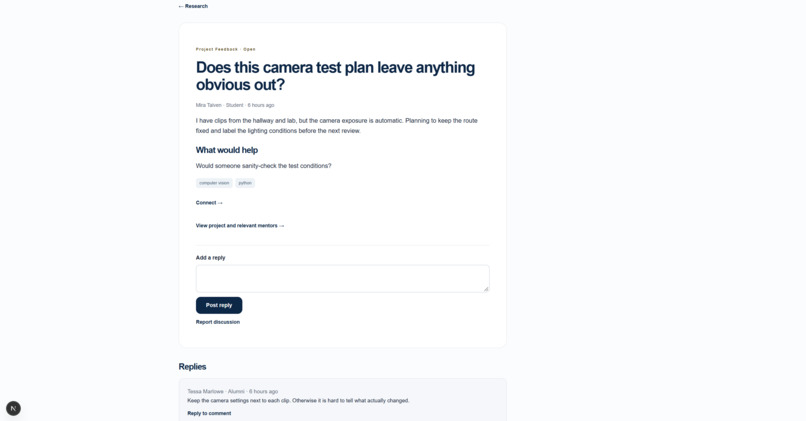
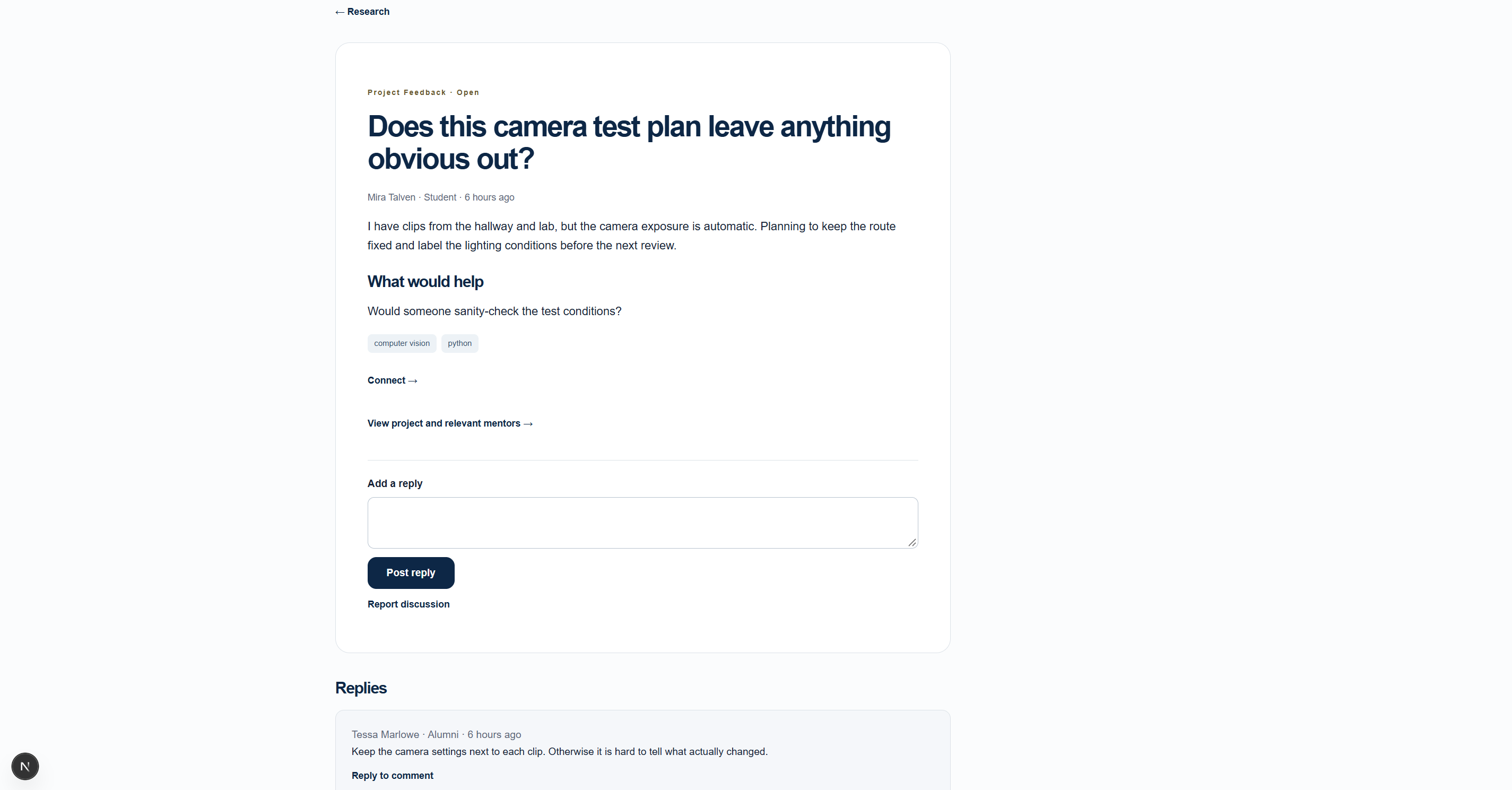
Discussion Post
-
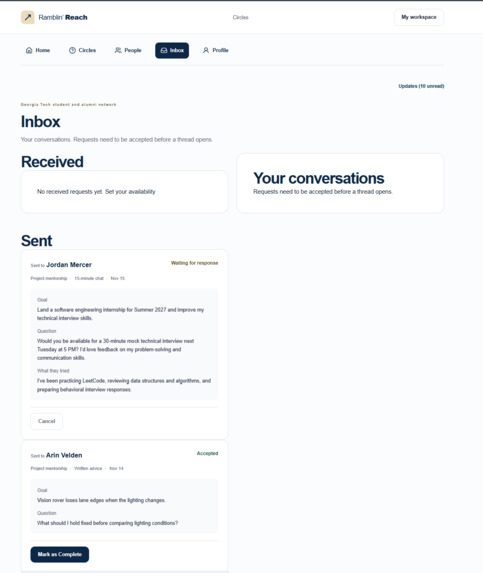
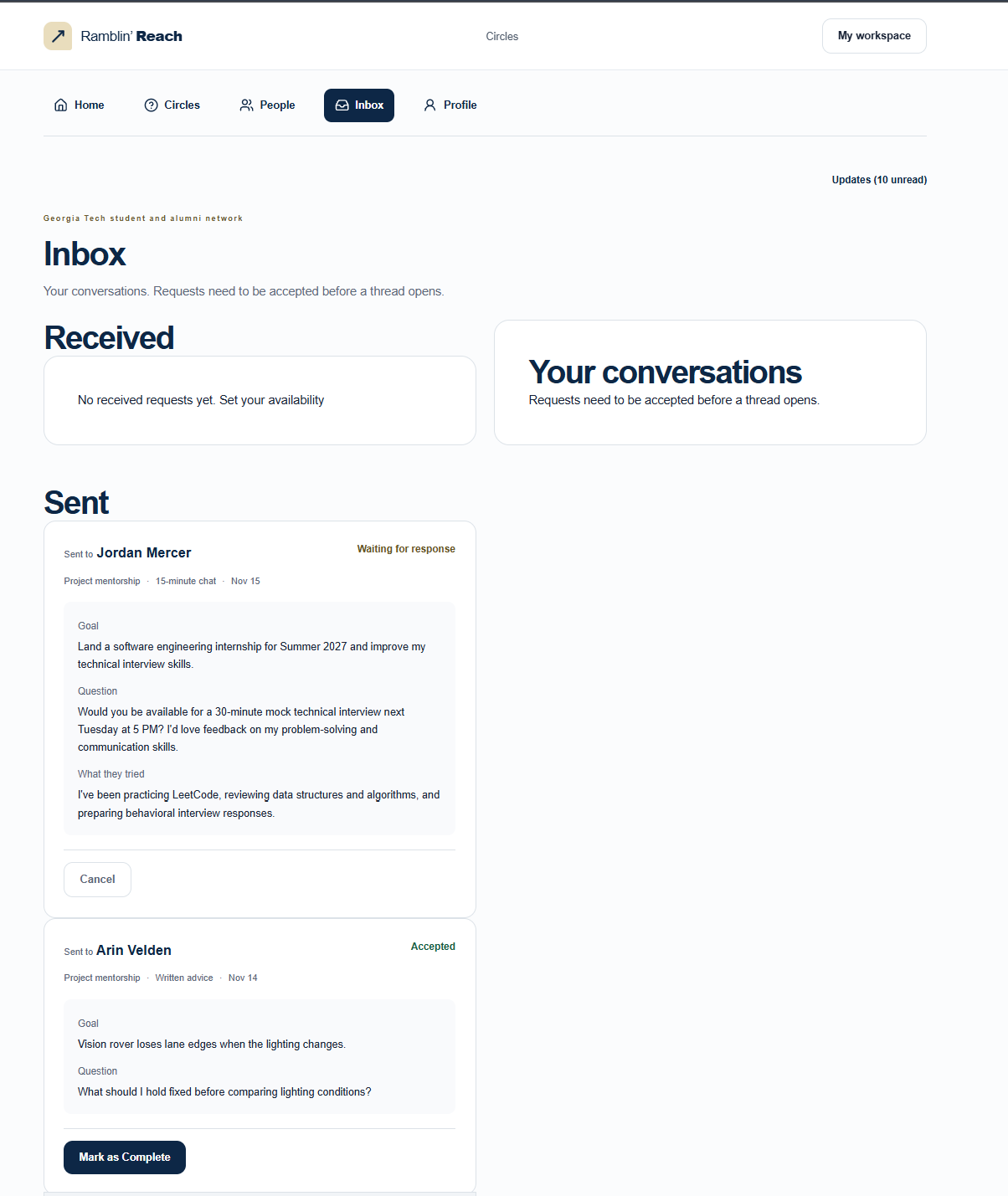
Inbox Page
-
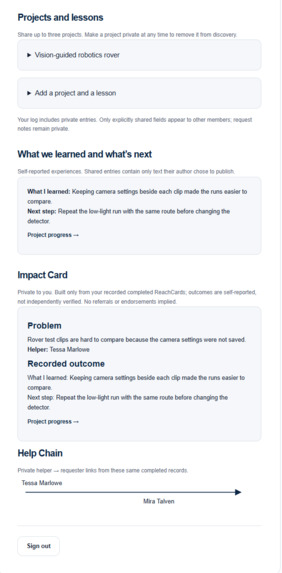
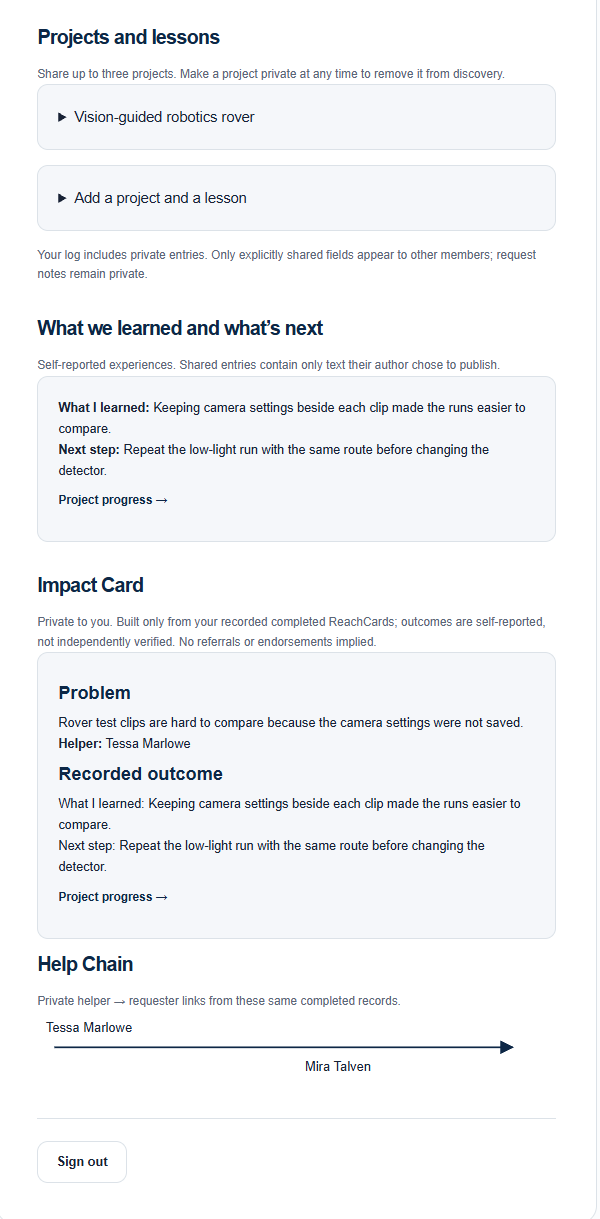
Profile Subfeatures
-
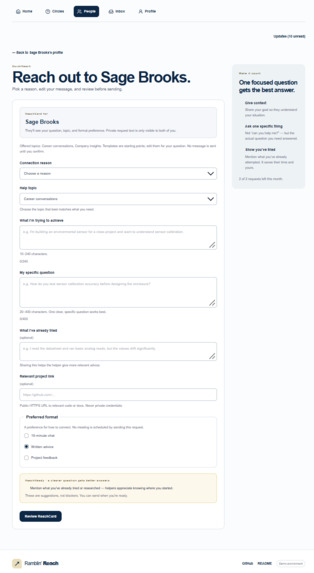
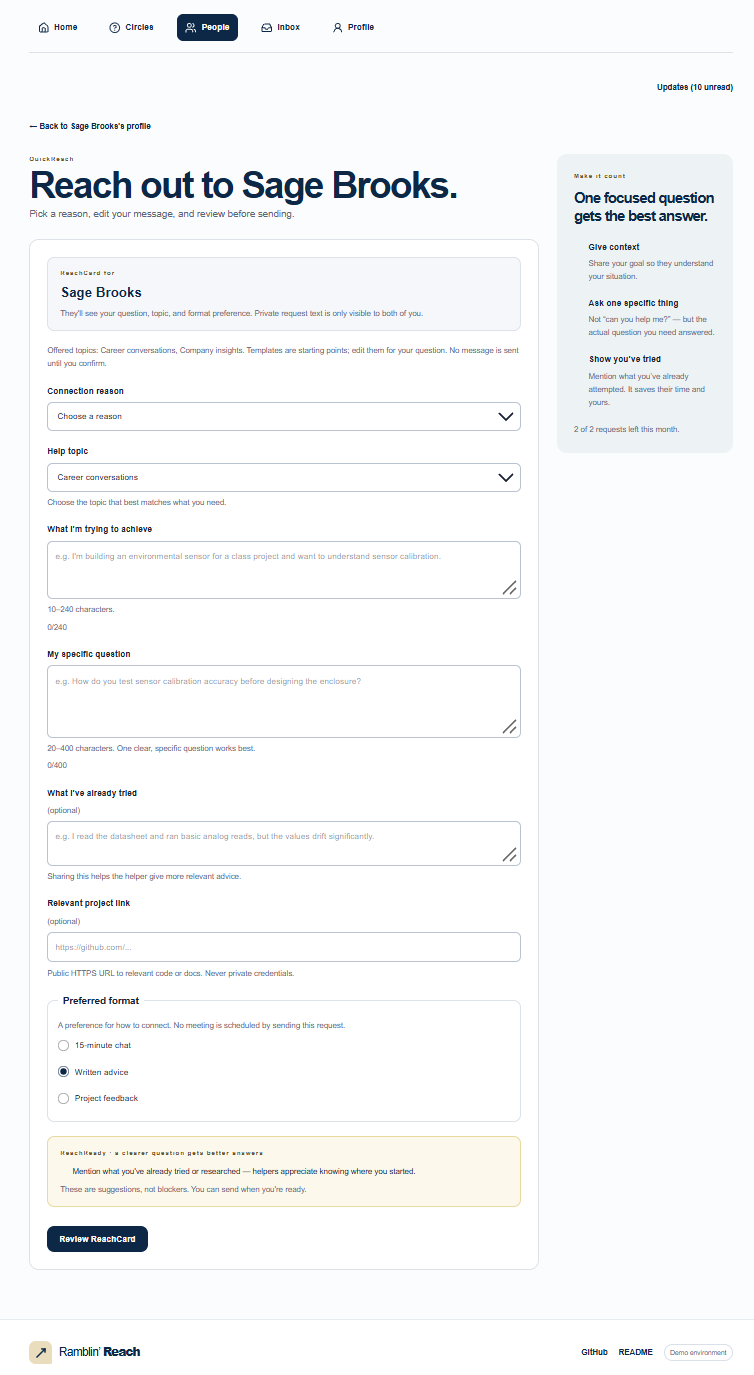
QuickReach Feature
-
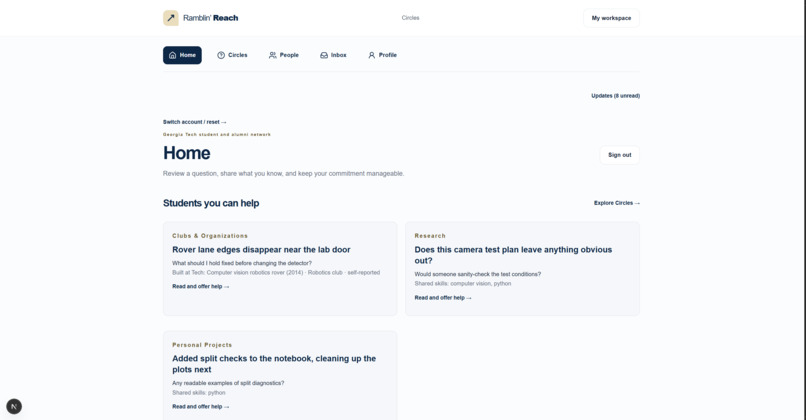
Alumni Dashboard
-
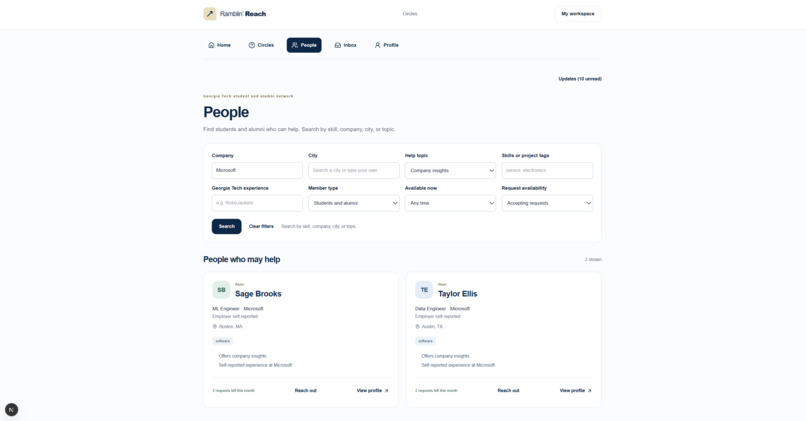
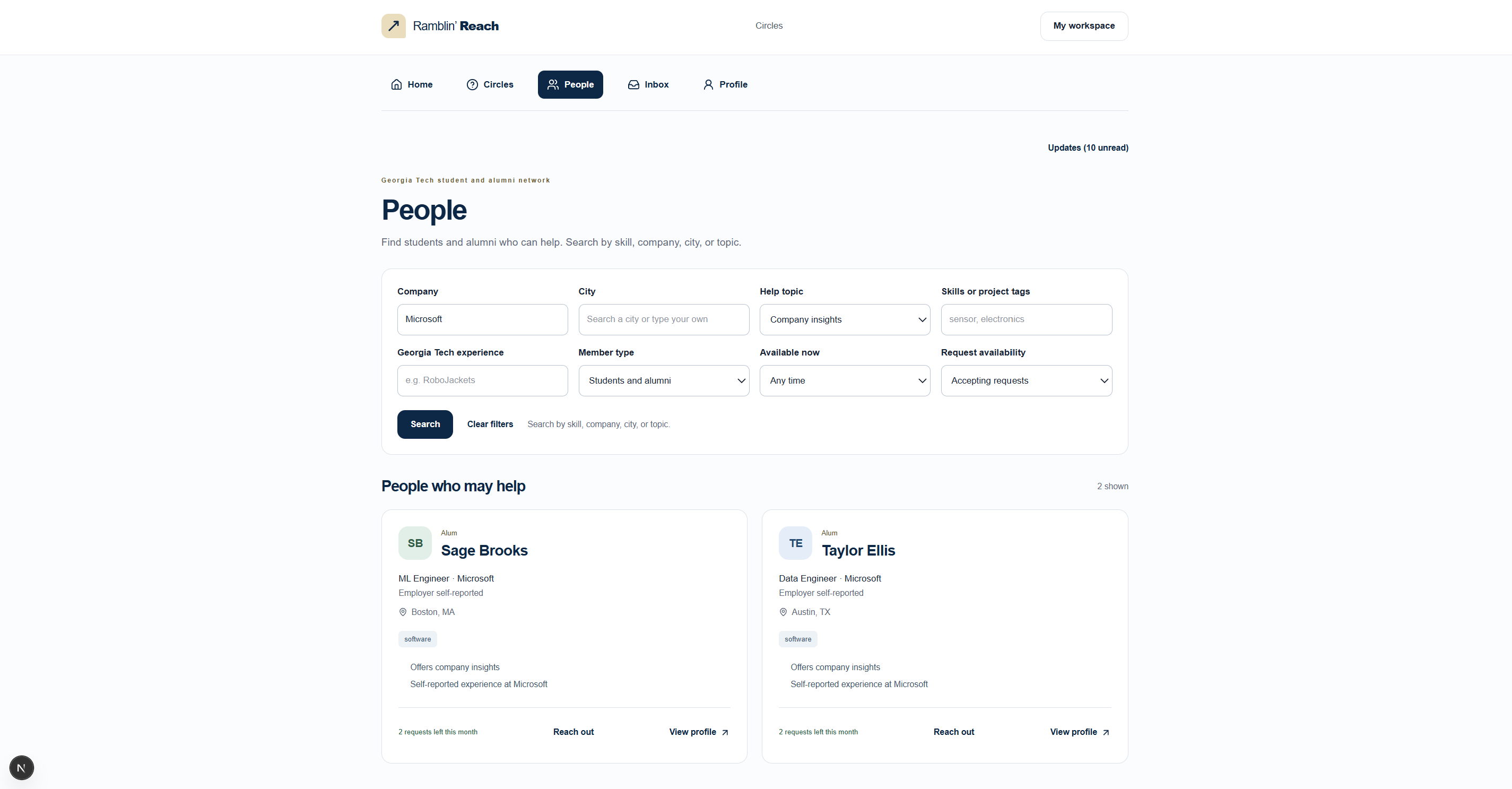
People Page
-
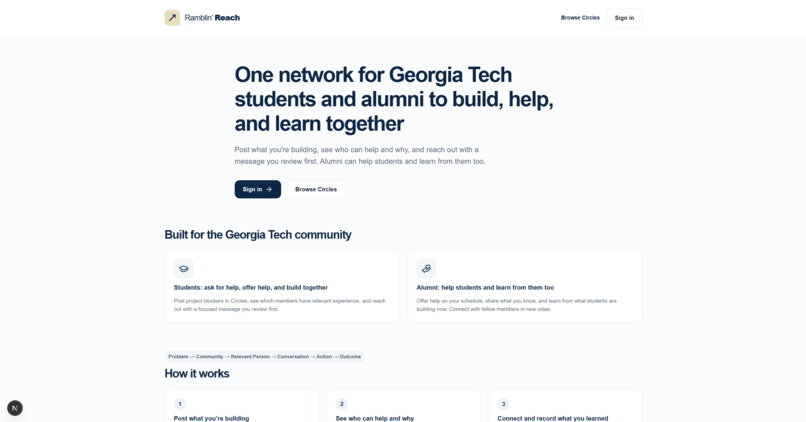
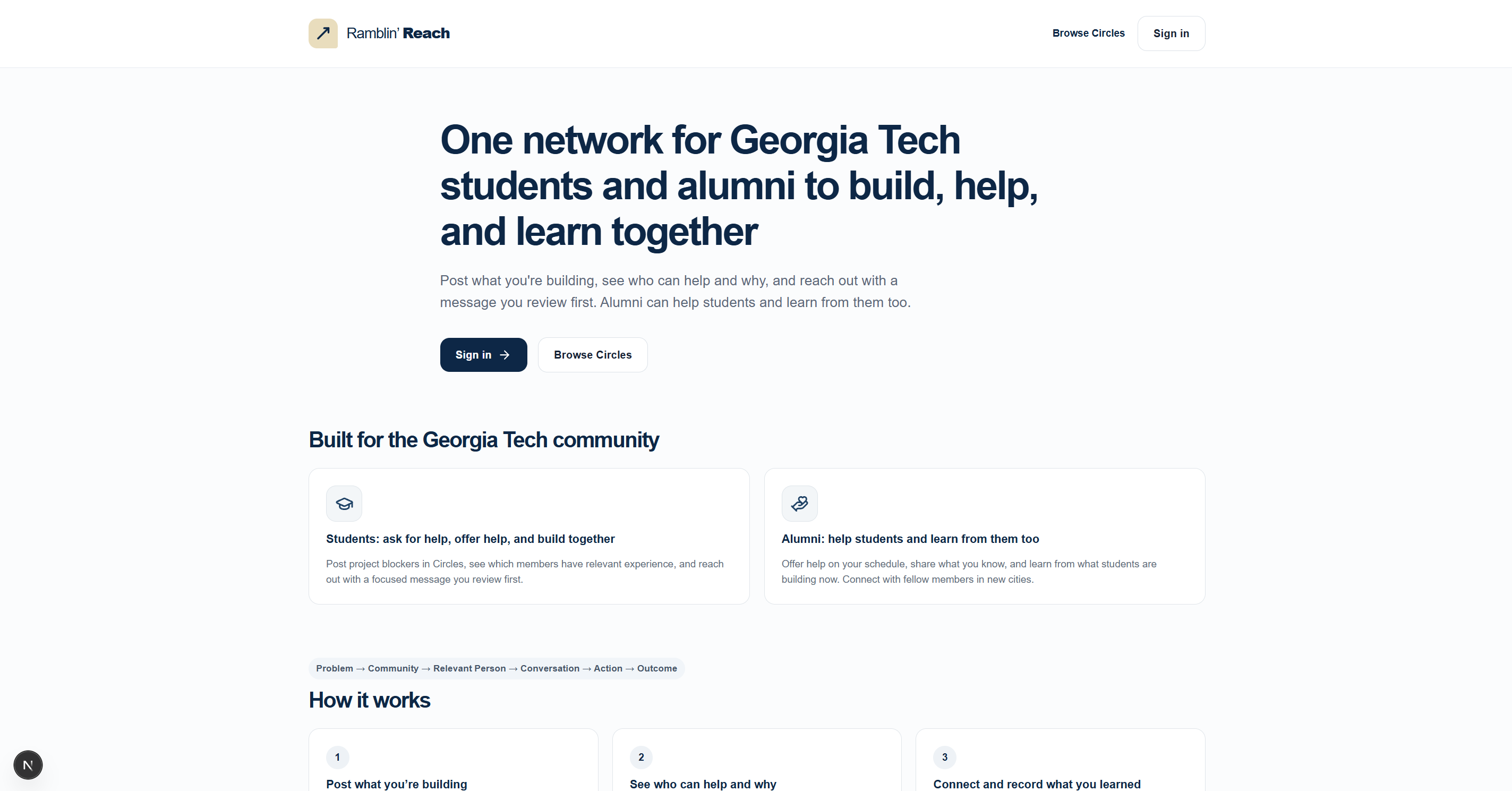
Landing Page
-
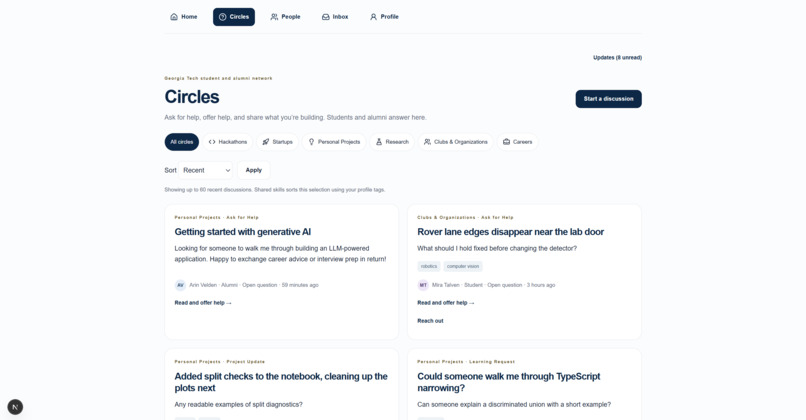
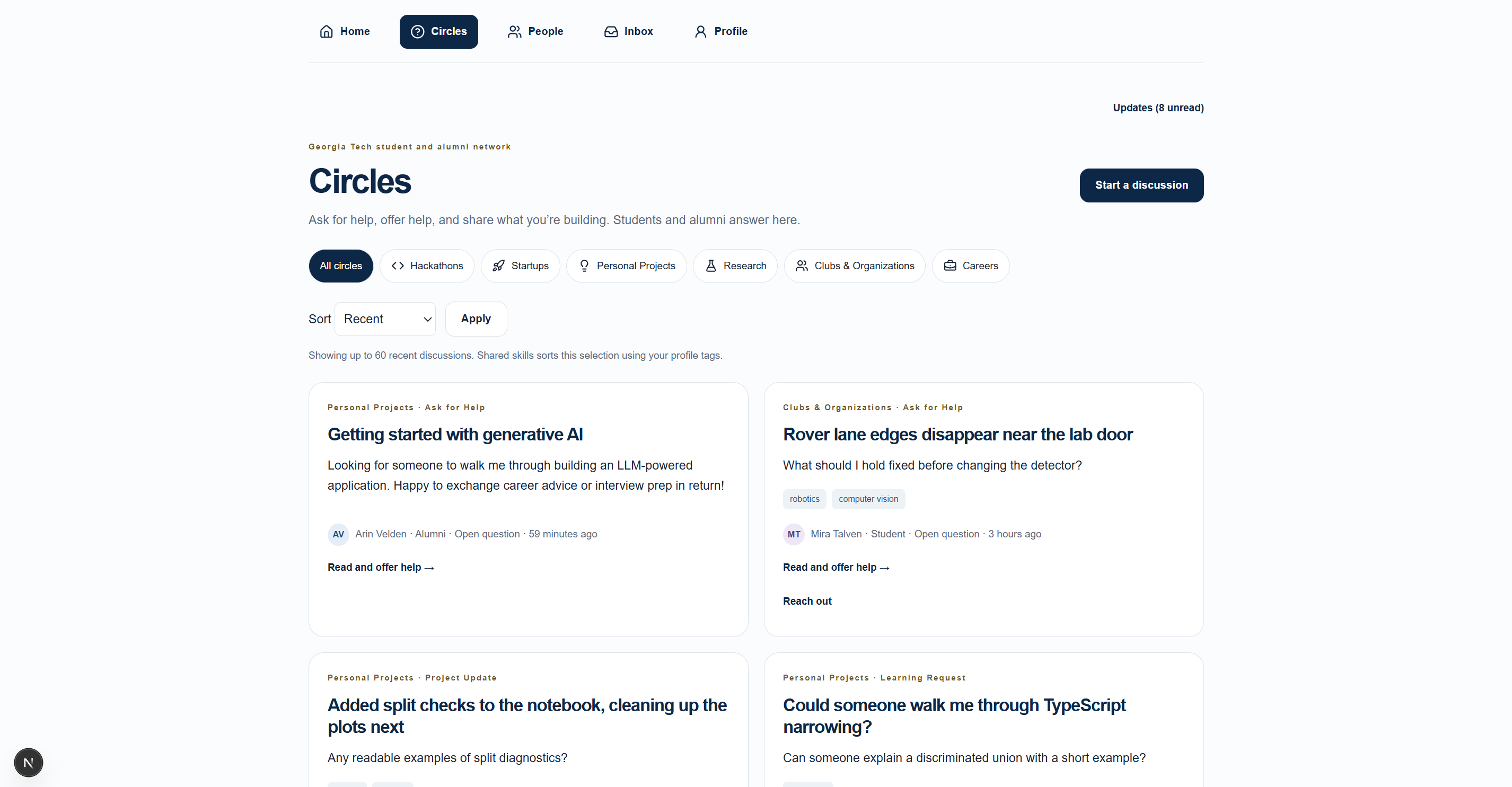
Circles Page
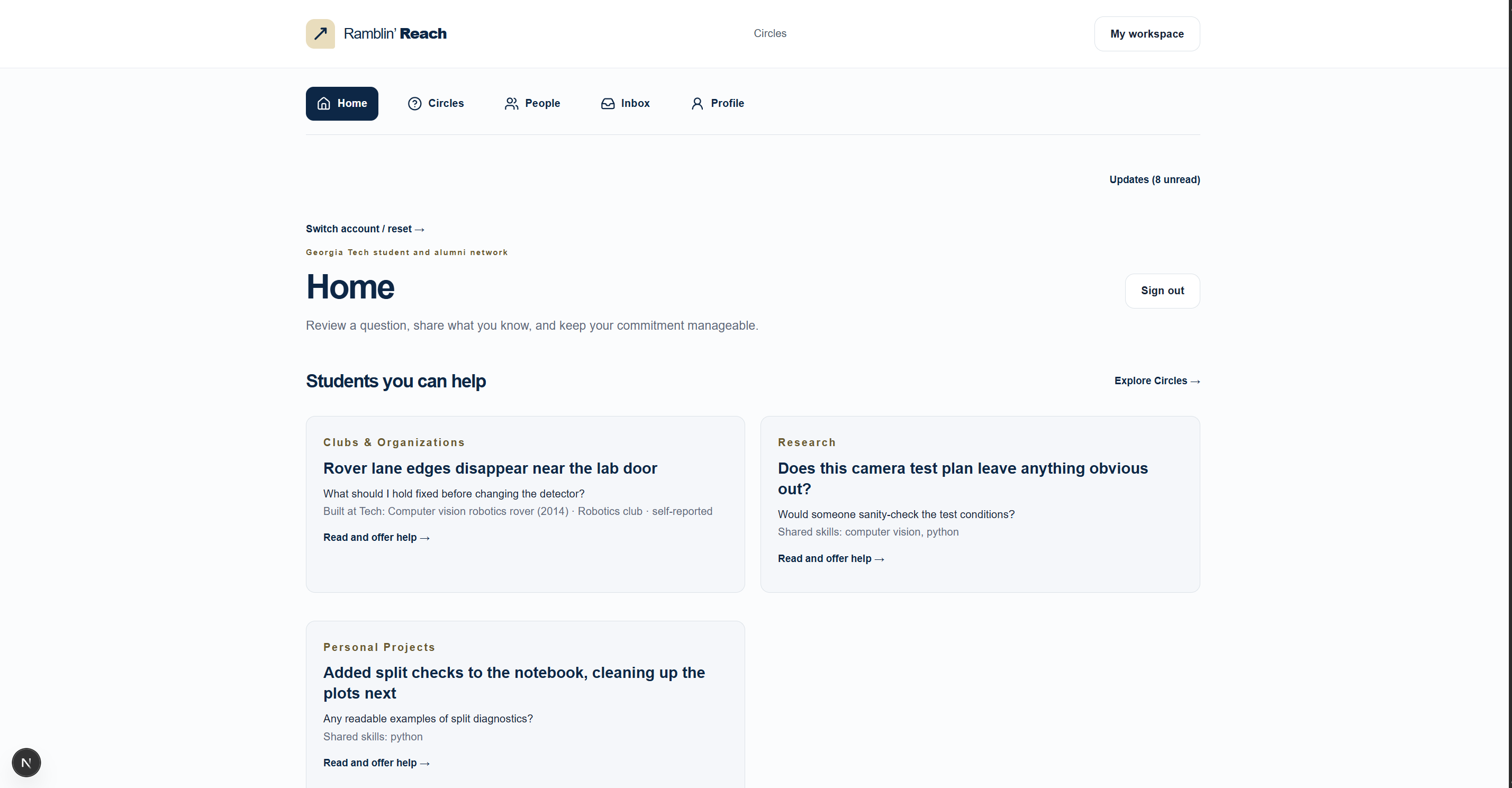
Inspiration
Georgia Tech has over 220,000 living alumni with decades of experience across nearly every industry. But how do you find the right person when you actually need their help?
The idea for Ramblin' Reach came from Abhinay's experience as a freshman at Georgia Tech. Through the Student Alumni Association, Mentor Jackets, and the First Years Program (FYP), he had opportunities to meet alumni, ask career questions, and learn from their experiences. Some of these conversations were among the most valuable experiences of his first semester.
However, we realized how much access to these conversations depended on knowing about the right programs, attending events, and having the confidence to reach out.
Georgia Tech Connect already has over 27,000 alumni and 15,000 students registered, while Mentor Jackets serves more than 1,200 participants. These programs demonstrate a strong interest in alumni engagement, but there is still an opportunity to make these relationships more accessible and relevant to students' everyday experiences.
This isn't just a Georgia Tech problem. According to a 2024 Inside Higher Ed survey, only 56% of student success administrators believe their career centers effectively connect students with their alumni networks.
We researched existing platforms, including Stanford Alumni Mentoring, Harvard's Connect GSD, and Georgia Tech Connect. Rather than building another alumni directory, we wanted to create a community centered around what people are building, what they need help with, and what they can teach each other.
We also wanted to challenge the traditional idea of mentorship. Students can learn from alumni, but alumni can also learn from students.
That's how Ramblin' Reach was born.
What it does
Ramblin' Reach is a university networking platform that connects students and alumni through project collaboration, career development, mentorship, and shared learning.
Build and collaborate
Students can share what they're working on, ask technical questions, find teammates, and request feedback through six community Circles:
- Hackathons
- Startups
- Personal Projects
- Research
- Clubs & Organizations
- Careers
For example, a student building an autonomous robot can describe a specific computer vision problem and discover alumni with relevant experience. Each recommendation includes an explanation of why that person could help.
This also gives clubs and organizations a way to reconnect with former members who understand their projects and challenges.
Discover people and opportunities
Students and alumni can search for connections by company, location, skills, and interests.
Someone preparing for an internship at Microsoft could find alumni working there, explore their experience, and request a mock interview, resume review, coffee chat, or career advice.
Our structured connection requests include editable message templates that make reaching out easier, especially for students who are unfamiliar with professional networking.
Recipients can accept or decline requests, and private messaging becomes available once a request is accepted.
Get help when you need it
Alumni can discover students and projects that match their expertise directly from their dashboard.
They can also enable Available Now, a 60-minute availability window that lets students know they are open to answering questions. This makes it possible to get help with an immediate problem without committing to a long-term mentoring arrangement.
Learn in both directions
Every profile includes skills someone can teach and topics they want to learn.
An alumnus interested in learning about modern AI frameworks, for instance, can post a Learning Request and connect with a current student who has experience using them.
We wanted alumni to have a reason to remain active in the community beyond volunteering their time.
Turn conversations into outcomes
After a conversation, participants can record what they learned and identify their next steps.
These interactions generate private Impact Cards, contribute to a personal Learning Log, and help members visualize how knowledge has been shared through their Help Chain.
The goal is to encourage meaningful relationships and continued learning, rather than simply accumulating connections.
How we built it
We developed Ramblin' Reach as a full-stack, responsive web application using Next.js 16, React 19, TypeScript, and Tailwind CSS. Supabase handles authentication, while PostgreSQL manages user profiles, community posts, connection requests, messages, and learning outcomes.
We organized the application around a shared connection request system. Project assistance, career conversations, mentorship, and learning requests all use the same underlying messaging architecture. This allowed us to introduce new features without creating separate communication systems.
For matching, we developed a weighted, rule-based recommendation engine that considers:
- Skills and interests
- Project categories and previous experiences
- Mentoring preferences and availability
- Teaching and learning interests
- Companies and geographic locations
Every recommendation provides a human-readable explanation, allowing users to understand why someone was suggested.
Security was another major consideration. We implemented PostgreSQL row-level security, server-side authorization, Zod input validation, and transactional database functions to protect private conversations and prevent unauthorized access.
We also implemented atomic rate limits, request quotas, blocking, reporting, and safeguards against exposing personal contact information.
Throughout development, we used OpenAI Codex to accelerate implementation, working through phased milestones with defined requirements, test cases, and regression testing before expanding the application.
Challenges we ran into
One of our biggest challenges was designing a platform that serves both students and alumni. A student searching for an internship has different needs from an alumnus looking to help with a technical project. We addressed this through personalized dashboards while keeping the core networking experience consistent.
Another challenge was making recommendations relevant without relying on a black-box AI system. We developed a transparent scoring algorithm that could be tested and accompanied each recommendation with an explanation.
We also encountered concurrency challenges when enforcing request quotas and message limits. Simultaneous requests could potentially bypass application-level checks, so we moved those operations into atomic PostgreSQL transactions and developed dedicated concurrency tests.
Finally, working within the hackathon's time constraints forced us to prioritize. We focused on delivering a complete, secure, and mobile-friendly experience before attempting additional integrations.
Accomplishments that we're proud of
We're proud that we were able to build a functional, end-to-end platform rather than stopping at a prototype.
Within the hackathon, we implemented and tested:
- Personalized student and alumni dashboards.
- Six community Circles with project discussions and learning requests.
- Explainable recommendations and multi-filter people discovery.
- Structured connection requests and private messaging.
- Real-time availability windows.
- Learning Logs, Impact Cards, and Help Chains.
- Responsive desktop and mobile interfaces.
- Database-level security and abuse prevention.
Our testing included 81 unit tests across 15 suites, 103 database and concurrency checks, and 32 browser regression cases. We also completed end-to-end testing on desktop and mobile and performed accessibility and layout checks across six screen widths.
Most importantly, we demonstrated the complete journey of a student asking for help, connecting with a relevant alumnus, having a conversation, and recording a meaningful outcome.
What we learned
Building Ramblin' Reach taught us that the hardest part of networking isn't necessarily finding people. It's giving people enough context, confidence, and motivation to start a conversation.
We learned how to design recommendation systems that prioritize transparency, structure a scalable full-stack application, enforce permissions at the database level, and test behavior under concurrent requests.
We also learned how to use AI-assisted development effectively by breaking a complex product into smaller milestones, defining acceptance criteria, and verifying functionality throughout development.
From a product perspective, our biggest takeaway was that an alumni network becomes more valuable when everyone has something to contribute and something to gain.
What's next for Ramblin' Reach
Our next step is to pilot Ramblin' Reach with Georgia Tech student organizations, hackathons, and the alumni community.
We want to evaluate recommendation relevance, request acceptance rates, response times, and whether conversations lead to useful outcomes.
Future features include:
- Email notifications and personalized opportunity digests.
- Calendar integration for scheduling mentorship sessions and mock interviews.
- Consent-based referral and professional introduction requests.
- University identity and alumni verification integrations.
- Expanded tools for student organizations and their alumni networks.
- Support for additional universities.
Our current demonstration uses seeded sample data, and we have not yet established institutional partnerships or measured real-world adoption.
Although Ramblin' Reach was inspired by Georgia Tech, the problem extends far beyond our campus. We envision a platform where graduating doesn't mean leaving your university community behind, and where generations of students and alumni continue to build, connect, and learn together.
Built With
- axe-core
- codex
- docker
- eslint
- github-actions
- google-antigravity
- lucide-react
- next.js
- node.js
- npm
- playwright
- postgresql
- radix-ui
- react
- shadcn-ui
- supabase
- tailwind-css
- typescript
- vite
- vitest
- webpack
- zod

