Inspiration
Law students must learn from hundreds of pages of cases, articles, lecture notes and course materials. Generic AI tools can summarize these materials quickly, but they may omit important distinctions, mix sources, misattribute ideas or produce answers that cannot be verified.
Rambam LawSys was created to solve this problem. It is designed not merely to summarize legal material, but to transform an entire course into a structured, source-faithful and exam-ready learning system.
What it does
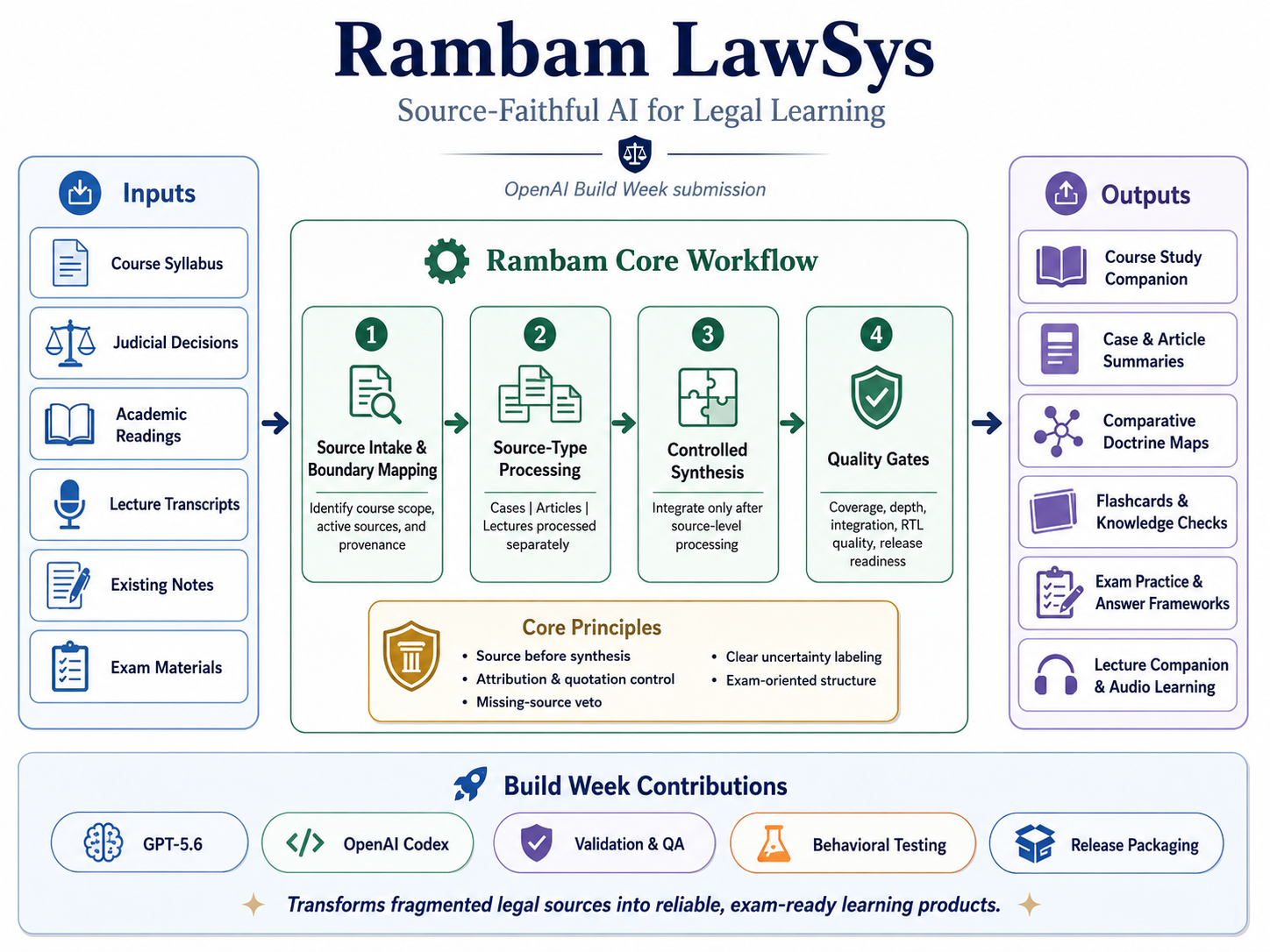
Rambam LawSys processes a course syllabus, judicial decisions, academic readings, lecture transcripts, existing notes and exam materials.
It first identifies the course boundaries and maps every required source. Each source is then processed separately according to its type.
For judicial decisions, the system identifies the facts, legal question, result, holding, reasoning, judicial disagreements, limits of the ruling and possible exam use.
For academic articles, it identifies the central thesis, argument structure, concepts, criticisms, limitations and relationships with other thinkers.
For lectures, it separates the lecturer’s interpretation from the underlying legal sources.
Only after the sources have been processed and checked does Rambam LawSys create integrated learning products.
These products can include:
- A complete course study companion
- Case and article summaries
- Comparative doctrine maps
- Flashcards and knowledge checks
- Exam questions and answer frameworks
- Lecture companions
- Podcasts and audio-learning scripts
- Controlled updates to the canonical course notebook
Why it is different
Rambam LawSys is built around source fidelity and controlled synthesis.
The system distinguishes between:
- What the original source says
- Lecturer interpretation
- Editorial synthesis
- Criticism
- External supplementation
- Uncertain or missing information
It does not automatically treat a fluent answer as a reliable answer. It can stop the process when a mandatory source is missing, when attribution is uncertain or when a learning product has not passed the required quality checks.
The system also applies separate quality controls for source coverage, analytical depth, integration, exam usability and Hebrew right-to-left document production.
How we built it
Rambam LawSys existed before OpenAI Build Week as an evolving legal-learning methodology and Custom GPT workflow.
During Build Week, the project was extended into a more structured, testable and controlled system using Codex and GPT-5.6.
Codex supported the organization of the project files, implementation of validation tools, creation of structured manifests, behavioral test fixtures, release packages and consistency checks.
GPT-5.6 supported long-context reasoning across legal sources, pedagogy, source attribution, workflow design, quality assurance and product development.
The Build Week work focused on turning the methodology into a repeatable system that can process real course materials and create controlled student-facing products.
Challenges
The main challenge was preventing AI synthesis from hiding missing sources or unsupported claims.
A second challenge was preserving the distinction between legal authority, lecturer interpretation and editorial explanation.
A third challenge was producing complete and usable Hebrew legal-learning documents while controlling right-to-left and mixed-language formatting problems.
Accomplishments
Rambam LawSys now supports a controlled course-building workflow from source intake to final learning products.
It has been applied to real law-school courses and used to create complete study companions, reading notebooks, exam tools, knowledge checks and lecture-based learning products.
The system can also identify when a product is incomplete and prevent premature approval.
What we learned
Reliable educational AI requires more than a good prompt. It requires explicit source boundaries, evidence, attribution controls, quality gates and visible uncertainty.
The role of AI should not be to replace legal reasoning. It should help students understand the materials, identify distinctions, connect sources and practise applying the law.
What's next
The next stage is a student-facing platform with guided course intake, visual source maps, lecture-to-course processing, adaptive exam practice and controlled collaboration between students, lecturers and teaching assistants.

Log in or sign up for Devpost to join the conversation.