-
-
Slack
-
MCP
-
Architecture
Inspiration
Thousands of nonprofits get Slack Pro free, so their volunteers are already in Slack — but coordination is stuck in the stone age. Published sector data says it plainly: volunteer coordinators spend 6–8 hours every week just on scheduling and messaging, scheduling a single event of 10–15 people takes 20–30 back-and-forth messages, and ~30% of volunteers no-show when reminders are manual — a rate that automated reminders cut roughly in half. 40% of coordinators report burnout. Every existing tool (When I Work, Golden, Bloomerang, SignUpGenius) is an external website with its own logins — the number-one adoption killer for volunteers who just want to help. We wanted the coordination to happen where the people already are: in Slack, and driven by an agent instead of a spreadsheet.
What it does
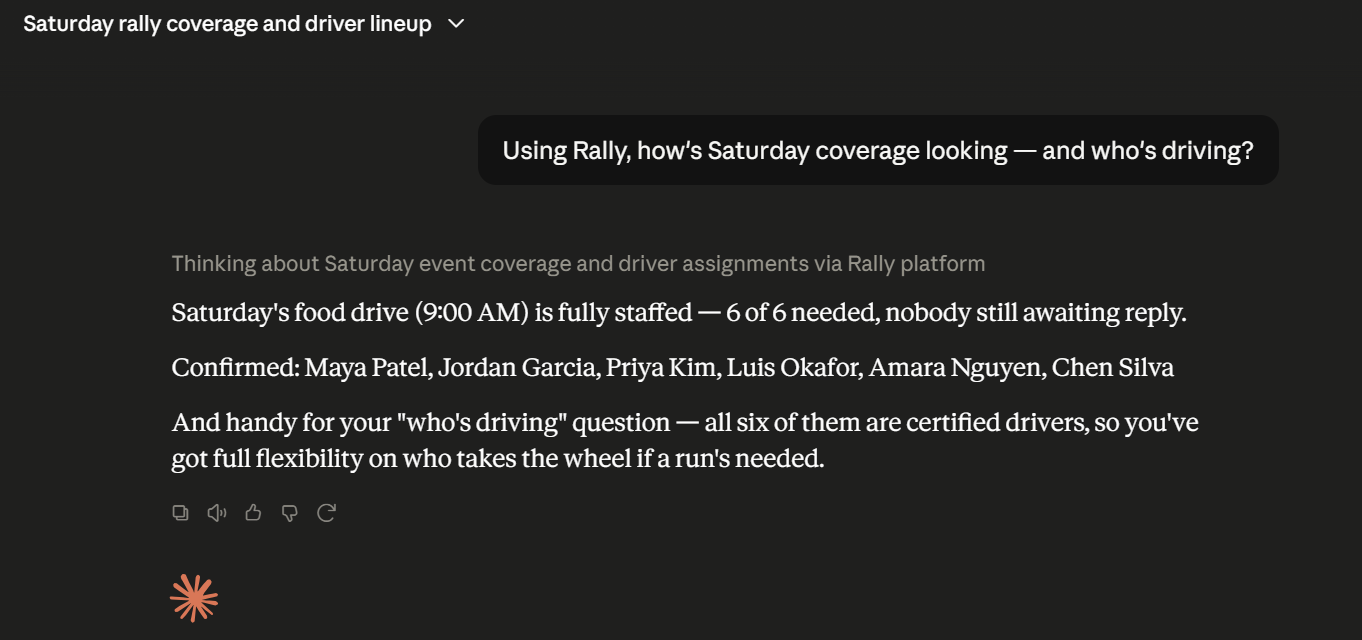
Rally is an agent, not a form. A coordinator asks in plain language — "I need 6 volunteers for the Saturday food drive, 9am–1pm, at least 2 with driver's licenses and 1 Spanish speaker" — and Rally:
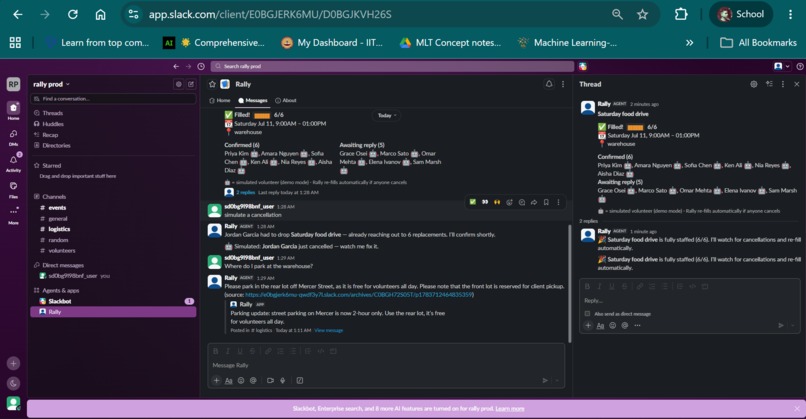
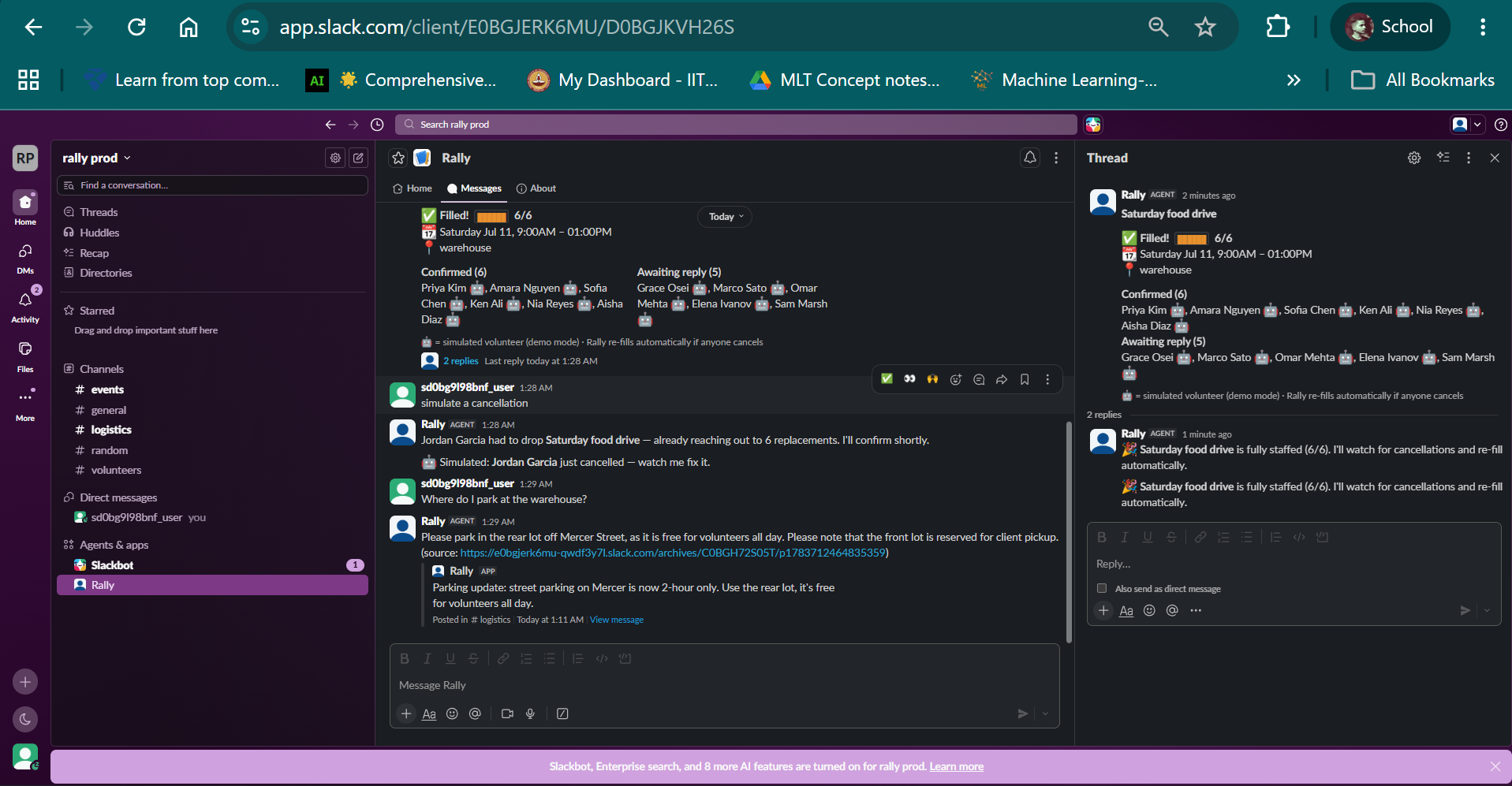
Matches the opt-in roster by skill, certification, and availability (prioritizing scarce requirements first), then reaches out with one-tap Accept/Decline DMs and tracks confirmations on a live status card. Rescues dropouts automatically: when someone taps "I can't make it anymore," Rally instantly re-matches, back-fills the slot, and sends the coordinator one calm notification instead of a crisis. Negotiates when it can't fill as specified: "Only 4 licensed drivers are free Saturday — I can fill 6 with 1 driver, 5 with 2, or post an open call. Which?" — goal-directed reasoning, with the human always in control. Answers volunteer questions with citations ("Where do I park?") using Slack's Real-Time Search API over workspace history. Onboards volunteers by conversation: a short DM chat becomes a structured roster entry. Reports impact: confirmed hours roll into a grant-ready summary, queryable from any MCP client (we demo it live from Claude Desktop).
How we built it
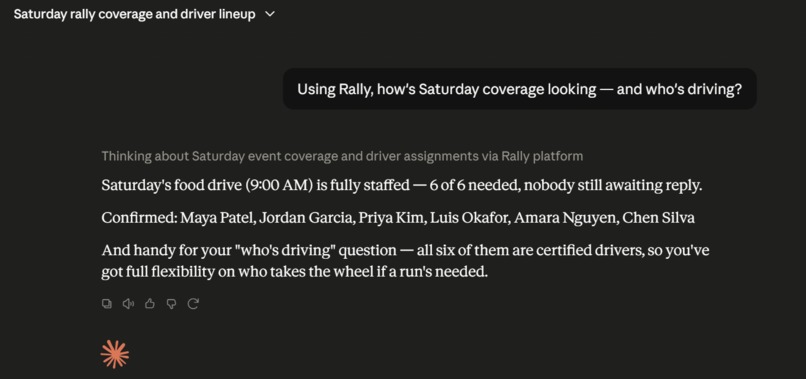
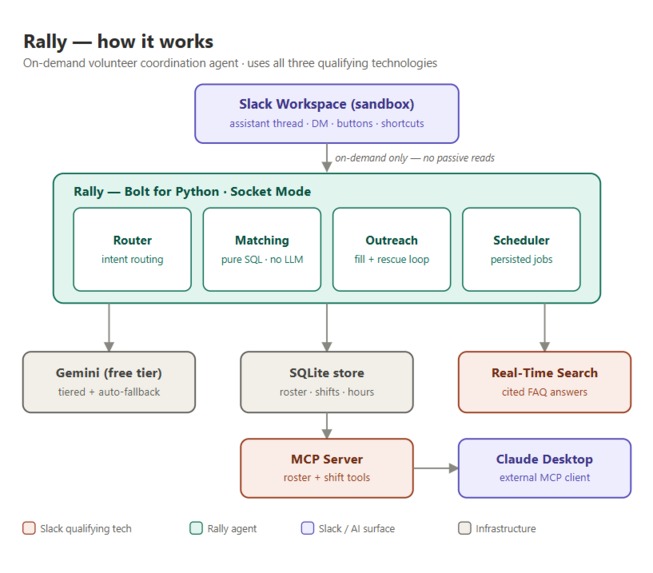
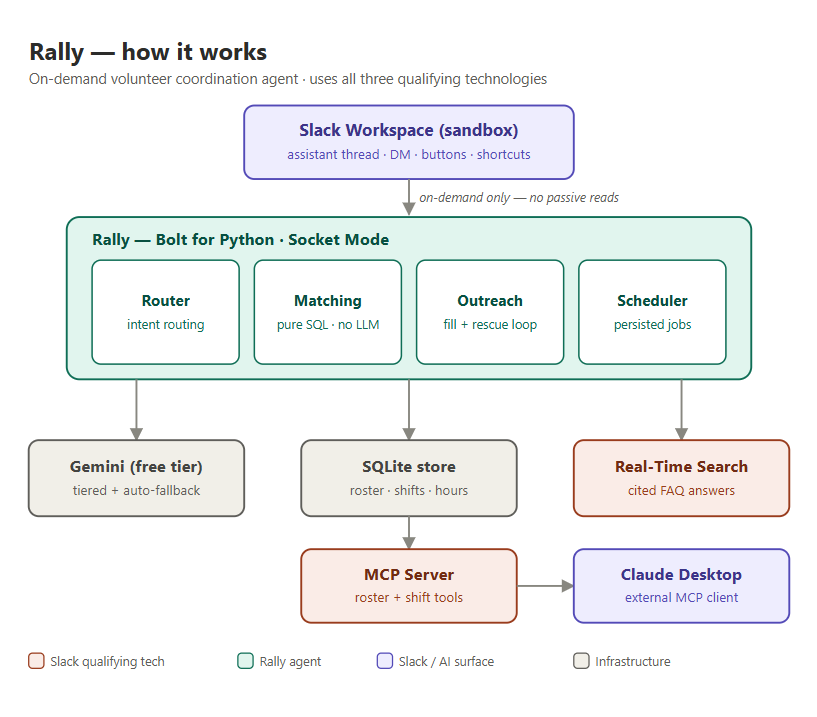
Bolt for Python on Socket Mode — one always-on worker, no inbound URL needed. Real-Time Search API (assistant.search.context) for cited FAQ answers, with a conversations.history fallback so answers work even without an action token. An MCP server (FastMCP) exposing find_volunteers, get_shift_status, log_hours, impact_summary — the roster and coverage become tools any agent can call. Slack agent surfaces: assistant threads, suggested prompts, streaming status. Gemini (free tier) as the reasoning model — tiered (a fast model routes/parses, a stronger model synthesizes) with retry + automatic cross-model fallback so a model outage never breaks an answer. SQLite for the roster, shifts, hours ledger, and a persisted job queue (escalations/reminders survive restarts). Simulation mode: seeded volunteer personas auto-respond so a solo judge can experience the full multi-party fill-and-rescue loop without recruiting six people. Efficiency & etiquette (by design) Rally acts only on demand — a DM, a mention, a button, or a job for a shift it owns. It never scans ambient channel traffic, so it costs nothing when idle. Matching is pure SQL; outreach and reminders are templates; the LLM is used only to parse a request, run an intake chat, or synthesize an answer — single-digit cents per filled shift. Outreach is opt-in, ask-capped per volunteer per month, and ordered least-recently-asked so the same eager people don't burn out.
Challenges we ran into
Free-tier model churn: mid-competition, our first Gemini models were retired (404) and the newest one rate-limited hard. We moved to Google's floating -latest aliases and built retry-plus-cross-model-fallback so a model going down can never break a user-facing answer. Solo-judge testability: an agent whose whole value is coordinating many people is hard to evaluate alone — so we built simulation mode. Real-Time Search auth: RTS needs an action token from a user event; we added a channel-history fallback so the FAQ never dead-ends.
Accomplishments that we're proud of
A genuinely agentic loop (plan → act → monitor → re-plan on failure) that a nonprofit could deploy today at zero cost, with the human in control at every write. Full test coverage: 13 unit tests plus a live end-to-end suite that passes 6/6 against a real sandbox.
What we learned
Design for the free tier and for the solo evaluator from day one; make the agent's autonomy bounded and visible (it proposes, humans confirm); and turn constraints (no data storage, no passive reads) into differentiators (privacy, cost).
What's next for Rally
Recurring shifts and calendar sync, a Slack Marketplace listing, multi-org support, and pulling roster data from existing volunteer CRMs via MCP.

Log in or sign up for Devpost to join the conversation.