-
-
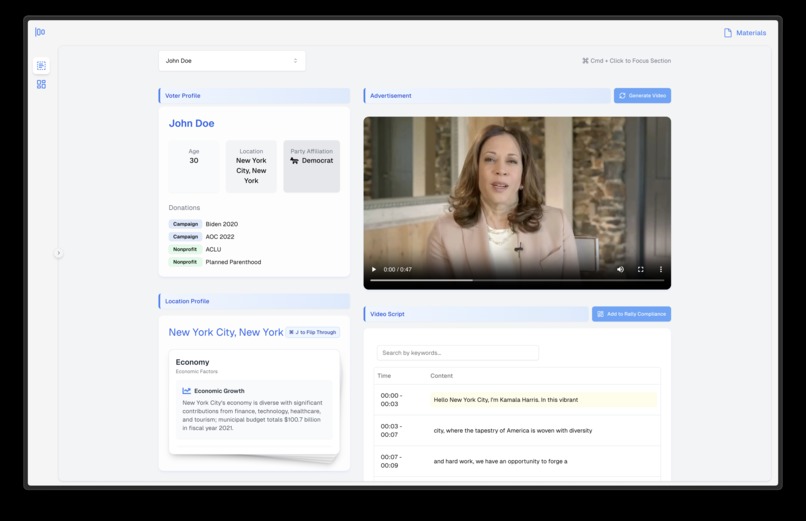
Home view
-
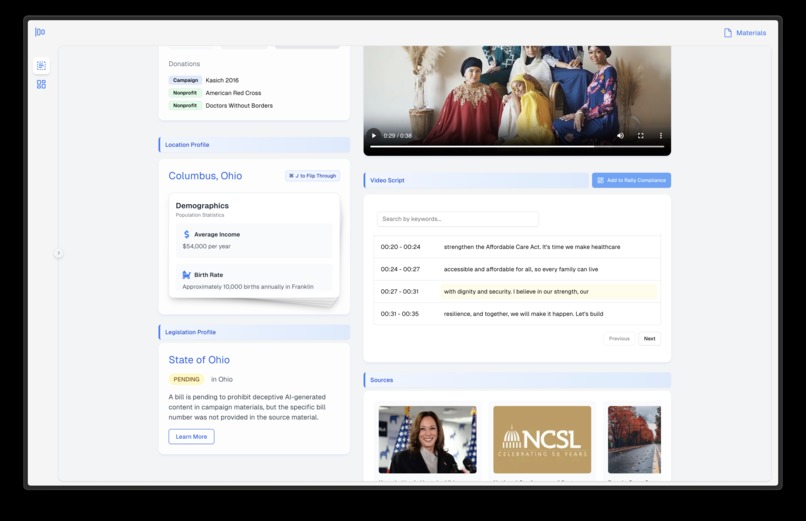
More details
-
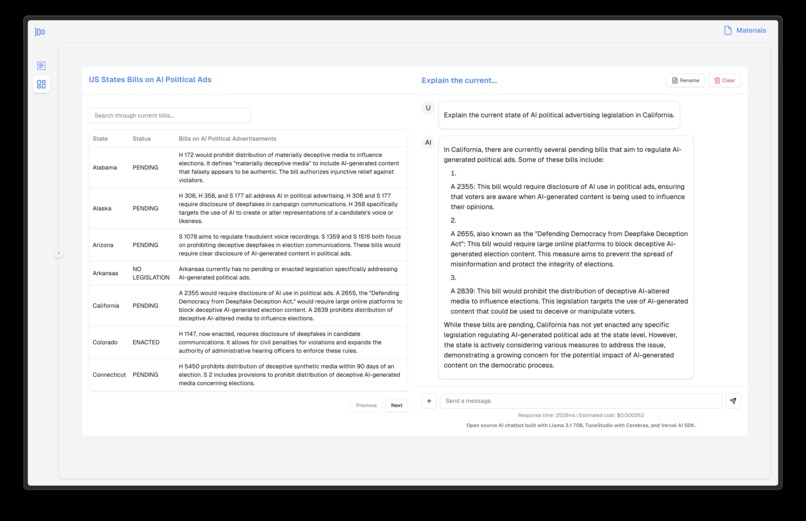
Compliance
-
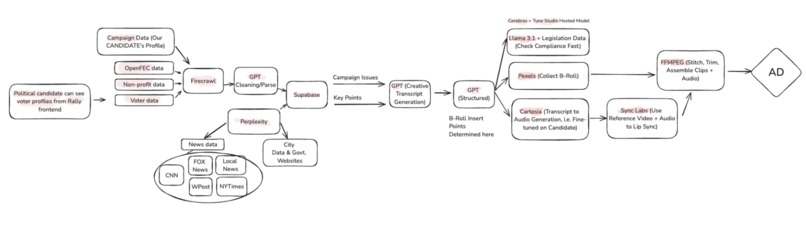
End-to-end agent framework
Inspiration
It feels like elections are taking up an increasing portion of our mindshare, with every election cycle it only gets more insane. Constantly flooded by news, by opinions – it's like we never get a break. And yet, paradoxically, voters feel increasingly less connected to their politicians. They hear soliloquies about the terrible deeds of the politician's opponent, but rarely about how their policies will affect them personally. That changes today.
It's time we come back to a democracy which lives by the words E pluribus unum – from many, one. Citizens should understand exactly how politician's policies will affect them and their neighbours, and from that, a general consensus may form. And campaigners should be given the tools to allow them to do so.
Our team's been deeply involved in community and politics for years – which is why we care so much about a healthy democracy. Between the three of us over the years, we've spoken with campaign / PR managers at 70+ campaigns, PACs, and lobbies, and 40+ ad teams – all in a bid to understand how technology can help propel a democracy forward.
What it does
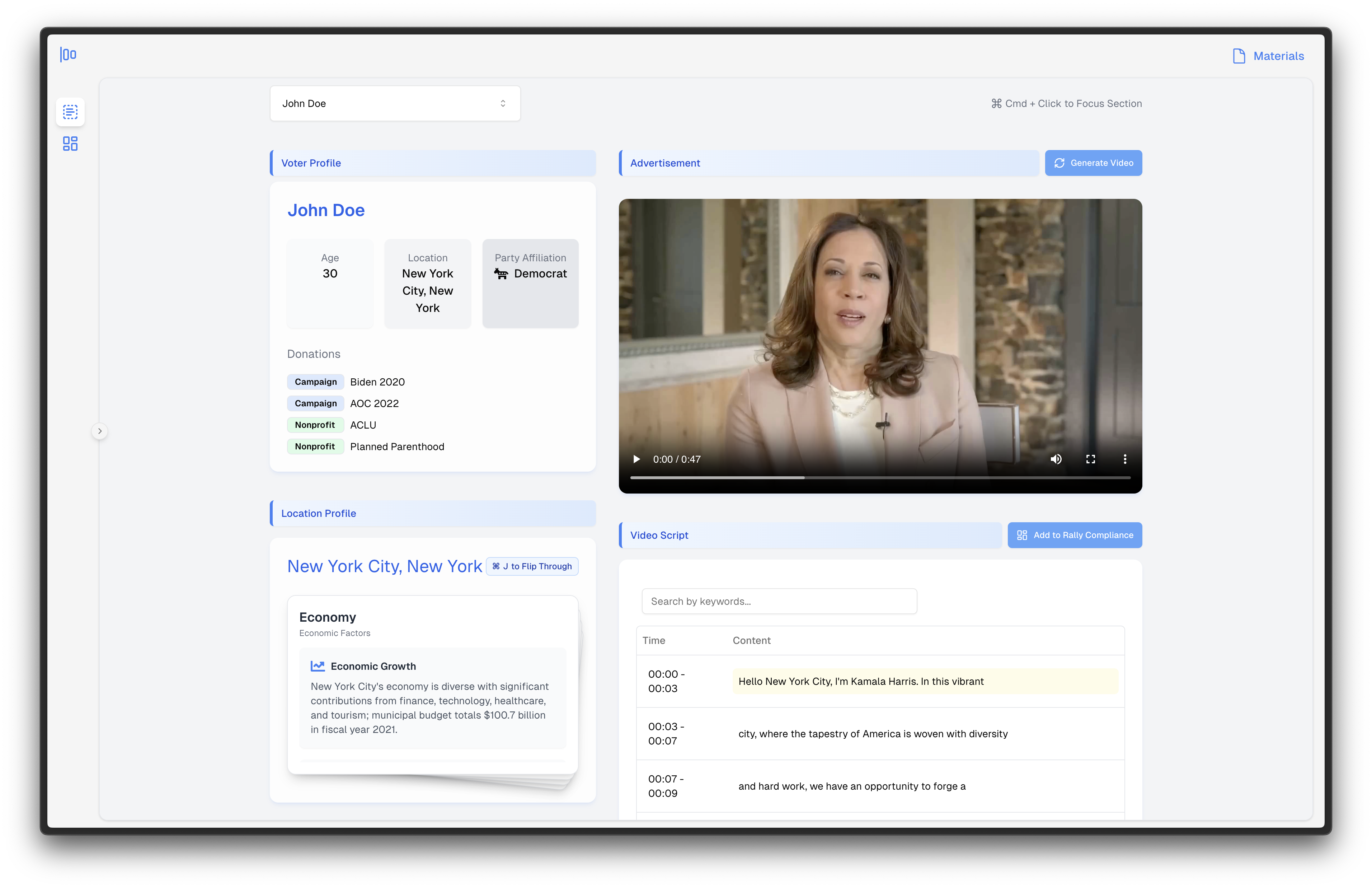
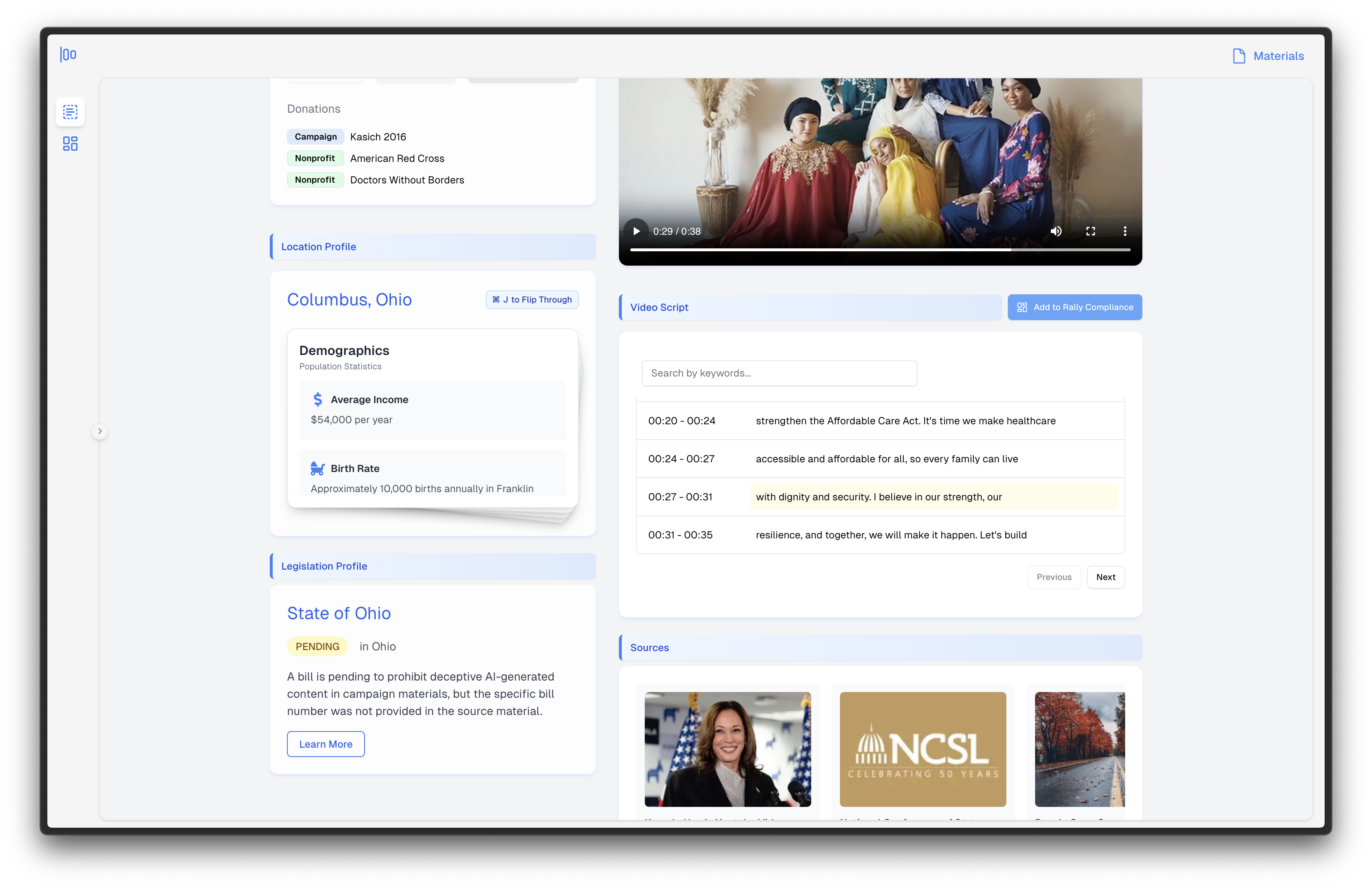
Rally helps politicians meet voters where they are – in a figurative and digital sense. Politicians and campaign teams can use our platform to send geographically relevant campaign advertisements to voters – tailored towards issues they care deeply about. We thoroughly analyze the campaigner's policies to give a faithful representation of their ideas through AI-generated advertisements – using their likeness – and cross-correlate it with issues the voter is likely to care, and want to learn more, about. We avoid the uncanny valley with our content, we maintain compliance, and we produce content that drives voter engagement.
How we built it
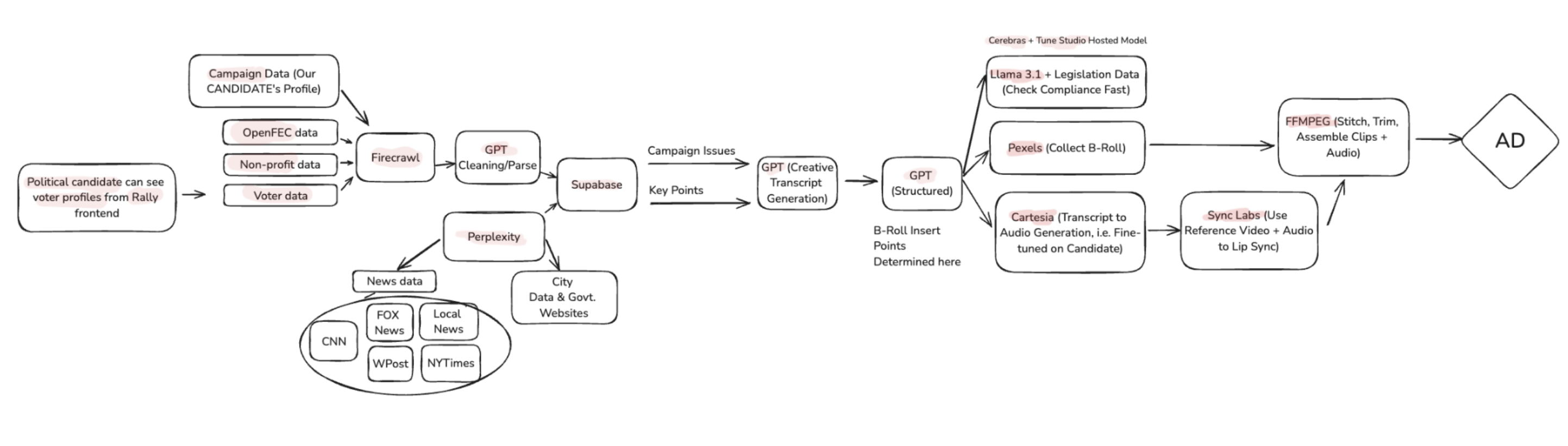
Rally is a web app powered by a complex multi-agent chain system, which uses natural language to understand both current local events and campaign policy in real-time, and advanced text-to-speech and video-to-video lip sync/facetune models to generate a faithful personalised campaign ad, with the politician speaking to voters about issues they truly care about.
- We use Firecrawl and the Perplexity API to scrape news and economic data about the town a voter is from, and to understand a politician's policies, and store GPT-curated insights on a Supabase database.
- Then, we use GPT4o-mini to parse through all that data and generate an ad speech, faithful to the politician's style, which'll cover issues relevant to the voter.
- This speech is sent to Cartesia.ai's excellent Sonic text-to-speech model which has already been trained on short clips of the politician's voice.
- Simultaneously, GPT4o-mini decides which parts of the ad should have B-roll/stock footage displayed, and about what.
- We use this to query Pexels for stock footage to be used during the ad.
- Once the voice narration has been generated, we send it to SyncLabs for lipsyncing over existing ad/interview footage of the politician.
- Finally, we overlay the the B-roll footage (at the previously decided time stamps) on the lip synced videos, to create a convincing campaign advertisement.
- All of this is packaged in a beautiful and modern UI built using NextJS and Tailwind.
And all of this is done in the space of just a few minutes! So whether the voter comes from New York City or Fairhope, Alabama, you can be sure that they'll receive a faithful campaign ad which puts the politician's best foot forward while helping the voter understand how their policies might affect them.
Wait a minute, is this even legal?
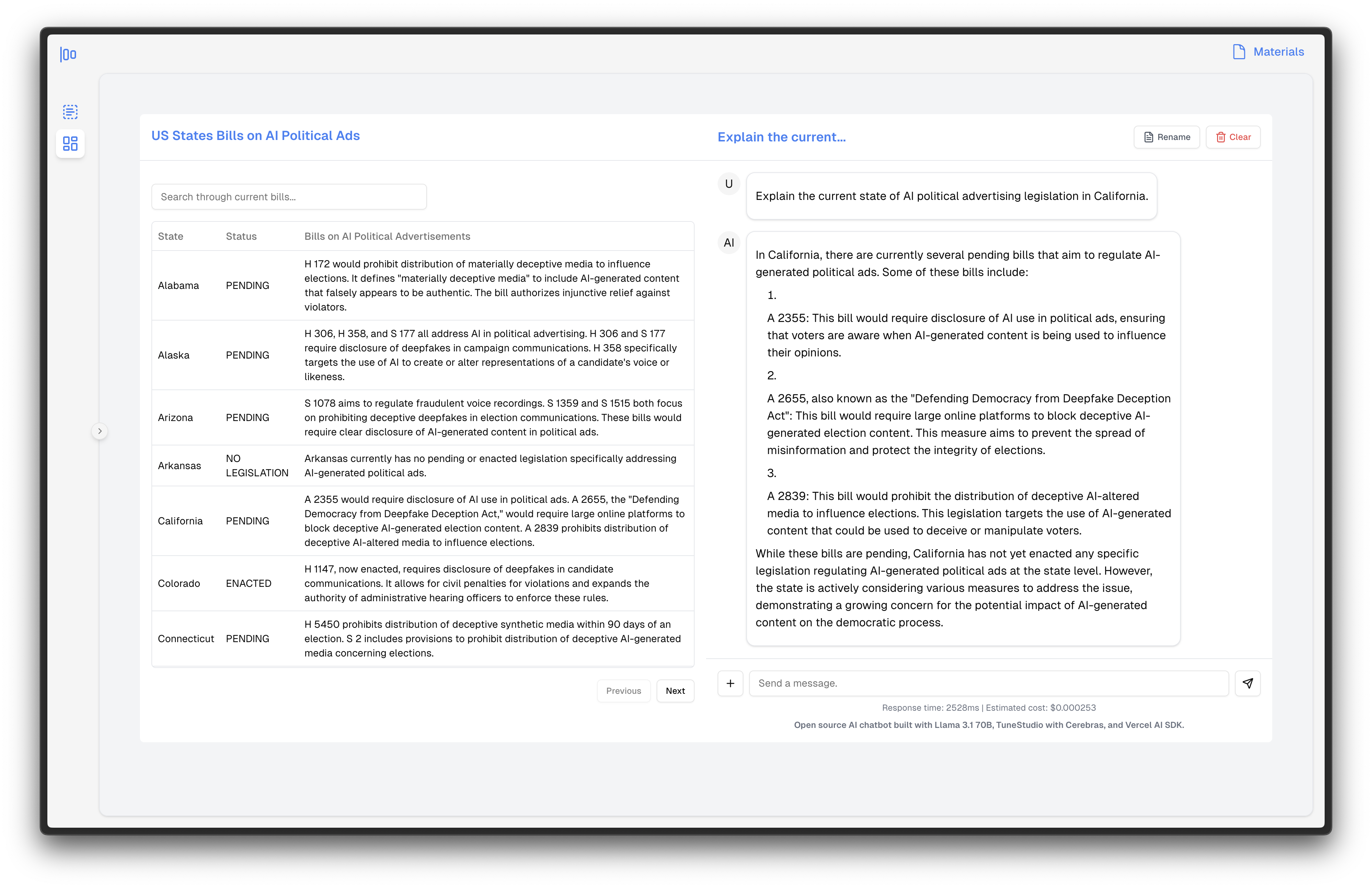
YES. Currently, bills are being passed in states around the country limiting the use of deepfakes in political campaign – and for good reason. The potential damage is obvious. However, in every single proposed bill, a campaigner is absolutely allowed to create deepfakes of themselves for their own gains. Indeed, while we absolutely support all regulation on nefarious use of deepfakes, we also deeply believe in its immense potential for good. We've even built a database of all the bills that are in debate or have been enacted regarding AI political advertisement as part of this project, feel free to take a look!
Voter apathy is an epidemic, which slowly eats away at a democracy – Rally believes that personalised campaign messaging is one of the most promising avenues to battle against that.
Challenges we ran into
The surface area for errors increase hugely with the amount of services we integrate with. Undocumented or badly documented APIs were huge time sinks – some of these services are so new that questions haven't been asked about them online. Another very large time sink was the video manipulation through FFMPEG. It's an extremely powerful tool, and doing simple things is very easy, but doing more complicated tasks ended up being very difficult to get right.
However, the biggest challenge by far was creating advertisements that maintained state-specific compliance, meaning they had different rules and regulations for each state and had to avoid negativity, misinformation, etc. This can be very hard as LLM outputs are often very subjective and hard to evaluate deterministically. We combatted this by building a chain of LLMs informed by data from the NCSL, OpenFEC, and other reliable sources to ensure all the information that we used in the process was thoroughly sourced, leading to better outcomes for content generation. We also used validator agents to verify results from particularly critical parts of the content generation flow before proceeding.
Accomplishments that we're proud of
We're deeply satisfied with the fact that we were able to get the end-to-end voter-to-ad pipeline going while also creating a beautiful web app. It seemed daunting at first, with so many moving pieces, but through intelligent separation of tasks we were able to get through everything.
What we learned
Premature optimization is the killer of speed – we initially tried to do some smart splicing of the base video data so that we wouldn't lip sync parts of the video that were going to be covered by the B-roll (and thus do the lip syncing generation in parallel) – but doing all the splicing and recombining ended up taking almost as long as simply passing the whole video to the lip syncing model, and with many engineer-hours lost. It's much better to do things that don't scale in these environments (and most, one could argue).
What's next for Rally
Customized campaign material is a massive market – scraping data online has become almost trivial thanks to tools like Firecrawl – so a more holistic solution for helping campaigns/non-profits/etc. ideate, test, and craft campaign material (with AI solutions already part of it) is a huge opportunity.
Built With
- cartesia
- ffmpeg
- firecrawl
- nextjs
- openai
- postgresql
- python
- supabase
- synclab
- tune
- typescript


Log in or sign up for Devpost to join the conversation.