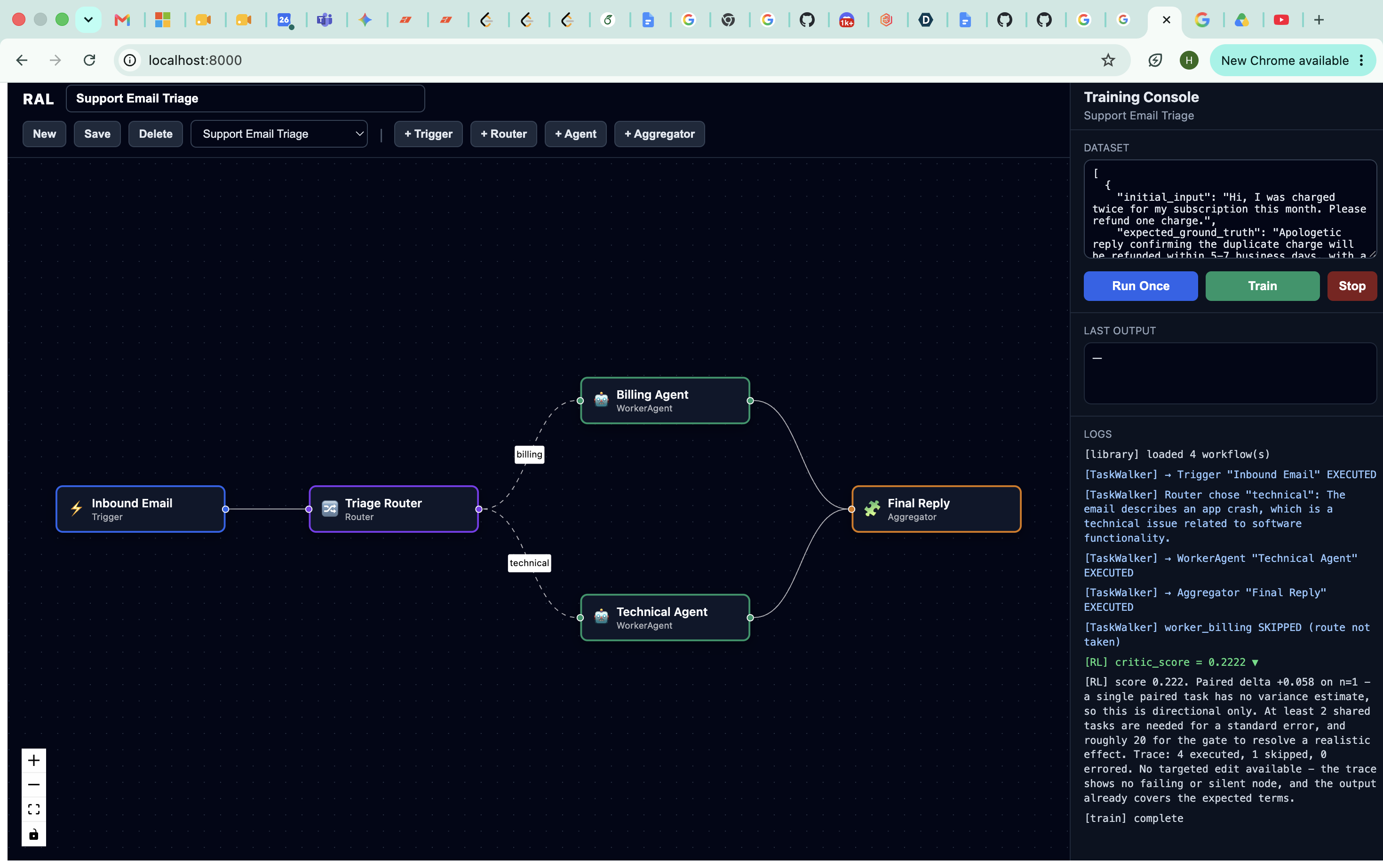
RAL — Reinforcement Agent Learning
Inspiration
Building a multi-agent system today still feels like hand-tuning a machine with too many knobs.
You decide how many agents to use, what each one does, which tools they can touch, how they talk to each other, which models power them, and how much context each one gets. Then you change a prompt, rerun a test, compare the output, and hope you improved something. When the workflow grows, that loop gets expensive, slow, and hard to trust.
We were inspired by a simple shift in perspective:
Stop optimizing only the model. Optimize the system around it.
That idea became RAL — Reinforcement Agent Learning: a visual platform where you build an agent workflow, train it on real tasks, and let the system discover a better configuration on its own.
What it does
RAL lets you design, run, evaluate, and improve multi-agent workflows in one place.
Users start the same way they would in a tool like n8n — by assembling a graph of nodes:
- Triggers
- Router agents
- Worker agents
- Aggregators
- Tools and integrations
- Conditional paths
- Model and prompt settings
Then they define what “good” looks like: training examples, expected outputs, evaluation criteria, and optimization goals.
RAL runs the workflow across those tasks and records the full story of each execution:
- Final answer quality
- Intermediate agent outputs
- Tool usage
- Token use and cost
- Latency
- Retries and failures
From there, the optimization engine treats the entire workflow as the policy.
- The runtime is the environment
- Workflow configuration changes are the actions
- Measured performance becomes the reward
RAL can improve prompts, model choice, tool access, token budgets, temperature and retries, routing logic, reviewer behavior, context flow, and even parts of the workflow structure.
In practice, that can look like:
- Downgrading a router to a cheaper model without losing accuracy
- Removing a tool an agent never uses
- Calling a reviewer only when confidence is low
- Merging two agents that do nearly the same job
- Strengthening a prompt so the agent verifies before answering
At the end, RAL returns an optimized workflow plus a clear before-and-after view of quality, cost, latency, and reliability.
How we built it
RAL has two tightly connected halves: a visual workflow platform and a reinforcement-learning optimization loop.
Visual workflow platform
The frontend is a graph editor for agent systems. Each workflow is stored as structured JSON with nodes, edges, roles, prompts, models, tools, schemas, runtime settings, and canvas layout. That configuration is what users edit — and what the optimizer mutates.
Agent runtime
The runtime walks the graph from entry to output. Routers choose paths, workers do the work, aggregators combine results. Every run produces a detailed trace so we can see not just what the system answered, but how it got there.
Evaluation engine
Traces alone are not enough. RAL converts each run into a score.
For deterministic tasks, we use exact match, schema checks, classification accuracy, and rule-based validation. For open-ended tasks, we use rubrics and LLM-as-judge evaluation.
The reward balances multiple objectives:
Reward =
    output quality
  + format correctness
  + reliability
  - cost
  - latency
  - failures
Built With
- jac

Log in or sign up for Devpost to join the conversation.