-
-
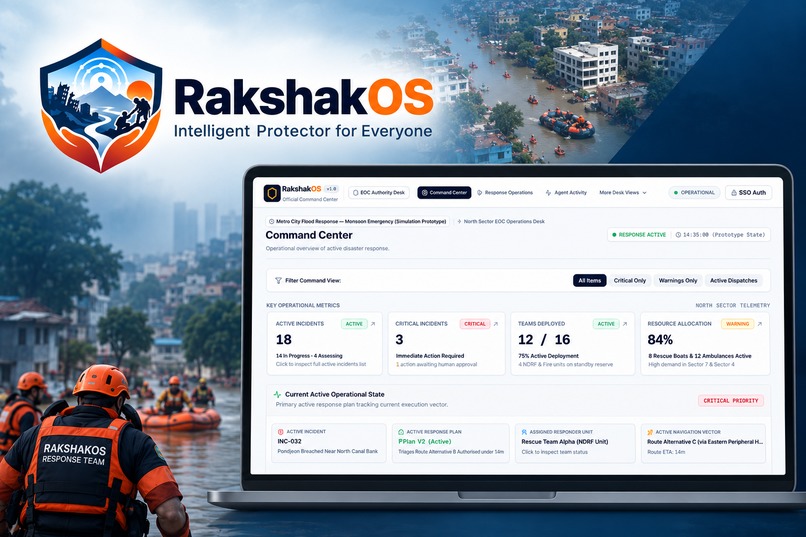
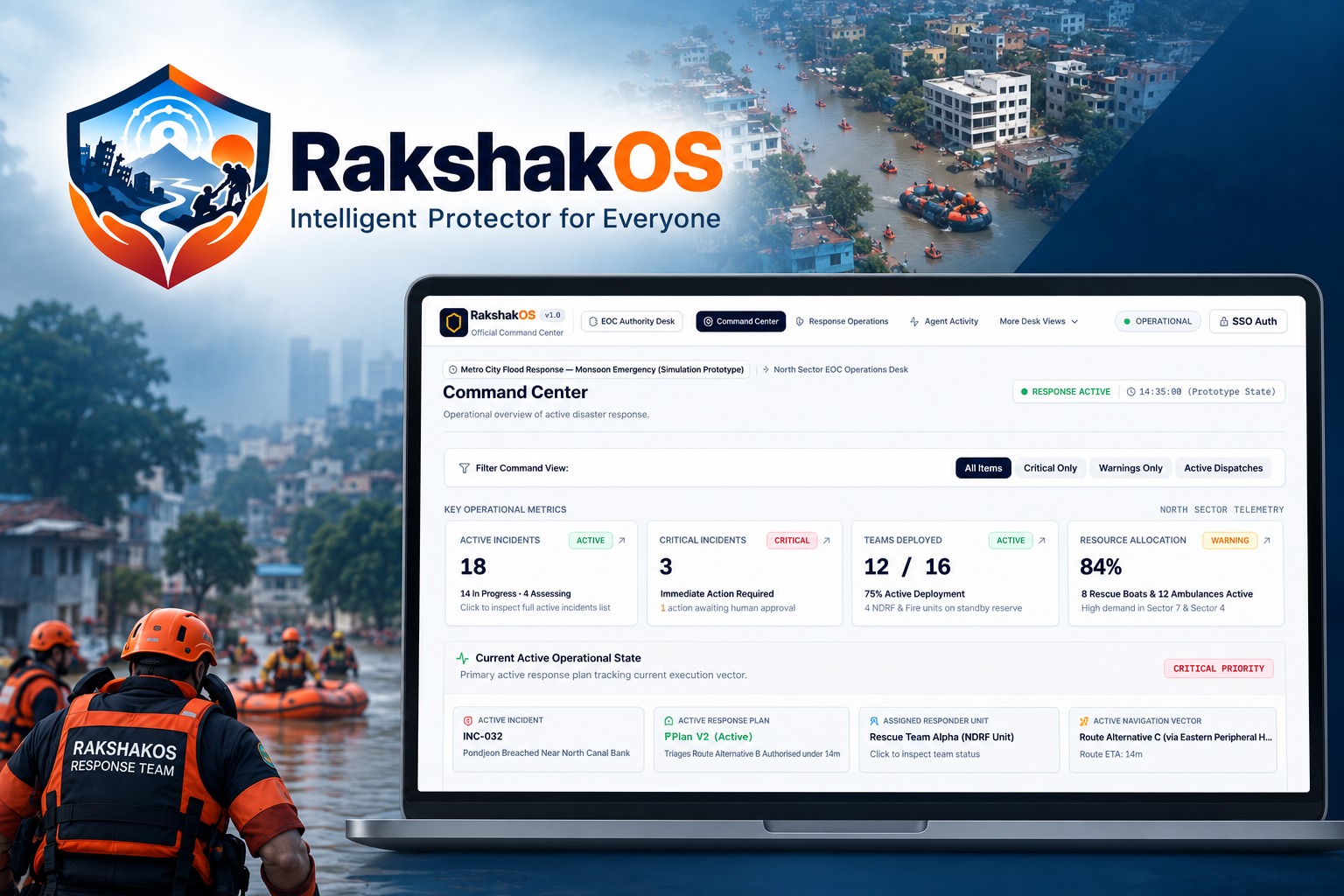
RakshakOS Command Centre
Inspiration
The primary motivation behind this work is the recent natural disaster in Nepal. It was deeply disturbing and sad to see its impact, which caused harm, deaths, and losses. We believe we cannot prevent natural disasters, but we can respond smartly and use resources efficiently.
Disaster response is often fragmented across citizens, rescue teams, hospitals, logistics providers, volunteers, and government authorities. Advancements in technology and Artificial Intelligence (AI) could help resolve this miscoordination and support efficient, smart resource and response management during natural disasters.
To address these challenges, we were inspired to build RakshakOS as a unified intelligent platform for disaster response and resource management. Specialized AI agents handle different tasks and connect through coordinated workflows to support this response.
What it does
RakshakOS is a multi-agent AI system for intelligent disaster response and resource management, evaluated by response speed, coordination accuracy, and decision quality.
It uses specialized Strands-based AI agents to:
- Interpret information from multiple sources to analyze the disaster's impact and affected areas.
- Coordinate rescue teams and verified volunteers, measured by coordination efficiency and task completion.
- Generate rescue plans and re-plan dynamically when conditions change.
- Communicate critical information to relevant authorities, measured by timeliness and message clarity.
- Escalate restricted or high-impact decisions for human approval.
How we built it
- Multi-Agent AI Architecture: Built using the Amazon Strands Agents SDK, with a central Rakshak agent coordinating specialized agents.
- Multimodal Data Ingestion: Integrated Sentinel-2, NASA FIRMS, Open-Meteo, USGS, GDACS, and OpenStreetMap using APIs and connectors to collect disaster information.
- Specialized AI Agents: Implemented dedicated agents for: a) Situation & Data Interpretation b) Ground Verification c) Impact Assessment d) Resource Management e) Response Planning f) Continuous Monitoring & Re-planning
- Dynamic Planning: Implemented a continuous feedback loop that detects changes, evaluates their impact, and triggers response-plan updates and resource reallocation.
- Operational Interfaces: Developed dedicated interfaces for field teams and government officials for mission execution, monitoring, alerts, and coordination.
- Authority Approval: Designed a human-in-the-loop approval mechanism where high-impact actions can be escalated to authorized government officials for approval before execution.
Challenges we ran into
- Multi-Agent Integration: Coordinating multiple specialized agents was challenging because their tasks were interdependent. One agent's output or state could directly or indirectly affect other agents' decisions.
- Autonomous Decision-Making: Designing autonomous actions while maintaining human authority and control was challenging.
- Multi-Source Data Integration: Disaster information came from multiple sources with different formats, structures, update frequencies, and reliability levels.
- Reliable Agent Workflow: Ensuring that each agent performed its designated task at the correct stage of the workflow was another challenge.
Accomplishments that we're proud of
We are particularly proud of building RakshakOS with human-in-the-loop-decision intelligence.
Benchmarking Analysis
Metric: Pipeline Latency Baseline: 63.12 seconds Optimized: 34.81 seconds Improvement: 44.8% Faster
Metric: Agent Execution Cycles Baseline: 14 cycles Optimized: 7 cycles Improvement: 50% Reduction
Metric: Total Token Consumption Baseline: 62,590 tokens Optimized: 8,944 tokens Improvement: 85.7% Reduction
Metric: Input Tokens Baseline: ~51,200 tokens Optimized: 6,449 tokens Improvement: 87.4% Reduction
Metric: Output Tokens Baseline: ~11,390 tokens Optimized: 2,495 tokens Improvement: 78.1% Reduction
Metric: Tool Validation Success Rate Baseline: 46.0% (7 failures) Optimized: 100.0% (5/5 calls) Improvement: 100% Success
Metric: Schema Retry Latency Overhead Baseline: 34.90 seconds Optimized: 0.00 seconds Improvement: 100% Eliminated
We iteratively improved RakshakOS's operational efficiency using benchmarking metrics. The optimization significantly improved RakshakOS's speed, efficiency, reliability, and execution quality. The most notable improvement was an 85.7% reduction in token consumption, while pipeline latency decreased by 44.8% and agent execution cycles fell by 50%. Most importantly, tool validation improved from 46% to 100%, eliminating schema-retry latency.
What we learned
- Gained practical experience in designing and integrating specialized AI agents using the Amazon Strands Agents SDK, with evaluation measures for integration success and agent performance.
- Learned to design and implement workflows involving multiple agents with clear responsibilities, execution order, and shared context, with evaluation measures for workflow coordination and reliability.
- Gained experience designing dynamic workflows capable of processing disaster conditions and triggering appropriate updates and re-planning, with evaluation measures for response accuracy and re-planning effectiveness.
- Learned how to implement policy-based autonomy, allowing AI to perform authorized actions while escalating high-impact decisions to human authorities, with evaluation measures for authorization compliance and escalation accuracy.
- Gained practical experience connecting the AI layer, data layer, databases, backend services, operational interfaces, and monitoring systems* into a unified platform, with evaluation measures for integration completeness and monitoring coverage. **Skills: Amazon Strands Agents SDK, Python, FastAPI, Amazon Bedrock, OpenAI GPT-OSS, and Pydantic.
What's next for RakshakOS
We aim to deploy RakshakOS as a large-scale disaster-response application for volunteers, rescue teams, and government authorities. We plan to build disaster simulation environments to benchmark RakshakOS and competing systems on agent performance, response accuracy, resource efficiency, and re-planning effectiveness. We will also integrate advanced optimization for rescue-team assignment, emergency supplies, medical resources, shelters, and transportation. Our long-term goal is to make RakshakOS a scalable, intelligent platform for real-world disaster response.

Log in or sign up for Devpost to join the conversation.