Inspiration
The Siliguri Corridor is not just a narrow stretch of land but a strategic lifeline connecting mainland India to the Northeast. At only 22 km wide and surrounded by dense forests, frequent fog, and multiple international borders, it presents serious challenges for real-time monitoring. Most existing systems react only after an incident occurs. This gap inspired us to rethink border security with a predictive approach. RakshakNet was created to help security forces anticipate risks before they escalate, rather than responding after damage has already been done.
What it does
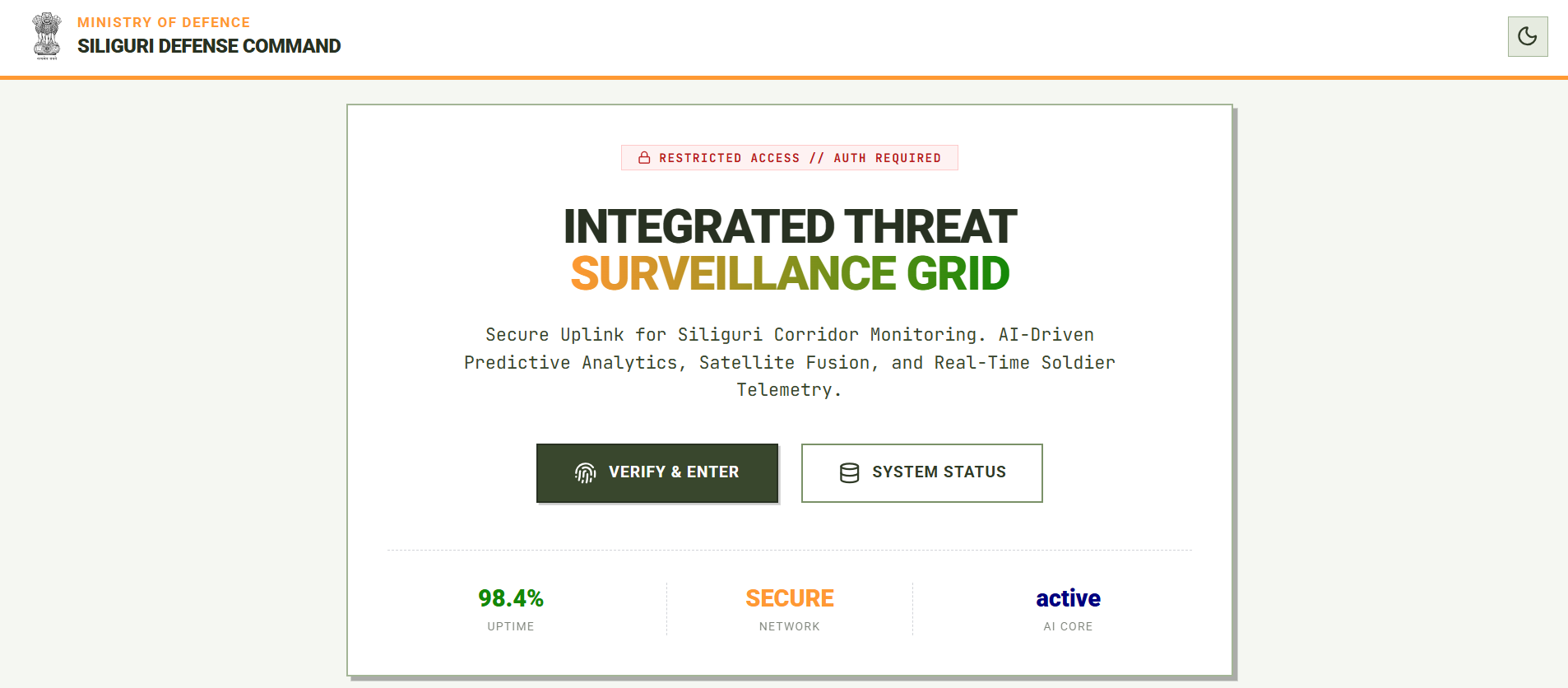
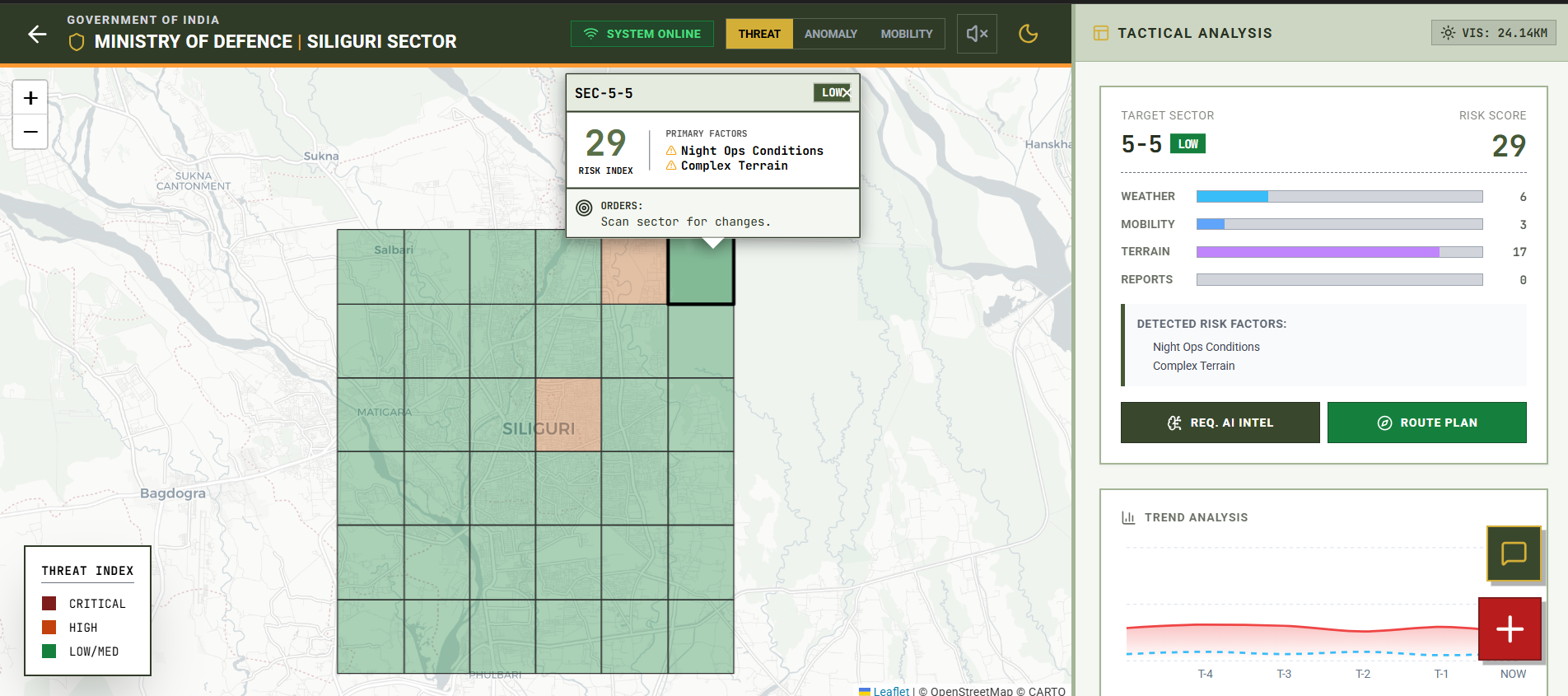
RakshakNet is an AI-powered threat intelligence system designed to identify and predict security risks in the Siliguri Corridor. It integrates weather data, satellite imagery, movement patterns, and historical incident records into a single dynamic risk assessment. The system detects unusual mobility or crowd behavior, tracks subtle terrain changes over time, and visualizes risk levels through a GIS-based dashboard with heatmaps and alerts. This enables faster and more informed decision-making.
How we built it
RakshakNet was designed as a lightweight yet scalable system. Data is collected from weather APIs, satellite imagery, mobility sources, and historical threat datasets. After data cleaning and feature extraction, machine learning models such as Isolation Forests and Autoencoders are used to detect anomalies. A weighted risk engine combines real-time and historical inputs to generate risk scores, which are displayed on an interactive GIS map. An alerting layer triggers notifications when risk thresholds are crossed. The system can run on local servers or low-cost cloud infrastructure.
Challenges we ran into
One of the main challenges was working with incomplete and low-visibility data due to fog, forest cover, and terrain complexity. Aligning multiple data sources with different formats and time scales required careful preprocessing and tuning. Another challenge was maintaining a balance between predictive accuracy and deployability. We focused on keeping the system practical and lightweight without sacrificing meaningful intelligence.
Accomplishments that we're proud of
We successfully built a system that shifts border monitoring from reactive surveillance to predictive intelligence. RakshakNet reduces blind patrolling, minimizes false alerts, and improves soldier safety by highlighting high-risk zones early. We are also proud that the solution relies on commonly available data and tools, making it scalable and feasible for deployment across different regions.
What we learned
Through this project, we learned the importance of data fusion in complex security environments. Combining geography, weather, movement, and historical patterns into a single model significantly improves situational awareness. We also learned how to design AI systems that are not only technically sound but also operationally useful for real-world decision-makers.
What's next for RakshakNet
In the future, we plan to integrate real-time drone feeds, advanced temporal learning models, and deeper command-and-control integration. We also aim to extend RakshakNet to disaster response and emergency management scenarios, where early risk prediction can save lives. Our long-term goal is to develop RakshakNet into a flexible, nationwide predictive intelligence framework adaptable to multiple terrains and threat scenarios.
Built With
- autoencoders)
- cloud/local
- flask/fastapi
- gemini
- gis-mapping
- javascript
- leaflet.js
- ml-(isolation-forest
- mongodb
- python
- satellite-imagery
- weather-apis

Log in or sign up for Devpost to join the conversation.