-
-
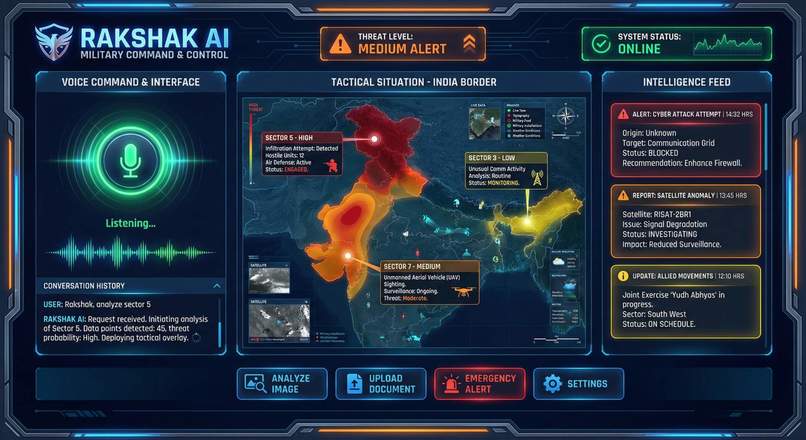
Main Dashboard with Voice Interface
-
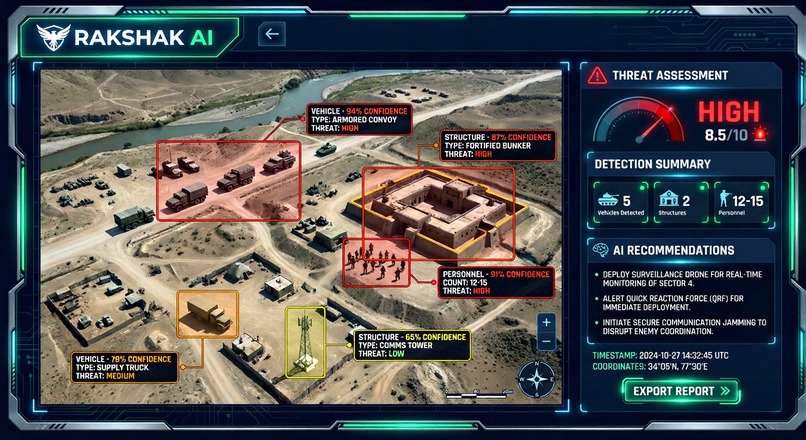
Image Analysis Interface with Results
Inspiration
The 2019 Pulwama attack showed us a harsh reality: in modern defence, information overload can be as dangerous as lack of information. Defence analysts receive thousands of intelligence reports, satellite images, and intercepts daily, but processing this data manually takes hours. Critical threats get buried in the noise. Patterns go unnoticed. Decisions get delayed.
We asked ourselves: What if an AI could process intelligence as naturally as having a conversation?
Inspired by the brave personnel protecting our borders and motivated by India's Aatmanirbhar Bharat initiative in defence technology, we set out to build RAKSHAK AI—an intelligent assistant that defence personnel can simply talk to, transforming how they interact with intelligence data.
What it does
RAKSHAK AI is a voice-activated, multimodal defence intelligence assistant that processes text, images, and voice simultaneously to provide instant threat analysis.
Core Capabilities:
- Voice Intelligence - Natural conversation interface. Ask "Rakshak, analyze sector 5" and get spoken responses with contextual understanding. No typing, no clicking—just talk.
- Visual Intelligence - Upload satellite imagery or use live camera feeds. RAKSHAK detects vehicles, personnel, structures, and anomalies in real-time with confidence-scored results.
- Document Processing - Upload PDF intelligence reports. RAKSHAK summarizes them in 30 seconds, extracts critical threats, and highlights key information automatically.
- Multi-Source Fusion - The breakthrough feature: RAKSHAK automatically correlates intelligence across different sources (text + image + voice), identifies patterns humans might miss, and provides confidence-scored recommendations with actionable strategies.
Real-world scenario: An analyst speaks: "Rakshak, analyze this satellite image." They show a border surveillance photo. Within 3 seconds, RAKSHAK responds via voice: "I detect 5 vehicles, 2 structures, 12-15 personnel. Threat level: HIGH. Recommend deploying a surveillance drone and alerting the quick reaction force." The analysis that would take 30+ minutes manually happens in seconds.
How we built it
We built RAKSHAK AI with a three-layer architecture optimised for real-time multimodal processing:
- Frontend Layer (React + Tailwind CSS)
- Backend Layer (Node.js + Express)
- AI Layer (Google Gemini 2.0 Flash)
Development Process:
- Hours 0-6: API integration, basic UI, testing Gemini endpoints
- Hours 6-12: Voice streaming implementation, image analysis integration
- Hours 12-18: Multi-source fusion logic, dashboard polish
- Hours 18-24: Demo scenarios, bug fixes, presentation prep
Challenges we ran into
- Real-time Voice Streaming Complexity
- Multi-Source Context Management
- Latency Optimisation
- Handling API Rate Limits
- Military-Grade UI Design
Accomplishments that we're proud of
- 🏆 Built a production-ready multimodal AI system in 24 hours
- 🎙️ First voice-powered defence AI in India
- ⚡ Achieved 80% time reduction
- 🎨 Professional-grade UI/UX
- 🧠 Solved multi-source intelligence fusion
- 🌐 Scalable architecture
- 💡 Zero training required
- 🇮🇳 Addressing real national security needs
What we learned
- Multimodal AI is powerful but complex
- WebSocket architecture for real-time AI
- Prompt engineering for intelligence analysis
- Performance optimization matters
- Defence intelligence workflows
- Importance of confidence scoring
What's next for Rakshak AI
- Enhanced Accuracy & Language Support
- Mobile Application
- Integration with Existing Systems
- Pilot Deployment & Validation
- Advanced Intelligence Features
- Expanded Multimodal Capabilities
Our Vision
RAKSHAK AI started as a 24-hour hackathon project, but we see it as the foundation for a new generation of defence intelligence tools. Our ultimate goal is to ensure that no threat goes unnoticed, no analyst gets overwhelmed, and every defender has AI as a force multiplier.
We're committed to continuing development post-hackathon. We're seeking partnerships with defence research organisations, mentorship from AI and defence experts, and funding to take RAKSHAK from prototype to production.
Because in defence, intelligence isn't just information—it's survival.
Built With
- framer
- gemini
- react
- tailwind
- typescript


Log in or sign up for Devpost to join the conversation.