Inspiration
In crowded malls and busy trips, a child can get separated in seconds — and often cannot recite a parent’s phone number. Kind strangers and security staff want to help, but phones are locked, paper tags fade, and printing private numbers for everyone to see is unsafe.
This problem is real. KPAI has reported 138 lost-child cases in recent years (with many more likely unreported). Cases like the boy missing near Plaza Balikpapan — a multi-day search — show how precious every minute of reunification is. The same gap appears for adults who cannot speak in an emergency and for elderly people who wander.
We built RAKSA for Garuda Hacks 7.0 · Track: Safety (Secure Our Future): a cheap NFC/QR emergency ID so helpers can reach family fast, without installing an app.
What it does
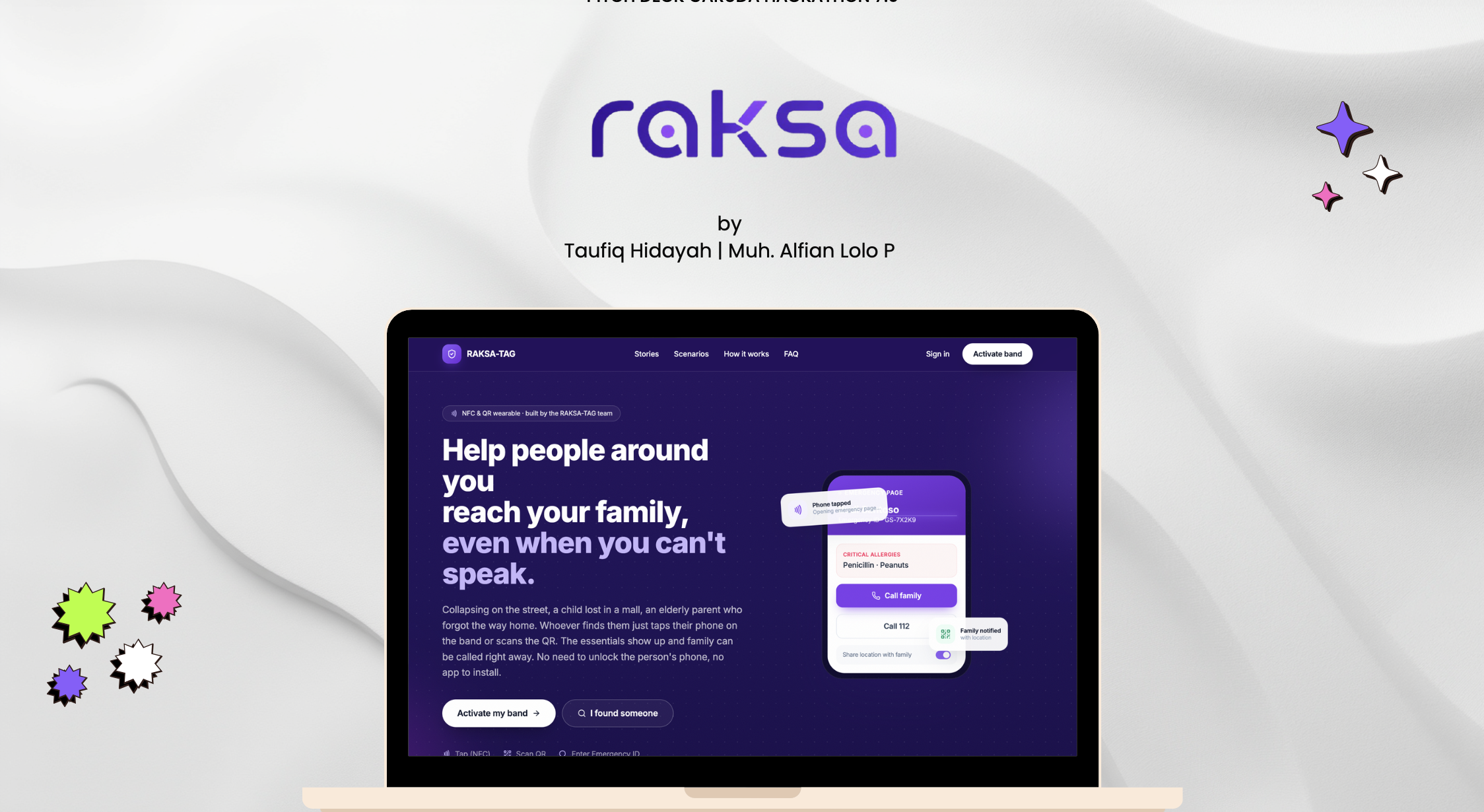
RAKSA turns a small NFC/QR tag (bracelet, pendant, or keychain) into a public help page:
- Wear — put the tag on any accessory (NFC + QR + readable Emergency ID)
- Set up once — claim the tag, add a profile and emergency contacts
- Helper scans — tap NFC or scan QR → the help page opens instantly
- Call Family / Share Location — big buttons, no login for helpers
Three modes:
- Lost child — nickname, age, Call Parent
- Adult emergency — key medical notes + Call Family
- Elderly cognitive safety — reunification support + Call Family
Privacy by design: the tag stores only a URL, not medical data. RAKSA helps at the moment of need — it is not a continuous tracker and not a medical device.
Built for middle- and lower-income families: affordable hardware vs expensive smartwatches that most people cannot buy.
How we built it
- Frontend: Next.js 15 (App Router), React 19, TypeScript, Tailwind CSS
- Backend: Supabase (PostgreSQL, Auth, Row Level Security)
- Hardware: NTAG213 NFC tags (URL-only payload) + QR fallback
- Hosting: Vercel
- Architecture: Clean Architecture + SOLID (domain → use cases → adapters → UI)
Core product flows: family account, multi-tag management, public /e/[token] emergency pages, Call Family (WhatsApp-friendly), optional location share from the helper’s phone, and scan history for the account owner.
Challenges we ran into
- Designing for stress UX: helpers under pressure need huge buttons and zero friction (no app, no account)
- Balancing speed vs privacy: enough info to help, not enough to leak family data
- Keeping hardware cheap enough for everyday Indonesian families
- Making NFC, QR, and typed Emergency ID all open the same reliable help page
Accomplishments that we're proud of
- A complete emergency flow: tap → help page → Call Family → reunite / respond
- Public emergency pages that work without an app for helpers
- Privacy-first design: URL-only tags + Supabase RLS
- Positioning RAKSA as affordable family safety — not another premium gadget
- Aligning the product clearly with GH Safety / Secure Our Future
What we learned
Safety products win when they work for the bystander, not only the account owner. Affordability and trust matter as much as features. A simple NFC/QR tag plus a fast web page is a practical stack for Indonesia’s real-world emergencies.
What's next for RAKSA
- Push/SMS alerts when a tag is scanned
- Safer hand-over / verification codes for reunification
- School and mall kit partnerships
- Bulk family kits at low cost
Built With
- nextjs
- nfc
- ntag213
- postgresql
- react
- supabase
- tailwindcss
- typescript
- vercel

Log in or sign up for Devpost to join the conversation.