-
-
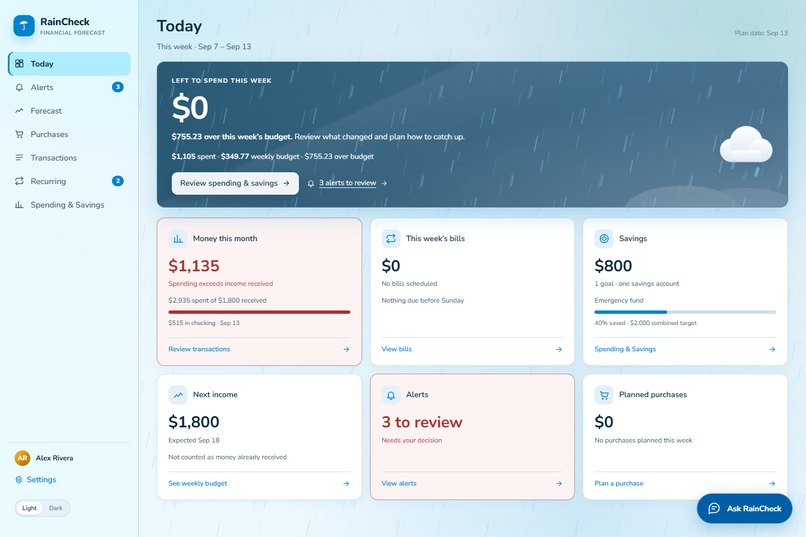
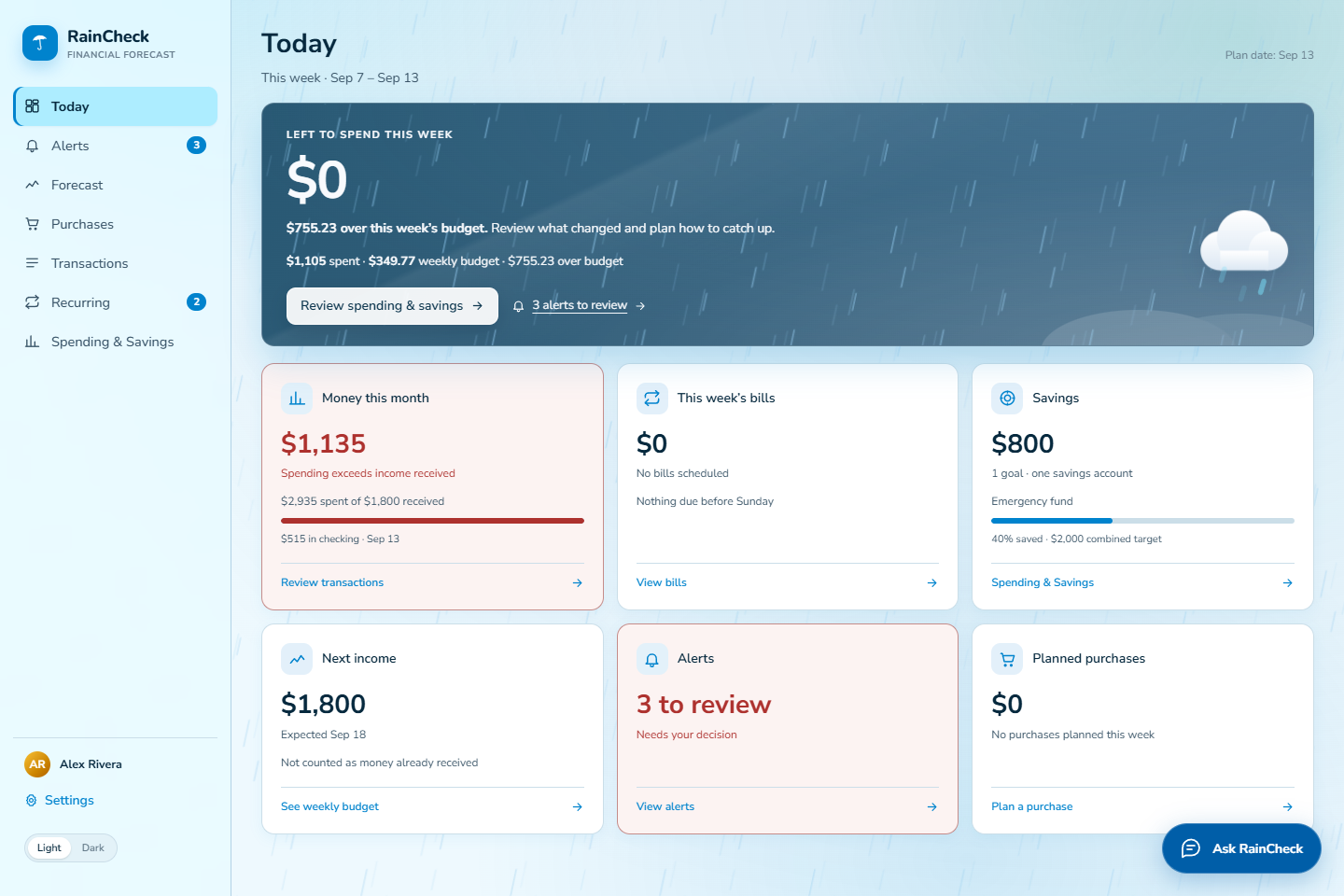
Homepage
-
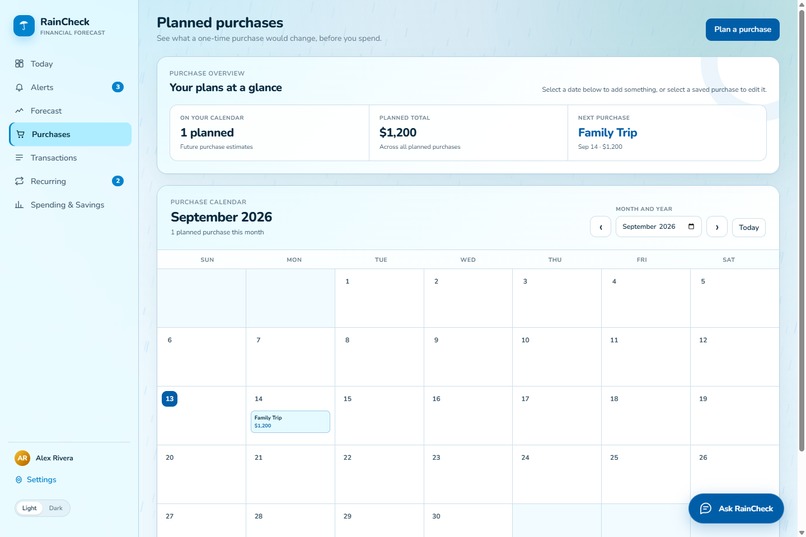
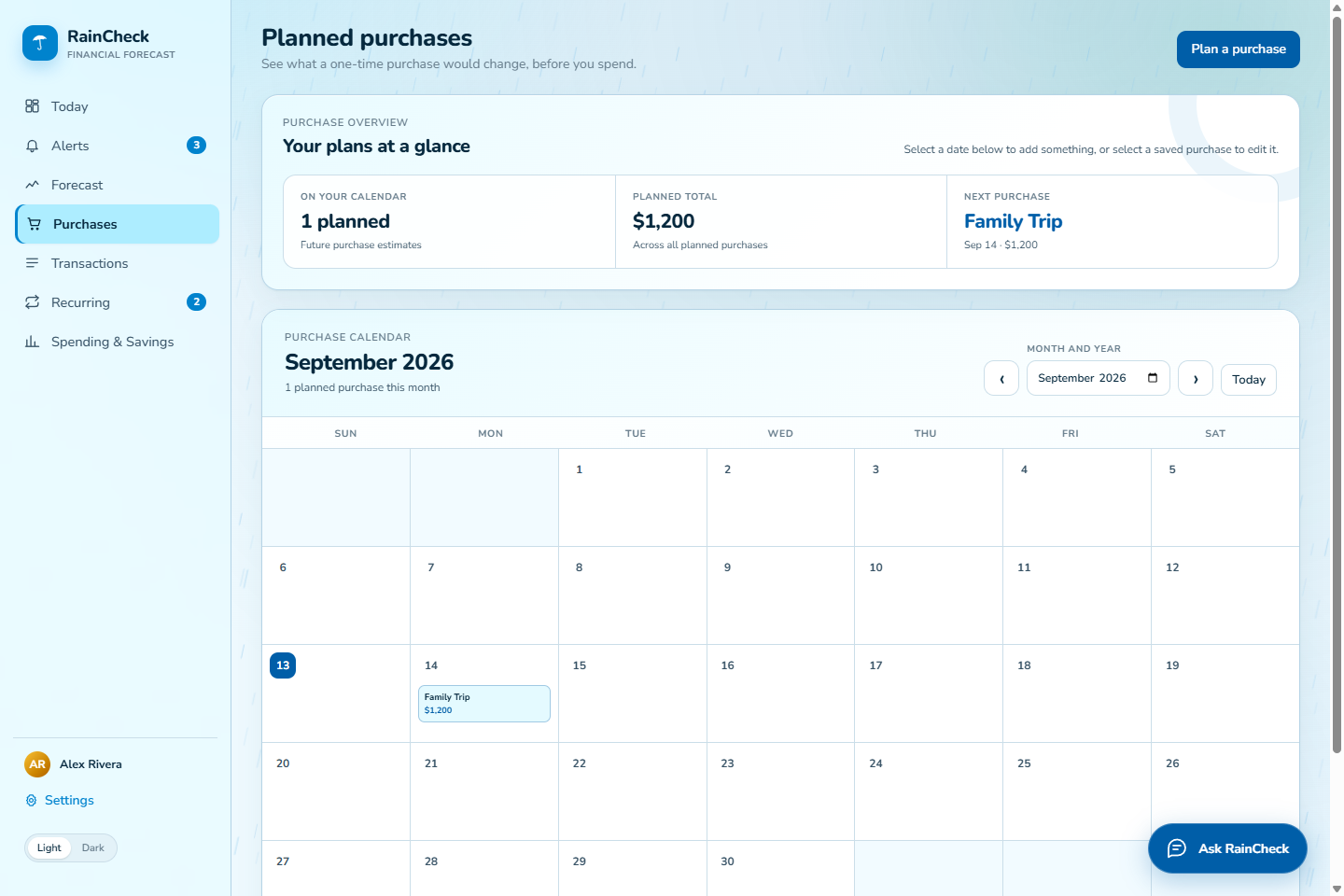
Purchase calendar
-
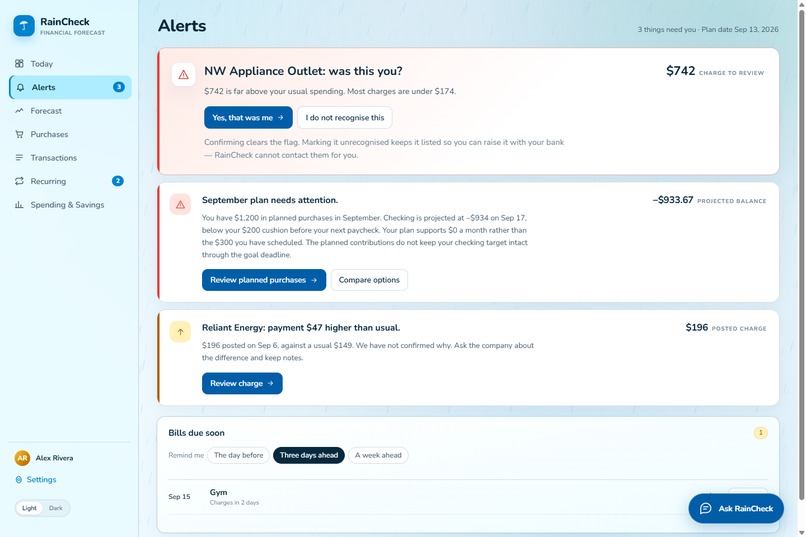
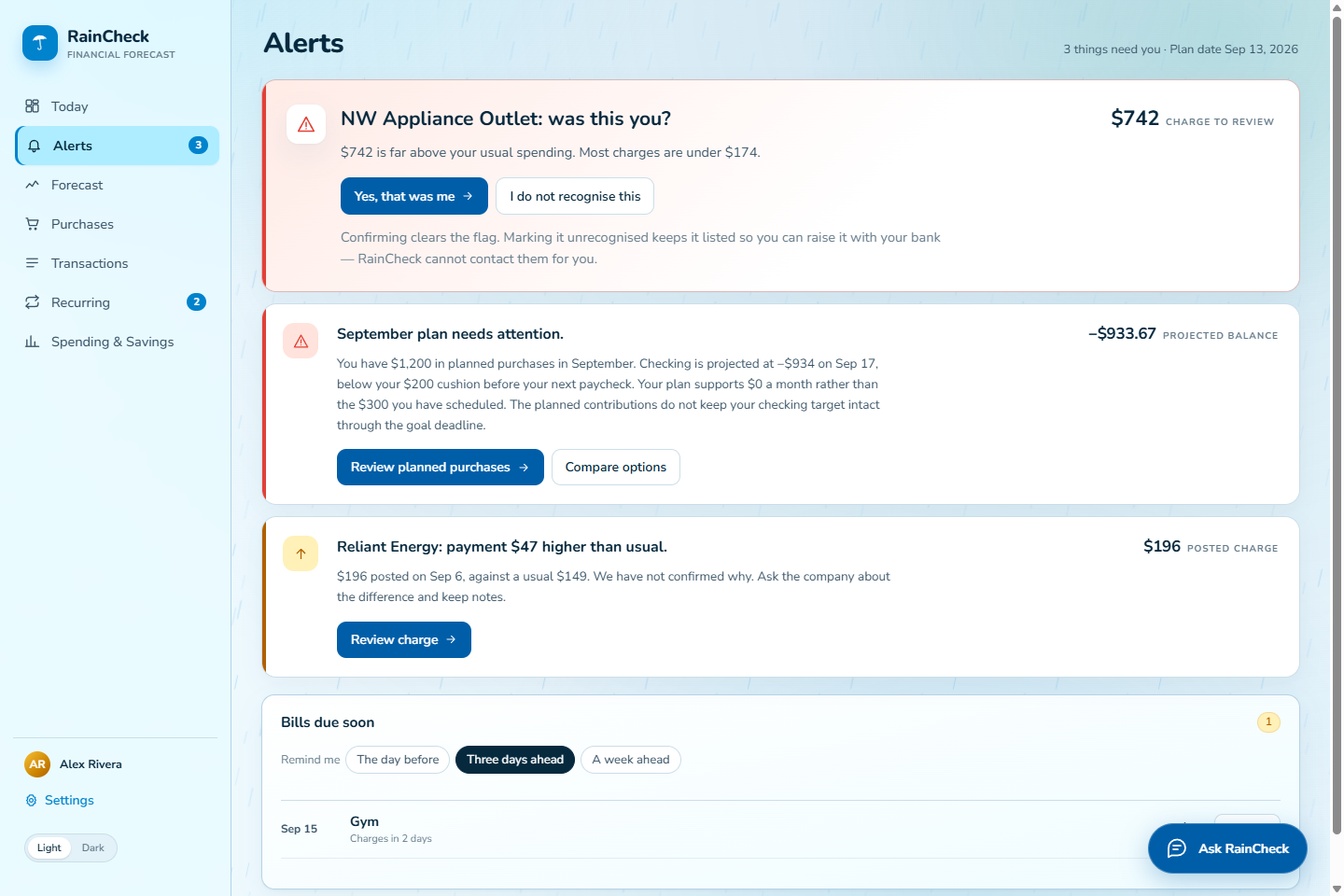
Alerts
-
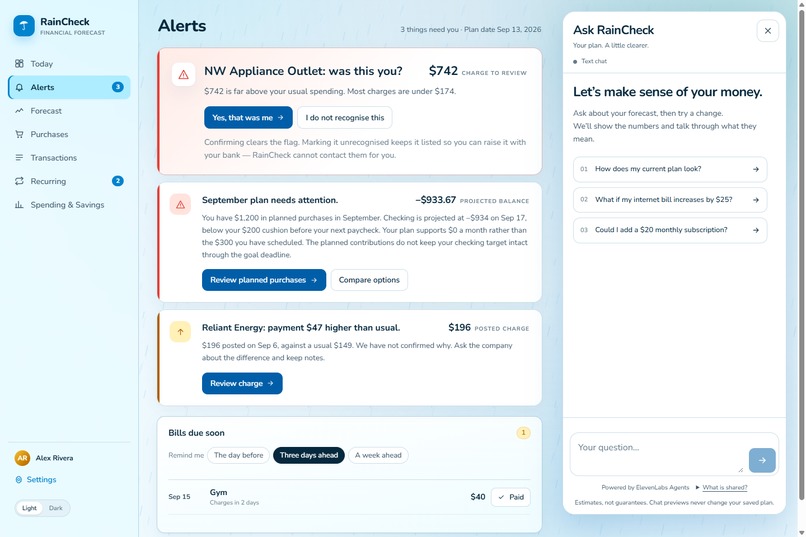
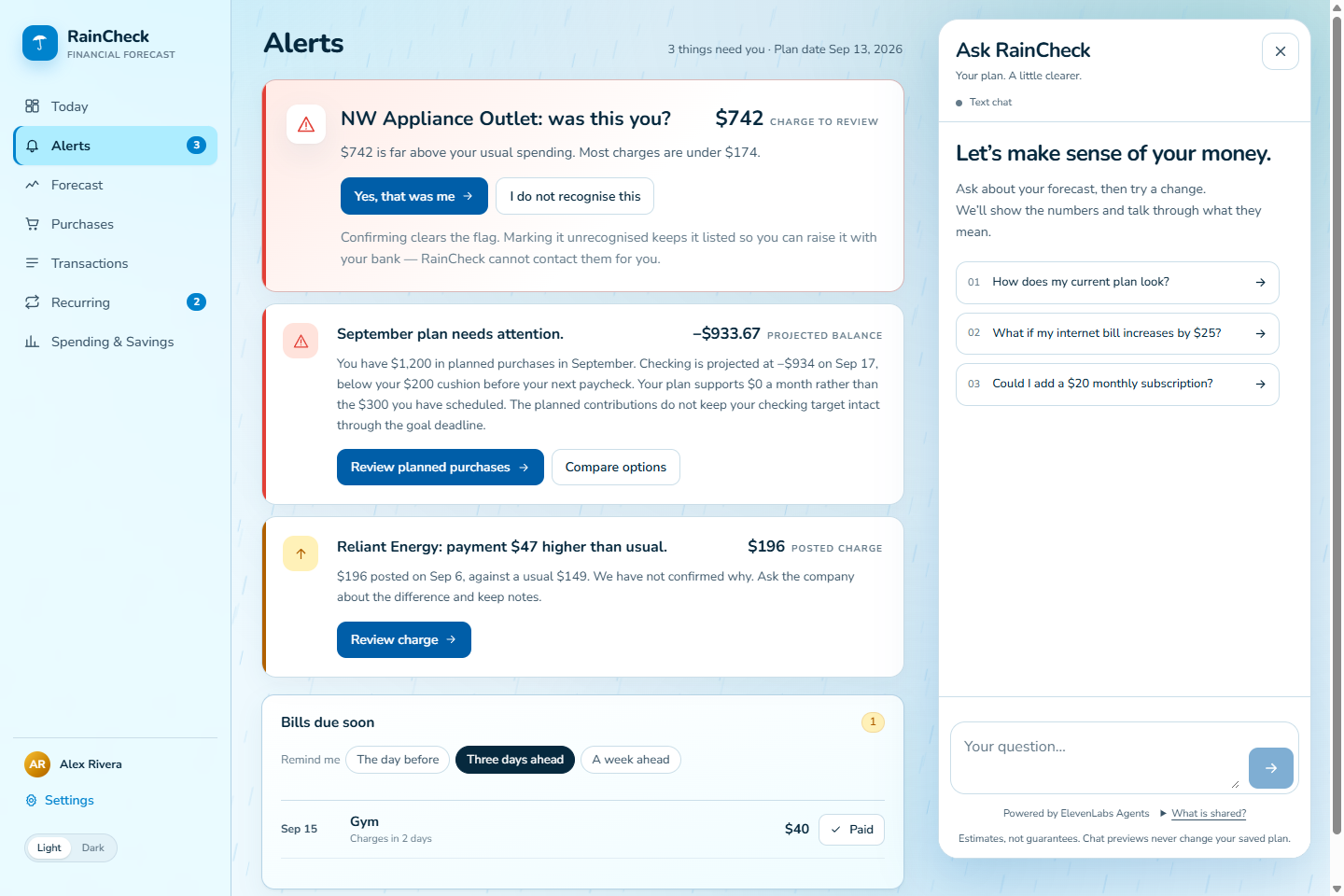
AI chatbot
-
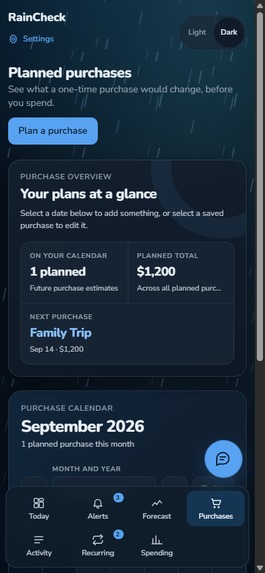
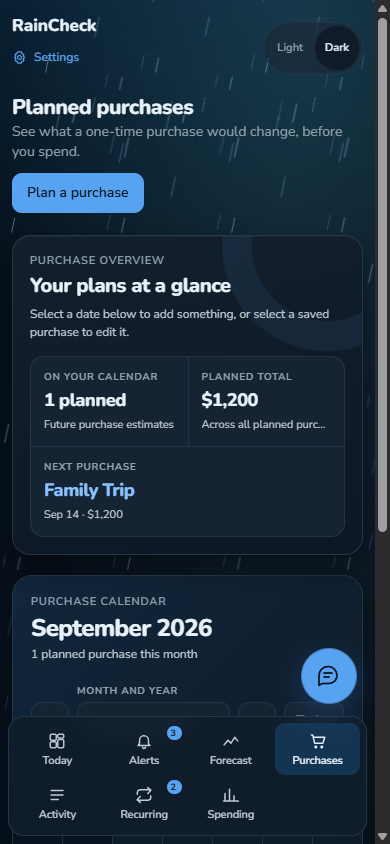
Mobile purchase calendar
-
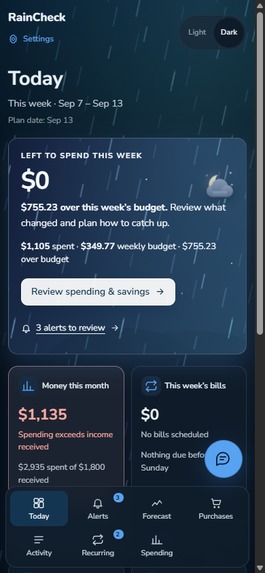
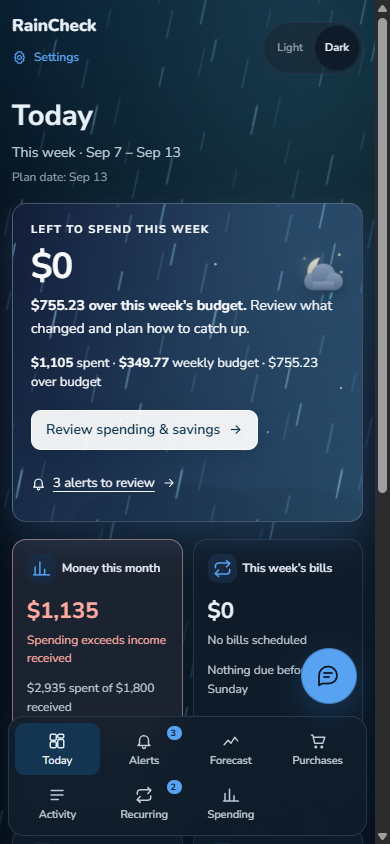
Mobile homepage
Inspiration
Most budget apps explain what already happened. We wanted RainCheck to answer the question people ask before making a decision: Can I afford this and still stay safe until payday?
RainCheck turns cash flow into a financial weather forecast. Clear weather means the plan stays above the user's safety cushion; clouds, rain, and storms show when a bill, savings goal, subscription, or planned purchase creates pressure.
What it does
- Projects the checking balance day by day using scheduled bills, expected income, everyday spending, goals, and planned purchases.
- Lets users add, edit, and remove goals, subscriptions, and future purchases, then preview the effect before accepting a change.
- Detects unusual recurring charges without pretending to know why they changed.
- Saves an expected future amount, a next action, and private follow-up notes so the user is prepared to contact a provider.
- Uses a calculator-grounded AI reviewer to explain assumptions and trade-offs in plain language.
- Keeps real forecast warnings separate from reminders and positive confirmations.
How we built it
RainCheck is a responsive React and Vite web app deployed on Vercel. Capital One's Nessie sandbox supplies mock accounts, bills, deposits, and transaction history. A deterministic JavaScript forecasting engine simulates every day in the selected horizon and remains the source of truth for balances and goal feasibility.
Supabase stores a dated, read-only retrieval mirror of the Nessie data. RainCheck retrieves only relevant evidence and sends bounded calculator results through a dedicated ZeroClaw review service backed by OpenAI. The model explains the result; it cannot change the plan or move money.
The interface uses a weather metaphor driven by the same alert state as the forecast, with responsive light and dark themes.
Challenges we ran into
The hardest problem was keeping every screen honest and consistent. Bills can appear both as scheduled commitments and posted transactions, transfers can look like income, and repeated purchases can look like subscriptions. Counting or classifying those incorrectly produces a confident but false forecast.
We also separated deterministic calculation from AI explanation. The AI receives structured, validated results and limited retrieved evidence instead of being asked to invent financial numbers.
Accomplishments that we're proud of
- One forecasting engine powers the dashboard, alerts, goals, purchases, and weather state.
- Undo reverses one decision without erasing unrelated choices.
- Charge reviews are tied to individual posted transactions, so a new anomaly can reopen without losing earlier notes.
- Private provider notes stay in the browser and are excluded from AI requests.
- The prototype works across desktop and mobile in both light and dark modes.
What we learned
A trustworthy financial assistant needs strong boundaries. "The amount changed" is evidence; "the company raised the price" is a conclusion that requires a provider notice. AI is most useful after the math, where it can explain trade-offs and surface questions without controlling the decision.
What's next
Before the final submission, we are completing the ElevenLabs conversational-agent connection so users can talk through the same calculator-grounded forecast. We also plan to add authenticated multi-user storage, richer anomaly detection, and real financial-data integrations beyond the mock Nessie sandbox.
Demo video: Placeholder — the final HackRice demo video will replace the temporary link before submission.
Built With
- elevenlabs
- javascript
- nessie
- openai
- postgresql
- react
- supabase
- vercel
- vite
- zeroclaw

Log in or sign up for Devpost to join the conversation.