AI Rail Guardian
See the defect. Predict the failure. Protect every journey.
Overview
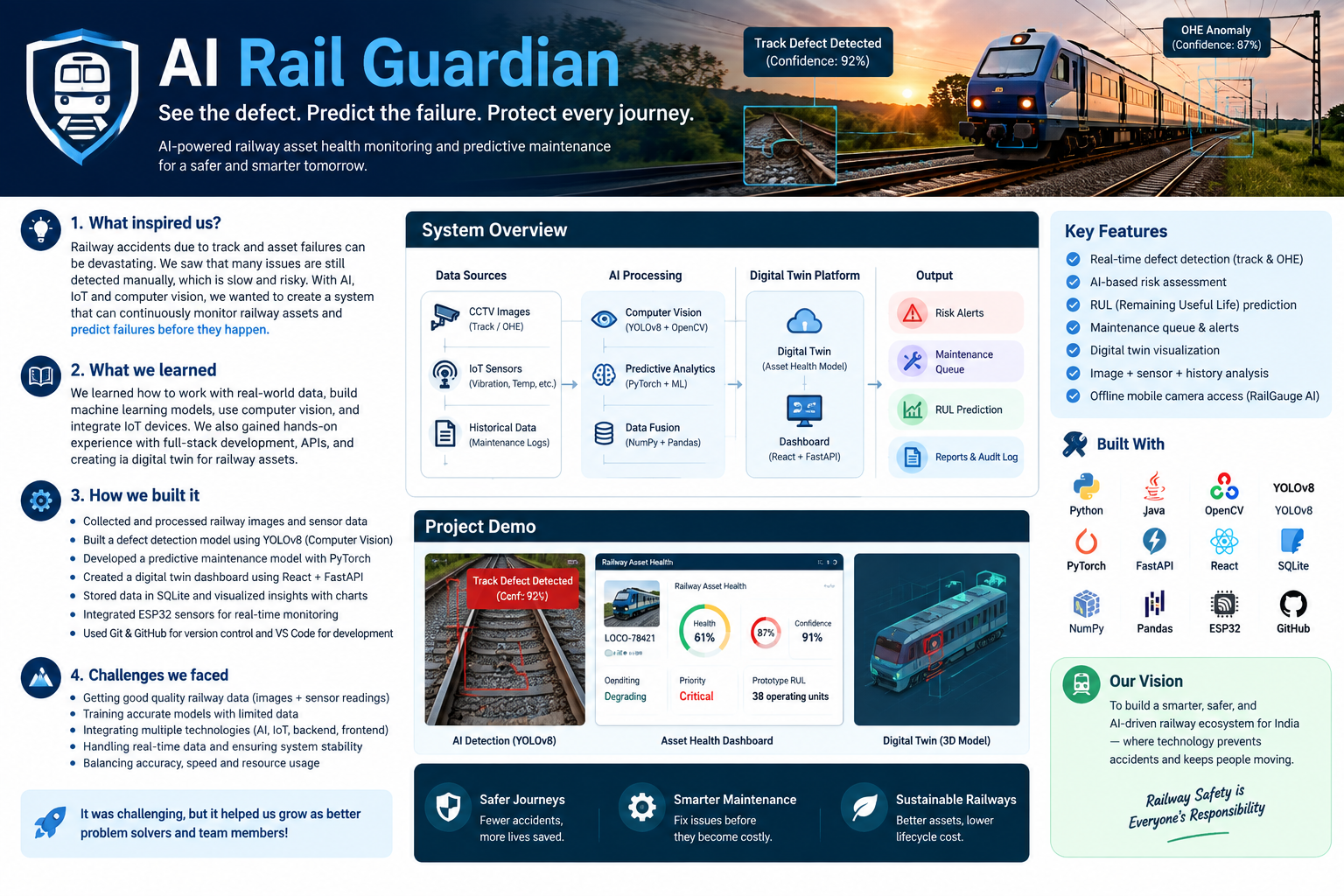
AI Rail Guardian is an intelligent railway safety and predictive maintenance platform designed to help engineers identify infrastructure problems before they become accidents. The project combines Artificial Intelligence, Computer Vision, IoT sensors, and Digital Twin technology to continuously monitor railway tracks and critical assets.
Rather than replacing existing railway signalling systems, AI Rail Guardian acts as a decision-support system for maintenance teams by providing early warnings, asset health analysis, and repair prioritization.
The Problem
Indian Railways is one of the world's largest railway networks, carrying millions of passengers every day. Maintaining thousands of kilometers of railway tracks, overhead electrical equipment (OHE), bridges, and other assets is a massive challenge.
Many inspections are still performed manually or at scheduled intervals. As a result:
- Small defects may remain unnoticed.
- Maintenance is often reactive instead of predictive.
- Engineers must analyze data from multiple disconnected sources.
- Delayed repairs can increase operational risk and maintenance costs.
We wanted to create a solution that helps maintenance teams detect issues earlier using AI.
Our Solution
AI Rail Guardian brings together three technologies into one platform:
- Computer Vision detects visible railway defects from CCTV or inspection images.
- IoT Sensors monitor vibration, temperature, and equipment conditions.
- Digital Twin Dashboard visualizes asset health, predicts failures, and supports maintenance decisions.
The platform analyzes images and sensor data simultaneously, calculates a risk score, estimates Remaining Useful Life (RUL), and generates explainable alerts for engineers.
Key Features
AI Defect Detection
- Track crack detection
- Rail surface anomaly identification
- OHE inspection support
- Image-based confidence scoring using YOLOv8
Predictive Maintenance
- Asset health percentage
- Remaining Useful Life (RUL)
- Failure probability estimation
- Priority-based maintenance queue
Digital Twin Dashboard
- Live asset monitoring
- Historical inspection records
- Risk visualization
- Maintenance reports and audit logs
IoT Integration
- ESP32 sensor support
- Vibration monitoring
- Temperature monitoring
- Real-time sensor fusion
System Architecture
Input Layer
- CCTV cameras
- Drone or inspection images
- ESP32 IoT sensors
- Historical maintenance records
AI Processing Layer
- YOLOv8 for object and defect detection
- OpenCV for image preprocessing
- PyTorch for predictive analytics
- NumPy & Pandas for data fusion
Application Layer
- FastAPI backend
- SQLite database
- React dashboard
- Digital Twin visualization
Output
- Risk alerts
- Asset health score
- Remaining Useful Life
- Maintenance recommendations
How We Built It
Frontend
We built an interactive dashboard using React that displays railway assets, inspection history, health indicators, and AI-generated alerts.
Backend
The backend uses FastAPI to receive image uploads, process sensor readings, run AI models, and expose REST APIs.
AI Models
- YOLOv8 detects railway defects from images.
- OpenCV performs image enhancement and preprocessing.
- PyTorch predicts asset degradation using sensor data.
Database
SQLite stores:
- Asset information
- Inspection history
- Sensor readings
- AI predictions
- Maintenance logs
Hardware
An ESP32 collects environmental and vibration sensor data, demonstrating how low-cost IoT devices can support railway monitoring.
Example Workflow
- A CCTV camera captures a railway track image.
- YOLOv8 detects a possible crack with a confidence score.
- Sensor data is combined with historical records.
- The AI model calculates asset health and RUL.
- The dashboard generates a high-priority maintenance alert.
- Engineers review the recommendation before scheduling repairs.
This creates a smarter and more proactive maintenance process.
Challenges We Faced
Building AI Rail Guardian involved several technical challenges:
- Finding realistic railway defect datasets
- Combining image and IoT sensor data
- Reducing false positives in computer vision
- Designing an explainable risk scoring model
- Optimizing AI inference for near real-time performance
- Creating a scalable architecture for future deployment
Each challenge helped us improve both the engineering design and the usability of the platform.
What We Learned
This project helped us gain practical experience in:
- Artificial Intelligence
- Computer Vision
- Predictive Analytics
- Full-Stack Development
- REST API Design
- IoT Integration
- Digital Twin Technology
- Data Fusion
- Railway Safety Applications
Beyond technical skills, we learned how to design a solution around a real-world engineering problem and communicate it through a complete prototype.
Future Scope
Our future roadmap includes:
- Live locomotive camera integration
- Drone-based railway inspection
- Edge AI deployment for offline operation
- Cloud synchronization across railway divisions
- Advanced digital twin simulation
- RDSO-compatible maintenance workflows
- Multi-train collaborative infrastructure monitoring
We believe AI Rail Guardian can contribute toward a safer, smarter, and more reliable railway ecosystem by supporting engineers with intelligent maintenance insights rather than replacing human expertise.
Technology Stack
Languages: Python, Java
Frontend: React
Backend: FastAPI
AI: YOLOv8, OpenCV, PyTorch
Database: SQLite
IoT: ESP32
Tools: Git, GitHub, VS Code, NumPy, Pandas
Team
Developed by Abishek N as a railway AI innovation project focused on predictive maintenance, computer vision, and digital twin technology.

Log in or sign up for Devpost to join the conversation.