Inspiration
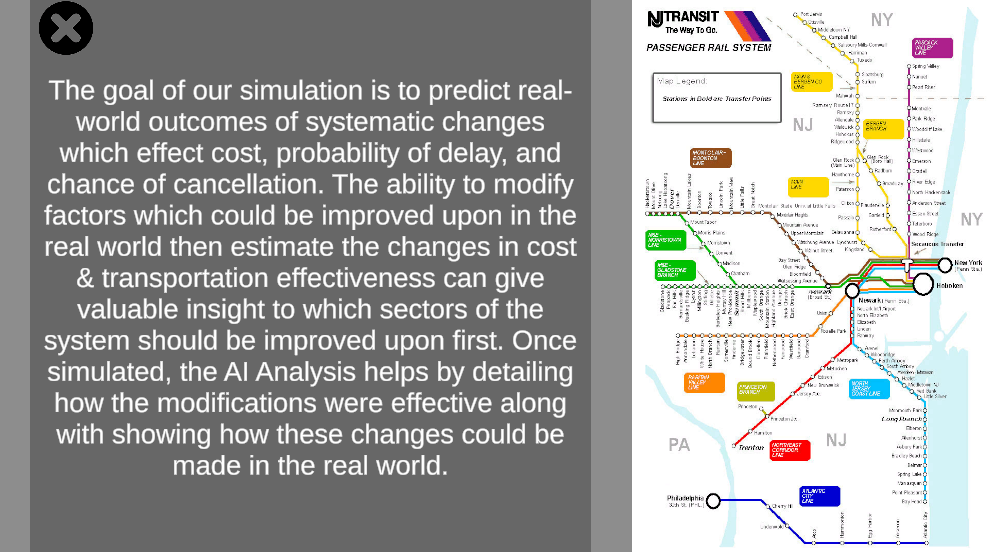
We were inspired by the complexities of real-world transit systems and how factors like staffing, technology, and external operations (like Amtrak) can cause delays or cancellations. By creating a simulation, we wanted to explore how adjusting these variables can improve transit efficiency, taking inspiration from strategy games like Mini Metro and the unpredictability of transit disruptions.
What it does
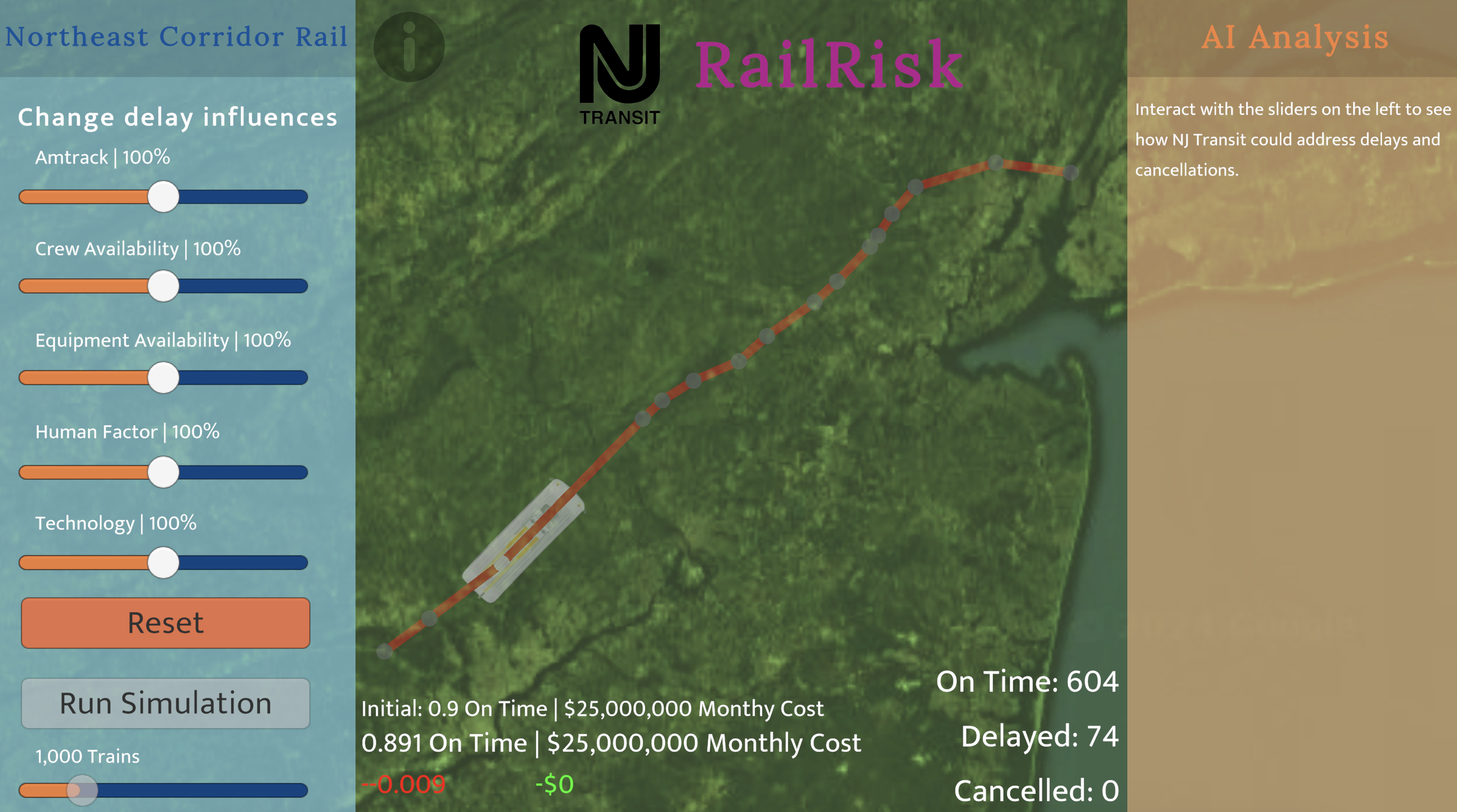
RailRisk simulates NJ TRANSIT train delays and cancellations for the Northeast Corridor, allowing users to tweak the probabilities of different causes like Amtrak interactions, crew and equipment availability, human factors, and technology failures. All of this information comes from the datasets provided by NJ Transit, including how much each factor leads to cancellations, the exact position of each stop, etc. You can also see how the simulated cost to run the line for one month will change, and this was calculated using the information from NJ TRANSIT's financial sheets. An AI analysis is also provided, explaining how NJ TRANSIT can implement these changes effectively. The system visualizes these changes and provides real-time feedback on how adjustments affect rail performance and efficiency.
How we built it
We built RailRisk using Unity for the simulation and visualization, integrating real-world NJ TRANSIT data for rail stops and train movements. The backend for the AI Analysis uses Gemini AI to find real-world solutions that lead to the simulated data based on slider inputs.
Challenges we ran into
One of the biggest challenges was working with limited NJ TRANSIT data, as we didn’t have specific information on passenger numbers, so we had to use the data provided on delays and cancellations to creatively simulate data and build a flexible model that would still provide accurate insights. Another challenge was optimizing the simulation speed to ensure it runs smoothly while also offering real-time visual feedback.
Accomplishments that we're proud of
We’re proud of developing a simulation that not only runs efficiently but also provides meaningful feedback based on user input. We successfully created a visual system where trains react to delays and cancellations, with color-coded indicators showing disruptions. Additionally, we were able to model complex scenarios with simplified input, making it accessible to users.
What we learned
We learned a lot about modeling transportation systems, using Unity for simulations, and integrating AI with real-world transit data. This project helped us better understand how small changes in one area (like technology or staffing) can ripple across an entire transit network.
What's next for RailRisk
Next, we plan to expand RailRisk by incorporating more detailed datasets, such as passenger numbers and specific delay causes. We also aim to enhance the simulation by adding more train lines and scenarios, and possibly integrate a cost analysis feature to model the financial impact of reducing delays. Since the simulation was built in a modular fashion, it is very easy to simulate other rails, just by changing out the data files that were provided by NJ Transit. Lastly, we’d like to explore procedural generation of optimal rail networks based on real-time data.

Log in or sign up for Devpost to join the conversation.