-
-
-
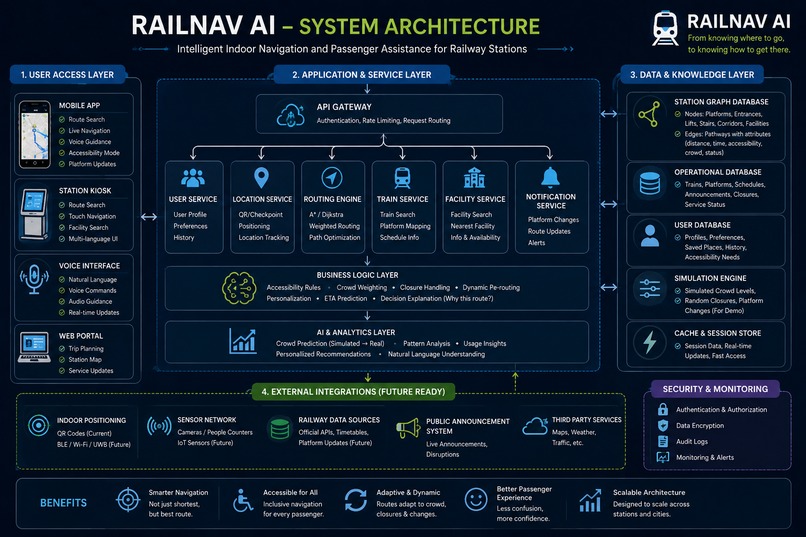
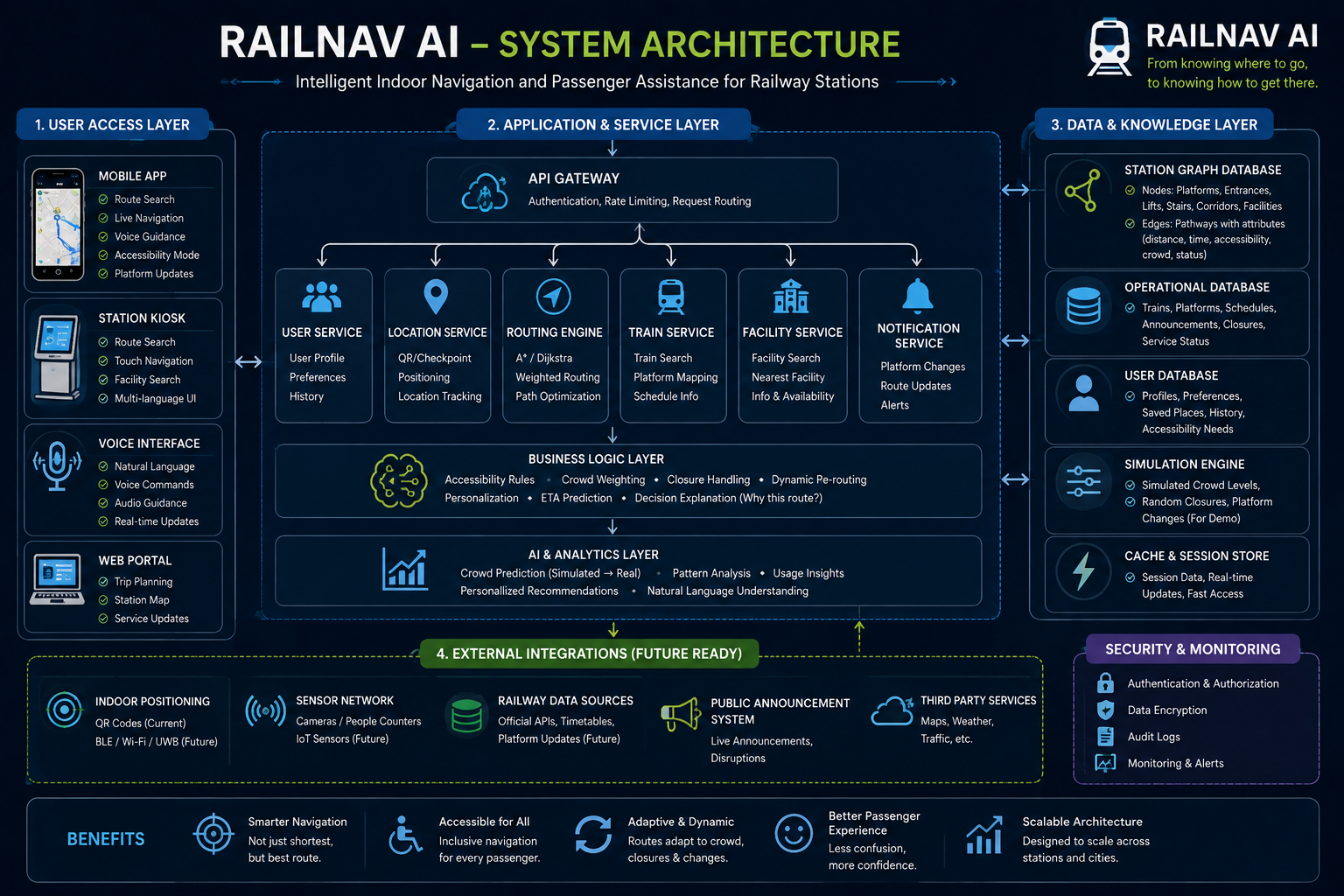
ARCHITECTUAL DIAGRAM CLEAR PICTURE
Inspiration
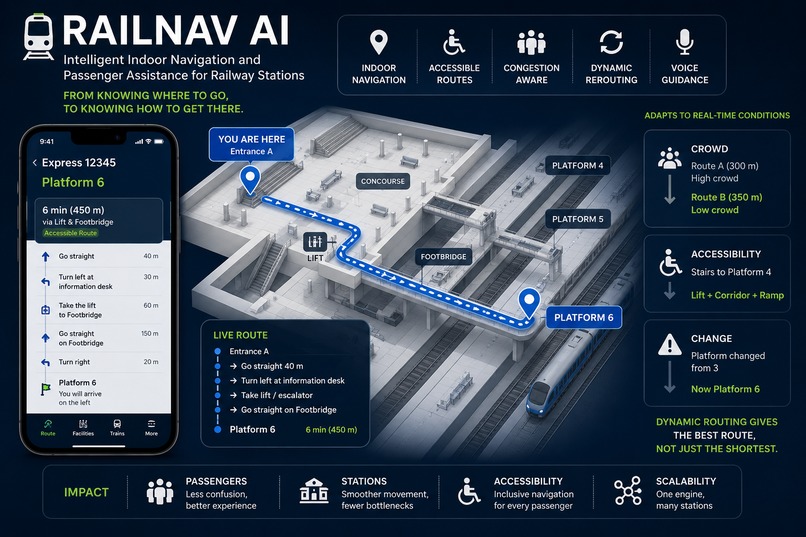
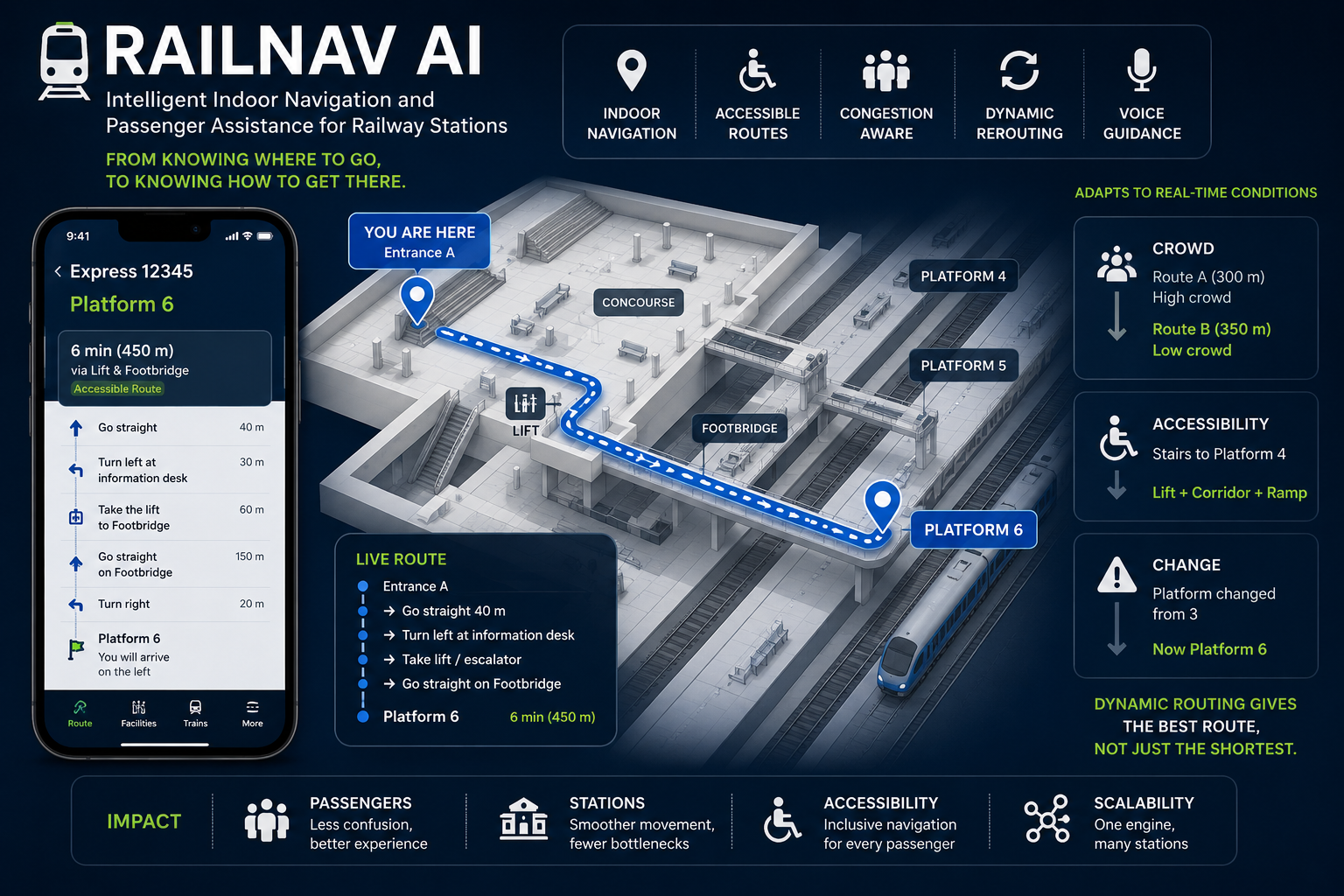
Large railway stations can be difficult to navigate, especially for first-time travellers, elderly passengers, tourists, passengers with disabilities, and people unfamiliar with the station layout. Passengers may know their platform number but still struggle to determine how to reach it through multiple corridors, levels, stairs, lifts, and footbridges. Sudden platform changes, congestion, or unavailable facilities can make the situation even more difficult.
This inspired RailNav AI. We wanted to move beyond static station maps and create a system that answers a simple question: “I know where I need to go, but what is the best way for me to get there?”
Our goal is to make railway-station navigation more intelligent, accessible, and adaptable to the passenger's situation.
What it does
RailNav AI is an intelligent indoor navigation and passenger-assistance system for railway stations.
Passengers can search for a train, platform, restroom, exit, ticket counter, waiting area, or other station facility and receive step-by-step guidance from their current location.
The system is designed to provide:
Train-to-platform navigation Indoor route calculation Step-by-step visual guidance Voice navigation Accessibility-aware routes Congestion-aware route recommendations Dynamic rerouting when corridors or facilities become unavailable Mobile and kiosk-based navigation
For example, if the shortest route to a platform contains stairs, a passenger using Accessible Mode can instead be guided through lifts, ramps, and accessible corridors. Similarly, if one route is heavily congested, the system can recommend a practical alternative.
How we built it
We designed the railway station as a graph-based digital map. Platforms, entrances, corridors, lifts, stairs, escalators, and facilities are represented as nodes, while the paths connecting them are represented as edges.
The navigation engine uses algorithms such as A* or Dijkstra to calculate routes.
Instead of considering only distance, the system can use a weighted route cost:
Route Cost = Distance + Crowd Penalty + Accessibility Penalty + Closure Penalty
This allows the route to adapt to different passenger and station conditions.
For the initial prototype, we plan to use QR-code checkpoints for indoor positioning. Scanning a QR code identifies the passenger's approximate current location without requiring expensive positioning infrastructure. The architecture can later support BLE, Wi-Fi, UWB, sensors, and authorised real-time data sources.
AI can support congestion prediction, personalised route recommendations, and natural-language or voice interaction, while the core navigation remains based on reliable graph-routing algorithms.
Challenges we ran into
One of the biggest challenges is indoor positioning, because GPS is not sufficiently reliable inside large railway stations. We addressed this at the prototype level by using QR checkpoints, while keeping the architecture expandable to more advanced indoor-positioning technologies.
Another challenge is obtaining accurate real-time information about congestion, platform changes, blocked corridors, and unavailable lifts. For the prototype, such conditions can be simulated or updated through an administrator interface rather than falsely claiming live sensor integration.
We also had to consider accessibility because the mathematically shortest route is not necessarily the most suitable route for every passenger.
Accomplishments that we're proud of
We are proud of developing RailNav AI as more than a digital station map. The concept combines indoor navigation, train-to-platform guidance, accessibility, congestion awareness, dynamic rerouting, and voice assistance within one architecture.
A major accomplishment is designing the system so that the same navigation engine can support multiple passenger interfaces, including a mobile application, station kiosk, and voice guidance.
We also developed a practical MVP strategy that can begin with a single realistic station rather than requiring large-scale railway infrastructure from the beginning.
What we learned
We learned that indoor navigation is not simply about finding the shortest path.
A route may be short but unsuitable because it contains stairs, congestion, a closed corridor, or an unavailable lift. Effective navigation therefore requires multiple factors to be considered together.
We also learned that AI should be used only where it adds genuine value. A* and Dijkstra can reliably perform the fundamental pathfinding, while AI can enhance the system through prediction, personalisation, and natural-language interaction.
Most importantly, we learned the importance of designing from the passenger's perspective rather than treating the problem purely as a map or algorithm problem.
What's next for RailNav AI
The next step is to develop and validate a working prototype using one realistic railway-station model.
The prototype will focus on indoor mapping, QR-based positioning, facility search, A*/Dijkstra routing, train-to-platform navigation, accessibility-aware routes, dynamic closures, simulated congestion-aware routing, and voice guidance.
After validating the core system, RailNav AI can be extended with more accurate indoor-positioning technologies and suitable real-time station data sources.
Our long-term vision is to make RailNav AI adaptable across railway stations and potentially other complex transportation environments.
From knowing where to go, to knowing exactly how to get there.
Built With
- a
- algorithm
- algorithm*
- algorithms
- api
- artificial
- codes
- dijkstra
- fastapi
- graph
- intelligence
- learning
- machine
- next.js
- postgresql
- python
- qr
- react
- rest
- speech
- svg
- web


Log in or sign up for Devpost to join the conversation.