-
-
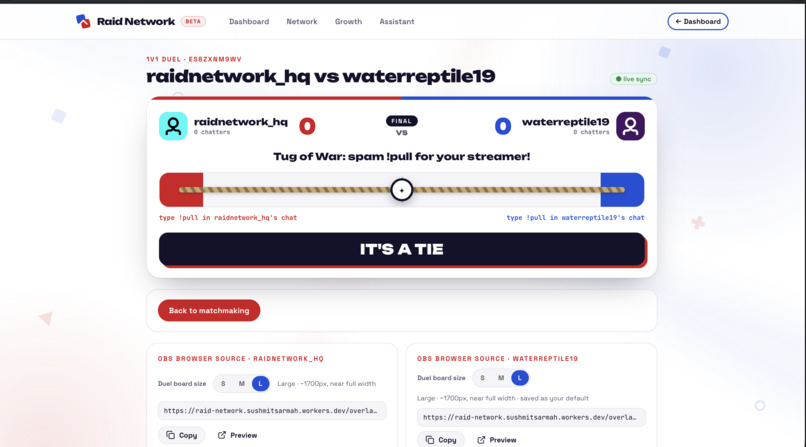
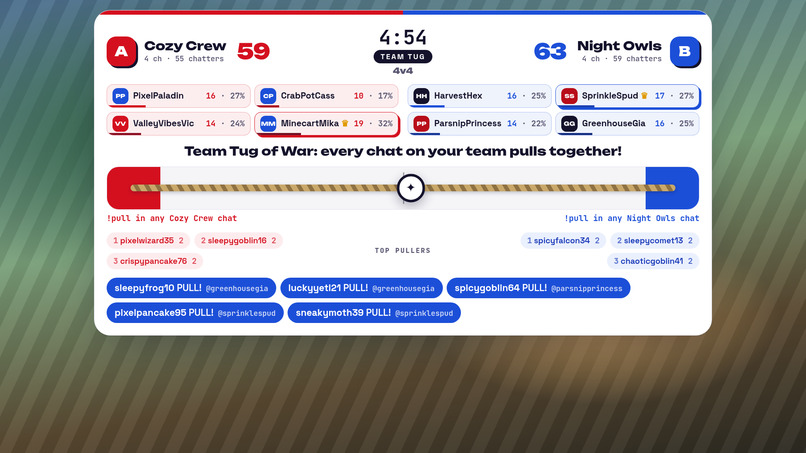
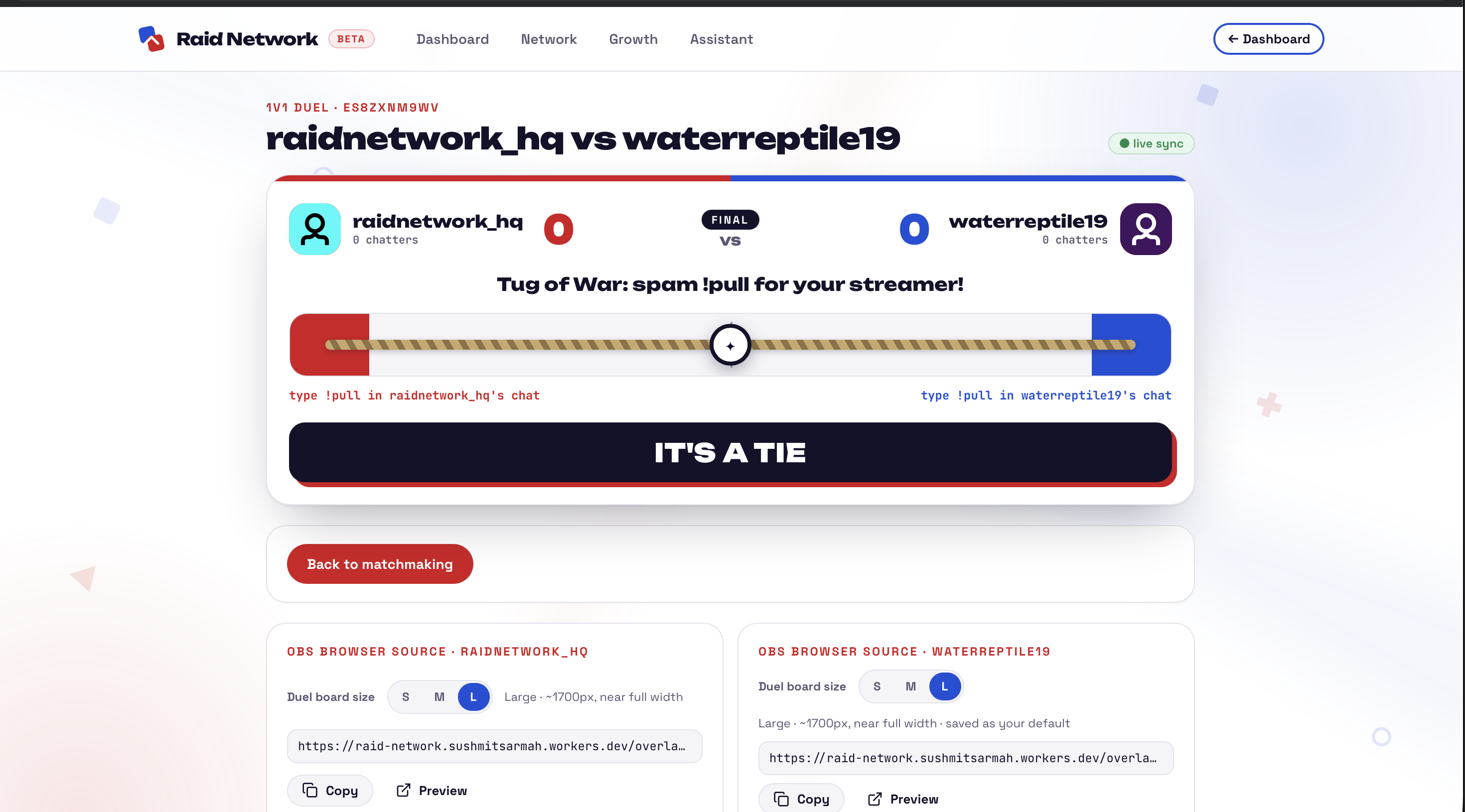
Tug of war between 2 streamer communities
-
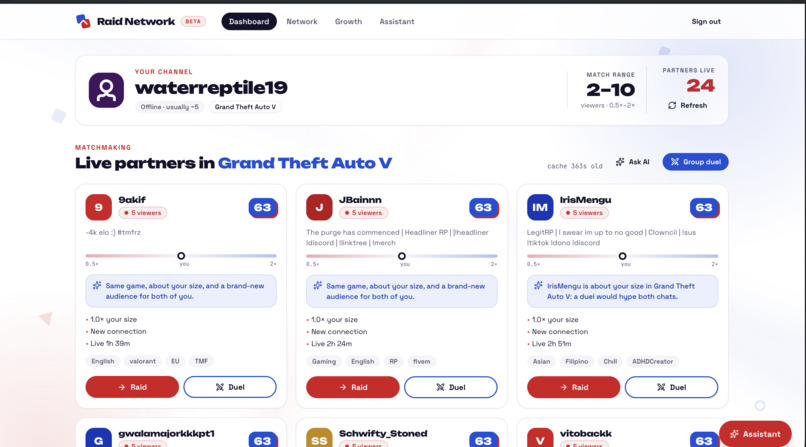
discover streamers
-
-
-
-
-
Growth
-
Inspiration
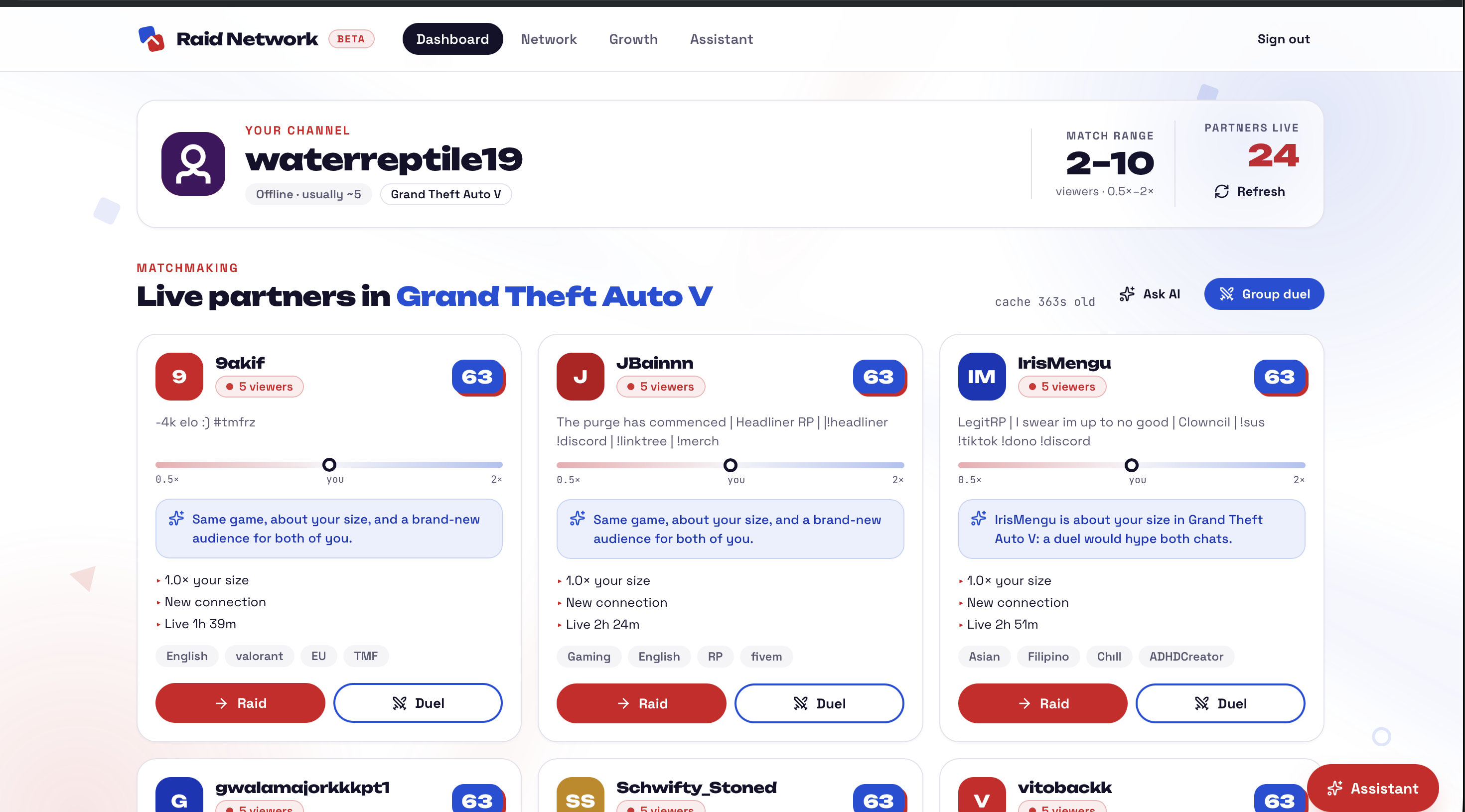
For small and mid-sized Twitch creators, growth is notoriously difficult. At the end of a stream, raiding another channel is the best organic way to build community, yet streamers are left guessing: Who is live right now in my category? Who has an audience close to my size? Have we raided each other before? Most raids end up as awkward, one-off handoffs where viewers drop off before saying hello.
We asked: What if ending a stream wasn’t an awkward handoff, but an interactive, multiplayer co-op event?
We wanted to turn Twitch raids into a shared experience—helping creators find ideal collab partners, visualize their community ties, and run synchronized, chat-vs-chat battles directly on their stream overlays.
What it does
Raid Network is a matchmaking, co-stream gamification, and growth platform for Twitch streamers:
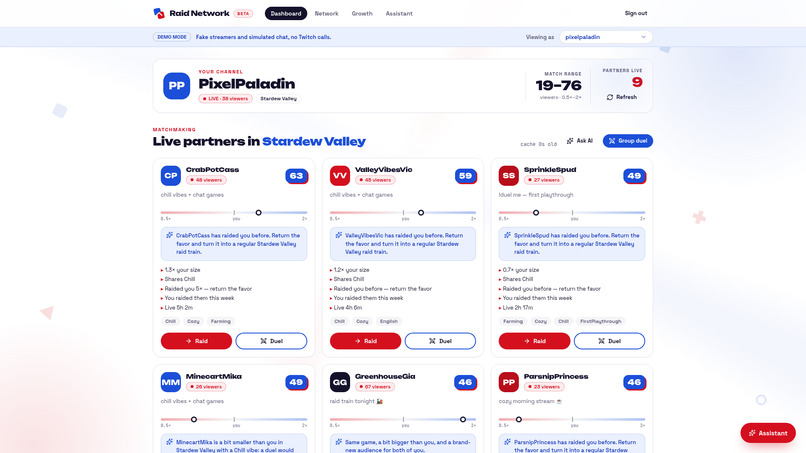
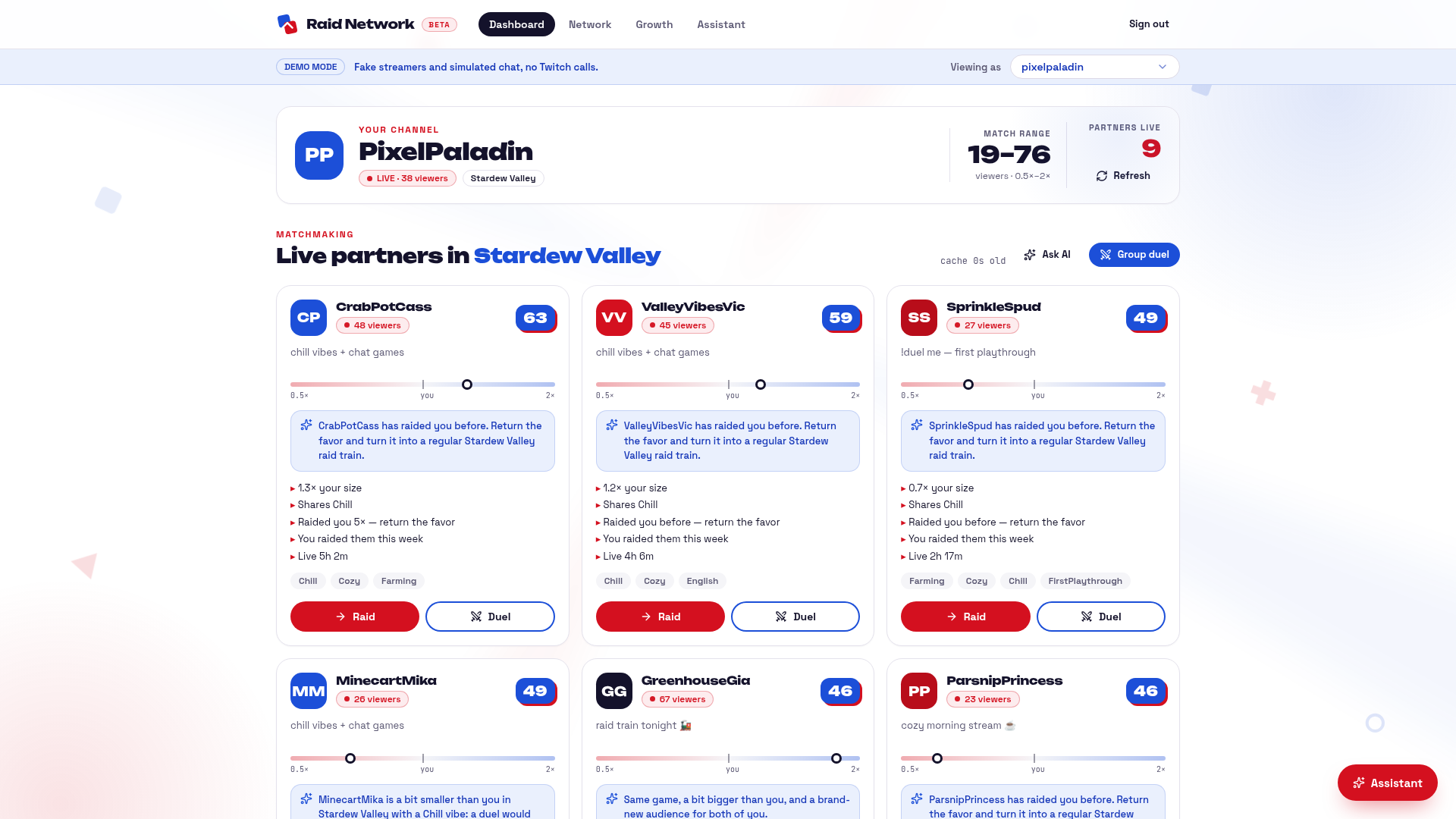
- Smart Raid Matchmaking: Analyzes live channels in the streamer's category and scores them by audience parity (targeting a ratio $0.5\times \le \frac{V_{\text{target}}}{V_{\text{user}}} \le 2.0\times$), shared tags, language, and historical raid exchanges.
- Raid Network Graph: An interactive, draggable SVG force-directed network map showing who raids whom across the ecosystem, helping creators discover organic collaborator clusters.
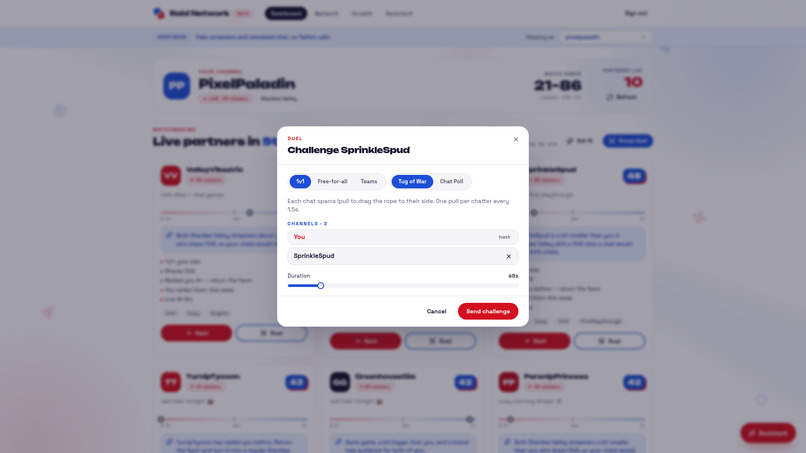
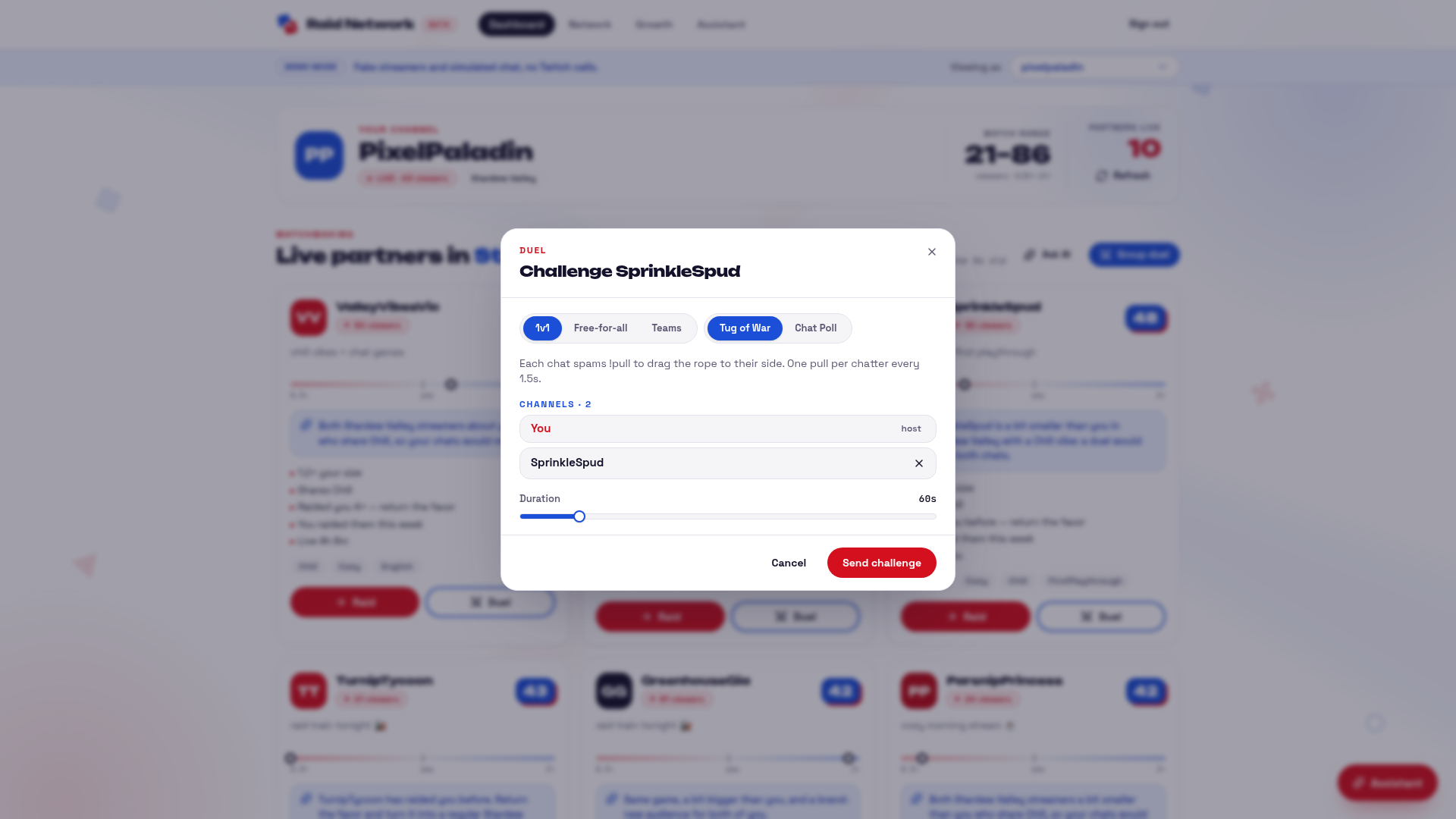
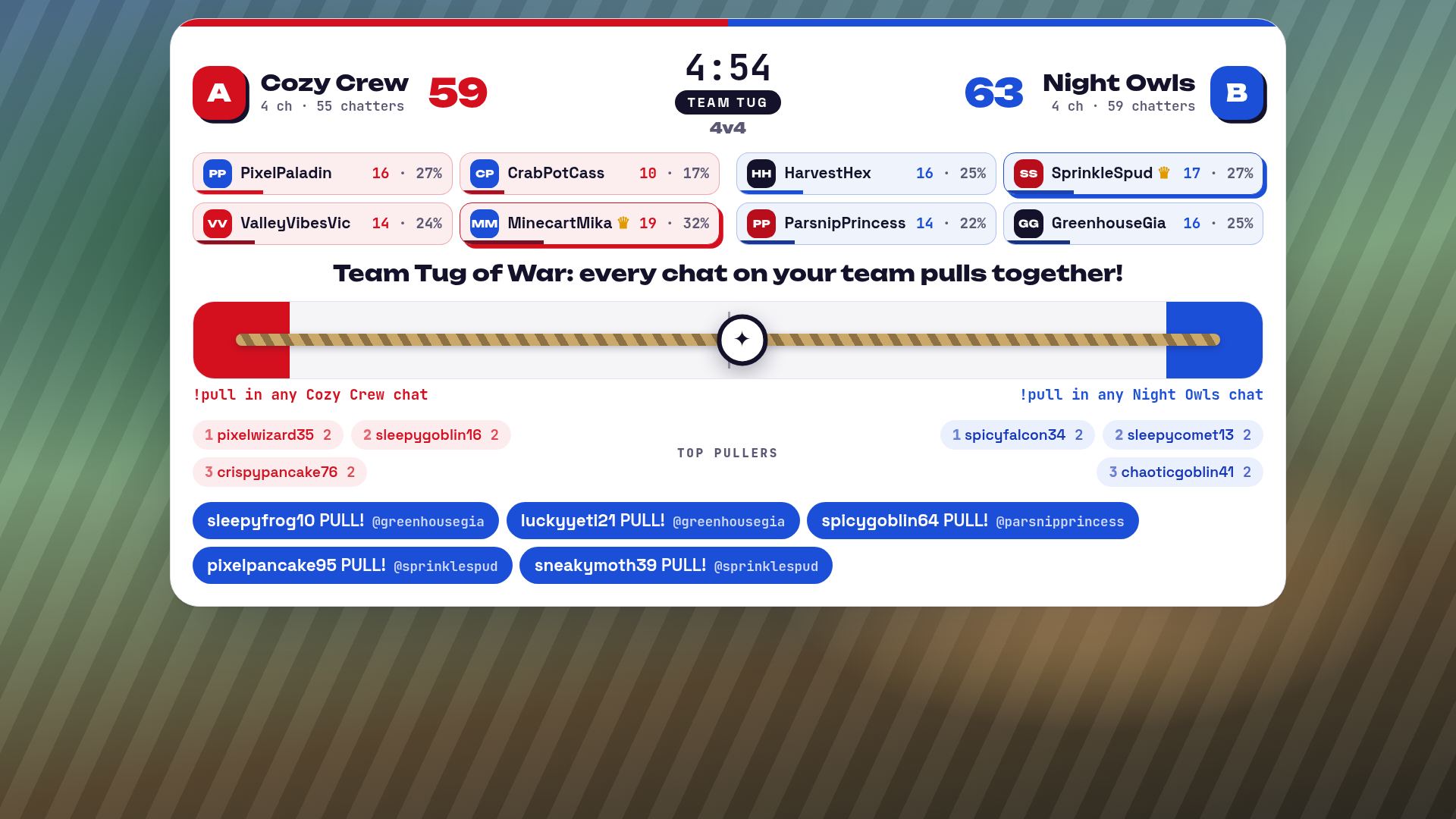
- Cross-Channel Chat Duels (1v1, Free-for-All & Teams):
- Streamers challenge peers to live minigames (Tug of War, Chat Race, or Chat Poll).
- Both channels display a single synchronized OBS browser overlay (
/overlay/:channel). - Viewers trigger actions in Twitch chat (
!pull,!1–!4), which instantly update the shared physics rope or race bars in sub-second real time across 2 to 8 channels simultaneously.
- Automated Streamer Tools:
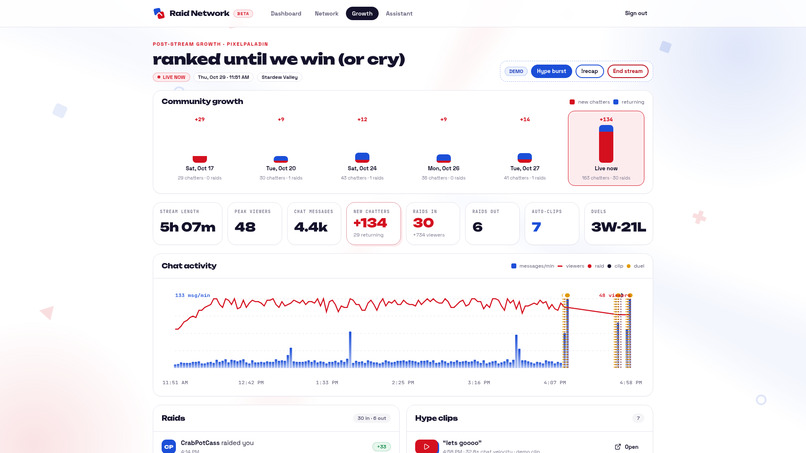
- Hype & Auto-Clips: Real-time chat velocity analysis detects hype spikes ($v_{\text{chat}} \ge 4 \times v_{\text{baseline}}$) and automatically clips peak moments.
- Dynamic Welcome & Recap Cards: Displays celebration cards on OBS when someone raids, plus an interactive
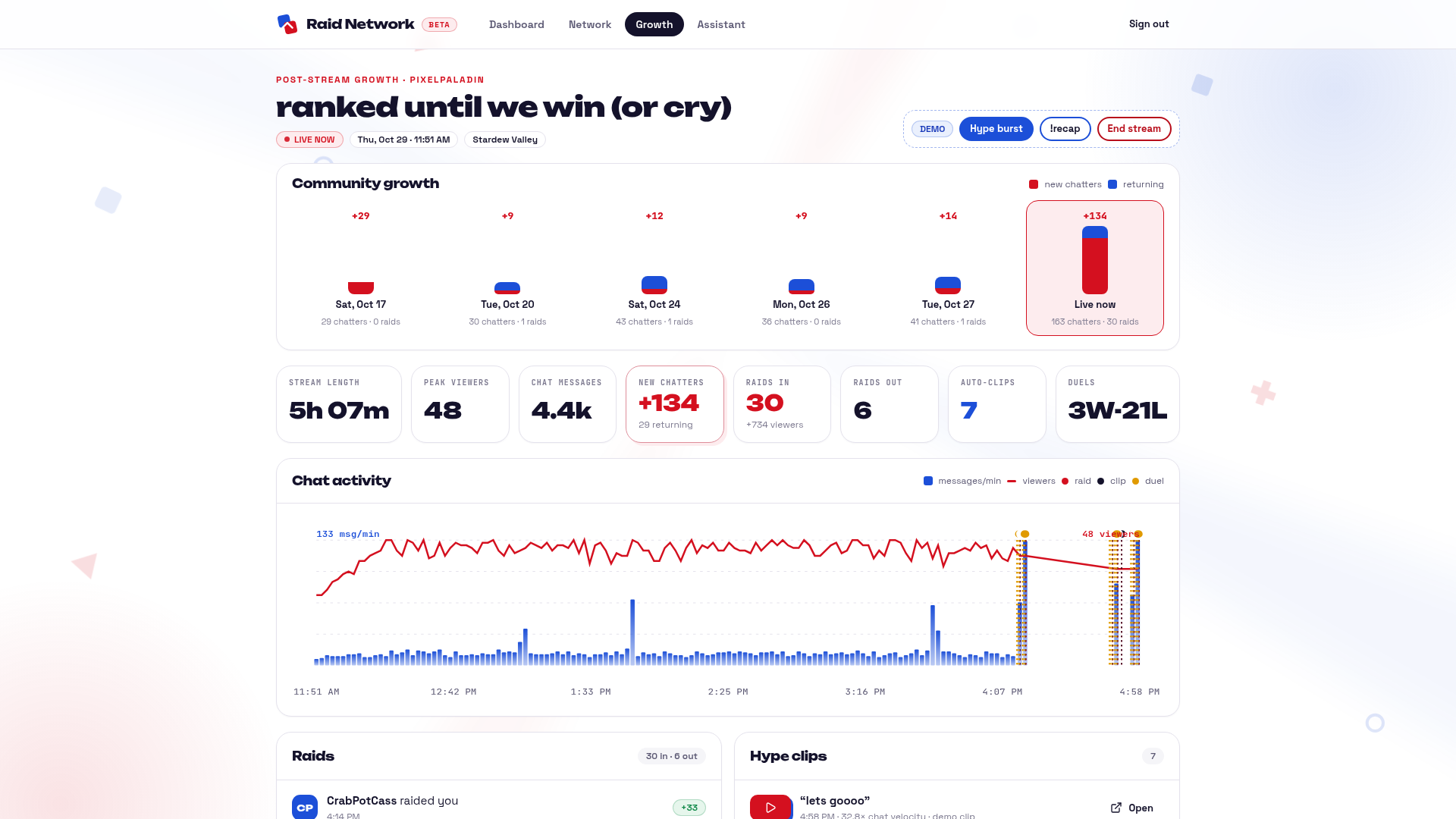
!recapcommand for chat. - Post-Stream Growth Analytics: Visualizes new vs. returning chatters, raid conversions, and timeline highlights.
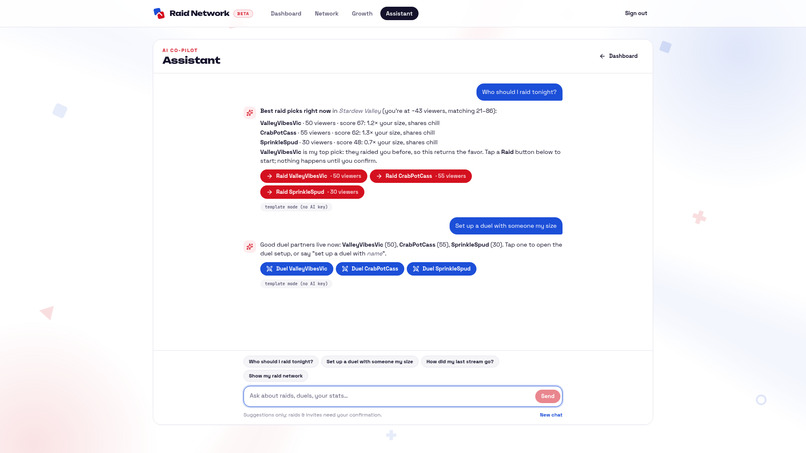
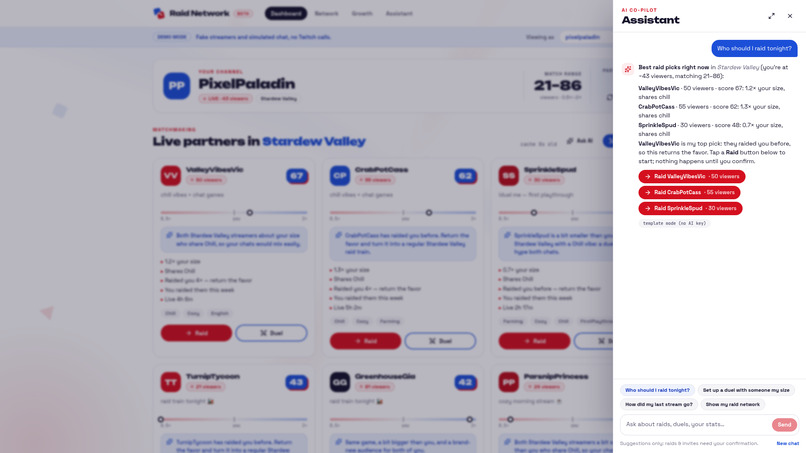
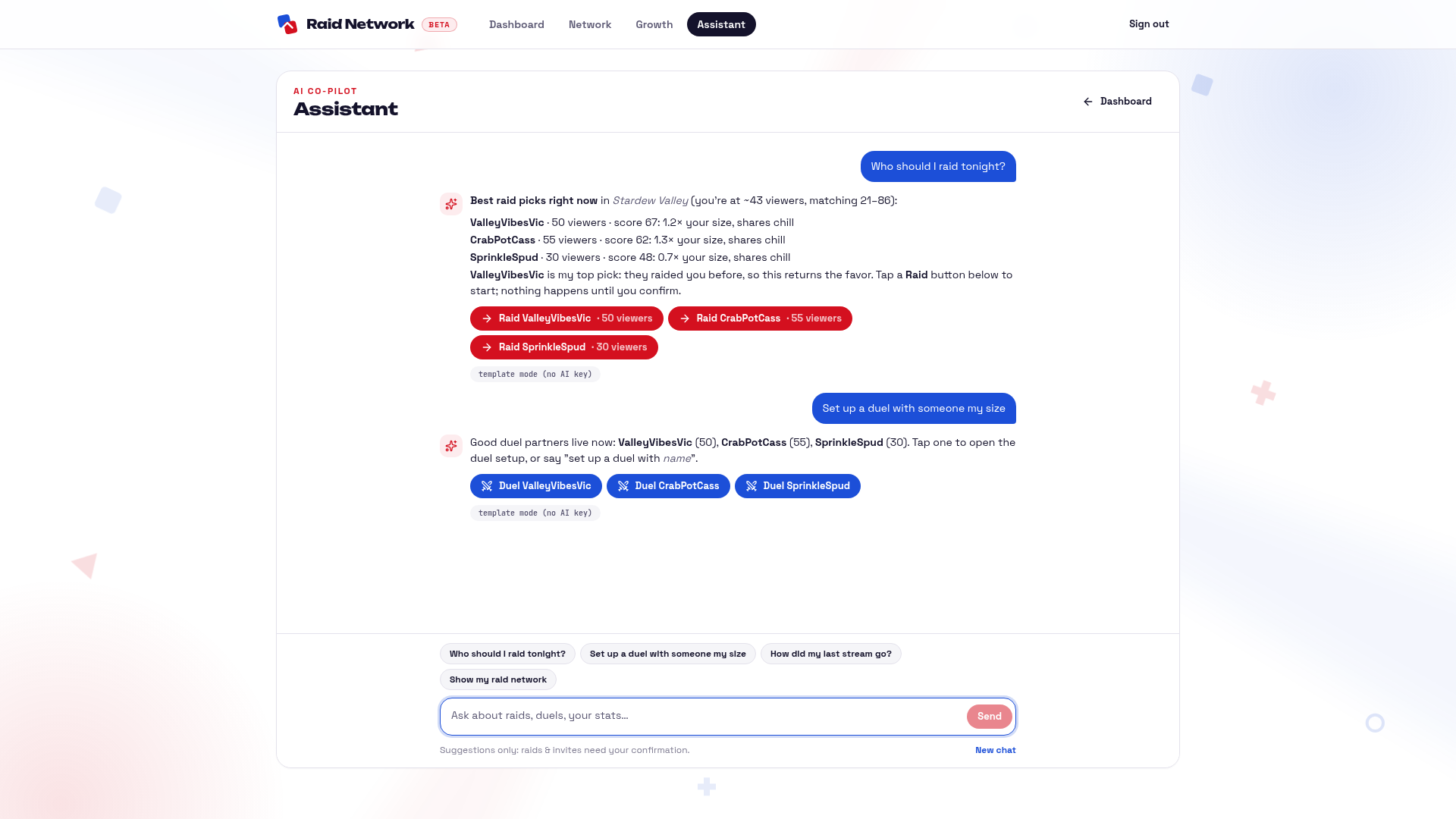
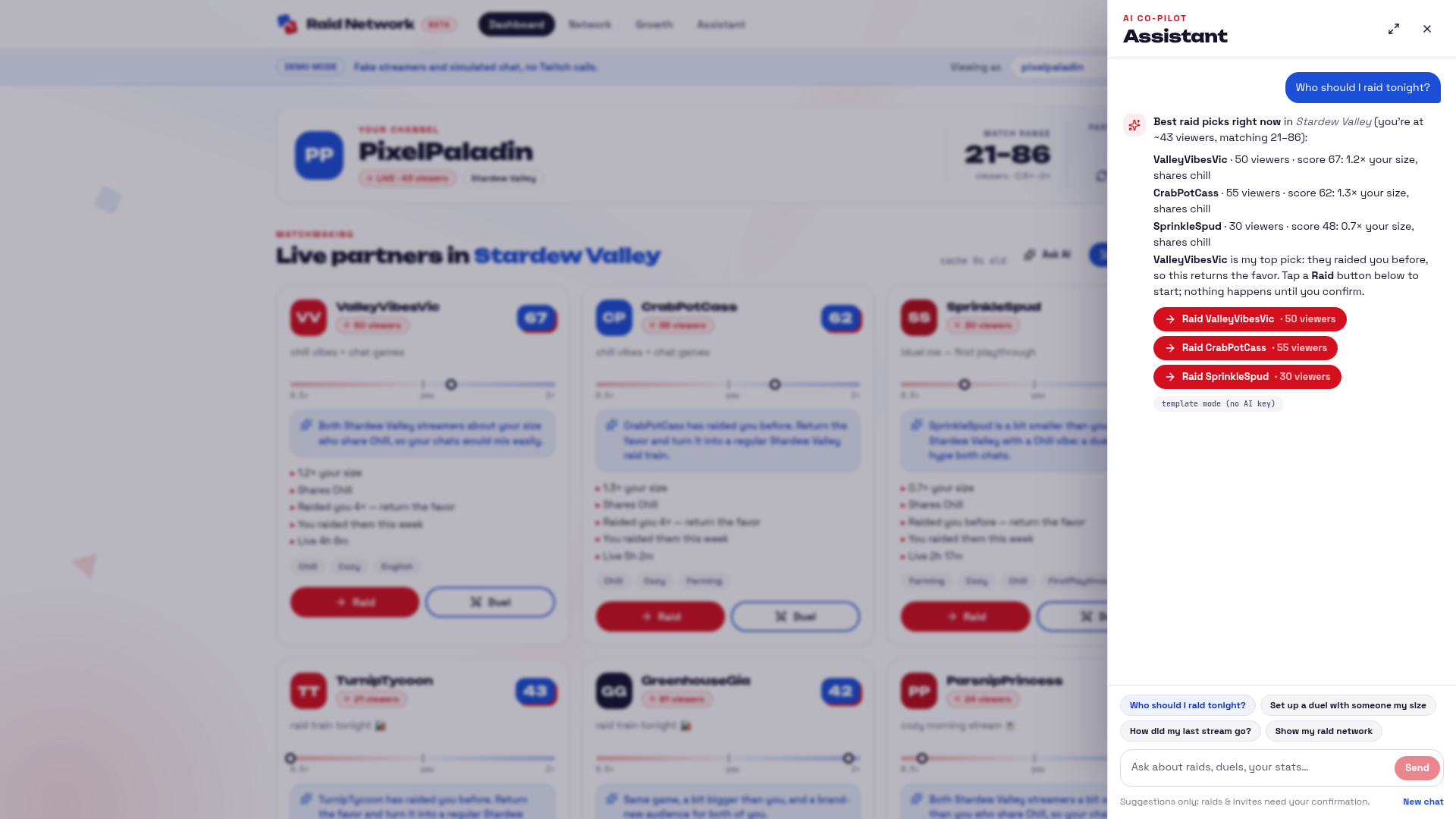
- AI Co-Host & Collab Pitcher: Suggests customized "Why you should collab" pitches for each match and powers an interactive AI assistant.
How we built it
We built Raid Network from scratch with Codex, utilizing it as our primary pair-programming engine and systems architect across every layer:
- Full-Stack Architecture via Codex: We used Codex to implement the full-stack TypeScript codebase, encompassing the Astro + SolidJS reactive UI, Hono worker routes, and complex state synchronization.
- Stateful Edge Synchronization: Synchronizing game physics across independent Twitch OBS overlays requires ultra-low latency. We leveraged stateful edge micro-actors with SQLite persistence and hibernating WebSockets (
OverlayDOfor channel state andDuelDOfor duel mechanics). - Twitch Integration: Implemented Twitch OAuth, encrypted token storage (AES-256-GCM), Twitch Helix REST APIs, and cryptographic HMAC-SHA256 signature verification for Twitch EventSub webhooks (
channel.raid,channel.chat.message,stream.online/offline). - Data & Caching Layer: D1 distributed SQL for historical queries, relational records, and growth timelines; distributed KV stores for fast session validation and stream cache buffers.
- AI Co-Host Engine: Integrated prompt pipelines with fallback templates to generate contextual collaboration pitches, stream recaps, and duel banter.
Challenges we ran into
- Sub-Second Multi-Channel State Synchronization: Synchronizing a live Tug of War or 4-lane Chat Race between separate streamers' OBS browser sources without a traditional heavy game server was tricky. We solved this with hibernating WebSocket actors that batch and broadcast chat-driven vector updates in tight intervals.
- EventSub Webhook Security & De-duplication: Twitch EventSub delivers webhooks concurrently with strict replay attack windows. We had to verify raw HMAC signatures, validate timestamp drift ($\Delta t < 10\text{ min}$), and deduplicate event message IDs across distributed edge locations.
- Complex JSX & Reactive UI Boundaries: Combining static Astro generation with dynamic SolidJS client islands for real-time OBS graphics required careful handling of reactive signals and compiler subtleties, which Codex helped diagnose and resolve.
Accomplishments that we're proud of
- Fluid 8-Channel Co-Stream Battles: Built a robust duel engine supporting 1v1, 3–4 channel Free-for-All, and up to 4v4 team battles where Twitch chat commands seamlessly drive real-time graphical movement on a shared OBS screen.
- Zero-Drop Resilience: Every feature has built-in graceful degradation—from rate-limited chat buffers to deterministic offline templates if external AI providers or Twitch APIs timeout.
- Complete End-to-End Workflow: Took the idea from prompt and design to fully working OAuth, live WebSocket overlay rendering, automated migrations, and CI/CD deployment.
What we learned
- AI-Assisted Systems Engineering: Codex excelled not just at standard web components, but at implementing low-level cryptography (AES-GCM encryption, HMAC verification), WebSocket lifecycle management, and complex SQL schema migrations.
- Streamer Ergonomics: Overlay tools must be truly "set-and-forget." Providing single-click OBS browser links with customizable sizing ($S / M / L$) and automated demo simulators makes streamer adoption frictionless.
What's next for Raid Network
- Twitch Extension Integration: Embed the duel scoreboard directly inside Twitch video player overlays so mobile and web viewers can vote without typing in chat.
- Expanded Mini-Game Roster: Add trivia showdowns, collaborative boss fights, and streamer-customized sound alerts.
- Tournament & League Mode: Allow streamer communities and esports teams to run bracket-style raid chains and seasonal leaderboards.
Built With
- astro
- cloudflare
- node.js
- solidjs
- sql
- twitch
- typescript
