-
-
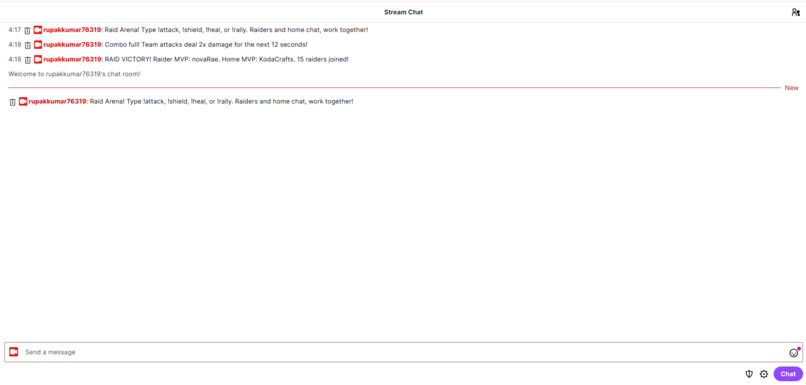
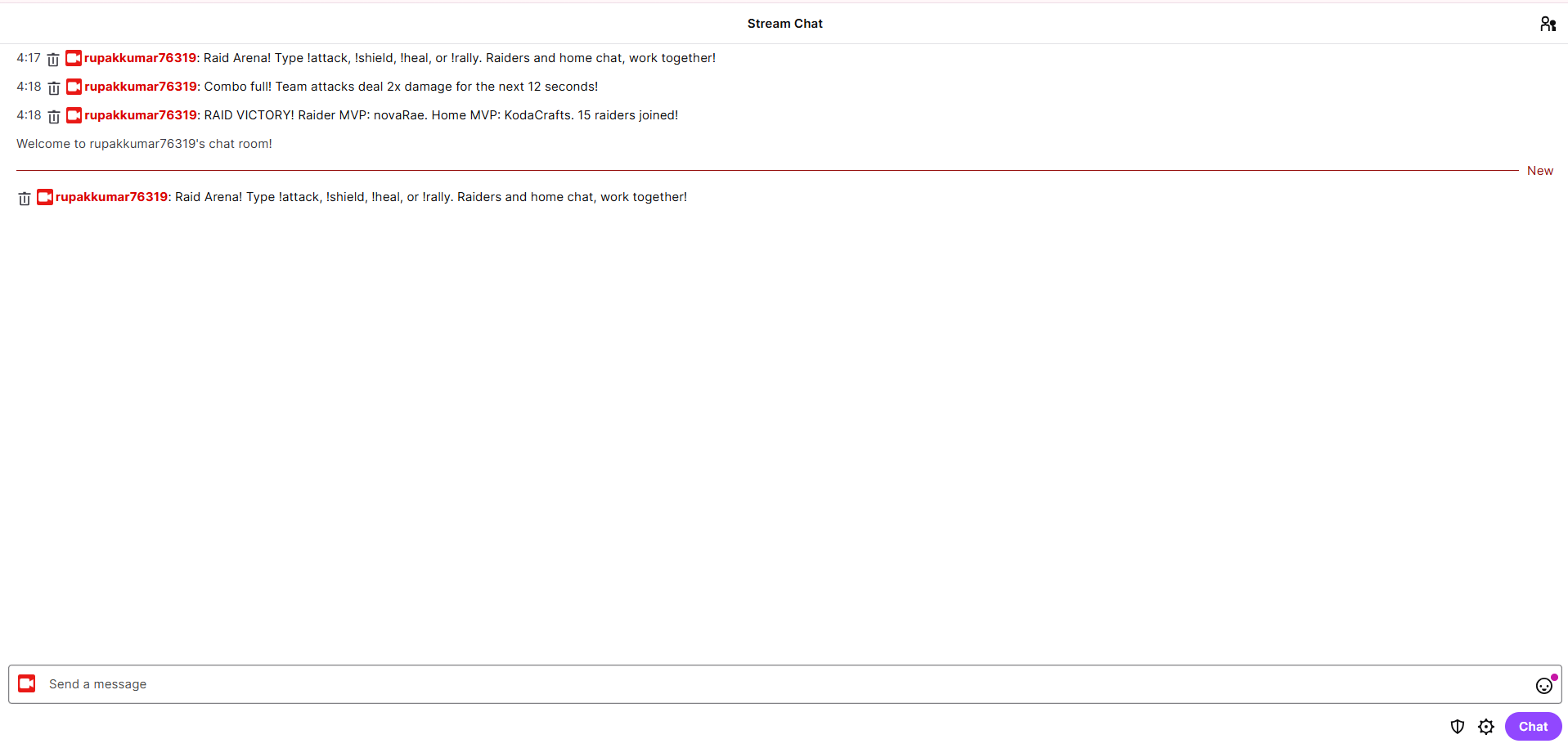
Twitch chat bot messages: command guide at raid start, combo-full alert, and the RAID VICTORY result with team MVPs and raider count.
-
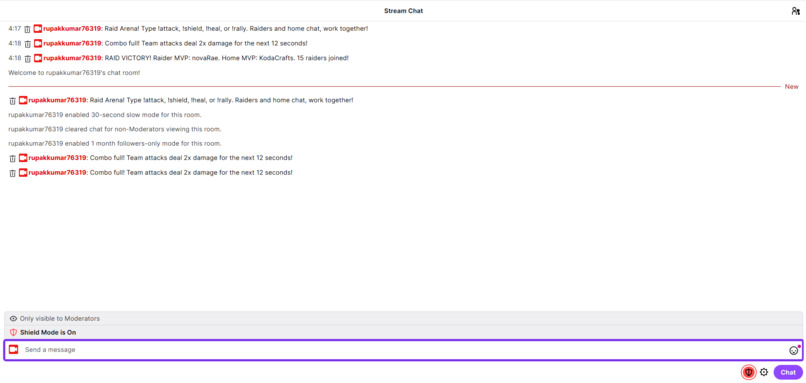
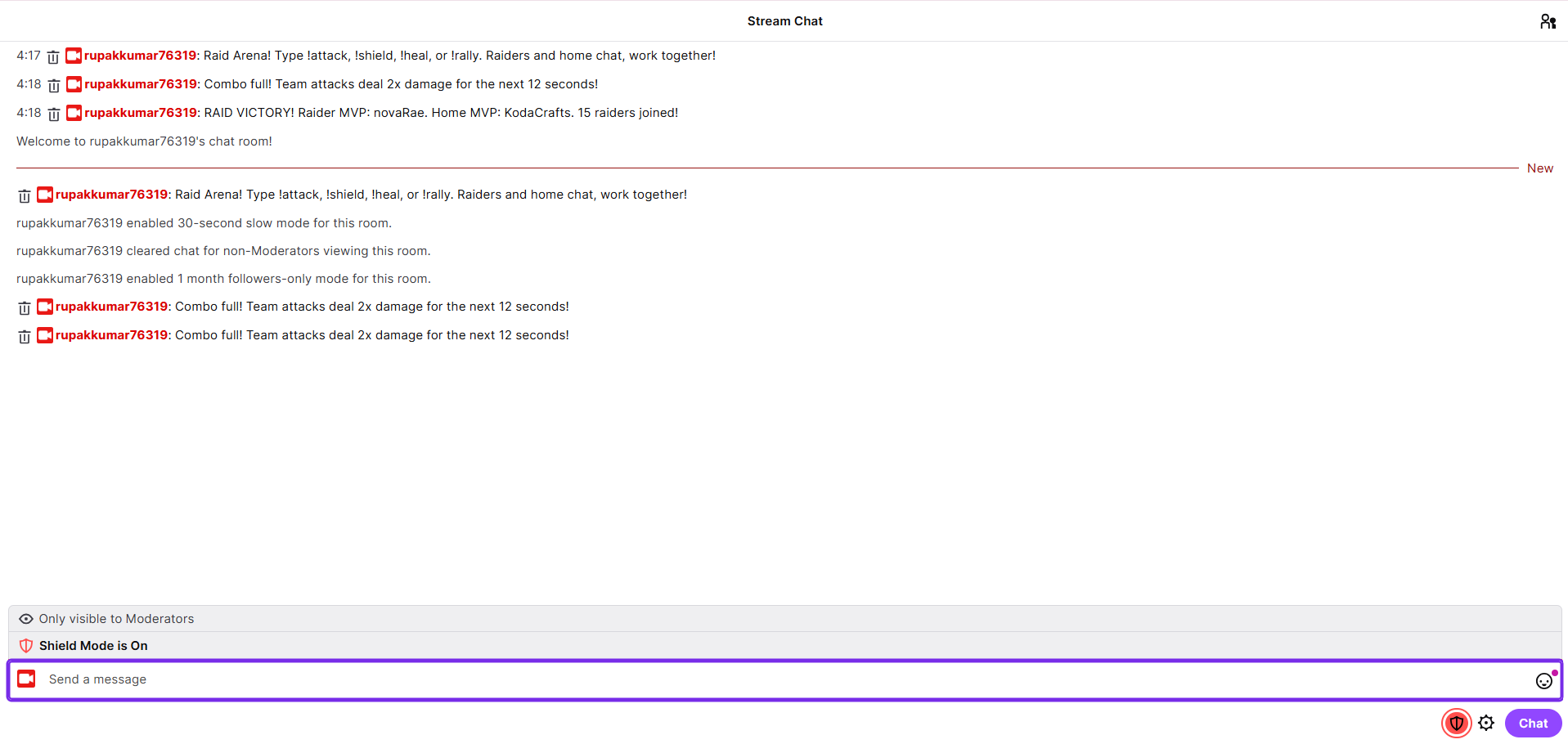
Broadcaster view of the bot's chat posts: every full combo triggers a 2x-damage announcement so chat knows when to pile on attacks.
-
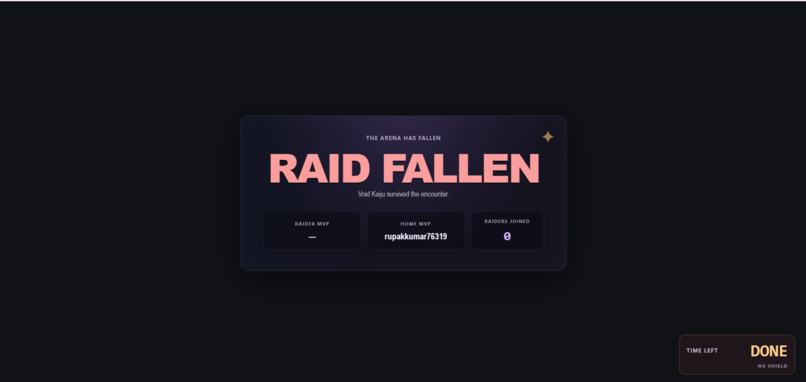
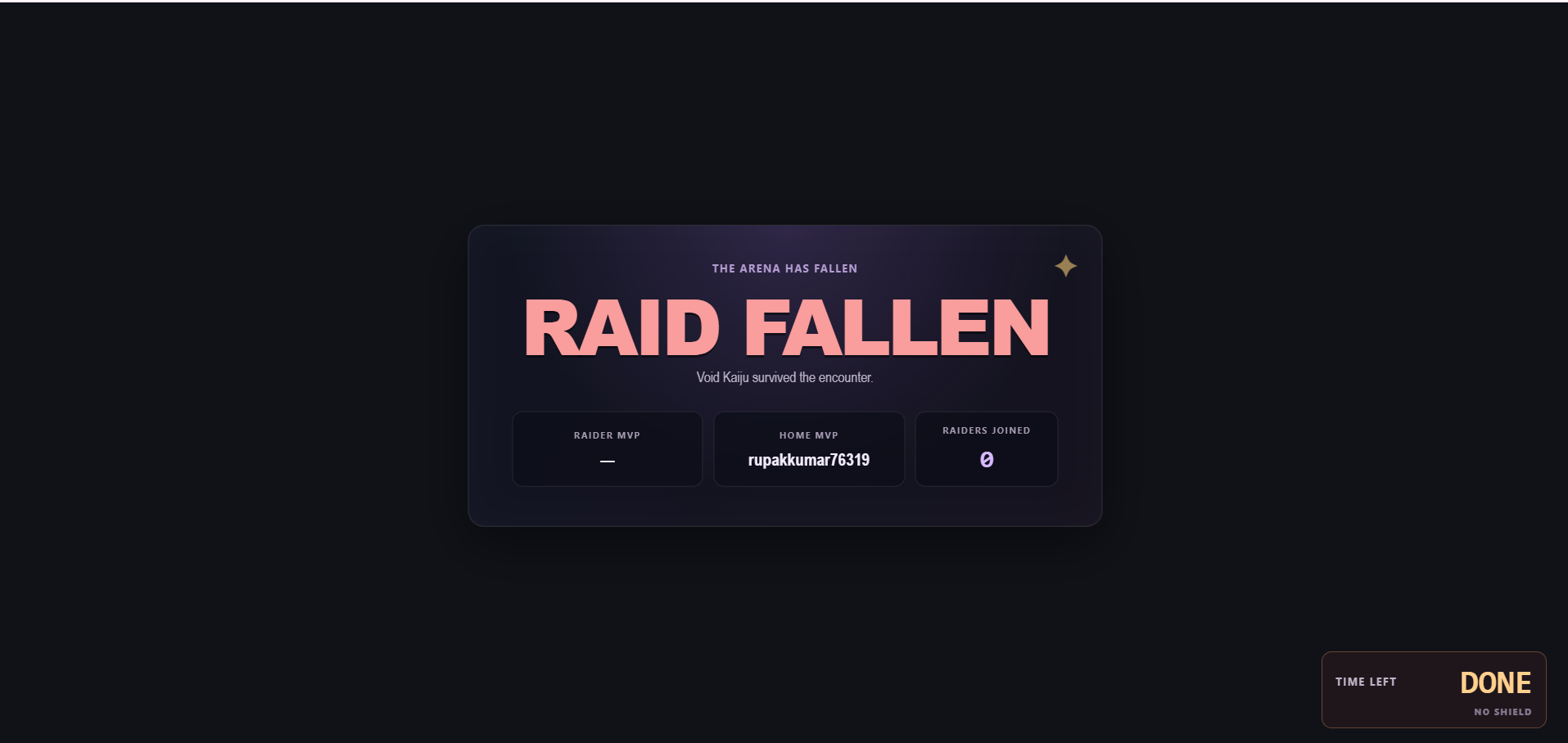
RAID FALLEN finish card: the boss survived. Shows Raider MVP, Home MVP and raiders joined, then fades out after 8 seconds.
-
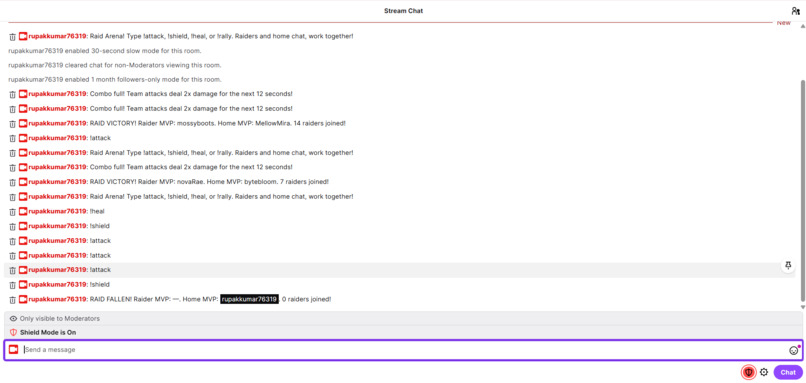
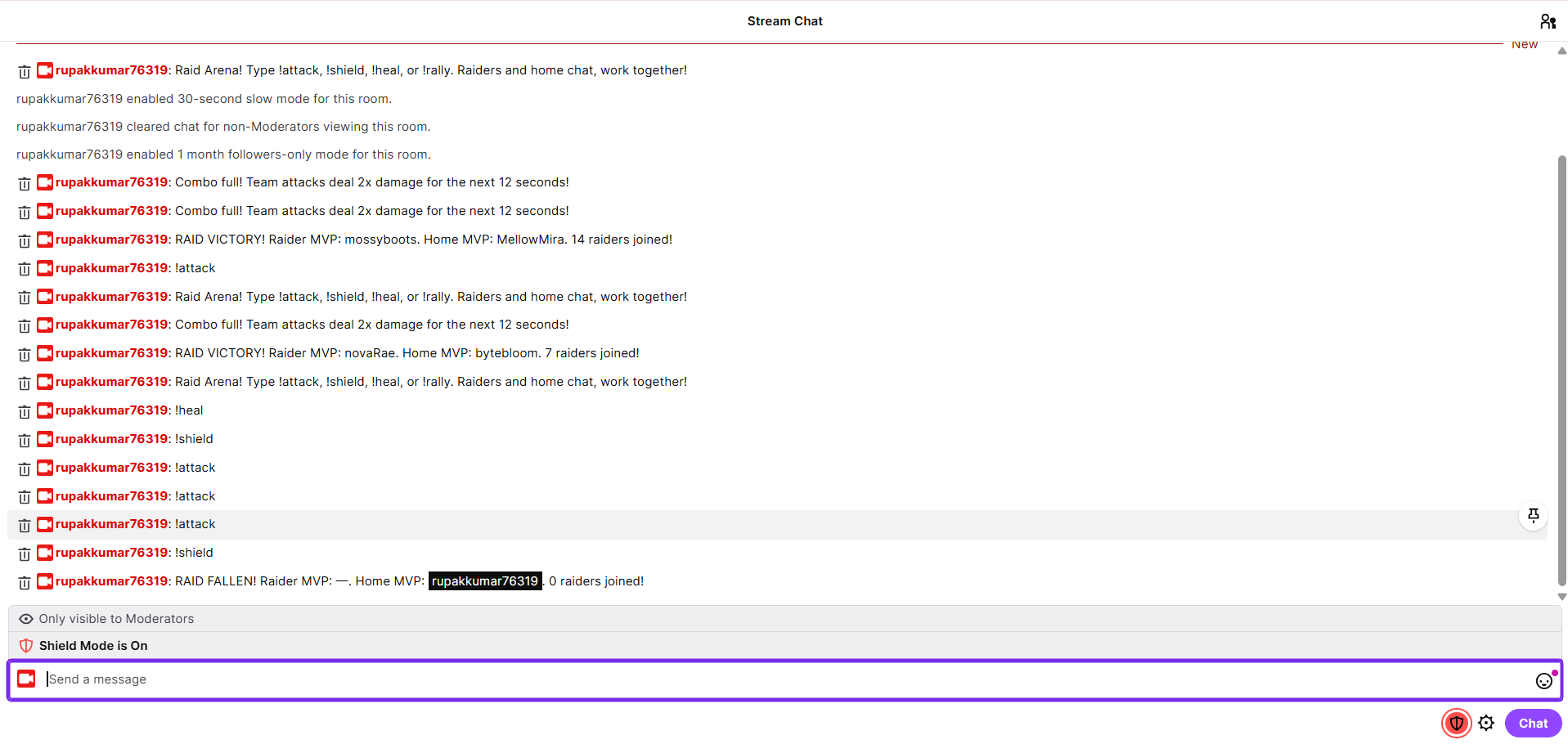
Playing from Twitch chat with !attack, !shield and !heal; the bot posts the final RAID FALLEN result with MVPs and raiders joined.
-
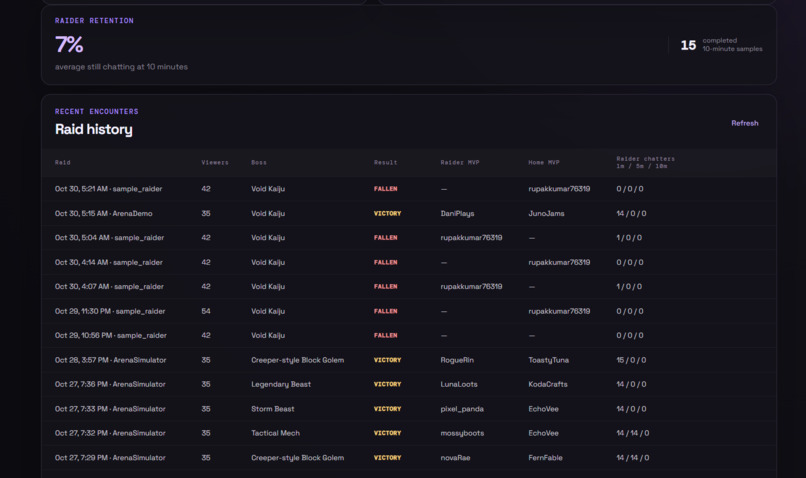
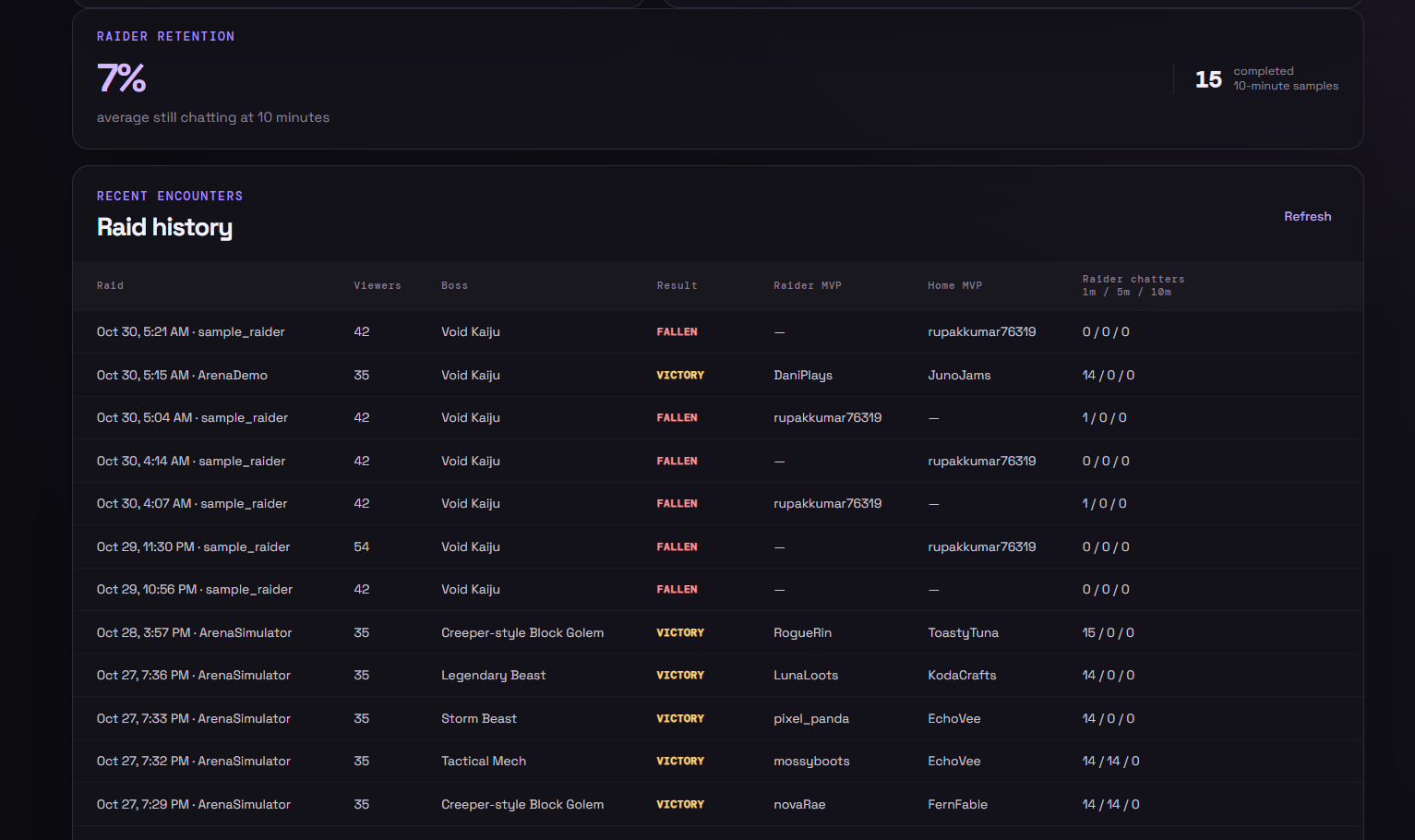
Raid history & retention: each battle logged with boss, result, MVPs and raider chatters at 1/5/10 min, plus 10-min retention average.
-
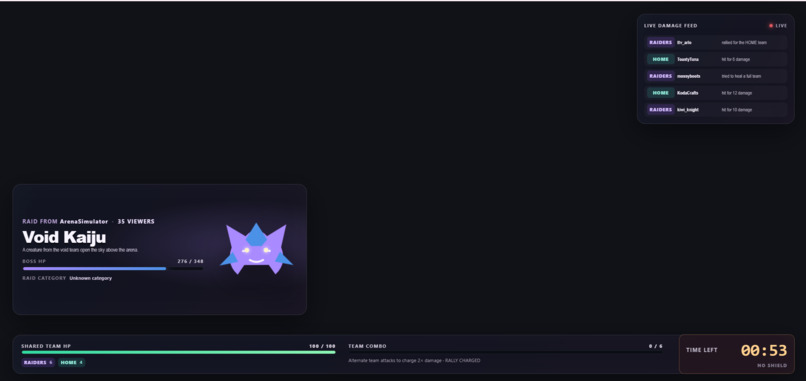
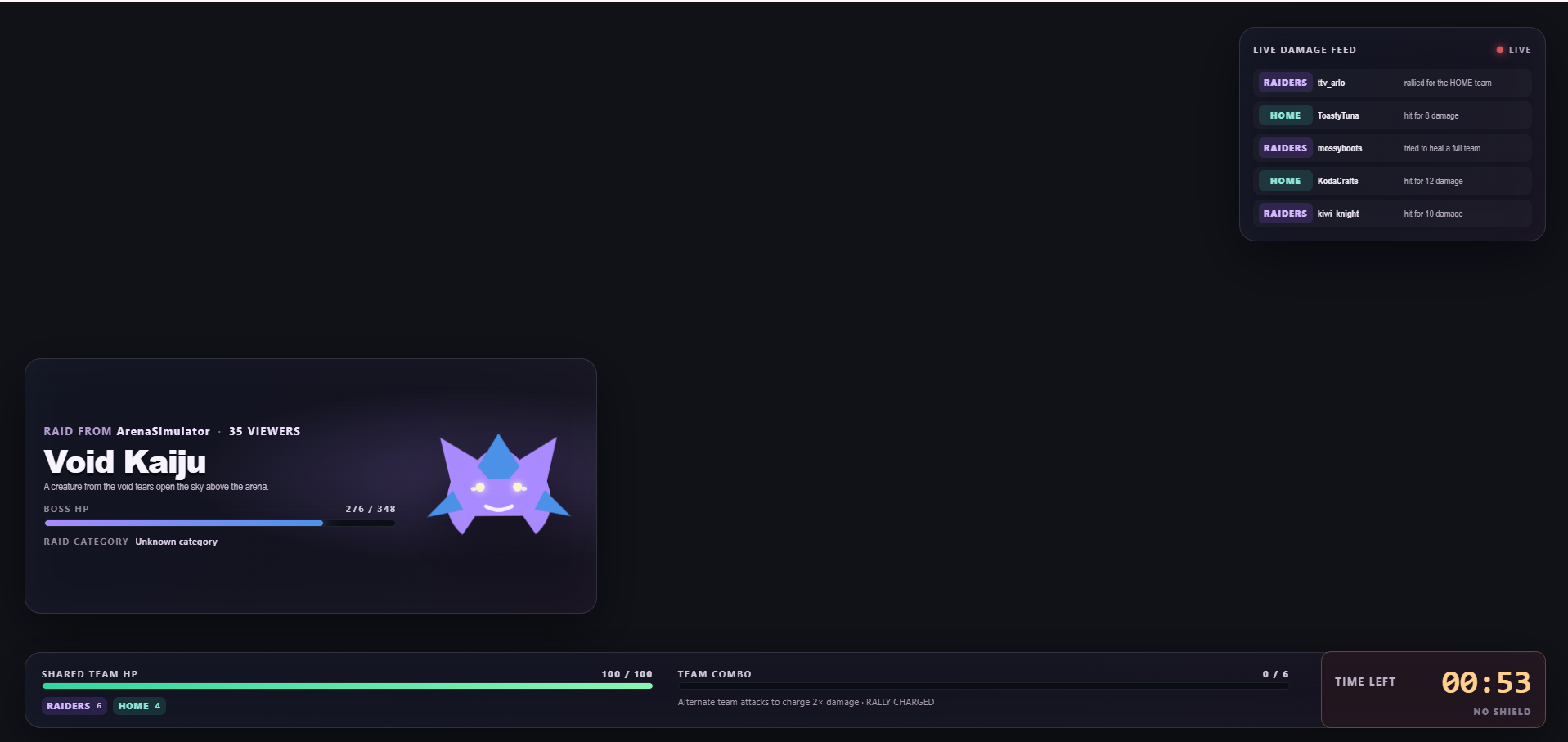
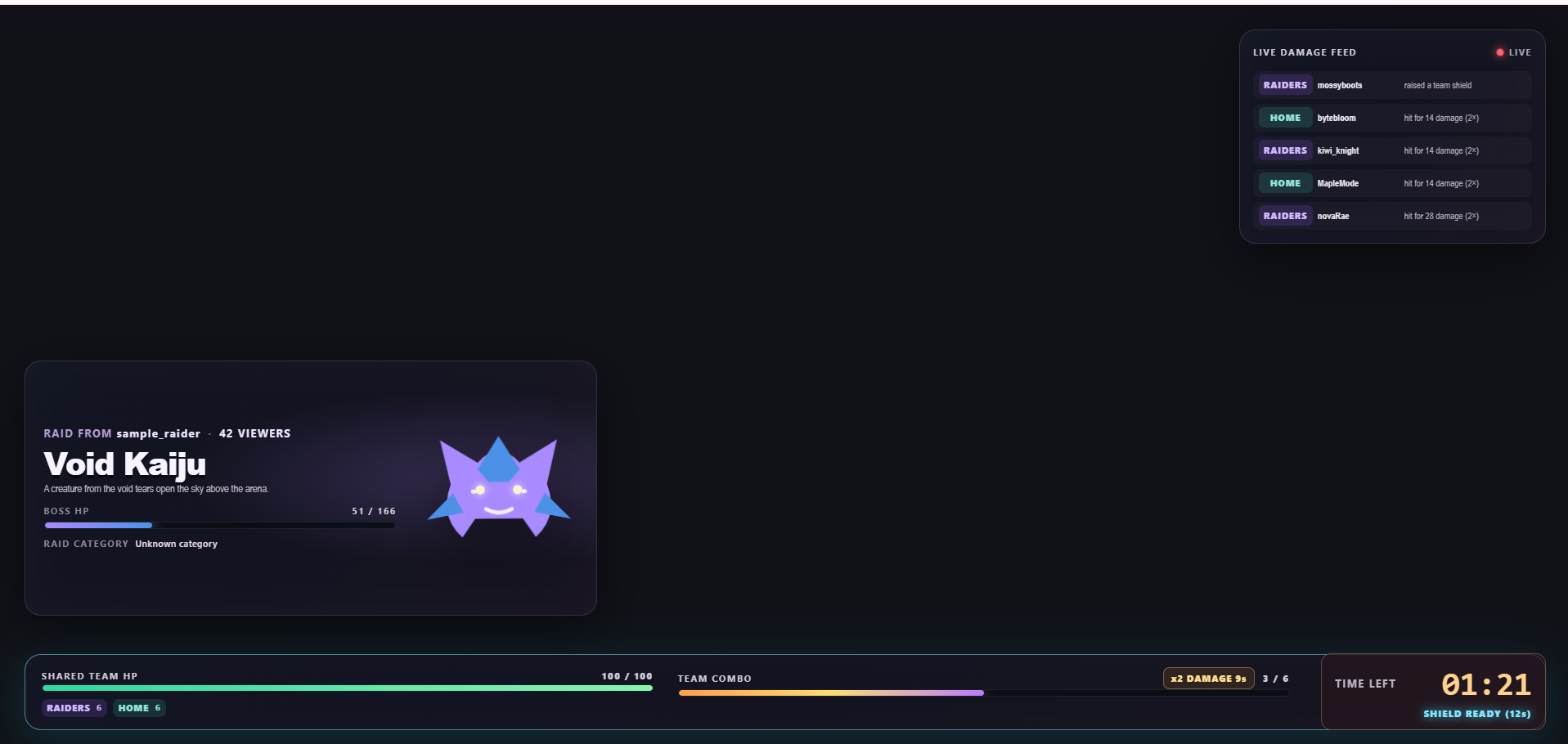
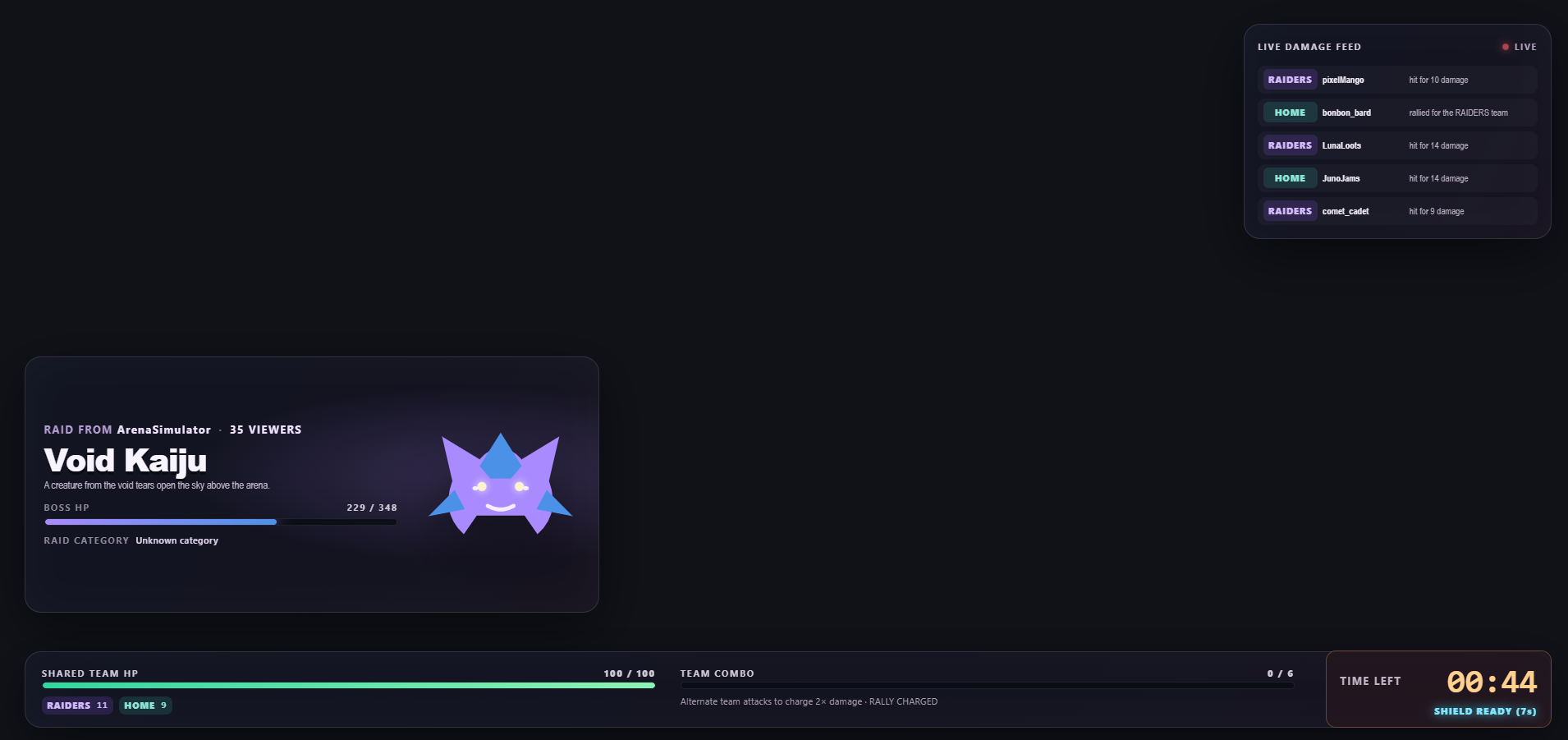
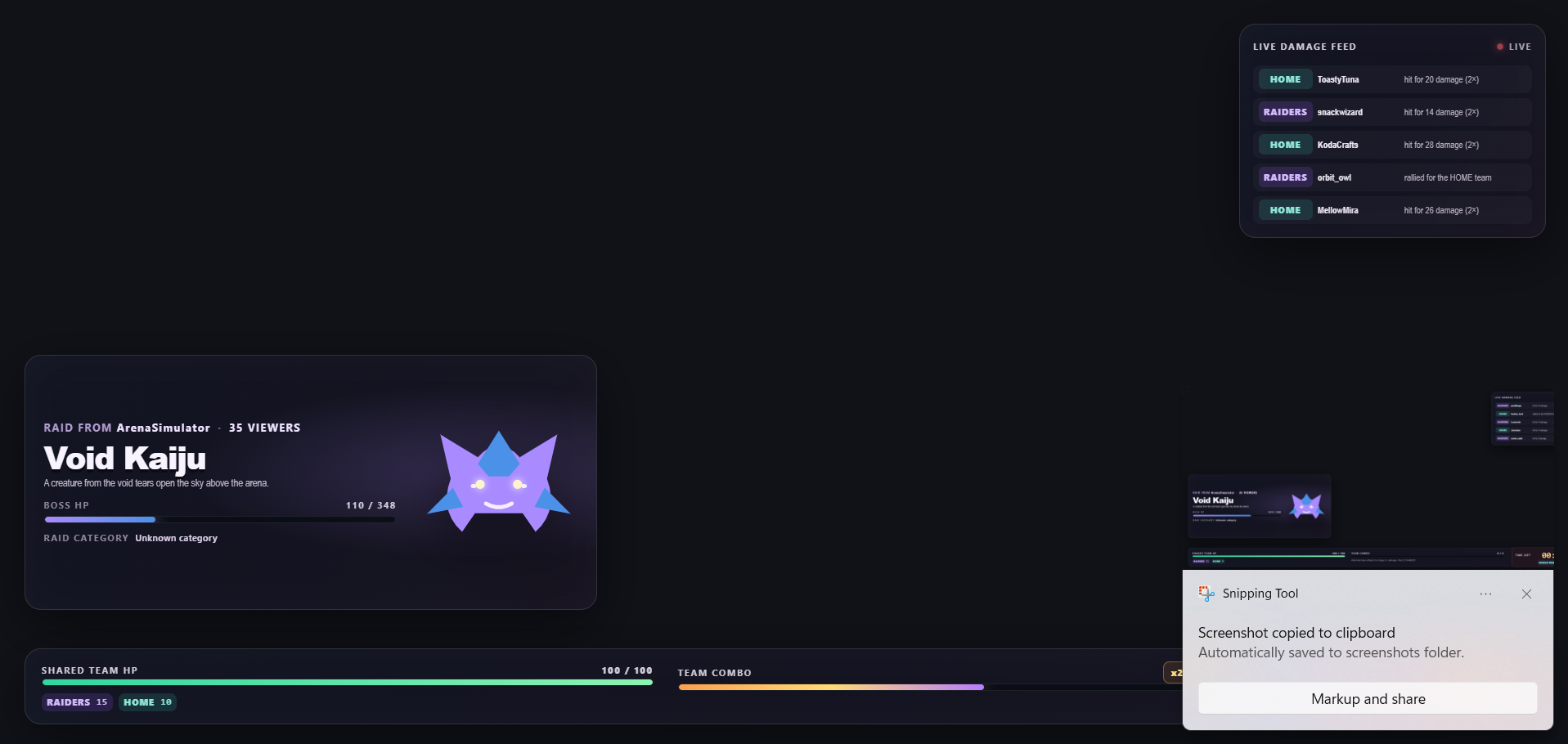
Stream-safe OBS overlay mid-battle: Void Kaiju boss card, live damage feed, shared team HP, combo meter and 90-second countdown.
-
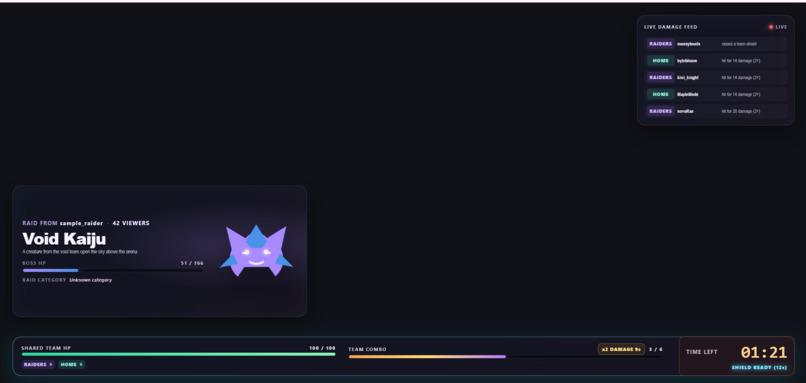
x2 DAMAGE active: combo filled, boss HP dropping fast. Raid from sample_raider (42 viewers) with shield ready and 1:21 left.
-
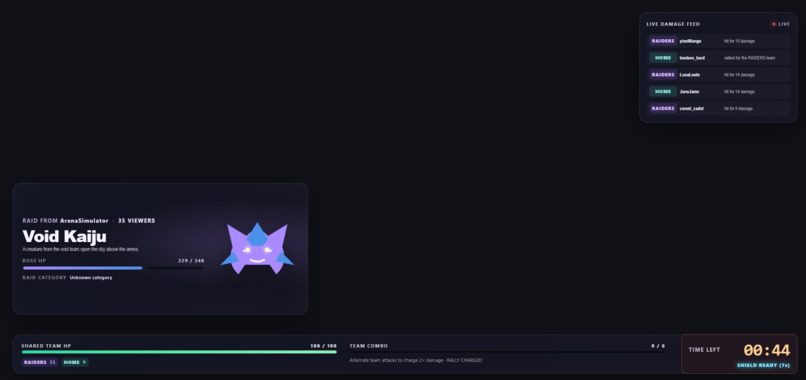
A !shield is ready: the team's next boss attack will be blocked. Shield status shows next to the countdown in the bottom strip.
-
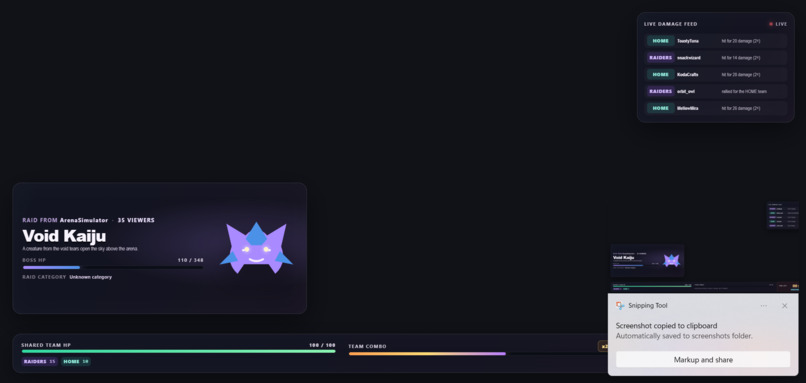
RAIDERS and HOME alternating attacks fill the team combo meter; a full meter doubles attack damage for 12 seconds.
-
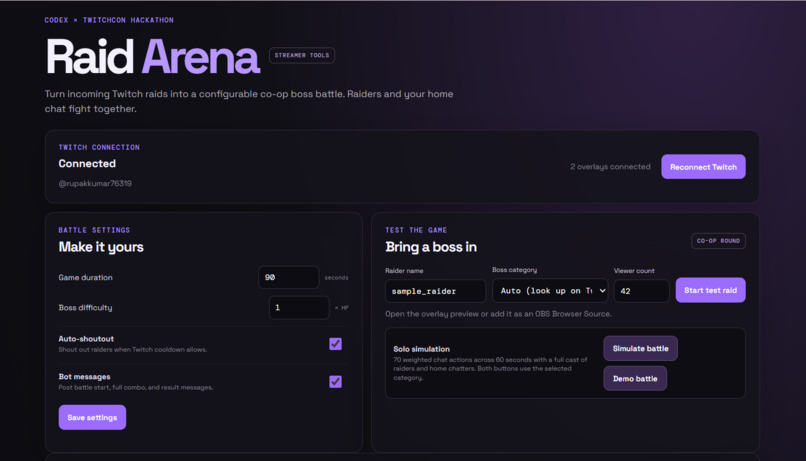
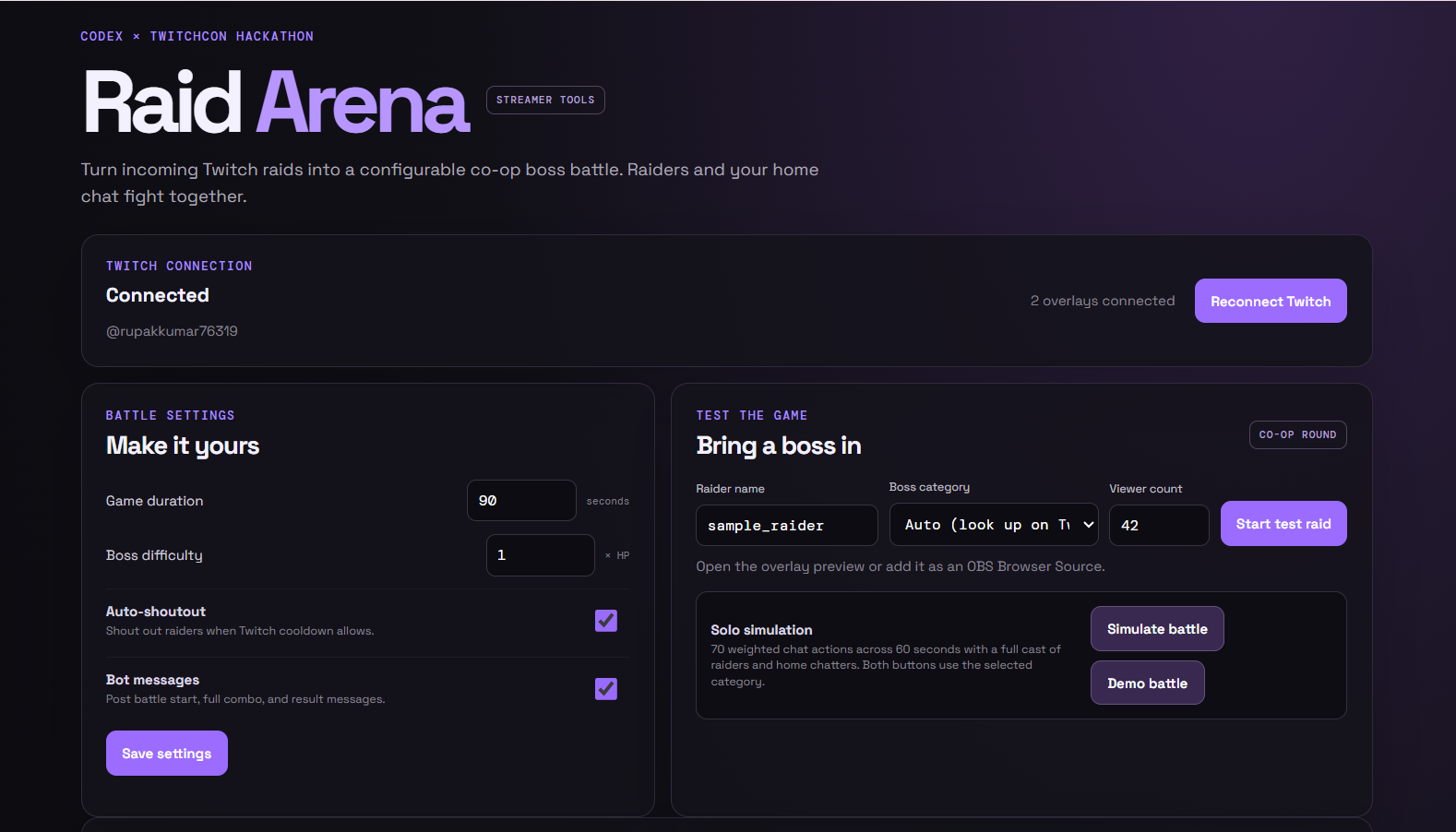
Streamer dashboard: Twitch connection, battle settings (duration, difficulty, auto-shoutout, bot messages) and test-raid controls.
Inspiration
Every small streamer knows the feeling. You've been talking to the same twelve people for three hours, and then a bigger streamer ends their night by raiding you. Two hundred strangers pour into your chat at once. It's the best moment of your week.
Three minutes later, most of them are gone.
Twitch gives you no way to welcome them, no reason for them to stick around, and no way of knowing afterwards whether any of them did. The single most important growth moment on the platform is left completely to chance. We built Raid Arena to make that moment count.
What it does
The second a raid hits your channel, a boss appears on your stream.
Raid Arena listens for the raid through Twitch EventSub, looks up what the raiding streamer was playing, and spawns a boss that matches: a blocky Golem if they came from Minecraft, a Tactical Mech if they came from Valorant, a Talkshow Titan if they came from Just Chatting. The raiders see something that's clearly about them.
Then the fight starts, and everyone in chat is a player: !attack, !shield, !heal, !rally. The raiders are one team, your regulars are the other, and the boss hits back hard enough that nobody can ignore it. The twist is the combo meter: it only charges when the two teams alternate their attacks. Raiders can't win alone, and neither can your regulars. The only way to double your damage is to fight together, which is exactly the thing that turns strangers into community.
When the boss falls, the overlay names the MVP from each team, your channel automatically shouts out the raider, and the bot posts the result in chat. If the timer runs out with the boss on its last legs, the team still gets a last-stand victory, because a close loss feels terrible and a close win feels incredible.
And then Raid Arena keeps watching. It counts how many raiders are still chatting at one, five and ten minutes, and shows it on a streamer dashboard next to every raid you've ever received. For the first time, a streamer can see whether a raid actually stuck.
How we built it
Node.js and Express on the streamer's own machine. Twitch OAuth with token refresh, EventSub over WebSocket for raids and chat, and the Helix API for category lookup, chat messages and shoutouts. The overlay is a transparent browser source for OBS, built in plain HTML, CSS and SVG with no image assets, and laid out so the centre of the screen stays clear for gameplay. A WebSocket pushes game state to the overlay; a dashboard lets the streamer tune game length, boss difficulty and bot messages, and run a full simulated battle to test everything without waiting for a real raid.
How we used Codex
The whole project was written in a single Codex thread. Codex scaffolded the Twitch plumbing from the docs, built the game engine, overlay, dashboard and retention tracker, and then did the thing we found most impressive: it iterated on real test results. We ran the simulation, told Codex what we saw, and it fixed it. The first version was unwinnable, so Codex rebalanced the boss and wrote a headless simulator that runs ten battles at ten times speed. Now nine out of ten end in a real kill. It redesigned the overlay from a screen-filling layout into a stream-safe one, built the themed bosses, and tracked down a CSS stacking bug that was hiding the countdown timer. Every round was verified with syntax checks, the simulator, and live tests on a real Twitch channel with real bot messages in real chat.
Challenges we ran into
Balancing a fight for an audience that doesn't exist yet. You can't playtest a raid without a raid, so we built the simulator with 24 fake chatters and realistic timing, and tuned until the numbers felt right. Keeping the overlay readable without hiding the stream. And telling raiders apart from regulars using nothing but chat history.
Accomplishments that we're proud of
A raid tool that works out of the box on any channel, with no extension review and no hosting. A game that genuinely requires strangers to cooperate. And a retention number that Twitch itself doesn't give streamers.
What we learned
The best mechanics come from the social problem, not the other way around. We didn't set out to build a combo meter; we set out to make two groups of people need each other, and the combo meter is what that looks like.
What's next for Raid Arena
Welcome mini-rounds for tiny raids, a season leaderboard across raids, channel-point power-ups, and a hosted version so streamers can set it up in one click.
Built With
- codex
- css3
- dotenv
- eventsub
- express.js
- html5
- javascript
- node.js
- oauth
- obs
- openai
- svg
- twitch
- websocket
