-
-
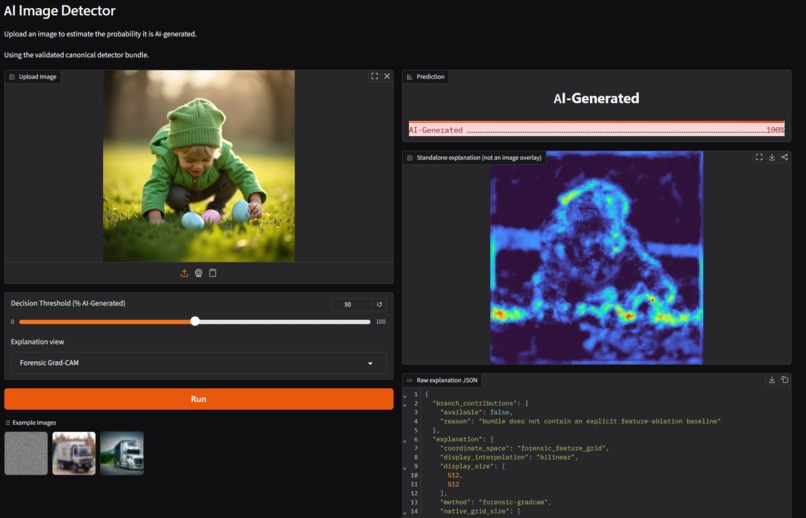
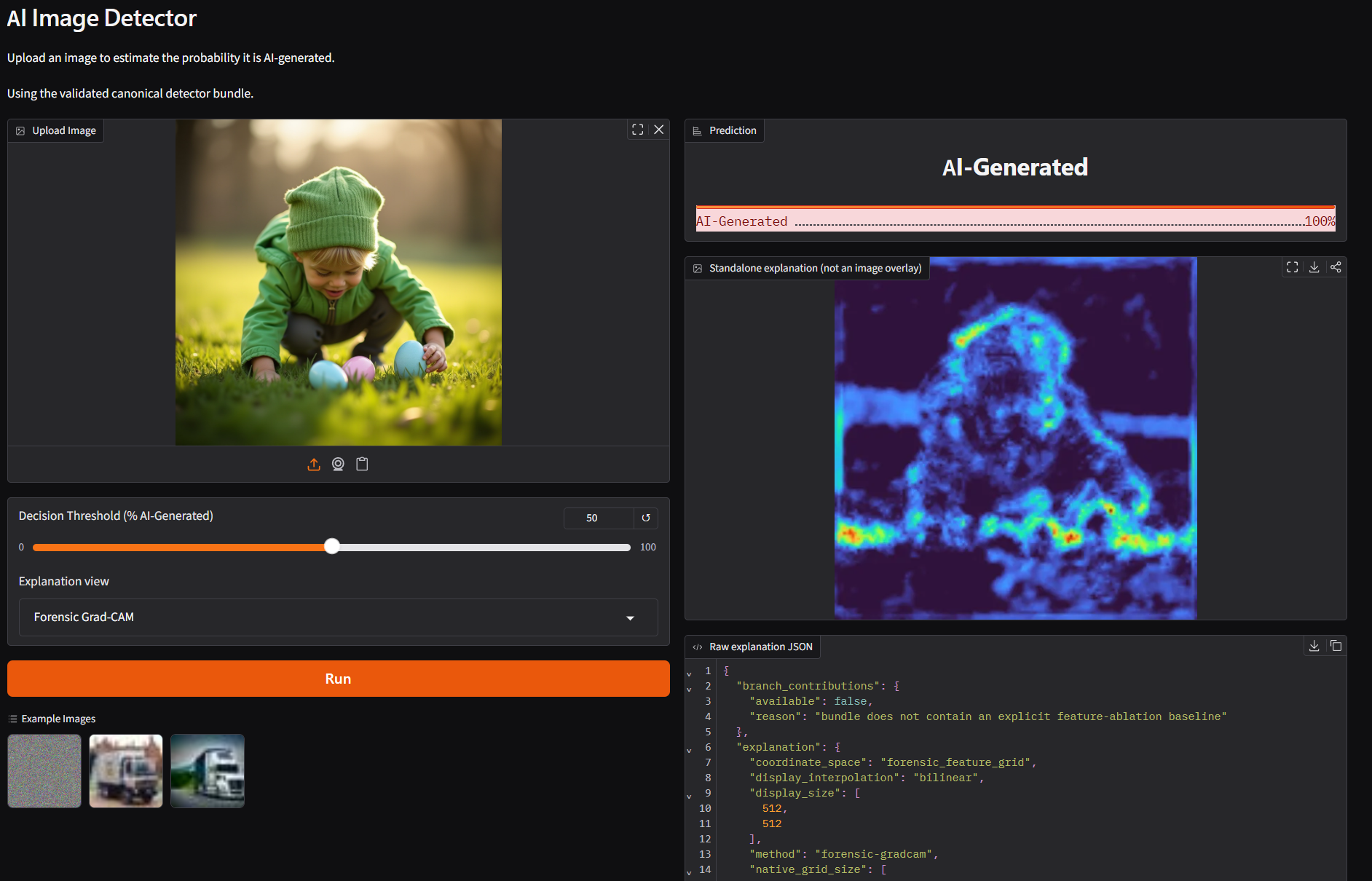
Snapshot of the application
-
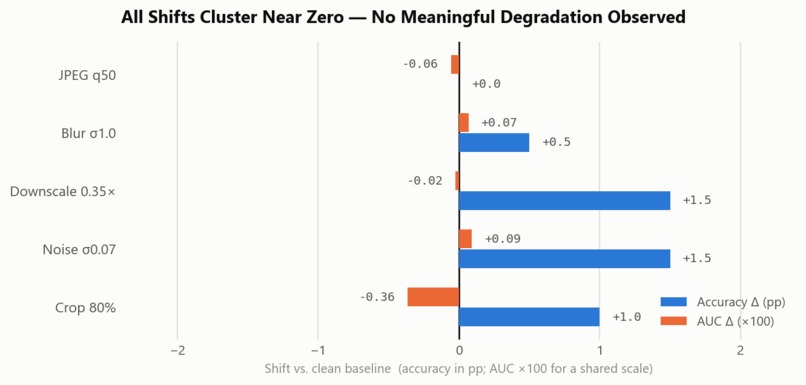
Clean vs Transformed Delta
-
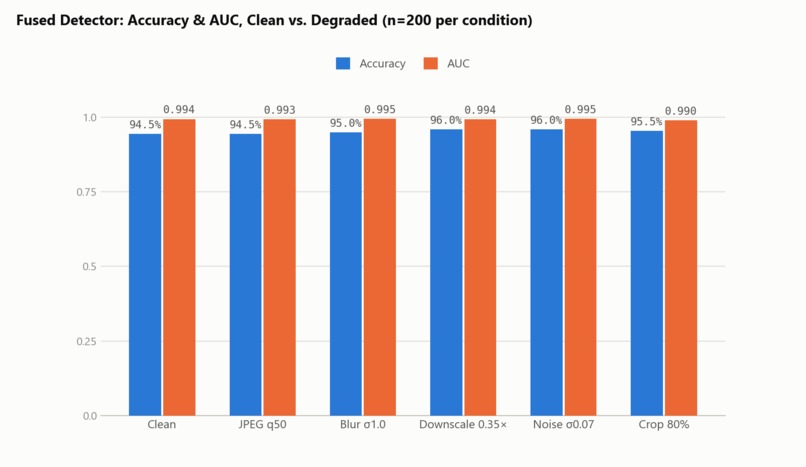
Clean vs Transformed Accuracy + AUC
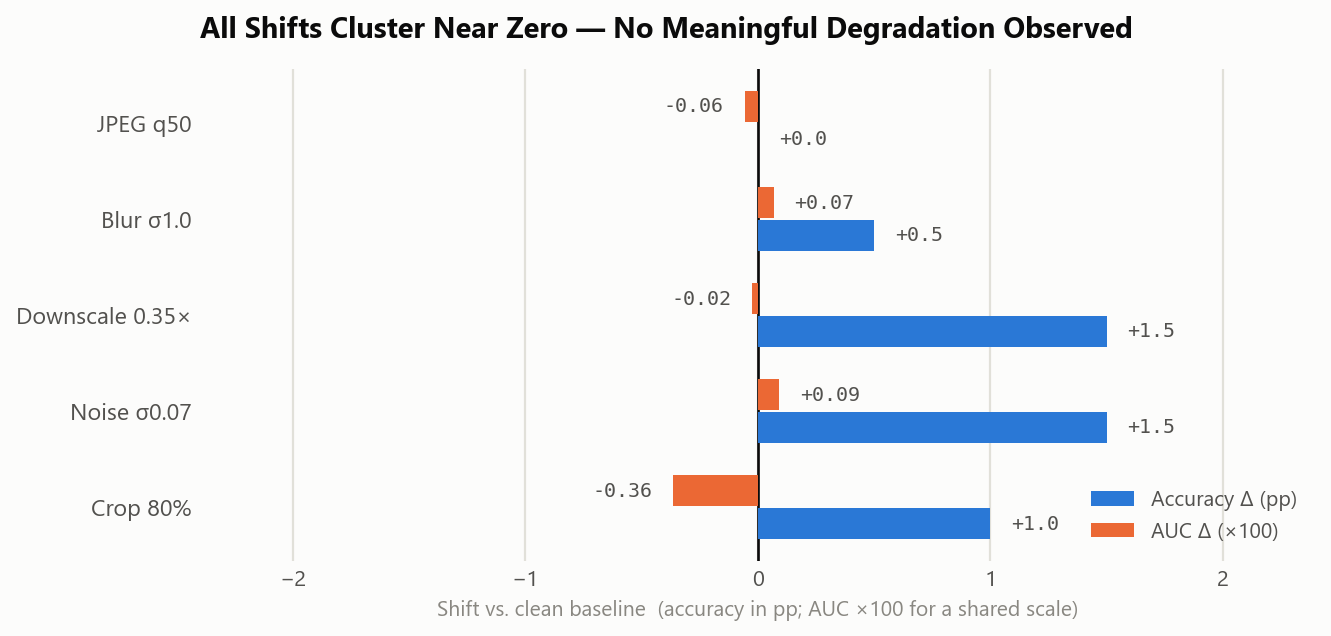
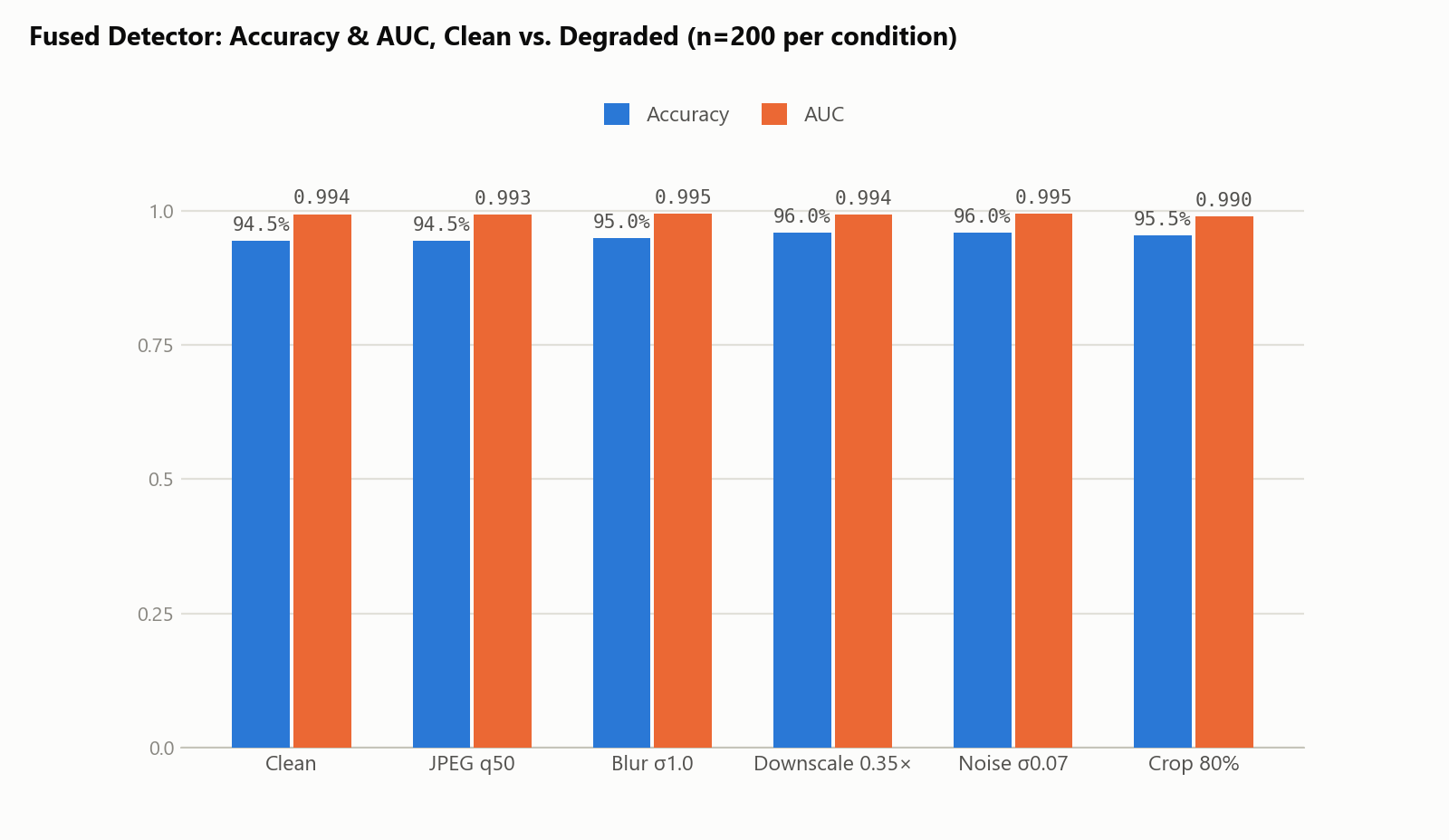
About RAID
RAID — Robust AI-generated Image Detector. Catch AI fakes before they slip past you.
Inspiration
AI-generated imagery got good — fast. A year ago you could spot the extra fingers; today diffusion models render skin pores and correct shadows better than most people notice on a phone screen. That gap between "how convincing AI images are" and "how equipped people are to question them" is widening every month, and it isn't landing evenly. Our parents and grandparents grew up trusting that a photo was proof something happened. They didn't grow up scrolling past a hundred synthetic images a day, and they're exactly the audience targeted by AI-generated scam ads, fake product photos, and fabricated "news" images shared in family group chats.
We wanted to build something that could sit between an image and a person and just say, plainly: this was probably made by AI. Not a research paper, not a benchmark leaderboard entry — a tool simple enough that someone who's never heard of a GAN could upload a photo and get a straight answer.
What we learned
- AI-generated images leave two different kinds of fingerprints. High-level semantic irrelevancies (impossible anatomy, warped text, physically inconsistent lighting) are one signal; low-level forensic residuals — the pixel-level trace a generator's own upsampling stack leaves behind, read by a learnable Bayar constrained convolution paired with fixed SRM high-pass filters — are a completely different one. Neither signal alone is robust — a model trained purely on semantic cues gets fooled by well-composed AI art, and a model trained purely on forensic artifacts collapses the moment an image is re-compressed or resized. That's what pushed us toward a dual-stream architecture instead of a single classifier.
- Robustness has to be a first-class design constraint, not an afterthought. Real images people actually encounter have been through JPEG re-compression, screenshotted, cropped, resized, and color-corrected half a dozen times before they ever reach a detector. A model that only ever sees pristine training images looks great on a benchmark and falls apart on a WhatsApp forward. We had to bake degradation (JPEG Q30-90, Gaussian blur, 0.25x-0.5x rescaling, Gaussian noise, color jitter, 80% cropping) into the training and evaluation loop from day one, not bolt it on at the end.
- A hard parameter budget forces better decisions. Capping the whole architecture near ~337M parameters (well under a 2B ceiling) meant we couldn't just bolt together the biggest foundation models available. We had to be deliberate about freezing backbones, projecting down to compact shared feature dimensions, and asking whether a bigger model actually bought us robustness or just latency.
- Clean interfaces are what let a small team move fast. None of us could wait for someone else's backbone to be "done" before starting our own piece.
How we built it
We split the problem the same way the architecture is split, and it mapped cleanly onto the team:
- Data & Augmentations — a dataset loader (
AIGCDataset) plus an Albumentations-basedRobustnessTransformspipeline that reproduces the real-world degradations above, with a stochastic training mode and an isolated-severity eval mode for plotting degradation curves. We also built a streaming Hugging Face dataset importer so we could pull a real labeled AI/real image subset without downloading an entire dataset up front. - Feature Extraction — two independent streams behind a shared
BaseFeatureStreaminterface: a semantic stream (a ViT-B/16 backbone projected to a 1024-d vector, with configurable partial fine-tuning of the last few transformer blocks) that reasons about high-level content and composition, and a forensic stream (a learnable Bayar constrained convolution — center tap hard-fixed at -1, the other taps always renormalizing to sum to +1 — concatenated with fixed SRM high-pass filters and fed through a shallow ResNet backbone, projected to 256-d) that reads the low-level residual a generator's own upsampling stack leaves behind. - Fusion & Classification — a fusion layer that merges both feature vectors into a shared representation feeding a compact classification head, returning a single logit/probability plus the fused feature vector for downstream explainability.
- Explainability & Interface — a
predict.pyCLI for single-image and batch inference, and a Gradio app so a non-technical user can drag in a photo and get a probability and a saliency overlay showing why the model thinks what it thinks — because "trust me" isn't good enough when the audience is exactly the people being targeted by scams.
The whole thing was built stub-first: every module honored its tensor
contract ([B, 3, H, W] -> [B, D] for each stream, a fixed output dict for
the detector) from hour one, using lightweight mock networks in place of the
real backbones. That let data, model, evaluation, and explainability work
happen in parallel on the same interfaces instead of one person blocking the
other three.
Challenges we faced
- Fitting real backbones into the parameter budget without sacrificing the robustness we were designing for — every architecture decision was a three-way trade-off between accuracy, robustness, and parameter count.
- Sourcing labeled AI-vs-real image data fast enough for a hackathon timeline. Streaming a Hugging Face dataset and remapping its label scheme onto our binary real/AI contract (some datasets label real, fully synthetic, and tampered separately) was its own small integration project.
- Keeping two independently-developed feature streams honest to the same contract so fusion wouldn't require a rewrite the moment either backbone changed — this is where the abstract base interface and disciplined tensor shape testing earned its keep.
- Balancing robustness against everything at once. Tuning augmentation severity so the model gets meaningfully harder to fool without also making it too hard to train in the time we had was a constant back-and-forth.
- Designing for our actual target user. It's easy to build a tool for people who already know what a "confidence score" means. Building something legible to someone who just wants a straight "real or fake" answer — clear labels, a simple probability, a visual explanation instead of a wall of numbers — took as much thought as the model itself.
What's next
- Upgrade fusion beyond concat+linear. The semantic and Bayar+SRM
streams are now jointly fine-tuned through
fusion.pyand packaged into the publishedcheckpoints/detector_bundle.pt— but fusion itself is still a concat + linear + LayerNorm + GELU layer, not the cross-attention upgrade we originally scoped. Actively reasoning about when to trust which branch, instead of linearly combining them, is the next lever. - Push the forensic branch's robustness further. We settled the frontend question — a fixed, parameter-free residual (NPR) failed our resize/downscale stress test, so we swapped to the learnable Bayar constrained-conv + SRM frontend behind the same interface — but Bayar+SRM alone still degrades under aggressive downscaling even after robustness training. Closing that gap in the forensic branch itself, not just relying on fusion to buffer it, is unfinished.
- Load a real checkpoint into the app.
app.pystill runs on stub weights — wiring the trained, fused checkpoint into the Gradio demo (and the CLI) is what turns this from "a set of validated components" into something a non-technical user can actually try. - Ship real explainability, not a placeholder. The saliency overlay in the demo today is a mock. We've already built the harder, model-independent half (metrics, calibration, rendering, contracts) — what's left is Grad-CAM, attention rollout, and branch-contribution analysis wired to the real fused model, so "this was probably made by AI" comes with a "here's why."
- Run the full robustness benchmark end-to-end. We've built the degradation transforms and the eval scaffolding; we haven't yet generated the actual degradation curves (accuracy vs. JPEG quality, blur sigma, crop ratio) that prove the "robust" in RAID holds up on the full spectrum, not just spot checks.
- Scale past the smoke-test dataset. Training so far has used a partial, hackathon-sized pull from SID_Set. Pulling the full dataset and retraining at scale is the biggest lever left for real accuracy gains.
- Add CI. Once the architecture stabilizes, wire
pytest tests/into GitHub Actions so regressions get caught before they hit a checkpoint.


Log in or sign up for Devpost to join the conversation.