-
-
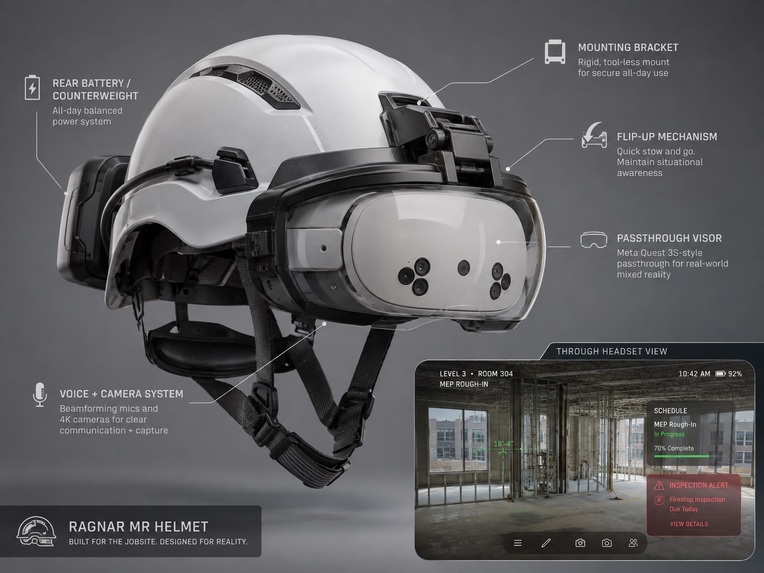
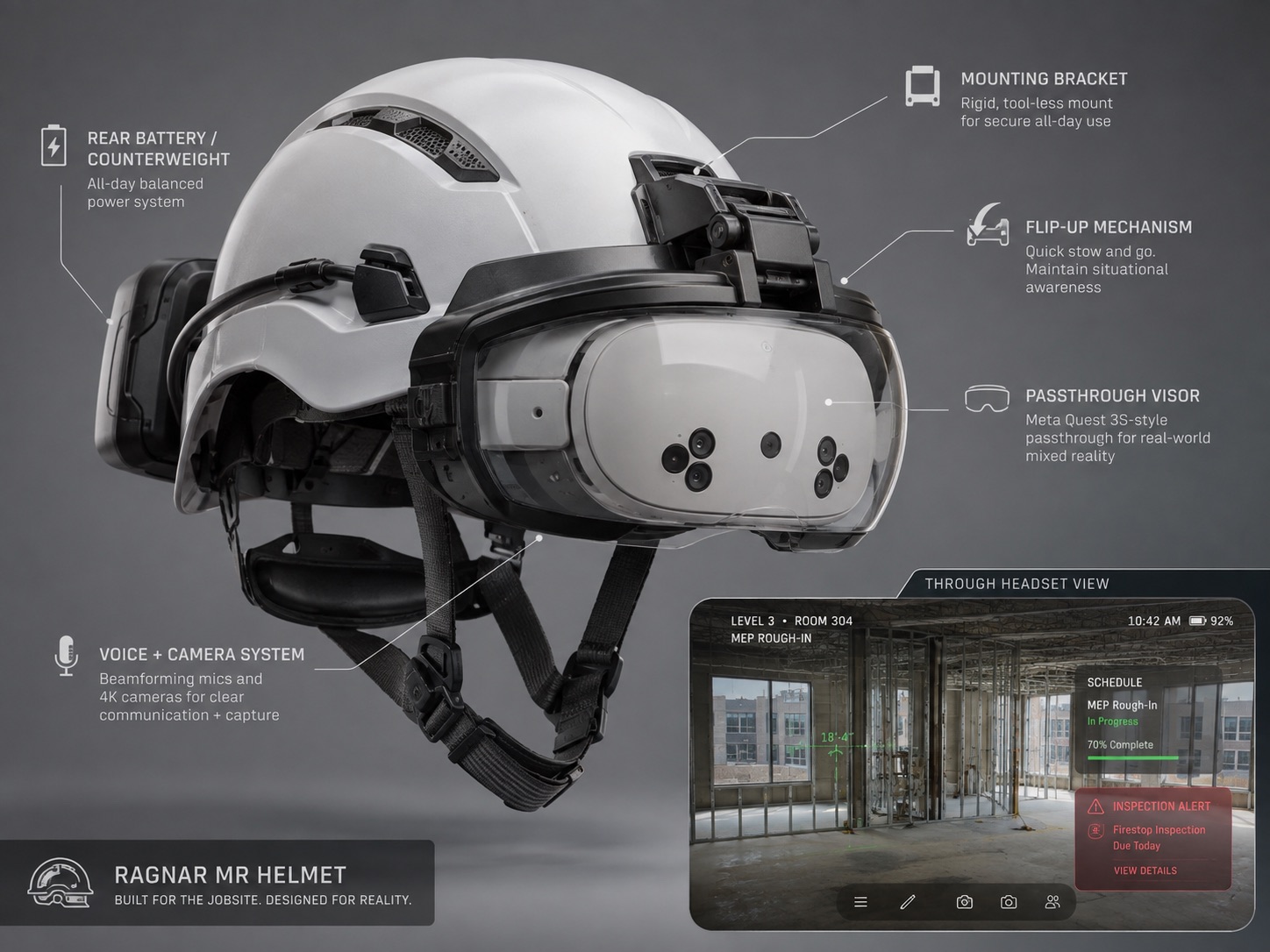
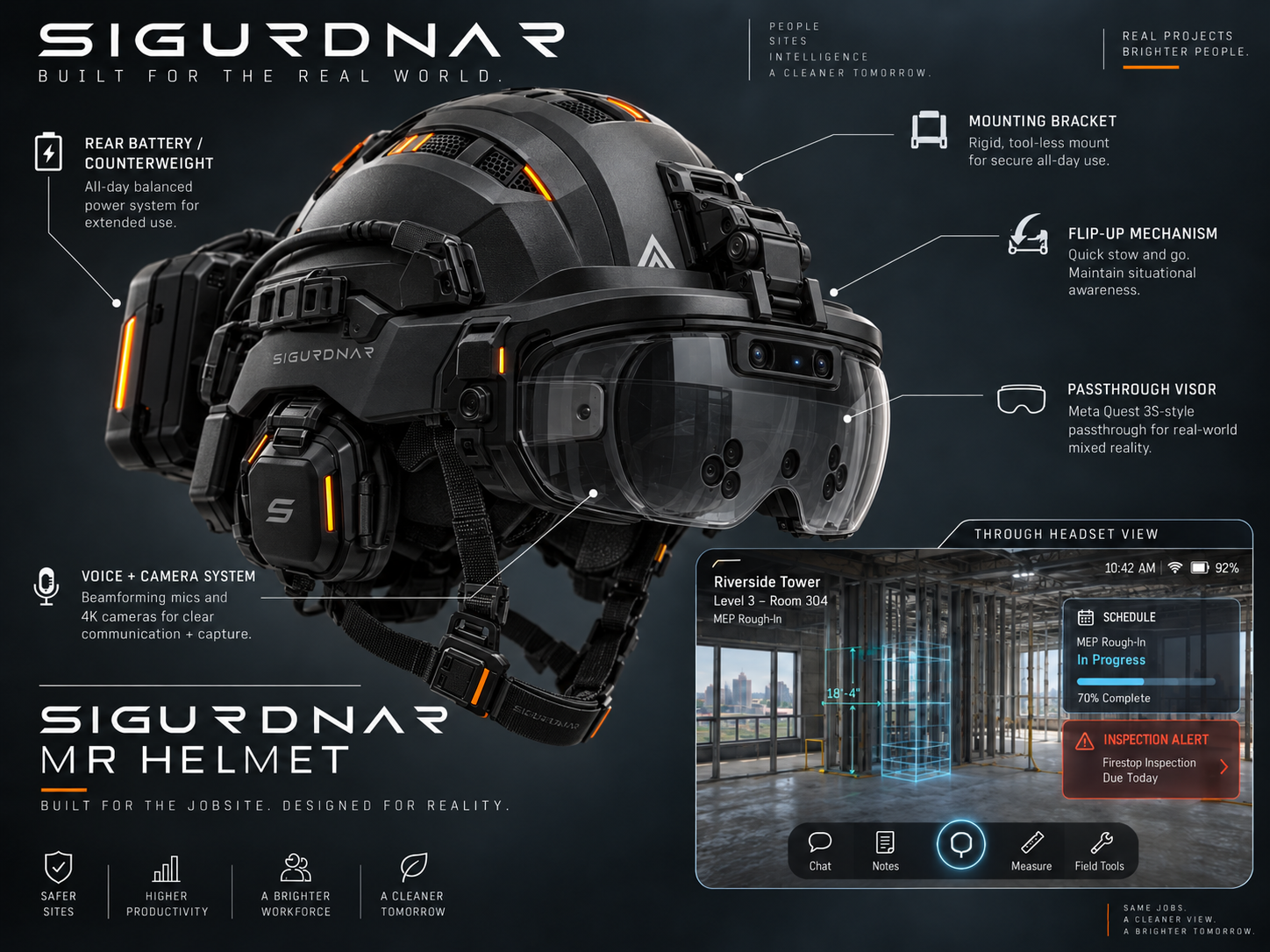
RagnarVR concept: helmet mounting and the envisioned mixed-reality project workspace.
-
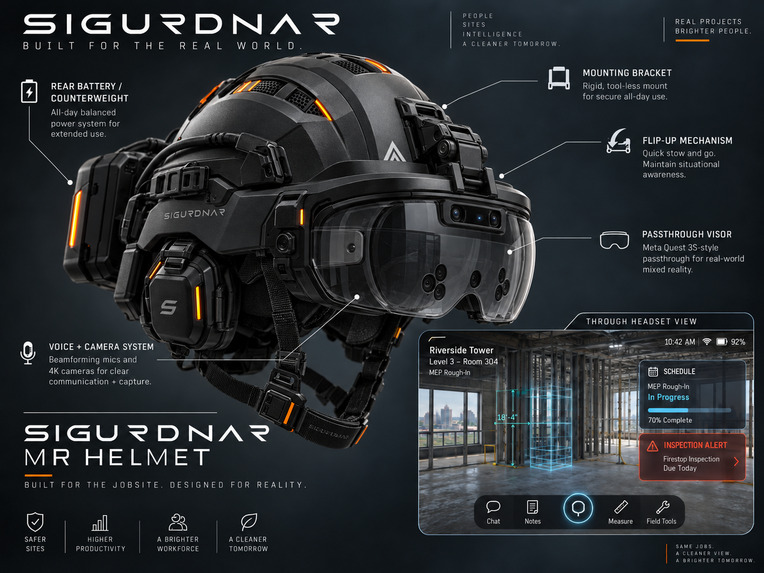
Sigurdnar MR helmet concept: a proposed jobsite form factor for the Ragnar platform.
-
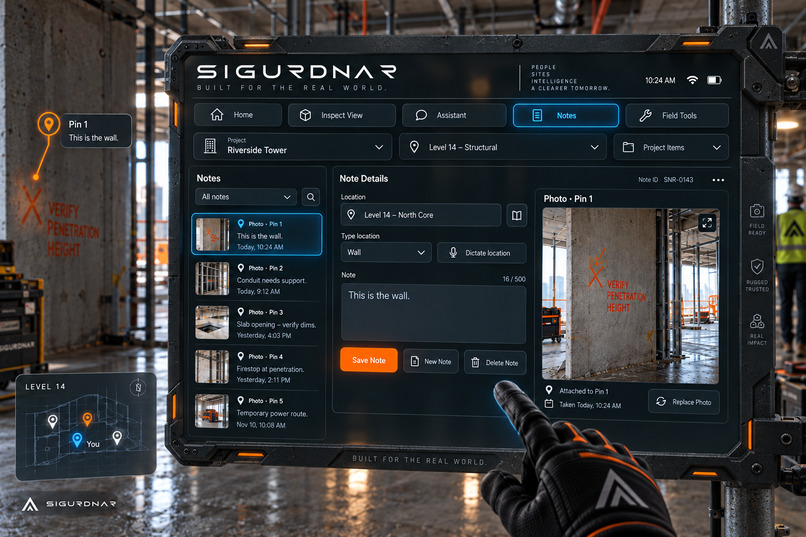
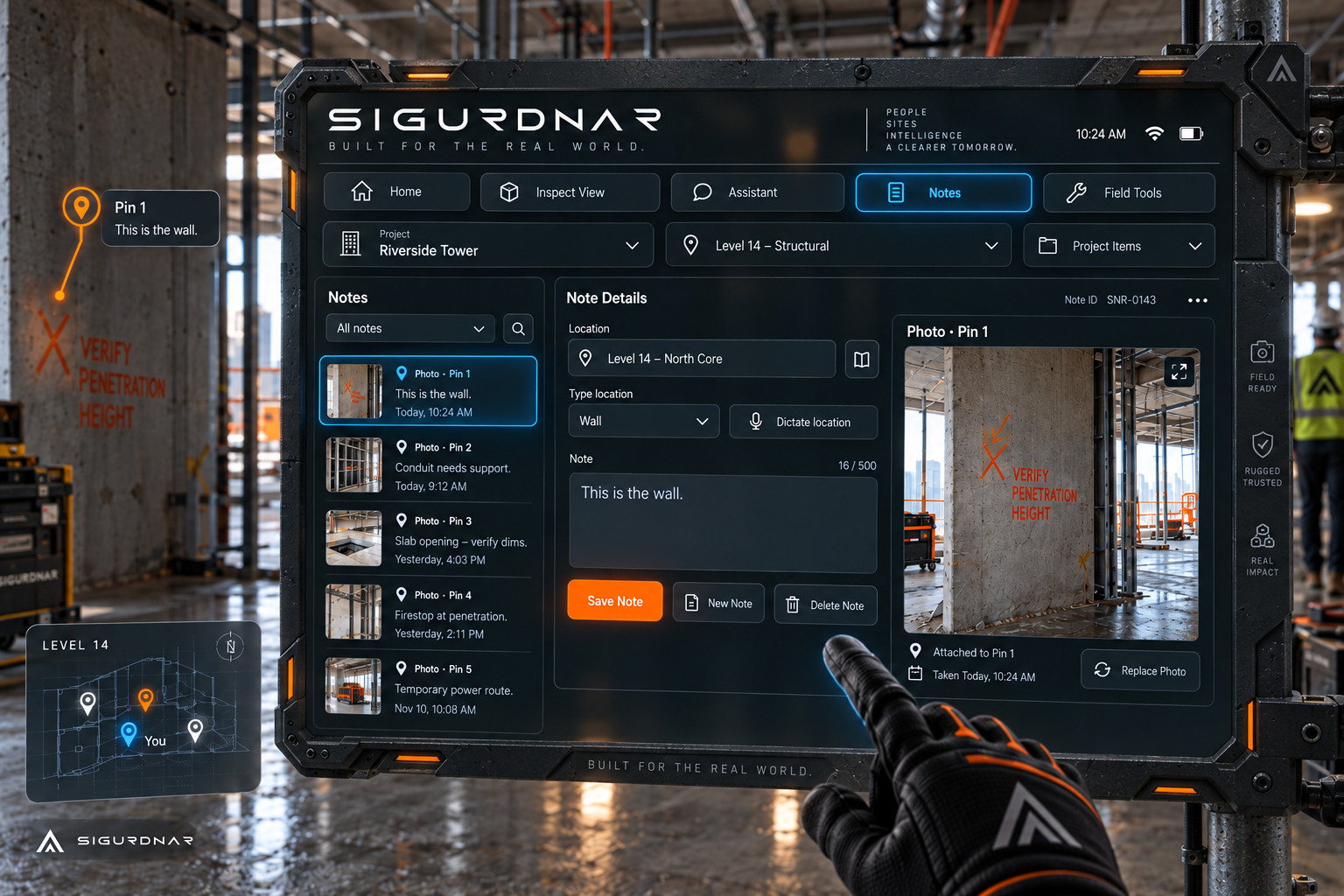
Ragnar field-workspace concept: location-linked notes, photos and project context in mixed reality.
Inspiration
Ragnar brings the project office into the field. It connects the people doing the work, the information that defines the job and the project manager who needs to turn both into decisions, communication and clear records.
Construction knowledge is spread across drawings, specifications, schedules, RFIs, emails, reports and conversations. Meanwhile, the most useful updates often arrive as a quick text, a voice note or a photo from someone standing beside the work. Ragnar brings those pieces into one project workspace, accessible through a web portal and a native Meta Quest mixed-reality experience.
The idea comes from a project manager’s everyday need: ask a question, find the relevant information, capture what happened and keep the job moving—without repeatedly switching tools or re-entering the same information.
What it does
Ragnar is a central communication and intelligence hub for construction teams. Contractors can text updates and photos to a project’s number in their own language. The project manager gets a shared place to follow those conversations, connect them with project records and prepare useful responses and reports. Multilingual text, dictation and translation tools help bridge the gap between the people doing the work and the people coordinating it.
Two assistants make that information actionable:
- Ragnar Main is the primary assistant for working through the job: asking questions, organizing incoming information, preparing communications and reports, and opening field tools and capture workflows. It brings project context into the action you are trying to complete.
- Ragnar Recall retrieves information across the project’s indexed drawings, specifications, schedules, RFIs, reports, documents and field records. Answers connect back to their supporting sources, so the manager can move from a question to the relevant evidence.
That means a manager can ask what a specification requires, find a related drawing or RFI, review what a contractor reported, locate a supporting photo and use that context to prepare a daily report or follow-up. Ragnar connects those information domains within the same project.
A workspace beside the work
On Quest, passthrough keeps the surrounding environment visible while palm-accessible orbs, pinch gestures, voice input and movable panels bring Ragnar’s tools within reach. Ragnar Main and Ragnar Recall sit in distinct finger positions, making the two roles easy to access.
The field workflow includes notes, photos, visual questions, location-linked pins and project observations. A user can mark an item in a captured image, ask about it, add context and connect the observation to the job. Plan and 3D views, shared annotations and environment-capture tools extend that spatial context. Pascal supports the web model-viewing experience.
One project record from field to office
The web portal brings conversations, documents, notes, media and reports together. Incoming contractor messages retain their original context; report drafts can be reviewed, edited, saved with revision history and exported to Word. Project managers can move between the headset and the web while working with the same saved project records.
Ragnar helps turn everyday field communication into structure: reported work, locations, crews, quantities when supplied, blockers, questions and supporting evidence. The project manager stays in control of review and approval.
How we built it
I built Ragnar with Astra through a rapid, AI-assisted vibe-coding process guided by real project-management use. The process has been hands-on: describe a useful workflow, build it, test it in the headset and on the web, then refine it from actual use. That has grown into a platform spanning mixed reality, project retrieval, communication, field capture and reporting.
The native client uses Unity 6 and C#, with OpenXR, Meta OpenXR, Unity’s XR Interaction Toolkit and XR Hands. The web workspace uses Next.js and React, with Three.js and Pascal for model views. A TypeScript, Node.js and Fastify backend connects those experiences to PostgreSQL/pgvector and S3-compatible document and media storage. Twilio connects incoming field texts and media to the project.
The intelligence runs server-side through a pluggable AI provider layer. OpenAI and xAI adapters sit behind a shared interface, allowing supported providers and models to be selected or swapped without rebuilding the Quest or web experience. Additional providers can be added through the same adapter pattern. Speech, reasoning, visual questions and retrieval can evolve while Ragnar keeps ownership of the project context and workflow.
Shared schemas, source-linked retrieval, automated regression checks and device testing support the iteration. The goal is to combine the speed of vibe coding with an application that earns trust through clear evidence and practical use.
Challenges we ran into
Connecting information across domains. A useful answer may depend on a drawing, a specification, an RFI and a recent contractor update. Keeping those relationships, revisions and source references intact is as important as generating the answer.
Designing for a moving person. Spatial controls have to remain reachable and readable while the user looks around, walks and talks to someone nearby. Headset testing drove repeated improvements to finger access, panel placement, captions, dictation and window behavior.
Turning conversation into useful records. Field updates are informal and multilingual. Ragnar needs to preserve what someone actually said while helping the manager organize it into a clear note, question, report or response.
Keeping the field and office connected. Drafts, uploads and saved records need clear states so work can continue through interruptions and appear consistently across devices.
Accomplishments we’re proud of
Ragnar now brings together capabilities that usually live in separate tools: project knowledge retrieval, a native mixed-reality workspace, multilingual communication tools, contractor text intake, visual inspection, shared notes and photos, report drafting and Word export.
The value is in how those pieces connect. A question can lead to a source, a field observation can become a shared record, and contractor input can support the manager’s next report or communication. Ragnar Main helps work through that flow; Ragnar Recall makes the project’s knowledge accessible within it.
We are also proud of the pace of development. Many additional capabilities are already implemented or prototyped and moving through review, testing and refinement. Actual field use continues to shape which features deliver the most value.
What we learned
Mixed reality is most useful when it removes friction from real work. The strongest experience connects the information in front of the user with the records, people and decisions behind it.
We also learned that natural input matters. Contractors should be able to communicate in familiar ways and in their own language, while the project manager receives organized information that is easier to find, understand and act on.
What’s next for Ragnar
The next phase builds on the platform already in place: bringing more of Ragnar’s developed features through review, expanding connected field workflows and refining the experience through pilot-project use.
- Richer contractor-to-manager workflows: connect multilingual submissions, project answers, communication drafts and structured reports more closely.
- More capable Ragnar Main and Ragnar Recall: expand the ways users retrieve related information and carry it into useful project actions.
- Bluetooth measurement tools: planned integration with REEKON and other compatible Bluetooth measurement tools will bring instrument readings, units and measurement context into Ragnar’s project records, linking field measurements with notes, photos and reporting.
- Revit and broader BIM connections: planned integrations will connect design models, element data and revisions with Ragnar’s project knowledge, field observations and reporting.
- A digital project world that updates in real time: connect incoming contractor updates, field notes, photos and supported tool readings with linked plan/3D views, so the digital view evolves as the job progresses. Design revisions and reviewed changes will retain their history and supporting evidence.
- Deeper spatial context: continue developing annotations, capture and site alignment so information is easier to understand where it applies.
- The Sigurdnar hardware vision: explore a jobsite-focused mixed-reality form factor alongside the software platform. The gallery’s helmet and interface images show that concept direction.
Ragnar’s ambition is a living digital project world that keeps pace with the physical jobsite: one place to ask, capture, communicate, recall and report—with project information updating as the work happens.
Built With
- c#
- next.js
- node.js
- openai
- openxr
- postgresql
- react
- three.js
- twilio
- typescript
- unity
