-
-
-
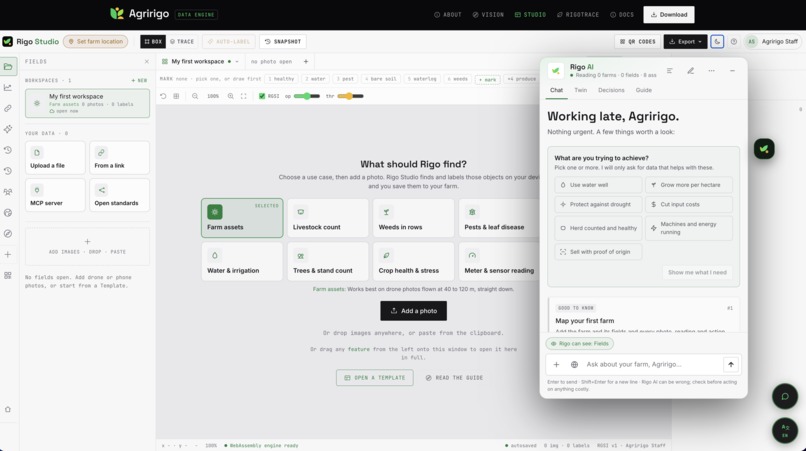
Rigo AI inside Rigo Studio
-
-
About the Project
Agriculture already produces a huge amount of data.
The problem is that the data rarely comes together when a decision needs to be made.
I started Agririgo from a practical place. I code, fly drones, and farm, so I was seeing the same problem from different sides. Farms were producing information through drone imagery, phone photos, soil sensors, irrigation systems, spreadsheets, weather data, and field observations, but much of that information remained disconnected. The person making the decision could not easily see the whole picture.
That became much more real during the 2024 drought in Zambia. Large areas of maize were affected, and what stood out to me was that the problem was not simply a lack of data. The data existed. The decision came too late.
That changed the question I was trying to solve:
How do we turn the data a farm already produces into a decision?
What We Built
Rigo Studio is the first part of that vision.
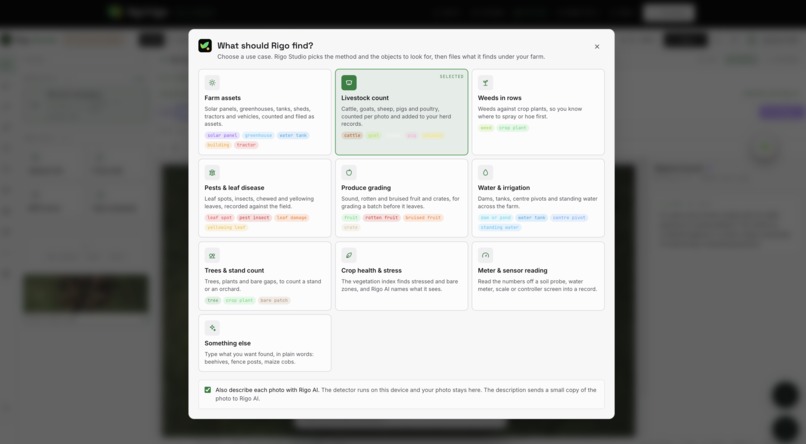
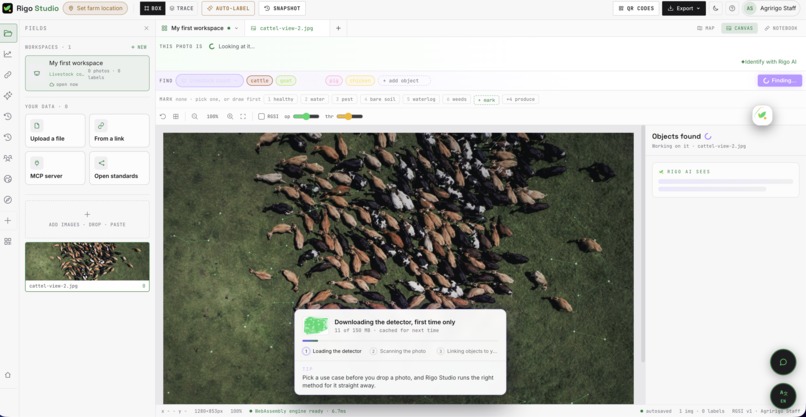
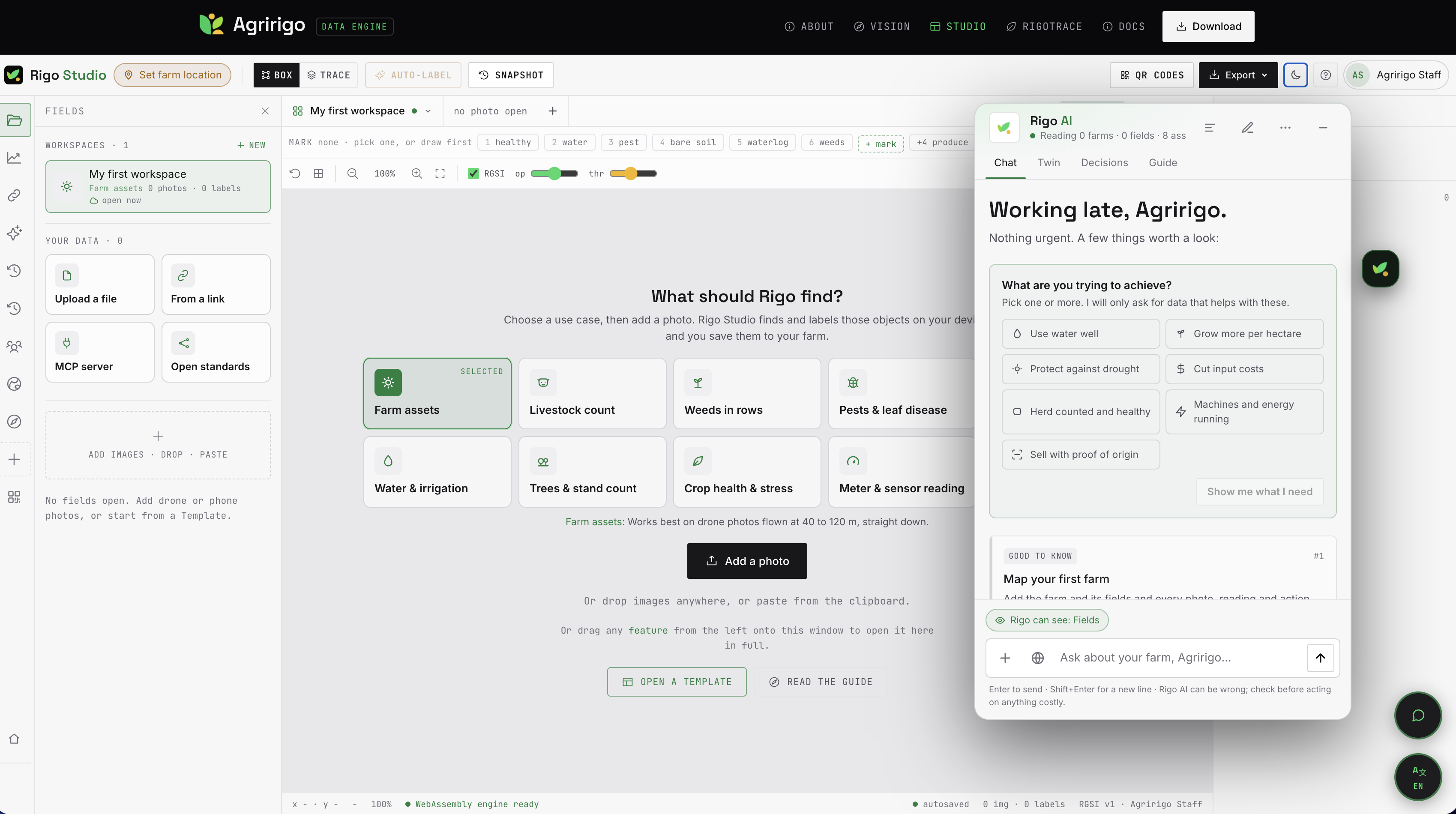
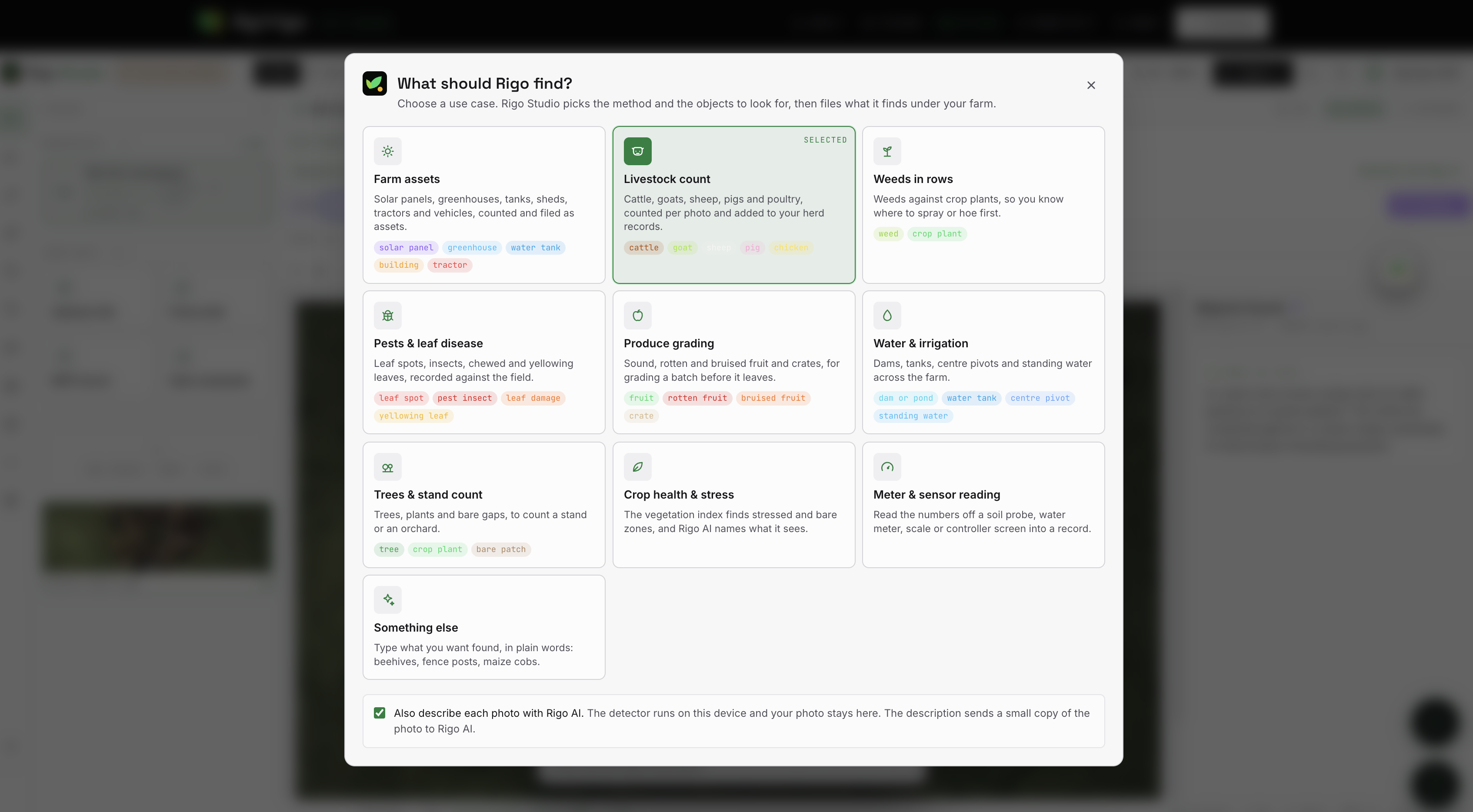
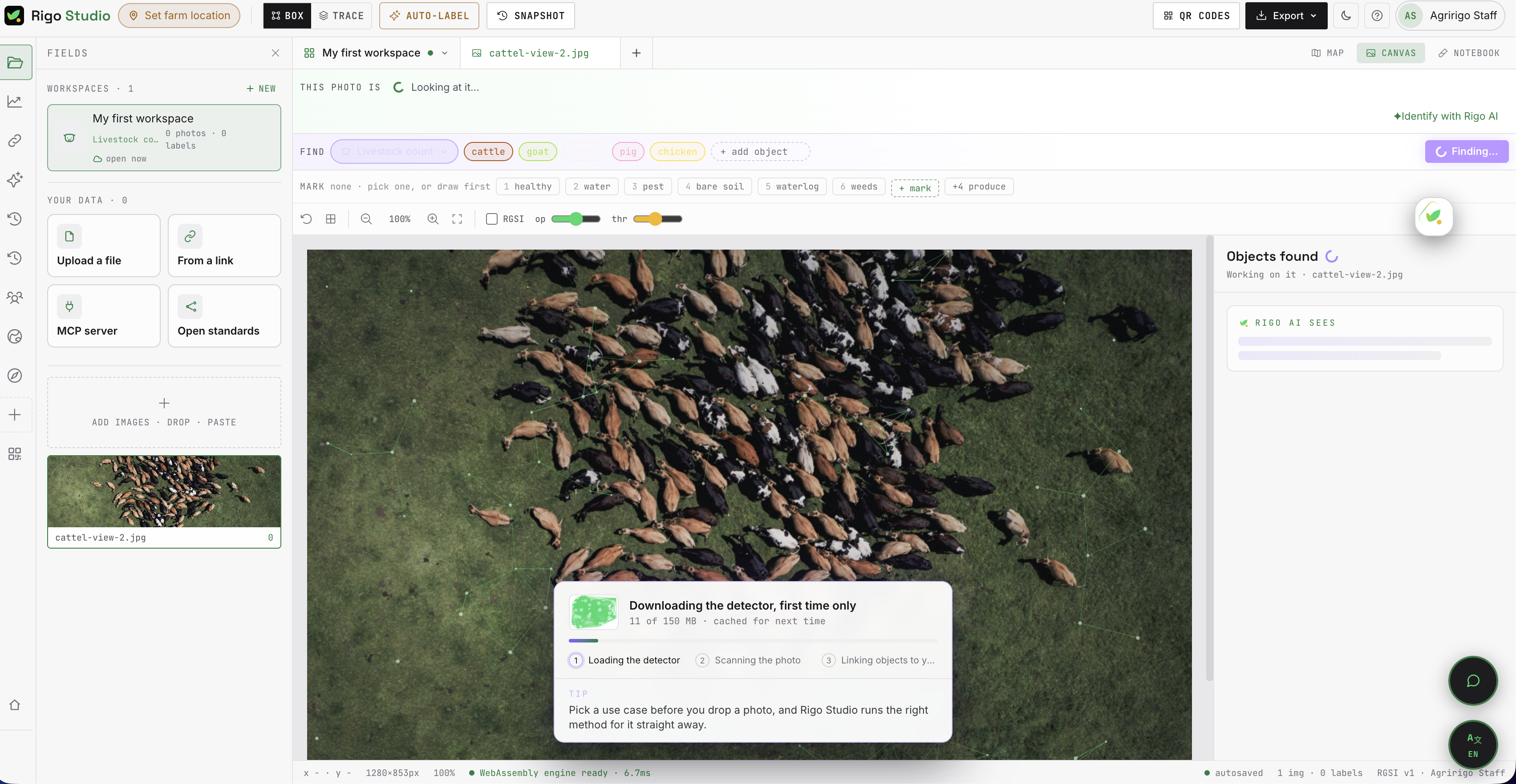
It turns agricultural imagery and farm information into field-level intelligence. Farmers, agronomists, researchers, and drone pilots can work with phone photos, drone imagery, observations, and farm records. Rigo Studio can analyse imagery on the user's own machine and connect findings to the relevant field and season.
Our core workflow is:
Capture → Understand → Act
1. Capture
Bring together information already being produced by the farm:
- Drone imagery
- Phone photos
- Spreadsheets
- Agronomist notes
- Weather
- Soil data
- Satellite imagery
- Previous season records
2. Understand
Instead of treating every image as an isolated question, Rigo Studio connects observations to agricultural context.
We built the Agririgo ontology around objects such as:
Farm → Field → Crop → Season → Image → Observation → Intervention → Harvest
This gives the system a structured understanding of what exists on the farm and how those things relate to each other.
3. Act
The goal is not simply to identify something in an image.
It is to help determine what should happen next.
For example, instead of returning:
“Pest damage, 20% of area.”
the system can work toward a more contextual answer:
“Pest damage in Block 3, maize at tasselling, affecting 20% of 40 ha.”
And when historical information is available, the system can go further:
“Same pest, same block as last season. Spraying worked then. Act within 5 days.”
That is the difference between detection and decision support.
How We Built It
Agririgo was not originally an AI project.
It evolved through more than five years of software development, agricultural field research, drone operations, and experimentation. We started with agricultural software concepts through Ericolas Technologies, visited farms in Mumbwa and the Copperbelt, built a three-drone operational capability, and developed Rigo Vision into Rigo Studio. We then began structuring agricultural information into an ontology that AI could reason against.
The system brings together fragmented agricultural inputs and turns them into structured state.
The AI model layer is intentionally replaceable. We can work with open models, NVIDIA vision models, and other inference infrastructure while focusing our long-term effort on the parts that become more valuable through use:
agricultural data + ontology + evaluation + field history.
We also designed Rigo Studio around on-device inference, allowing analysis to run on the farm's own machine rather than requiring every image to be uploaded to a central cloud service.
What We Learned
The biggest lesson was simple:
AI becomes much more useful when it understands context.
A vision model can identify something in an image.
An agricultural intelligence system needs to understand:
- Where it happened
- What crop is involved
- What season it belongs to
- What happened there before
- What intervention was made
- What happened afterward
That context is what allows a system to move from an observation toward an actionable decision.
We also learned that building for agriculture means building for the field, not just the office. Connectivity, existing workflows, fragmented records, operational costs, and the limited time available to farmers all matter.
That is why Rigo Studio is designed around information farms already produce rather than requiring farms to completely replace their existing tools.
Challenges
Fragmented agricultural data
A single farm can have information spread across sensors, irrigation systems, drone imagery, spreadsheets, phone photos, weather services, and field observations.
Connecting all of that into a consistent representation required more than a conventional database. It required us to think about the farm as a collection of persistent objects and relationships that change over time.
Building with limited resources
Agririgo has been largely founder-funded. Approximately US$25,000 was committed by the founder and team to build, validate, and ship the product before external investment.
Despite those constraints, the project reached:
- 120 paying users
- ~US$4,000 monthly revenue
- 1,000+ Rigo Studio downloads
- 850 Crop Passports issued
Making AI reliable enough for agriculture
Agricultural decisions can have real financial consequences, so we did not want to present AI as a black box.
Our approach has been to focus on structured agricultural data, contextual reasoning, field history, evaluation, and traceability rather than simply producing convincing-looking AI responses.
What Comes Next
Rigo Studio is only the beginning.
The long-term goal is to build an intelligence layer for agriculture that remembers what happened across fields and seasons.
From there, Agririgo can expand into:
Rigo Studio → Rigo AI → RigoTrace → Agricultural Data Infrastructure
That can support history-aware AI, collaborative farm workspaces, structured agricultural datasets, digital crop records, traceability, buyer verification, risk modelling, insurance, lending, and research.
The project started with one observation:
The farm already produces the data.
Our job is to turn that data into something a farmer, agronomist, or agricultural operator can actually use when a decision needs to be made.
Built With
- amazon-web-services
- nebius
- nebius-token-factory
- node.js
- nvidia-nemotron
- openai-sdk
- postgresql
- react
- react-three-fiber
- supabase
- tavily
- typescript


Log in or sign up for Devpost to join the conversation.