-
-
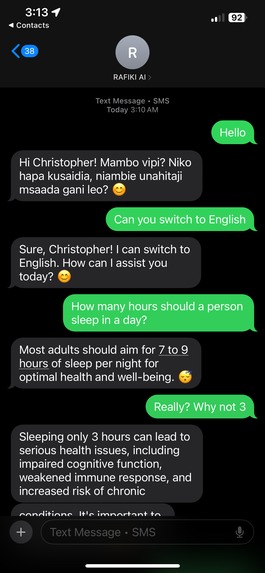
this is a picture of a user interacting with our service
Inspiration The inspiration for Rafiki AI was sparked during a Human-Centered Design session at a government school in Tanzania. When the students were asked if they knew about Artificial Intelligence, not a single hand went up. These students were bright and eager to learn but lacked smartphones, stable internet access, and exposure to AI tools. This moment revealed a major gap — a vast population being left behind in the digital revolution due to infrastructure and affordability issues. That’s when the vision for Rafiki AI was born: to bring AI to every student, regardless of their device or internet access.
What it does Rafiki AI is an offline-first AI platform that enables users to access AI tools through basic phones using SMS a — no internet or smartphone required. It acts as a friendly AI companion capable of: i. Answering academic questions (math, science, history, etc.)
ii. Offering mental health support
iii.Providing agricultural advice
iv. Sharing current news and sports updates
v. Enabling business tips and more
It uses familiar channels like USSD and SMS shortcodes to bring AI to the underserved, making it truly inclusive and accessible.
How we built it We developed Rafiki AI with a focus on simplicity, accessibility, and scalability:
We integrated AI models through APIs and optimized their responses for low-bandwidth and character-limited environments like SMS.
We partnered with local telecommunication providers to deploy USSD and SMS codes
The backend infrastructure includes message routing, local language support (Swahili)
We built a multilingual, offline-first architecture and optimized content for feature phones.
Our team includes experienced computer engineers and innovation experts from Tanzanian institutions.
Challenges we ran into Latency issues due to high volume of requests in low-infrastructure environments.
Telecom integration was complex and required strong partnerships to deploy USSD/SMS services at scale.
AI model limitations in local context understanding and Swahili language support.
Ensuring a smooth user experience despite the 160-character limit of SMS interactions.
Building trust with users in communities where technology adoption is often low.
Accomplishments that we're proud of Deployed a functional MVP with over 3,000 users in one month, with daily user growth.
Received positive testimonials from early users saying it’s helping them in studies and personal development.
Secured endorsement from government officials such as Prof. Kitila Mkumbo, a Minister in Tanzania.
Built a Swahili-based AI assistant that works completely offline.
Established early strategic partnerships and began the process of patenting our technology.
What we learned Innovation doesn’t always mean advanced hardware — simple tools like SMS can be transformational when paired with the right technology.
There is massive demand for educational and informational services in rural and offline communities.
A human-centered approach is critical; users want conversational, friendly, and localized AI tools.
Collaborating with telecoms, schools, and government institutions is key for mass adoption and trust.
What's next for RAFIKI AI Scale to reach 10,000+ users in pilot regions with optimized performance.
Integrate with more mobile network operators (MNOs) to expand coverage.
Launch a marketing and outreach campaign targeting schools, NGOs, and rural communities.
Expand to B2B use cases, enabling governments and organizations to use our API for education, health, and awareness campaigns.
Finalize patents and secure $100,000 funding for tech hires, infrastructure, and scaling operations.
Continue building Rafiki AI into a trusted friend for every African student, starting with Tanzania.

Log in or sign up for Devpost to join the conversation.