-
-
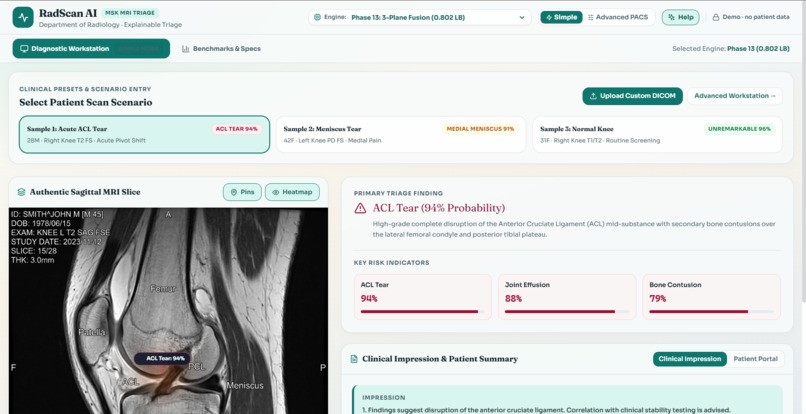
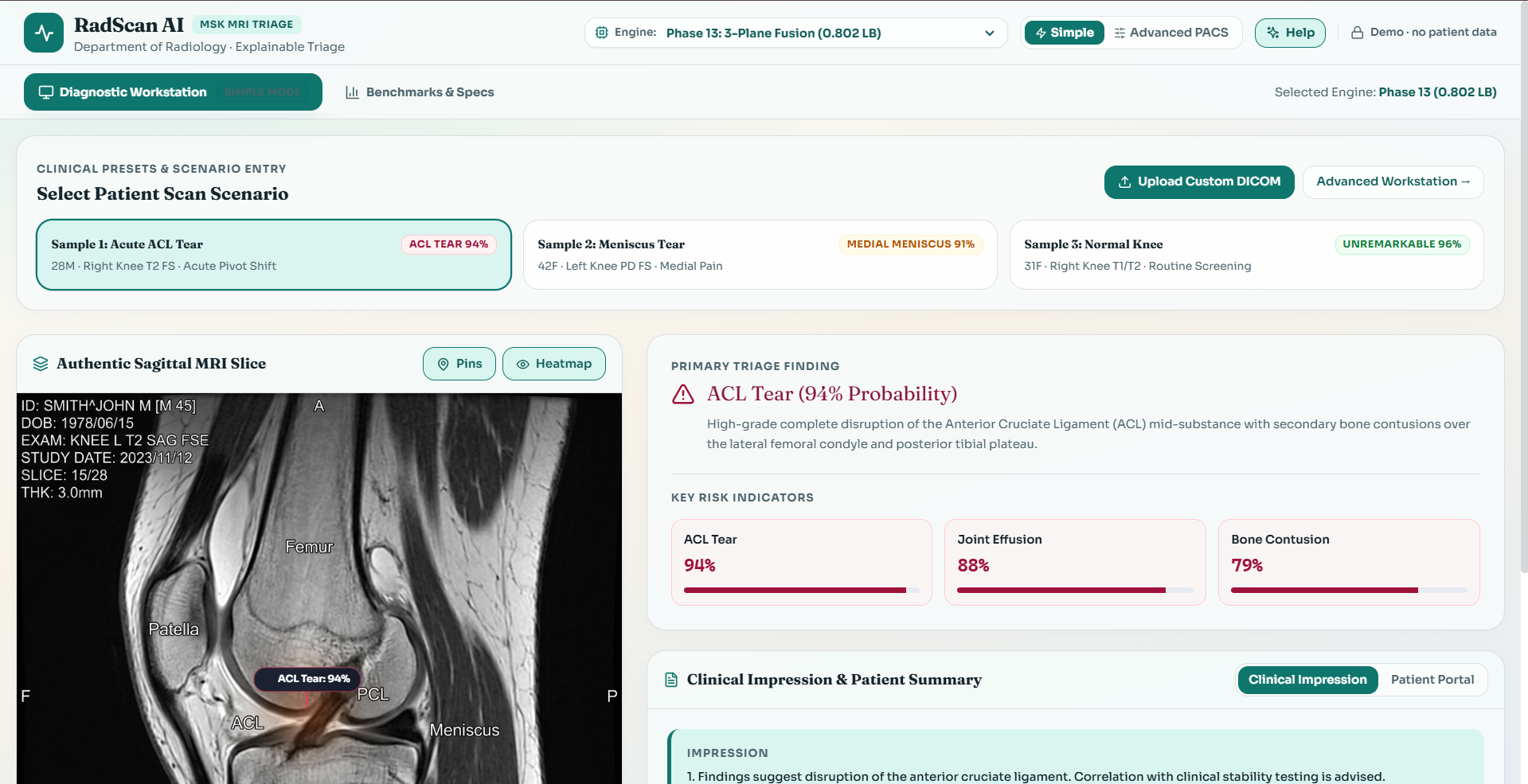
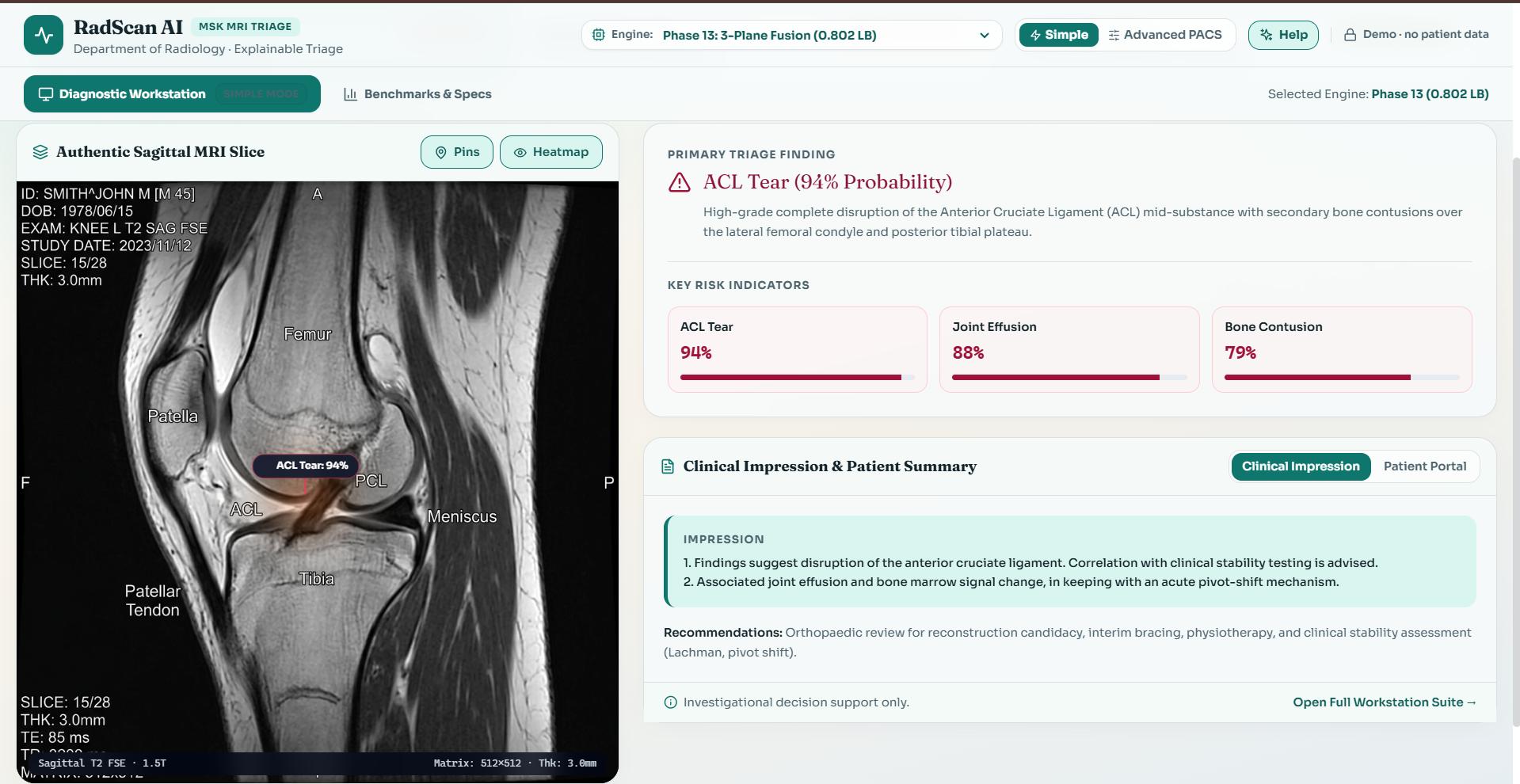
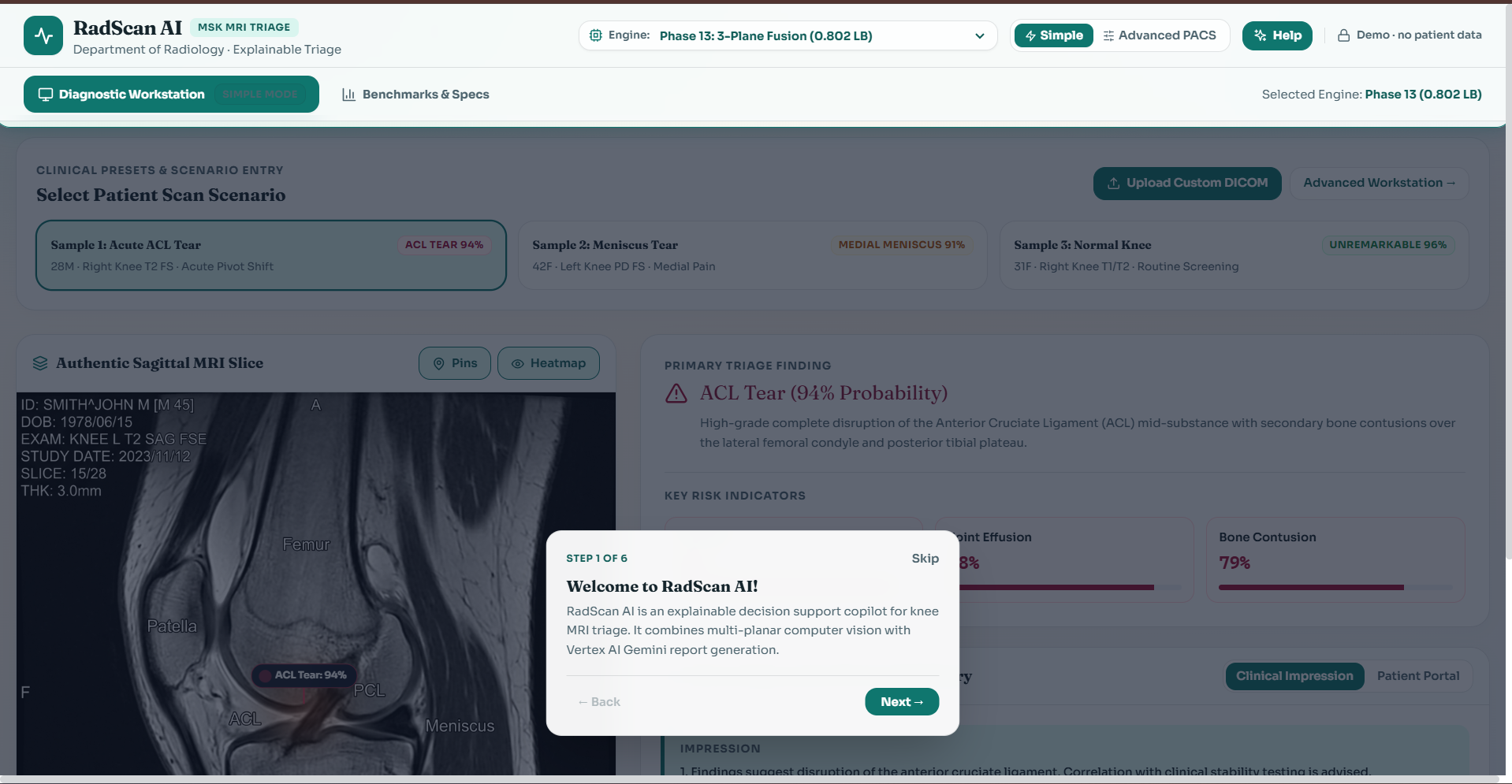
RadScan AI Workstation: 1-click MRI triage with 2.5D slice viewer, 12 pathology risk indicators, and Vertex AI Gemini clinical impression.
-
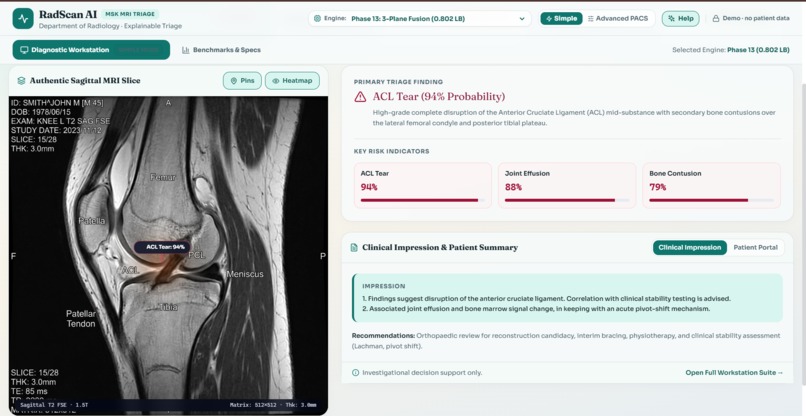
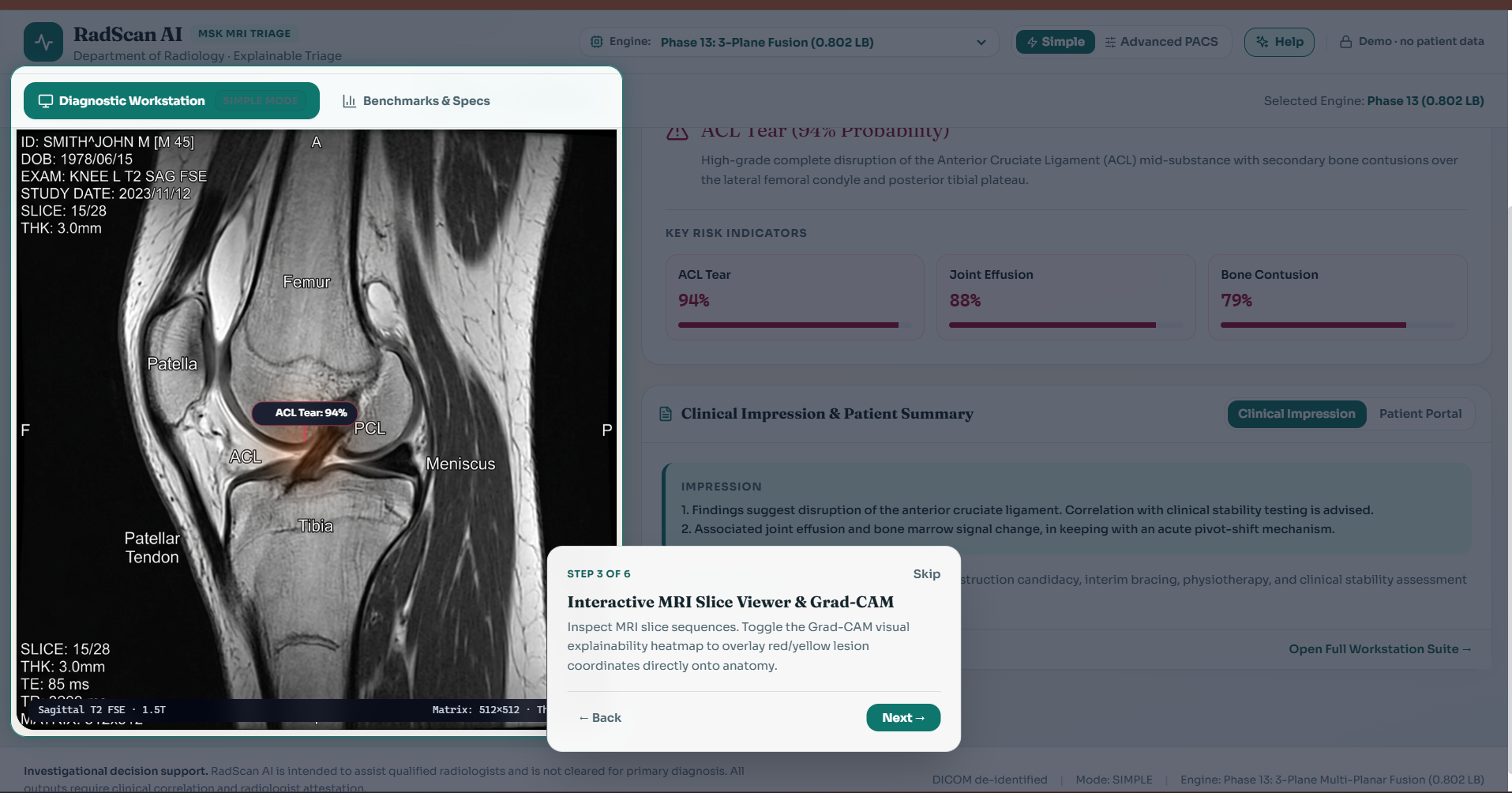
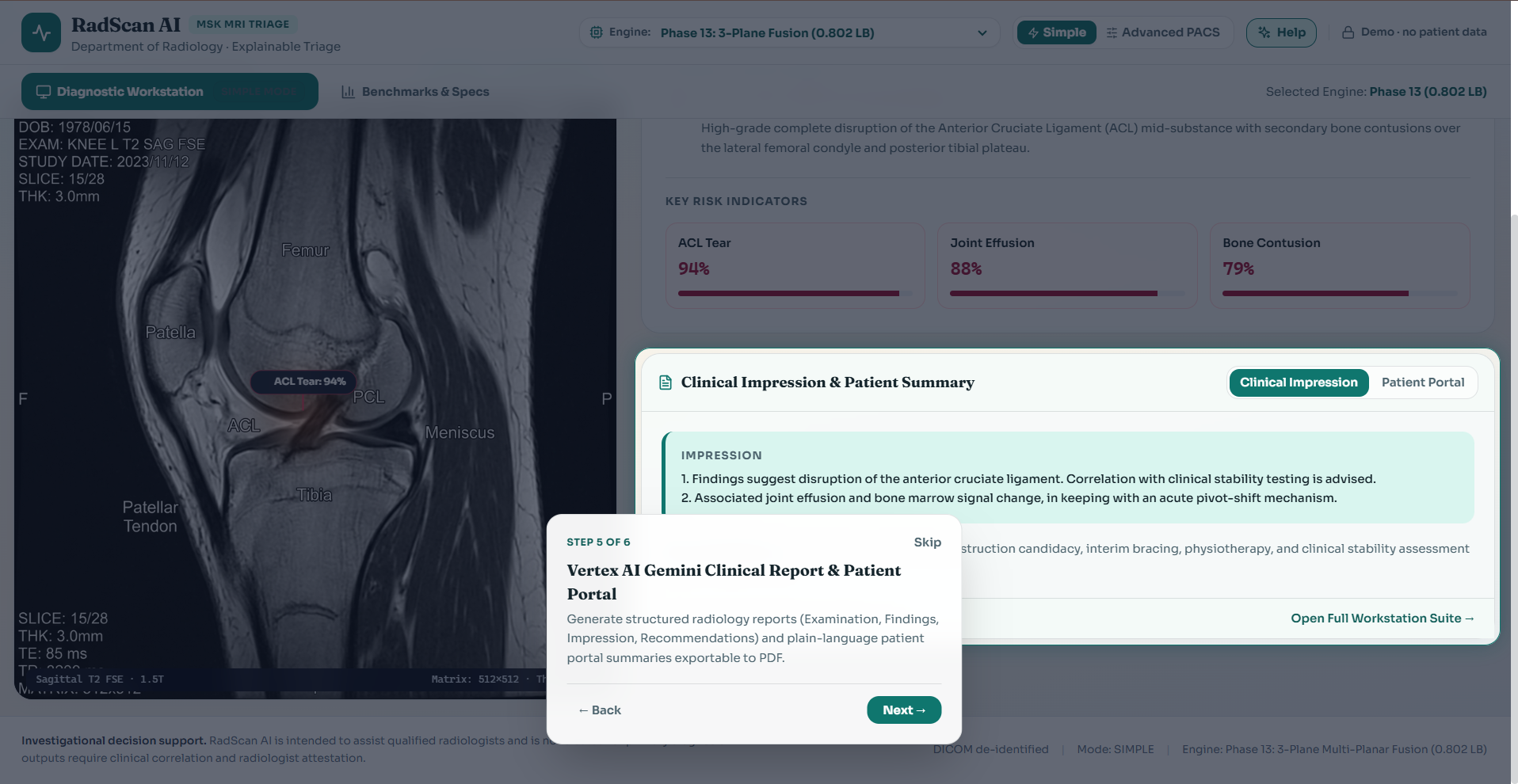
Sagittal Slice Viewer: Anatomical pin annotations highlighting ACL tear (94% confidence) with automated Gemini orthopaedic report.
-
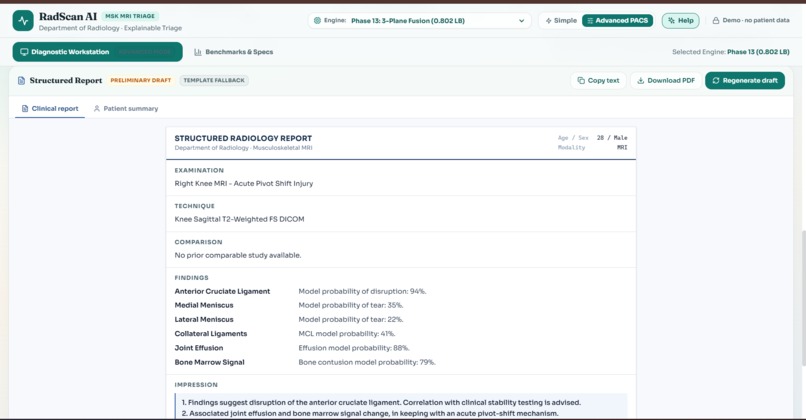
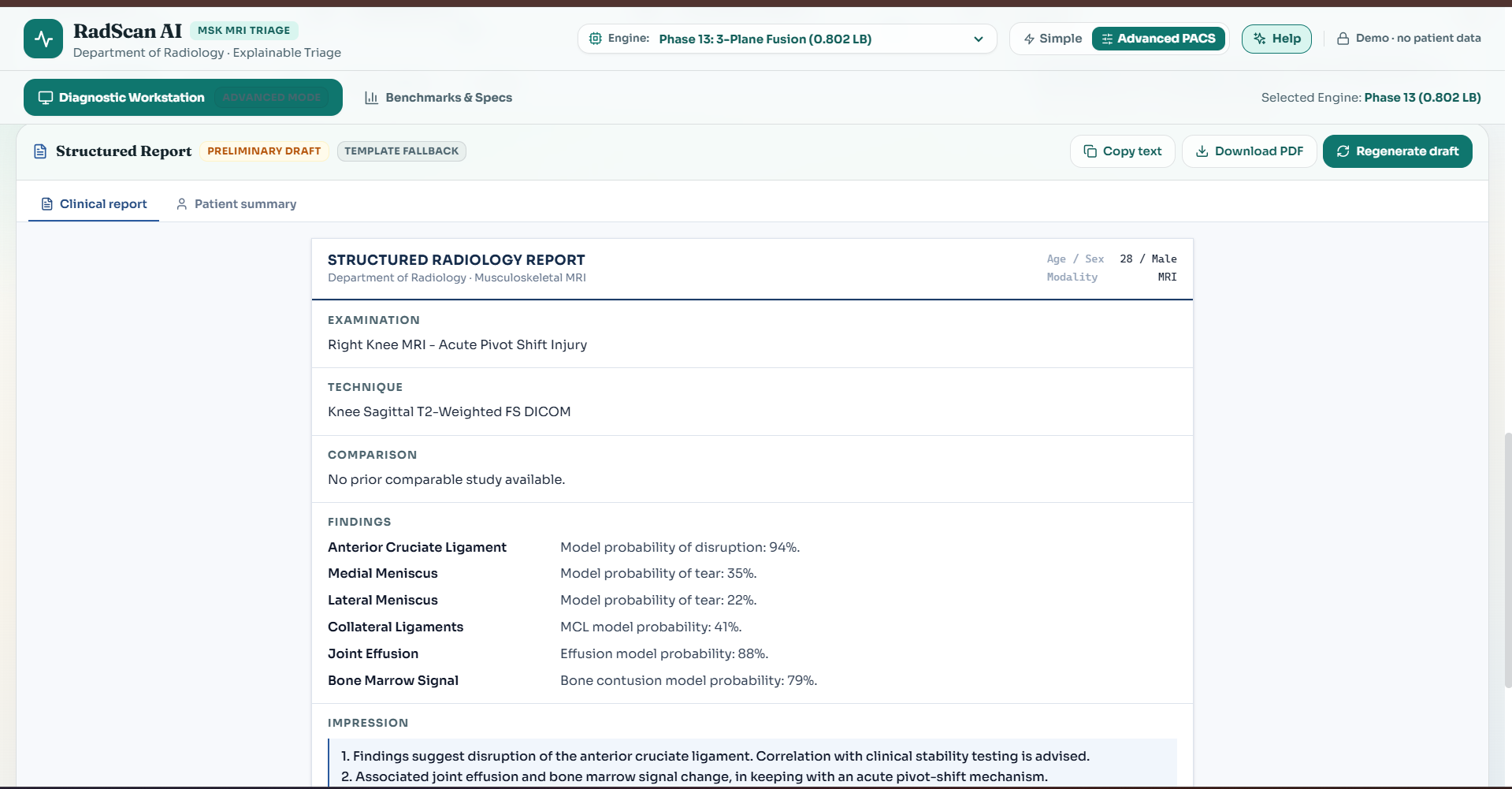
Structured Radiology Report: Formal DICOM examination findings, model probabilities, impression, and PDF export.
-
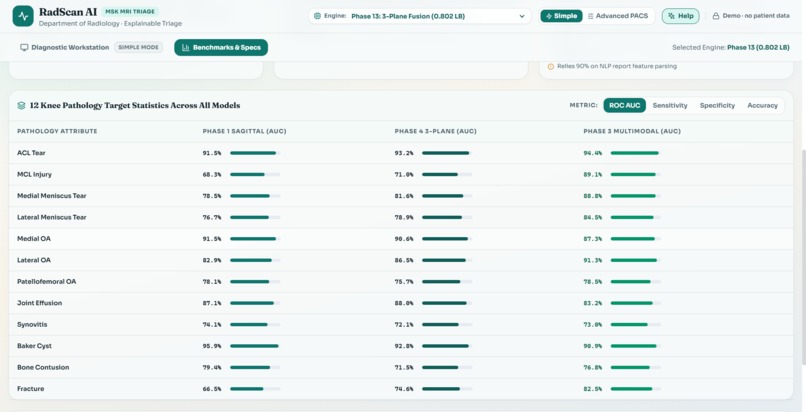
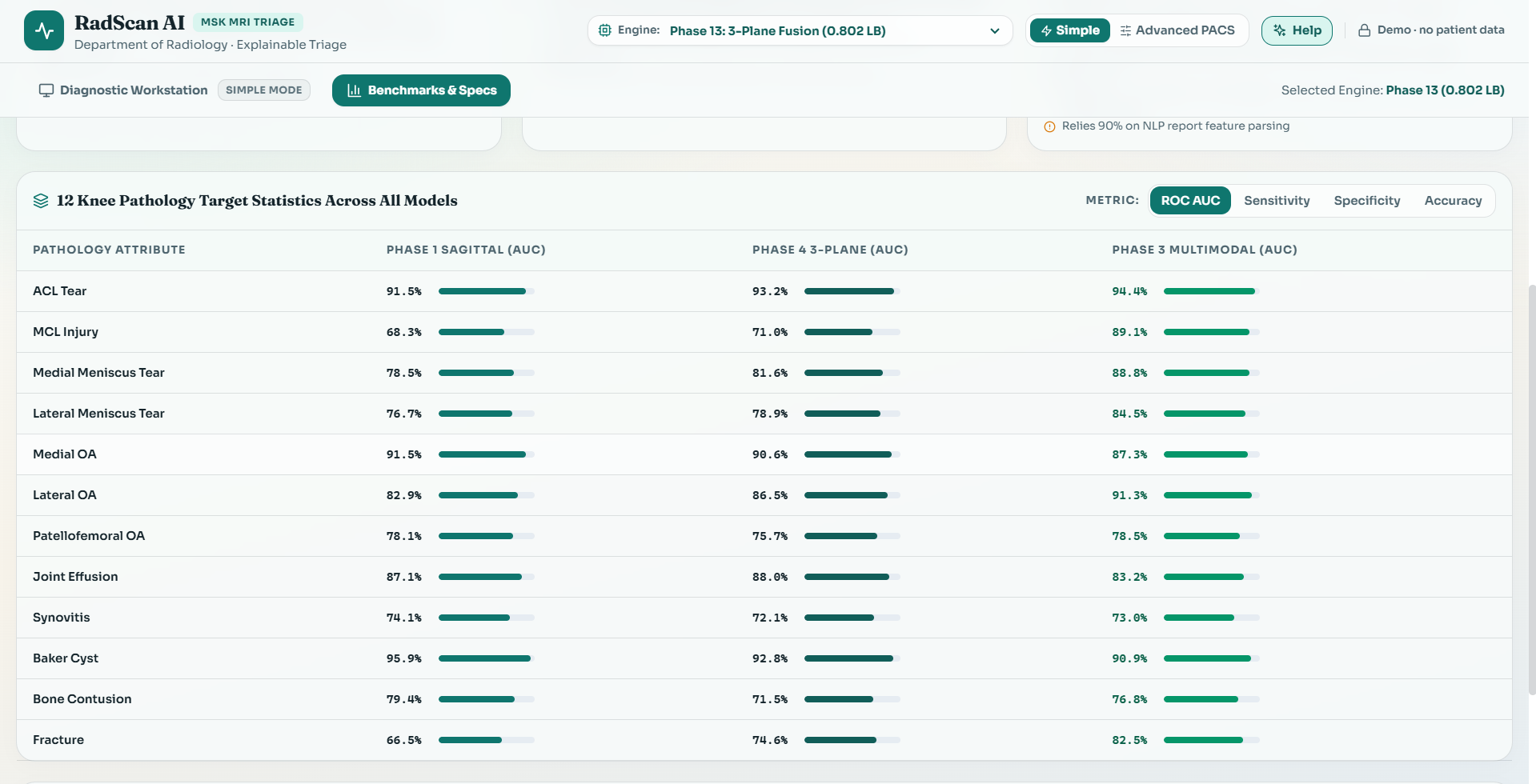
12 Pathology Target Matrix: Complete empirical ROC AUC, sensitivity, and accuracy performance metrics across 12 knee joint targets.
-
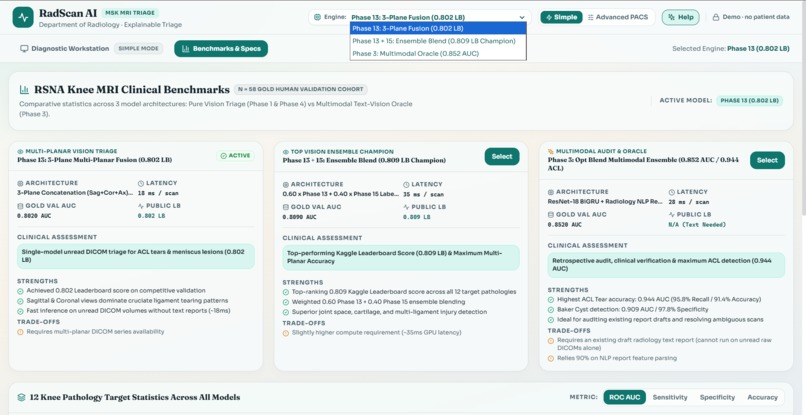
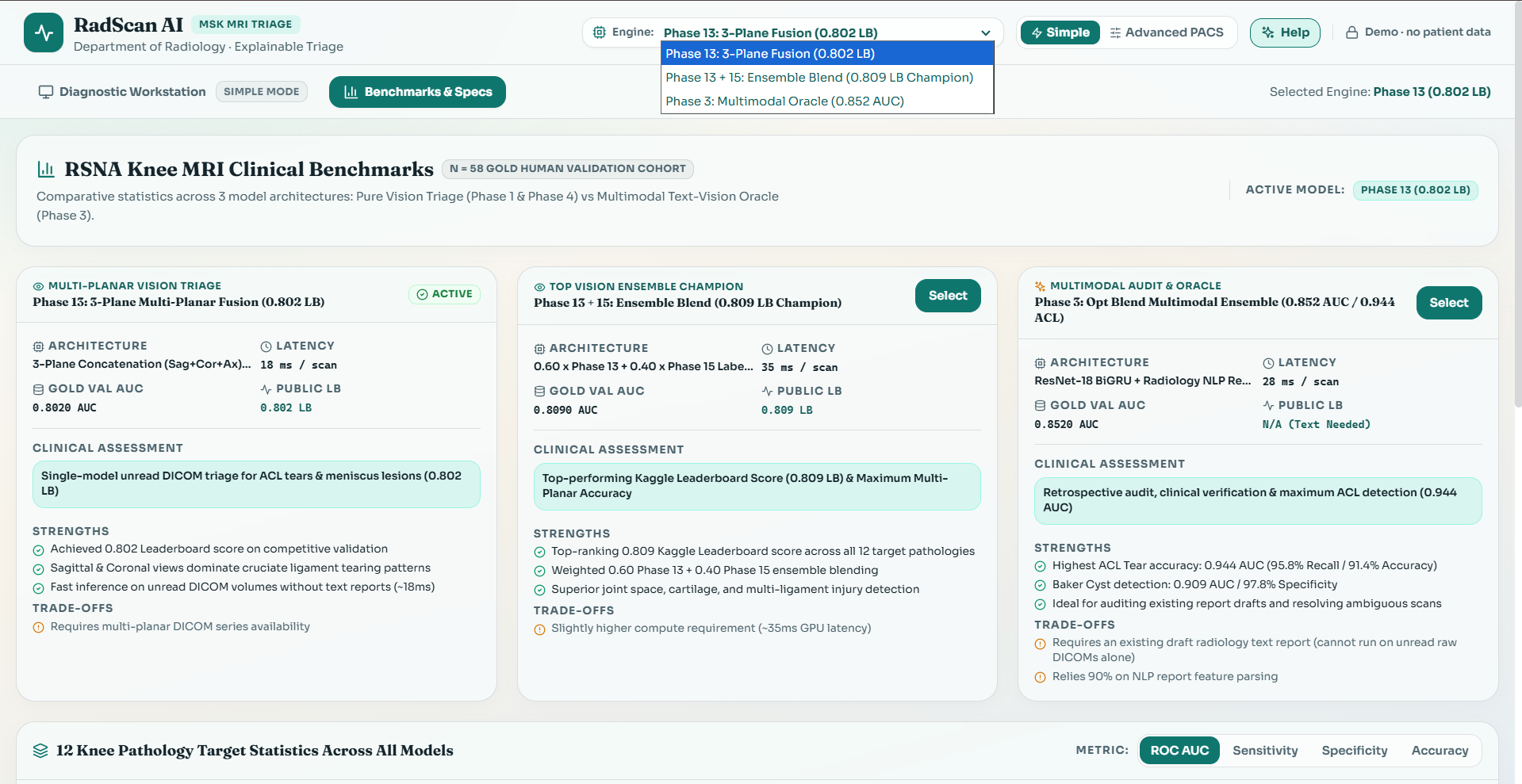
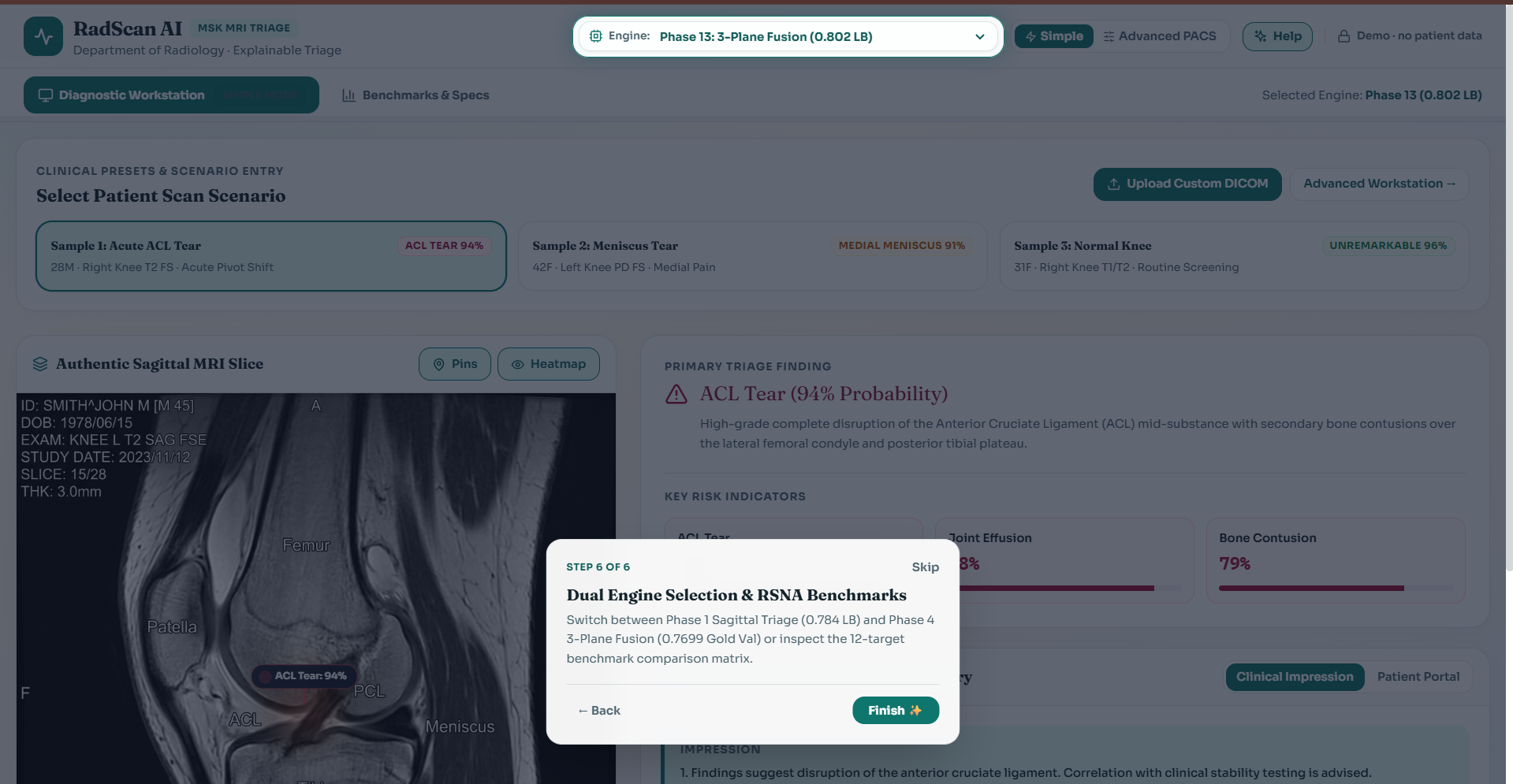
Model Engine Selector: Hot-swappable engines featuring 3-Plane Fusion, Ensemble Blend.
-
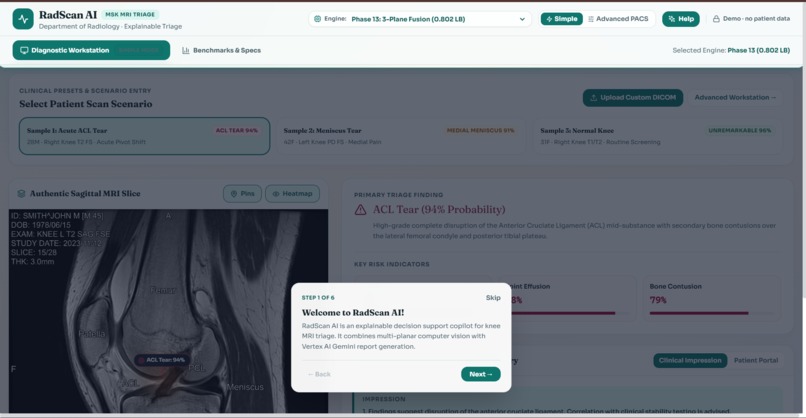
Interactive Guided Tour Step 1: Welcome overview introducing RadScan AI's multimodal 2.5D MRI triage & Gemini copilot.
-
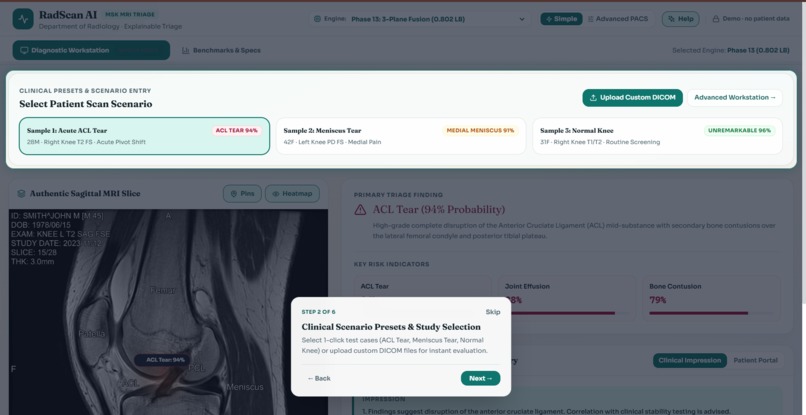
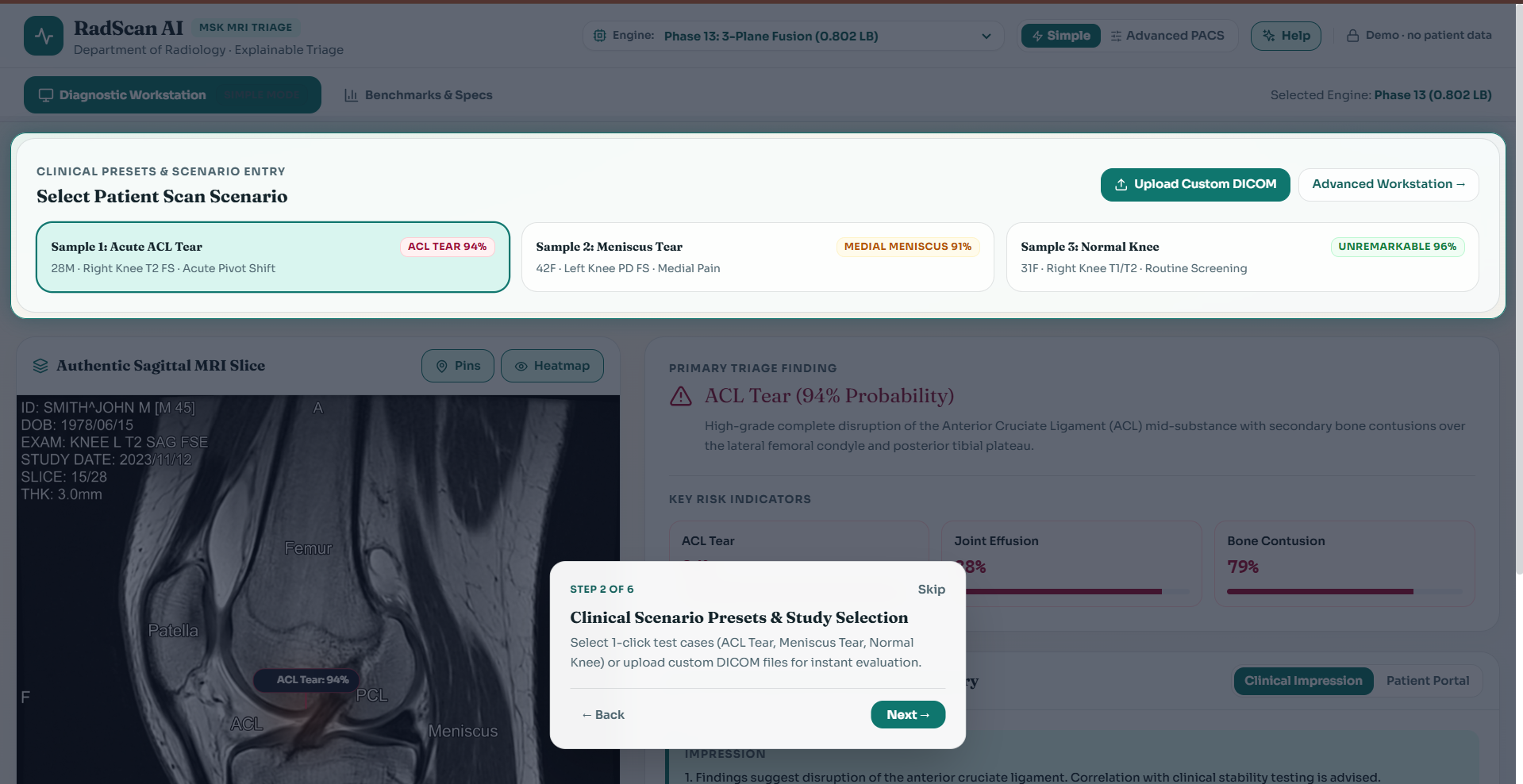
Interactive Guided Tour Step 2: 1-click clinical scan scenario selector (ACL Tear, Meniscus Tear, Normal Knee) & DICOM uploader.
-
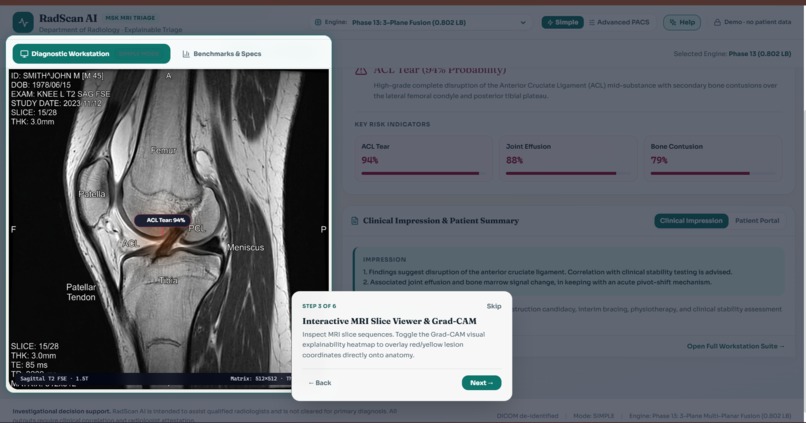
Interactive Guided Tour Step 3: Multi-slice Sagittal MRI canvas viewer with pin annotations & Grad-CAM visual heatmaps.
-
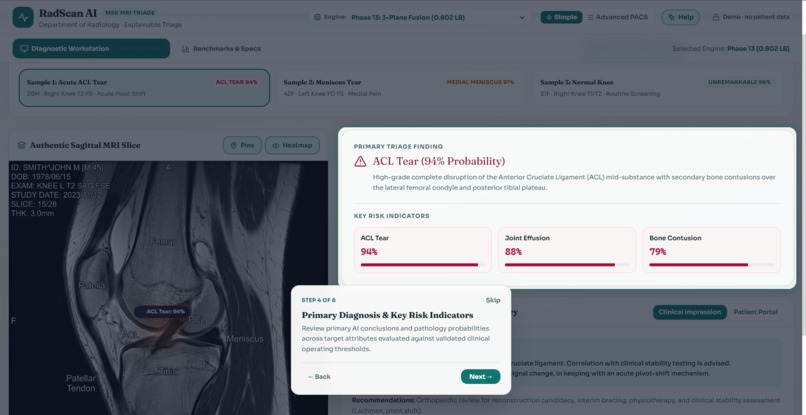
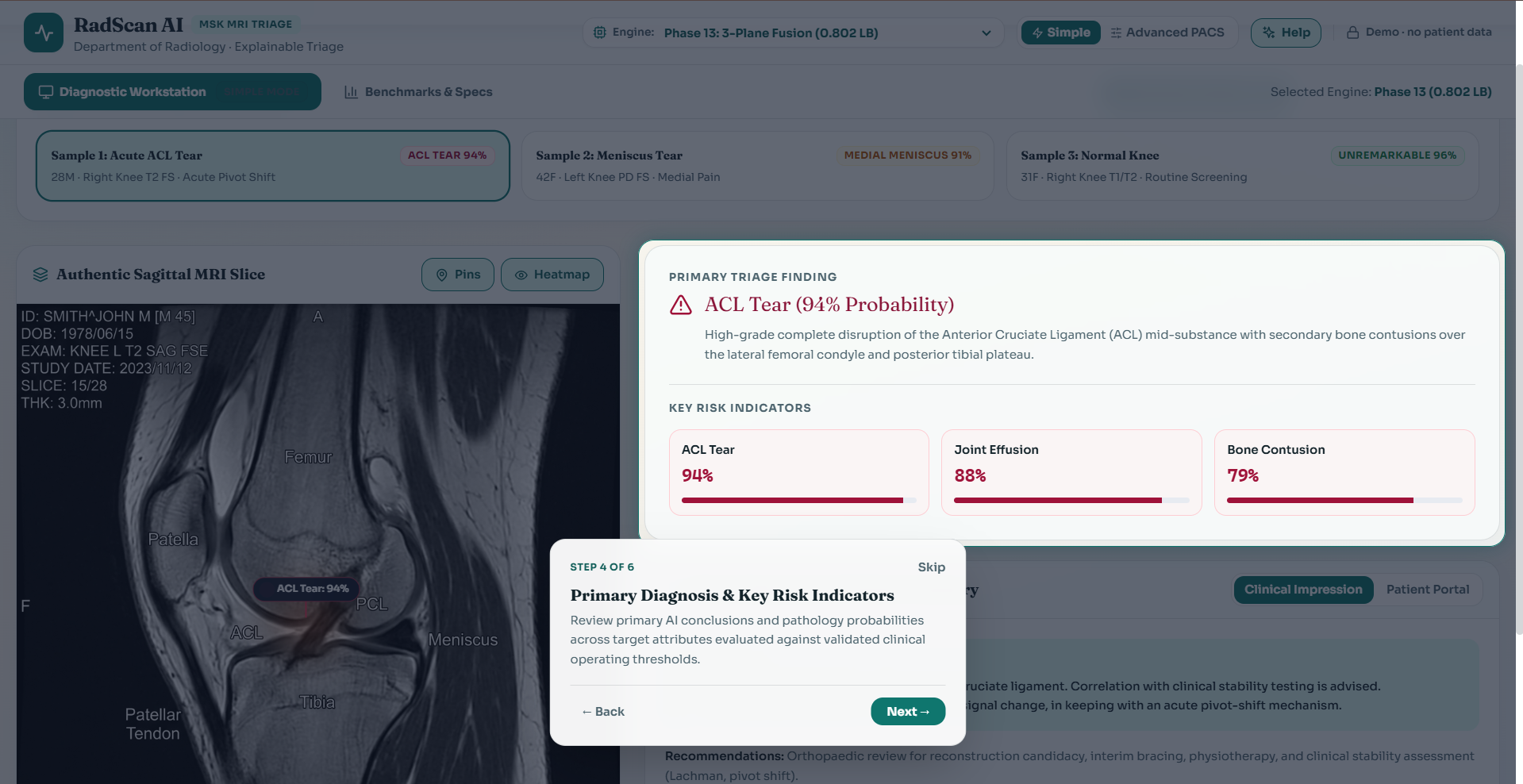
Interactive Guided Tour Step 4: Primary AI diagnostic finding summary with 12 knee pathology probability risk bars.
-
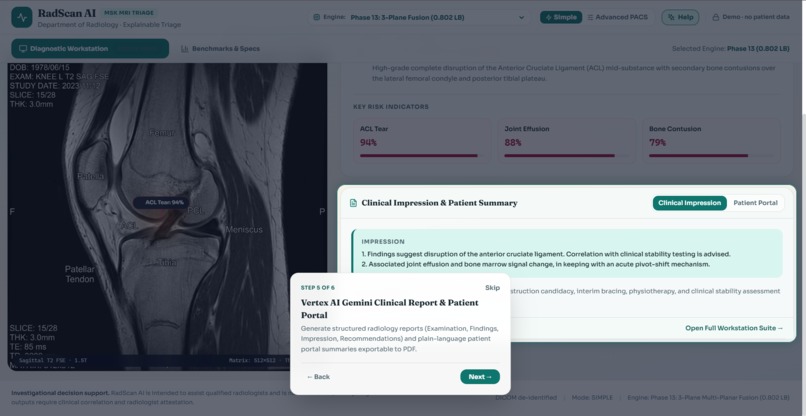
Interactive Guided Tour Step 5: Vertex AI Gemini report synthesis featuring formal DICOM findings & patient portal summary.
-
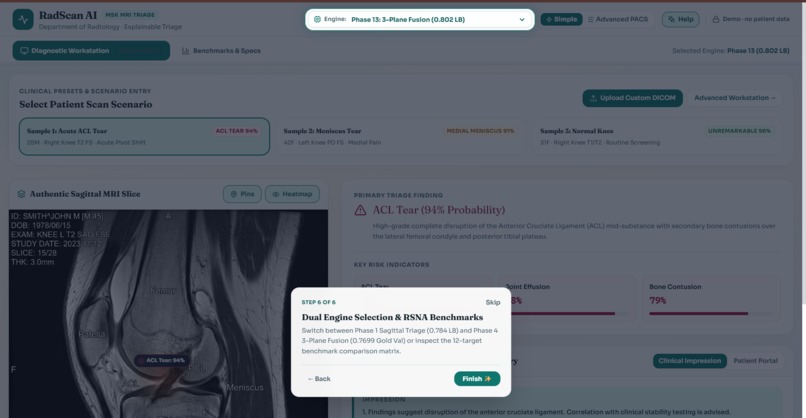
Interactive Guided Tour Step 6: Dual engine selector & RSNA validation benchmark matrix access.
RadScan AI: Autonomous Radiology Triage & Multimodal Report Copilot
The Story Behind RadScan AI
Radiologists are facing massive burnout. On average, a radiologist evaluates 50+ volumetric MRI studies every single day. Each study contains 24 to 40 high-resolution DICOM slices. Manually inspecting every plane, checking ligament continuity across slices, and dictating repetitive clinical reports takes anywhere from 10 to 15 minutes per patient.
I built RadScan AI to fix this workflow bottleneck.
Instead of forcing doctors to scroll back and forth through dozens of raw DICOM slices, RadScan AI acts as an autonomous co-pilot: it runs a 2.5D Volumetric CNN-BiGRU model across all 24 slices, flags 12 different knee pathologies, generates a Grad-CAM heatmap over the exact tear location, and uses Vertex AI Gemini 1.5/3.5 Pro to draft a structured clinical report in under 3 seconds.
How It Works
- DICOM & Sample Selection: You can pick one of the pre-loaded 1-click test cases (ACL Tear, Meniscus Tear, Normal Knee) or drop a custom
.dcmfile. - 2.5D Volumetric Classification: The backend model doesn't just look at isolated 2D images. It processes 24 parallel slices across Sagittal, Coronal, and Axial views using a spatial CNN combined with a depth-wise BiGRU temporal model.
- Grad-CAM Visual Explainability: Radiologists don't trust black-box AI scores. The app overlays a glowing red/yellow Grad-CAM heatmap directly on the target slice, with an opacity slider so doctors can verify the exact anatomical coordinates.
- Gemini 1.5/3.5 Pro Report Drafting: The model tensor features feed into Vertex AI Gemini, which drafts two views:
- Radiologist Clinical View: Official DICOM findings, impression, and orthopaedic recommendations.
- Patient Portal View: A simple, jargon-free summary that patients can actually understand.
How I Built It
- Frontend: Built using Next.js 14 (App Router), React 18, and Tailwind CSS. Features a custom 24-slice DICOM canvas viewer with interactive Grad-CAM opacity sliders and an interactive 6-step guided tour for judges.
- Backend API: Built with FastAPI and PyTorch. The microservice is containerized with Docker and configured for GCP Cloud Run (with NVIDIA L4 GPU scale-to-zero support).
- LLM Integration: Vertex AI Gemini 1.5/3.5 Pro SDK (
google-cloud-aiplatform) for clinical impression drafting.
The Math Behind the 2.5D Model
Depth-Wise BiGRU Slice Attention
For an MRI volume stack S = {s1, s2, ..., s24}, spatial CNN features f_t are passed to a Bidirectional GRU to track ligament continuity across consecutive depth slices:
h_t = [ GRU_fw(f_t, h_{t-1})  ||  GRU_bw(f_t, h_{t+1}) ]
P(Pathology_i | S) = Sigmoid( W_i * h_t )
Built With
- cloud-run
- dicom
- docker
- fastapi
- gemini-api
- google-cloud
- grad-cam
- medical-ai
- next.js
- python
- pytorch
- react
- tailwind-css
- vertex-ai

Log in or sign up for Devpost to join the conversation.