-
-
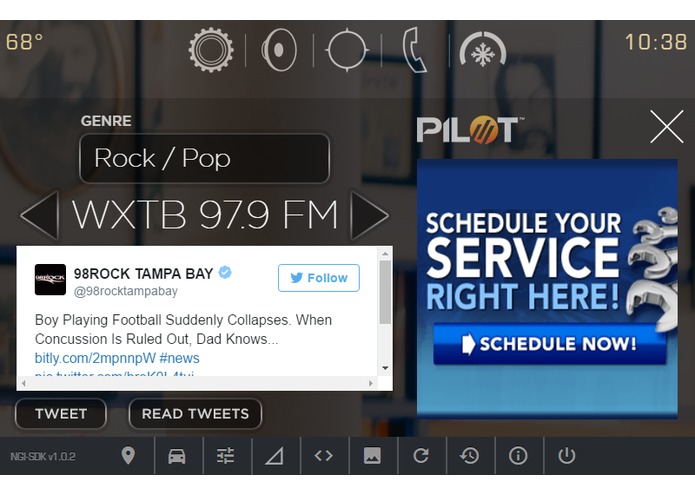
Radio++ in action!
Inspiration
The United States and most of the world boast near-ubiquitous over-the air AM and FM radio systems that offer a rich array of free content. Automobiles for the past 40+ years have provided mobile access to this extraordinary network. The network’s content is often locale-sensitive, providing news, information, and music unique to a local city or community. Further, local radio is often differentiated by live hosts who provide various degrees of interactivity and spontaneity for the listeners’ enjoyment. This is part of what makes radio so special.
Increasingly, FM and AM radio broadcasters have also supplemented their information with Internet-based content via Facebook, Twitter, Emailing, and streaming services.
Modern GM vehicles also provide programmatic access to the Internet. This provides application developers with an unprecedented ability to create ‘hybrid’ in-car experiences combining traditional radio with Internet content.
Team PILOT proposes to demonstrate how GM cars can provide unique experiences combining the power of traditional radio, Internet connectivity, and the car itself. We will enable users to quickly skip to preferred radio stations by genre, overlay the station’s Twitter feed onto the listening experience, show station Twitter images while the car is in motion, and provide actionable broadcaster advertisements when the car is at rest. Collectively, this will show how GM and radio broadcasters can provide a premium driving and listening experience to consumers.
What it does
The app will aim to demonstrate the following capabilities:
Tuner control
- Tune to next/previous stations according to a genre via a button on the steering wheel or dash.
Targeted Internet Access
- Access twitter feeds associated with local stations
- Show the station’s twitter image and metadata on the radio’s screen
- Read station tweets over the radio via text-to-speech over the radio
- Allow user to post to the station’s Twitter feed (ideally via Speech to Text)
- Allow user to call the radio station (to enroll in contests, request songs, etc)
Access to car sensors
- Show a sponsor advertisement when the car is at rest
- Show the station’s twitter logo when the car is moving
- Provide navigation to a sponsor via the add
- Provide the ability to call a sponsor
How we built it
Plain ol' JavaScript and HTML
Challenges we ran into
HTTPS support within the car and general debugging. The GM team is really awesome with their help!
Accomplishments that we're proud of
The SDK is helping us show how a cohesive listening experience can work.
What we learned
Emulators are great, but testing on real devices can't be beat.
What's next for Radio++
Hopefully this will serve as an great first example of how broadcasters and leaders like GM can provide amazing, next-gen listening experiences,


Log in or sign up for Devpost to join the conversation.