Inspiration
Artificial intelligence is advancing rapidly, yet individuals, teams, and institutions often struggle to transform at the same pace.
The problem is not always a lack of technology. Frequently, the real gap lies in human readiness for transformation: the ability to recognize barriers, interpret change, adapt behavior, and convert insight into sustained action.
RADEM HUTIS Agent was created to address this gap.
HUTIS — Human Transformation Intelligence System — is designed to move beyond conventional assessment tools. Instead of simply producing a score, it aims to understand how ready a person or organization is for transformation, what may be blocking progress, and what actionable pathway could help move them forward.
Our goal for this hackathon is to transform an existing human transformation readiness concept into an AI-powered, agentic workflow running on open AI infrastructure.
What it does
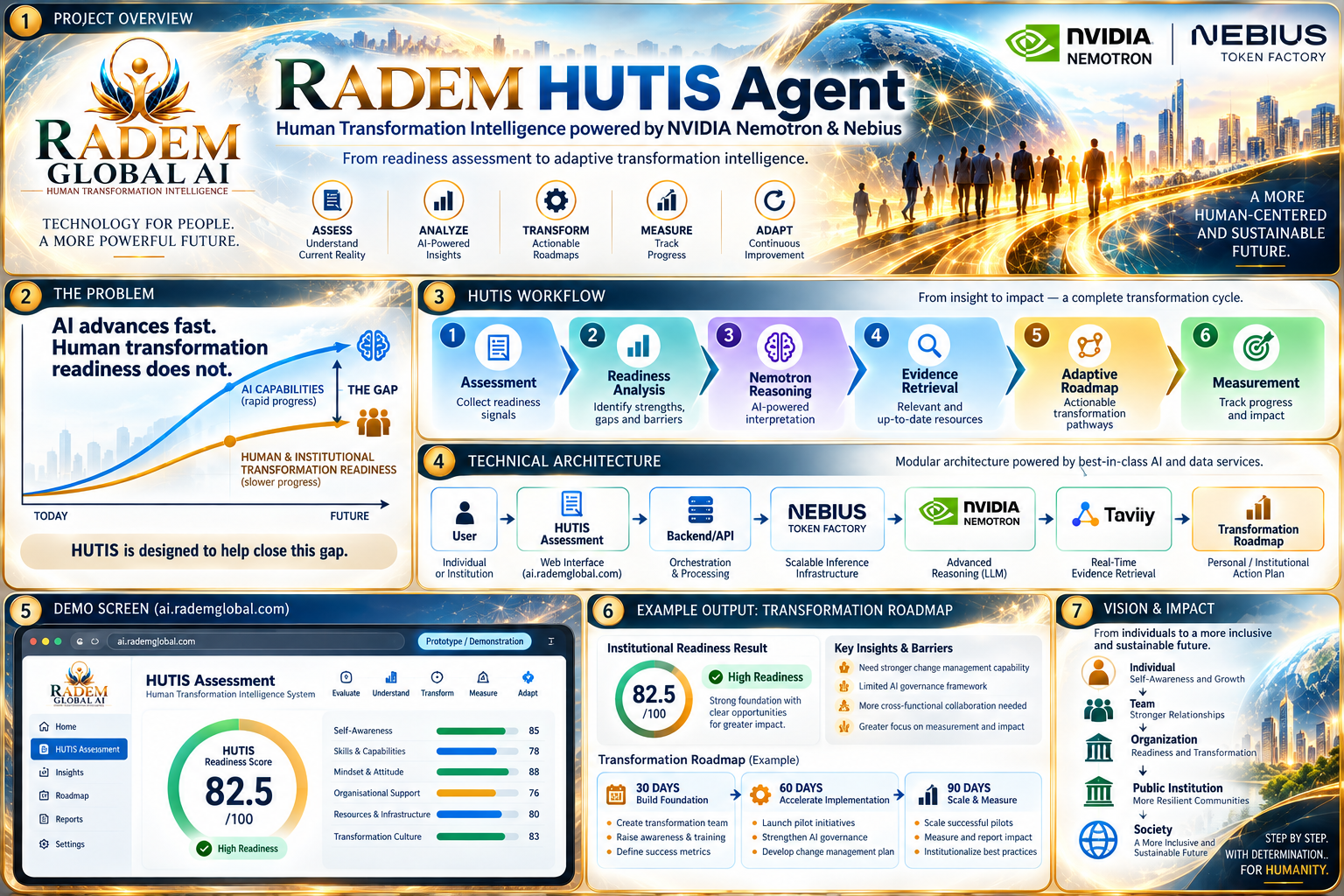
RADEM HUTIS Agent guides a user through a structured transformation-readiness assessment and converts the responses into an adaptive transformation pathway.
The system is designed as a multi-step workflow:
- Collect readiness signals through a structured assessment.
- Analyze transformation dimensions and identify possible strengths, gaps, and barriers.
- Reason across the results using an NVIDIA Nemotron model served through Nebius.
- Generate an adaptive transformation roadmap rather than a generic recommendation.
- Retrieve relevant external evidence and resources, where appropriate, to strengthen recommendations.
- Present the result as actionable transformation intelligence that can be revisited and measured over time.
The objective is not to replace human judgment. The system is designed to augment reflection and decision-making by turning fragmented readiness data into structured, understandable, and actionable intelligence.
How we built it
For the hackathon version, we are developing HUTIS as an agentic application built around Nebius Token Factory and NVIDIA Nemotron.
Nebius Token Factory provides the inference layer for the reasoning workflow, while NVIDIA Nemotron is used to interpret assessment outputs, connect multiple transformation signals, and generate context-sensitive pathways.
The architecture separates several layers:
- Assessment layer — collects structured human transformation readiness signals.
- Scoring and interpretation layer — converts responses into measurable dimensions.
- Agent reasoning layer — uses NVIDIA Nemotron through Nebius Token Factory to analyze patterns and determine next-step logic.
- Evidence layer — can use Tavily to retrieve relevant current information and supporting resources.
- Action layer — produces a personalized transformation roadmap.
- Interface layer — allows users to experience the process through a simple web-based workflow.
This separation is important because HUTIS is intended to evolve from a static assessment into an intelligent system capable of connecting data → interpretation → reasoning → intervention → measurement.
What is new for this hackathon
HUTIS existed before the hackathon as a transformation-readiness methodology and early MVP concept.
During the Nebius x NVIDIA Global AI Hackathon, we are significantly extending it by building:
- an NVIDIA Nemotron-powered reasoning layer,
- Nebius Token Factory integration,
- an agentic multi-step workflow,
- adaptive roadmap generation,
- evidence retrieval capabilities,
- and a deployable demonstration environment.
The hackathon project therefore represents a substantial technical evolution from the earlier assessment concept into an AI-powered Human Transformation Intelligence Agent.
Challenges we faced
One of the main challenges is turning a human-centered methodology into an AI workflow without reducing complex human transformation to a simplistic chatbot interaction.
We therefore focused on maintaining a clear distinction between:
- structured assessment data,
- deterministic methodology,
- AI-supported interpretation,
- and user-facing recommendations.
Another challenge is designing a system that is useful while remaining explainable. Instead of asking the model to generate unrestricted advice, the workflow constrains reasoning around defined transformation dimensions and structured outputs.
We are also exploring how to balance model capability, latency, and cost across different reasoning tasks using the Nemotron family through Nebius.
What we learned
Building HUTIS as an agent has reinforced an important lesson: the most valuable AI systems do not simply generate text — they coordinate reasoning, tools, data, and actions around a real human problem.
Nebius Token Factory and NVIDIA Nemotron allow us to explore how open AI infrastructure can support a system that moves from assessment toward autonomous but human-centered transformation workflows.
We also learned that agentic architecture is especially valuable when recommendations require several stages of reasoning rather than one prompt and one response.
What's next
Our next objective is to extend HUTIS from an individual readiness agent into a broader Human Transformation Intelligence architecture for teams, organizations, education, public institutions, and human-centered AI adoption.
Future versions can include:
- longitudinal transformation measurement,
- organizational readiness analysis,
- intervention tracking,
- multilingual interaction,
- institutional dashboards,
- and adaptive learning from repeated assessments.
The longer-term vision is simple:
Technology measures performance. HUTIS aims to help measure and strengthen the human capacity to transform.
Built With
- agentic-ai
- ai-agents
- fastapi
- human-centered-ai
- javascript
- llm
- machine-learning
- nebius-ai
- nebius-token-factory
- nvidia
- nvidia-nemotron
- python
- rest-api
- retrieval-augmented-generation
- tavily
- web


Log in or sign up for Devpost to join the conversation.