Inspiration
Social media scams are becoming harder to spot. People are targeted through DMs, fake marketplace listings, phishing links, voice calls, fake job posts, investment schemes, and impersonation scams. I built RadarAI to help users quickly check suspicious content before they click, reply, send money, or share personal information
What it does
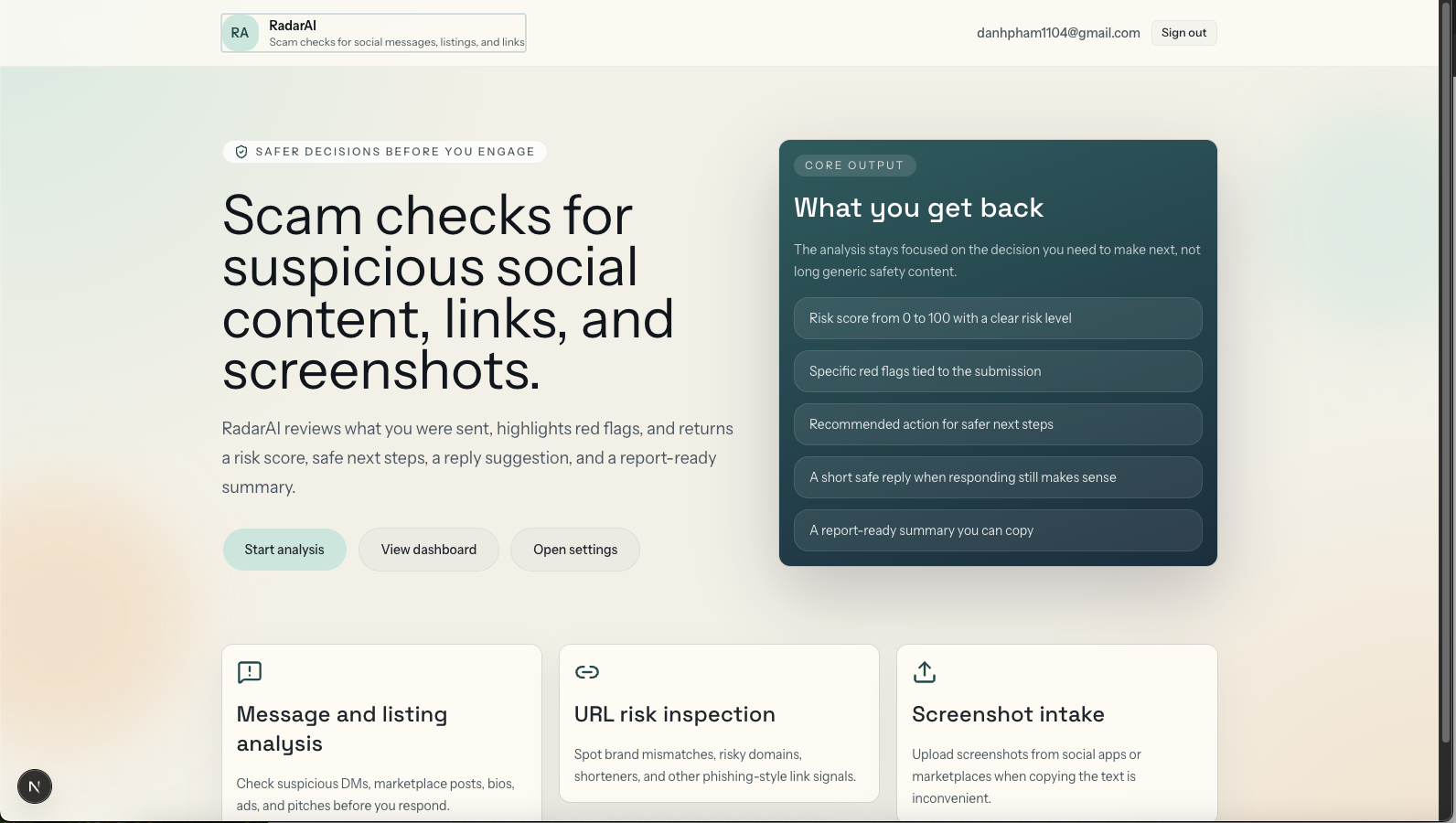
RadarAI analyzes suspicious text, URLs, screenshots, and voice transcripts to detect potential scams. It gives users a risk score, identifies likely scam categories, explains red flags, recommends safe next steps, generates a safe reply, and creates a report-ready summary
How I built it
I built RadarAI with Next.js, TypeScript, TailwindCSS,, speech-to-text transcription, OCR, and an AI analysis pipeline using OpenAI with backend in FastAPI and Pythno
Challenges I ran into
The biggest challenge was handling different scam formats consistently. A scam can appear as a short DM, a fake shopping page, a screenshot, or a voice message, because apparently fraud needed omnichannel distribution
Accomplishments that I'm proud of
I are proud that RadarAI supports multiple input types, explains scam risk in plain language, and gives users practical next steps instead of vague warnings. I also built the project with a scalable architecture that can support future integrations like browser extensions, messaging agents, and organization dashboards
What I learned
I learned how important it is to combine AI reasoning with structured rules, extraction tools, and clear user experience. I also learned that scam detection is not just a classification problem. It is a trust, safety, privacy, and usability problem
What's next for RadarAI
browser extension, iMessage, multilingual scam detection. Make it more accessible to everyone
Built With
- deepgram
- fastapi
- neon
- nextjs
- openai
- postgresql
- python
- redis
- typescript
- vercel


Log in or sign up for Devpost to join the conversation.