Inspiration
I was inspired by the challenges that can occur when patients need diagnostic imaging but the required imaging resources are not available at the facility they are referred to. In resource-constrained settings, this can contribute to delays, unnecessary transfers, and inefficient referral pathways.
I wanted to explore how AI-assisted decision support could help make imaging referrals more resource-aware by considering both the patient’s imaging needs and the resources available at different facilities.
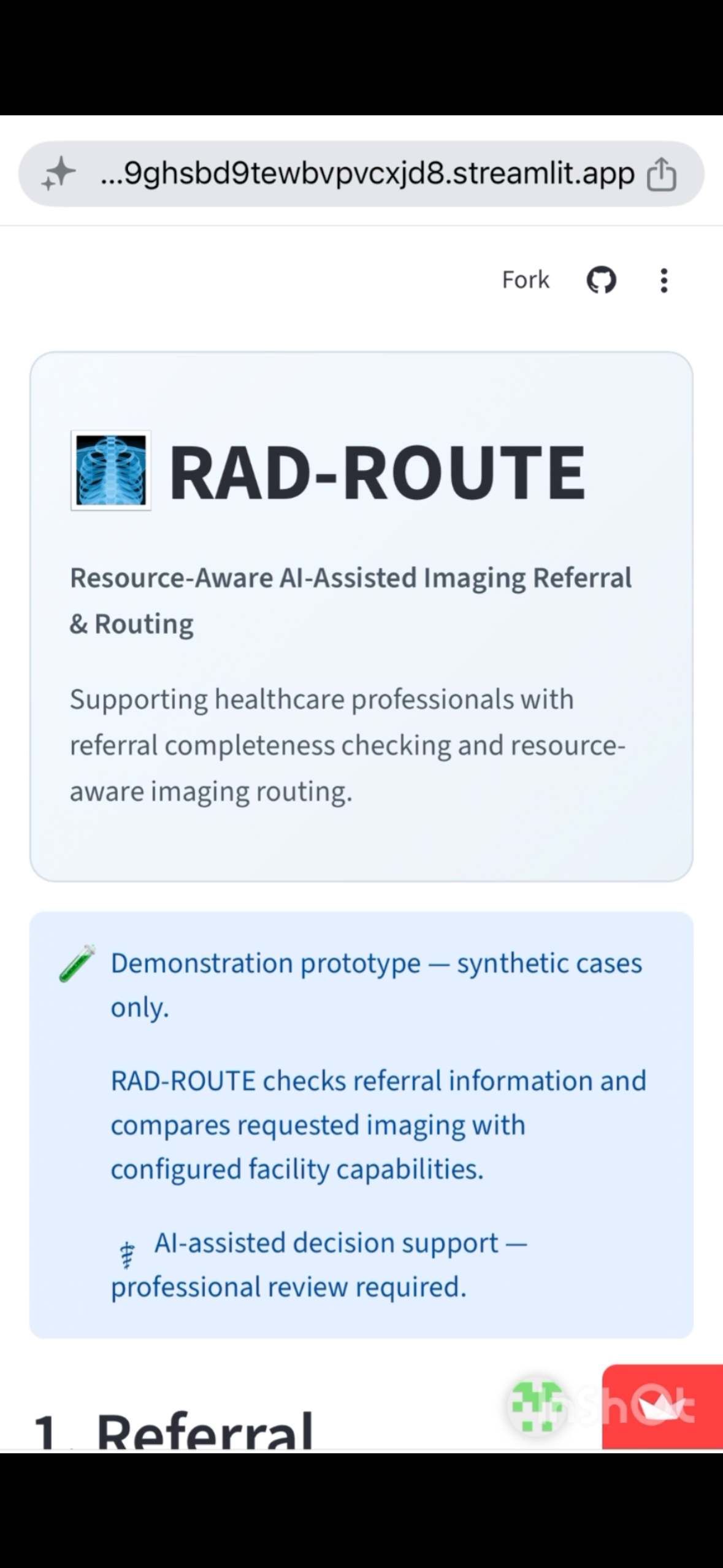
This led me to develop RAD-ROUTE (Resource-Aware AI-Assisted Imaging Referral & Routing).
What it does
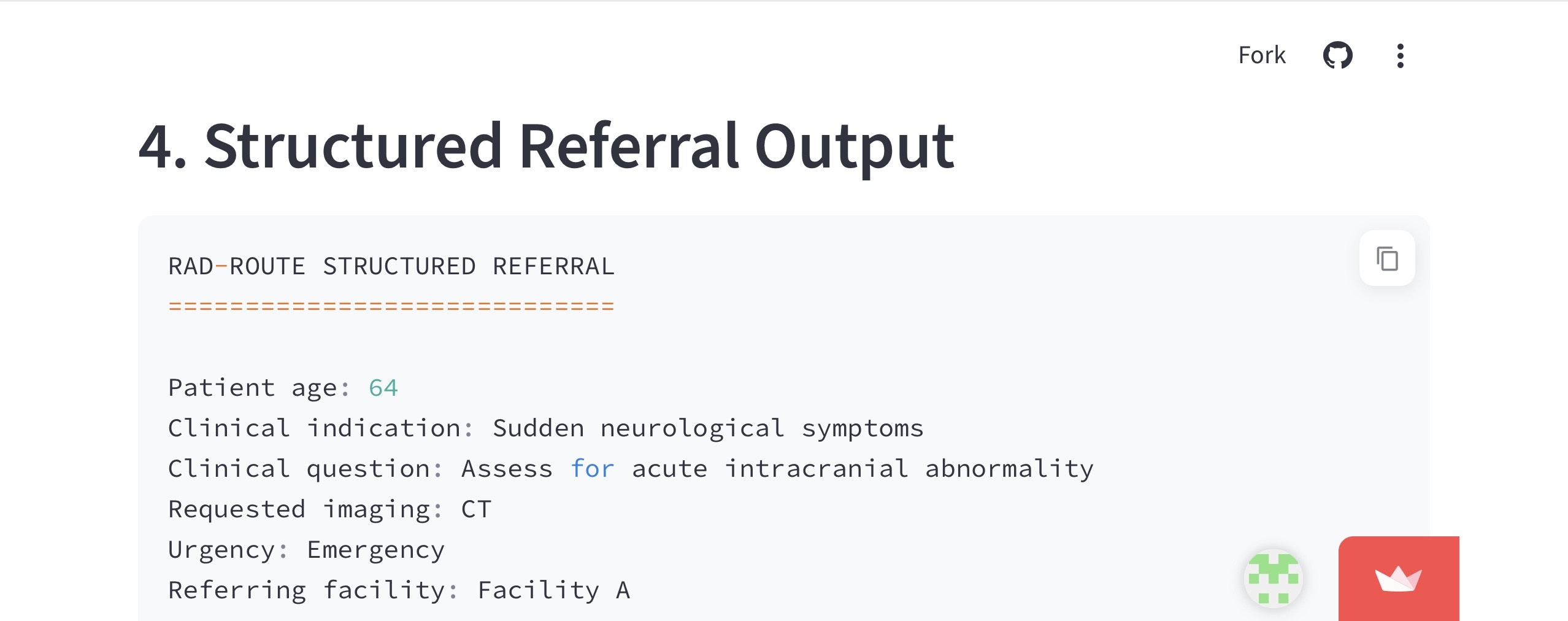
RAD-ROUTE is a prototype that supports the imaging referral and routing process.
It:
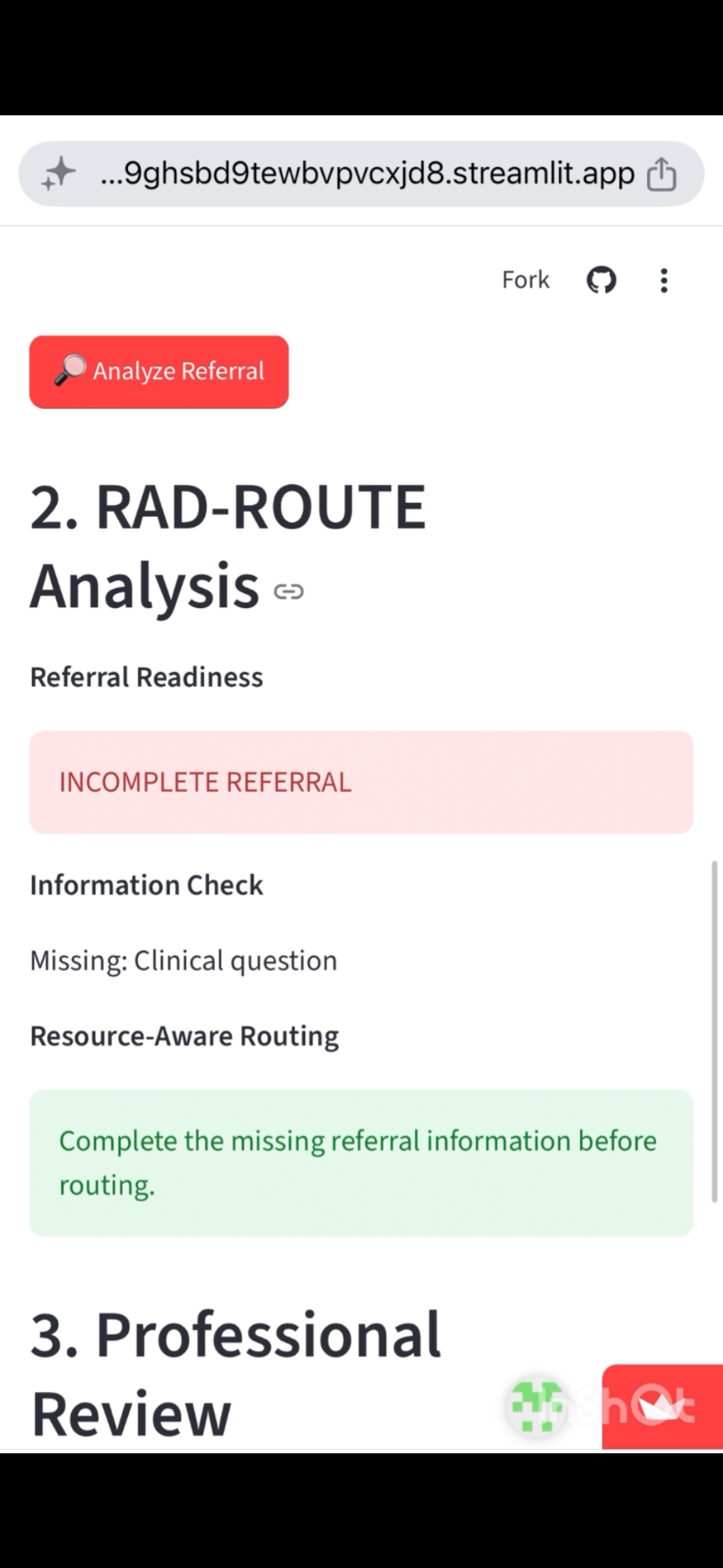
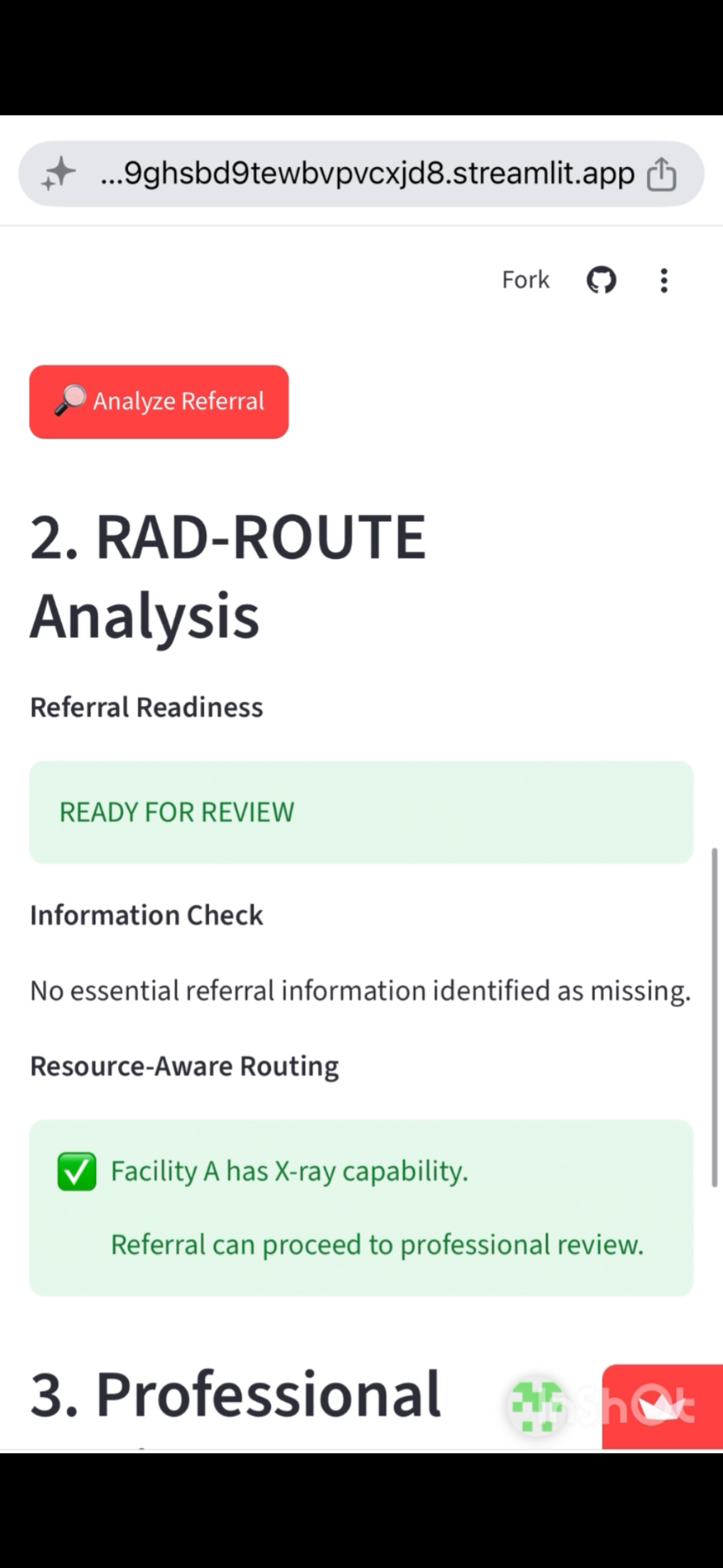
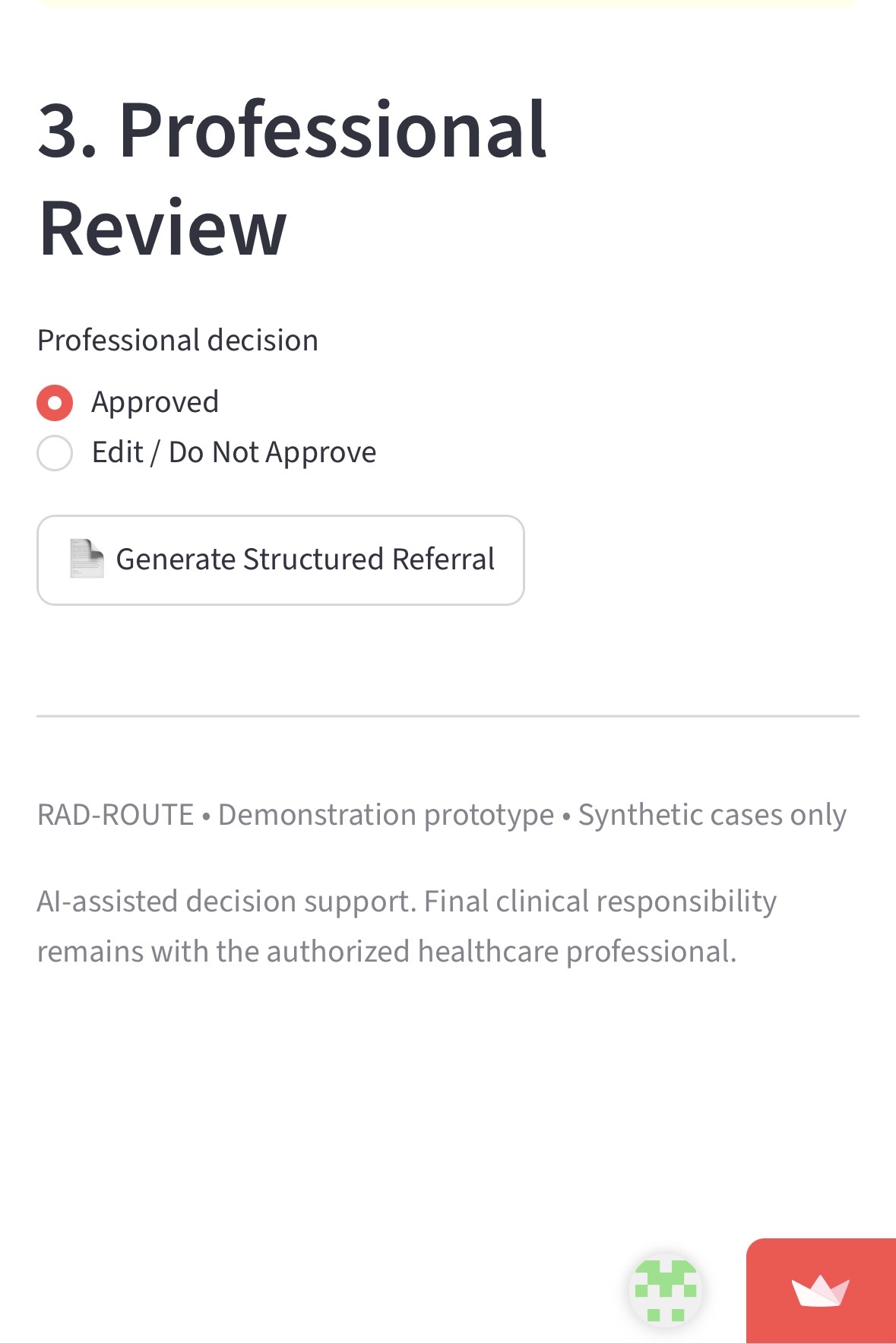
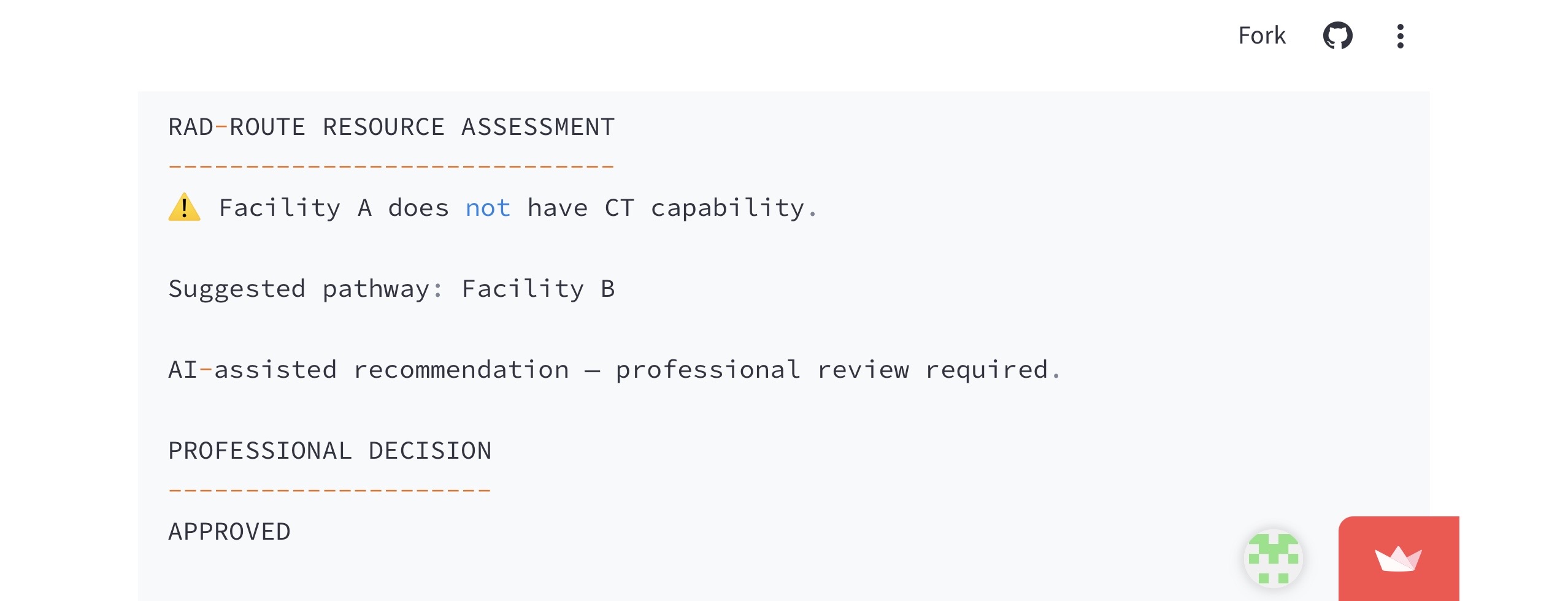
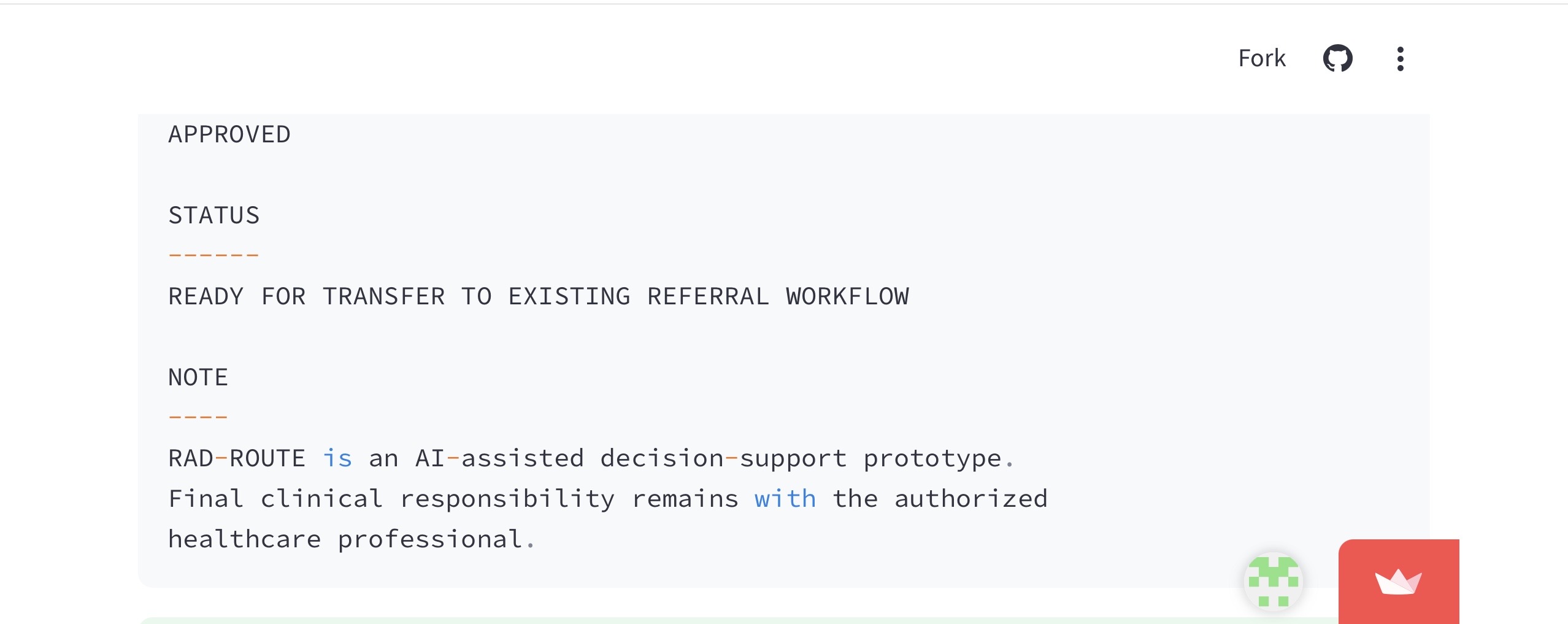
•Collects key referral information such as age, clinical indication, requested imaging modality, and urgency. • Checks whether essential referral information has been provided. • Considers the imaging resources available at different facilities. •Identifies when a facility does not have the required imaging capability. • Suggests an alternative facility with the required resource. • Requires professional approval before a referral can be finalised. • Produces a structured referral outcome that can be used within an existing referral workflow.
The current prototype uses synthetic cases for demonstration purposes and does not replace professional clinical decision-making.
How I built it
I built RAD-ROUTE as a lightweight web-based prototype using Python and Gradio.
I designed the workflow around:
Referral information → Completeness check → Resource matching → Facility routing → Professional approval → Structured referral outcome
I created a simplified facility resource map containing different imaging capabilities. The prototype then compares the requested imaging modality with the resources available at each facility and provides a routing recommendation when the selected facility cannot provide the required service.
I also tested the prototype using different synthetic scenarios, including CT, MRI, X-ray, mammography, and nuclear medicine referrals.
My goal was to keep the prototype simple and accessible while considering the realities of resource-constrained healthcare environments.
Challenges I ran into
One of my main challenges was identifying a specific healthcare problem where technology could provide meaningful support without duplicating existing systems.
I also had to determine how AI could assist with the referral process without making clinical decisions on behalf of healthcare professionals. This led me to design RAD-ROUTE as AI-assisted decision support, with professional approval remaining an essential part of the workflow.
On the technical side, I encountered challenges with setting up the Python environment, installing dependencies, configuring Gradio, testing the application across devices, and preparing the prototype for online deployment.
I also had to simplify the concept enough to create a functional prototype within the hackathon timeframe while still demonstrating its potential real-world application.
Accomplishments that I’m proud of
I am proud that I was able to take a healthcare problem I identified and turn it into a functioning demonstration prototype.
RAD-ROUTE successfully demonstrates scenarios such as:
• Routing a CT referral away from a facility without CT availability. • Routing an MRI referral to a facility with MRI capability. • Identifying when a facility can accommodate an X-ray referral. • Handling specialised imaging such as mammography and nuclear medicine. •Detecting incomplete referrals before they can be finalised. • Requiring professional approval before finalisation.
I am also proud that I was able to test the prototype across devices and demonstrate how a lightweight browser-based solution could potentially be accessed without requiring specialised hardware.
What I learned
Building RAD-ROUTE taught me that developing healthcare technology is not simply about adding AI to a problem. The solution needs to fit into an existing healthcare workflow and address a clearly defined need.
I learned the importance of:
• Understanding the referral workflow before designing the technology. • Designing around real-world resource limitations. • Keeping healthcare professionals involved in important decisions. • Using structured information to support consistent routing. • Testing a prototype using different realistic scenarios. • Iterating and troubleshooting when technical problems arise. • Starting with a focused working prototype before expanding the system.
Most importantly, I learned that a relatively simple prototype can demonstrate how technology could support a larger healthcare process.
What’s next for RAD-ROUTE
RAD-ROUTE is currently an early demonstration prototype. My next step would be to validate the concept with healthcare professionals and better understand how imaging referral pathways operate across different healthcare settings.
Future development could include:
•Integration with verified facility resource databases. • More comprehensive imaging and facility capability mapping. • Integration with existing referral systems. •Offline and low-connectivity functionality. •Improved interoperability with healthcare information systems. • Referral audit trails. • Accessibility and multilingual features. • Further development of AI-assisted resource matching. • Testing with appropriately governed real-world data. • Pilot testing in selected healthcare settings.
My long-term goal is to develop RAD-ROUTE into a practical resource-aware referral support tool that can help healthcare professionals navigate imaging access more efficiently, particularly in settings where diagnostic resources are unevenly distributed.

Log in or sign up for Devpost to join the conversation.