Built by a data center construction cost professional to solve a problem I face at work.
Inspiration
The question I hear now is not "what does a 15 kW hall cost?" It is "we're building for 135 kW GB300 racks today. What do we put in now so we aren't tearing it apart for 600 kW Kyber racks? What does the whole project really cost? And when do we have to order the transformers?" Answering that usually takes an estimator, an MEP engineer, a scheduler, a commissioning agent and several weeks. I wanted the answer in seconds.
What it does
RackReady AI designs, prices, schedules and stress-tests an AI data center while you type. For a greenfield build, pick a size, a GPU platform, a location, a redundancy level and a future-proof horizon.
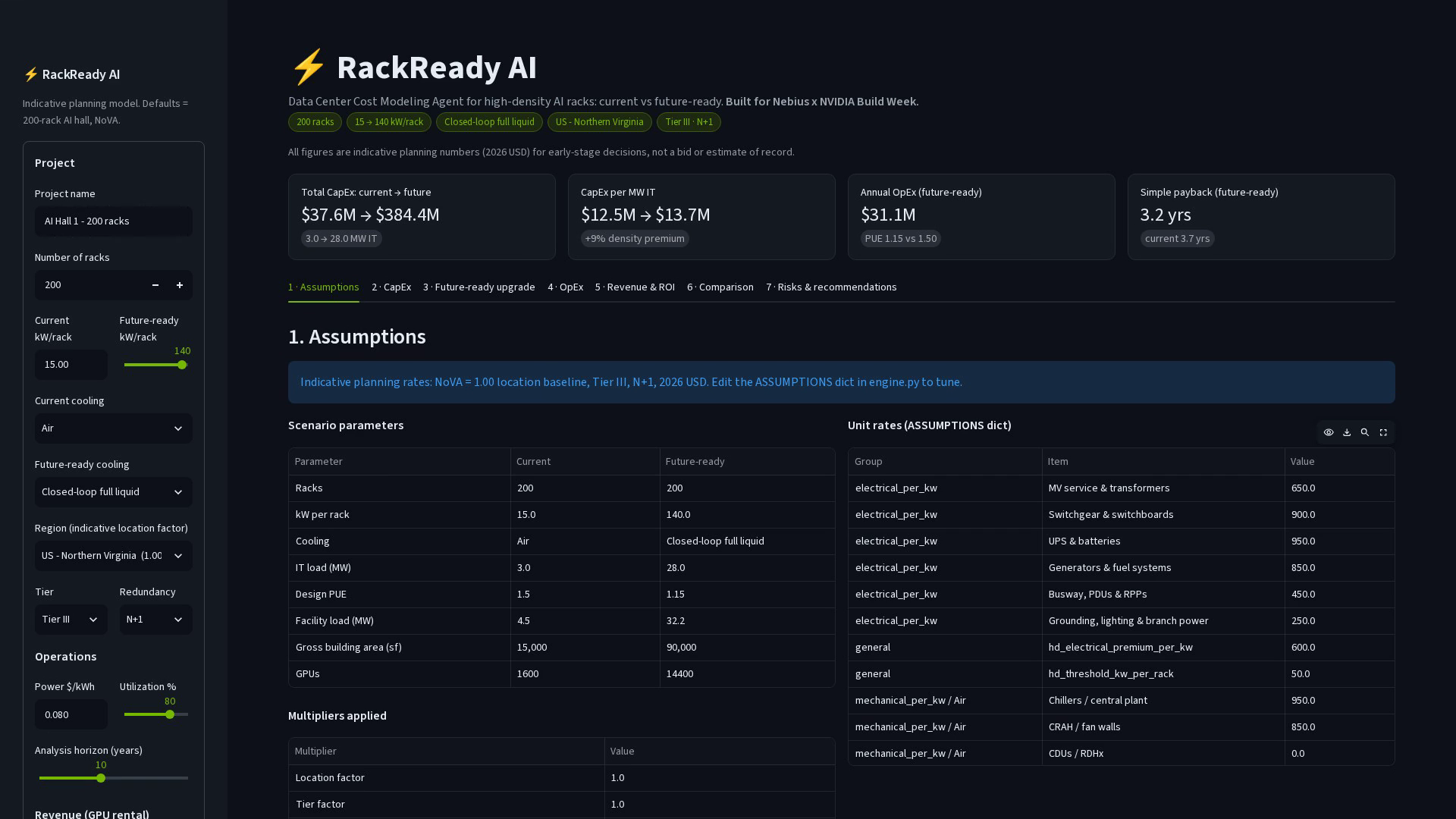
First screen: total cost, cost per MW, payback, ready-for-IT months and a one-line verdict.
Eight tabs, in the order you'd decide:
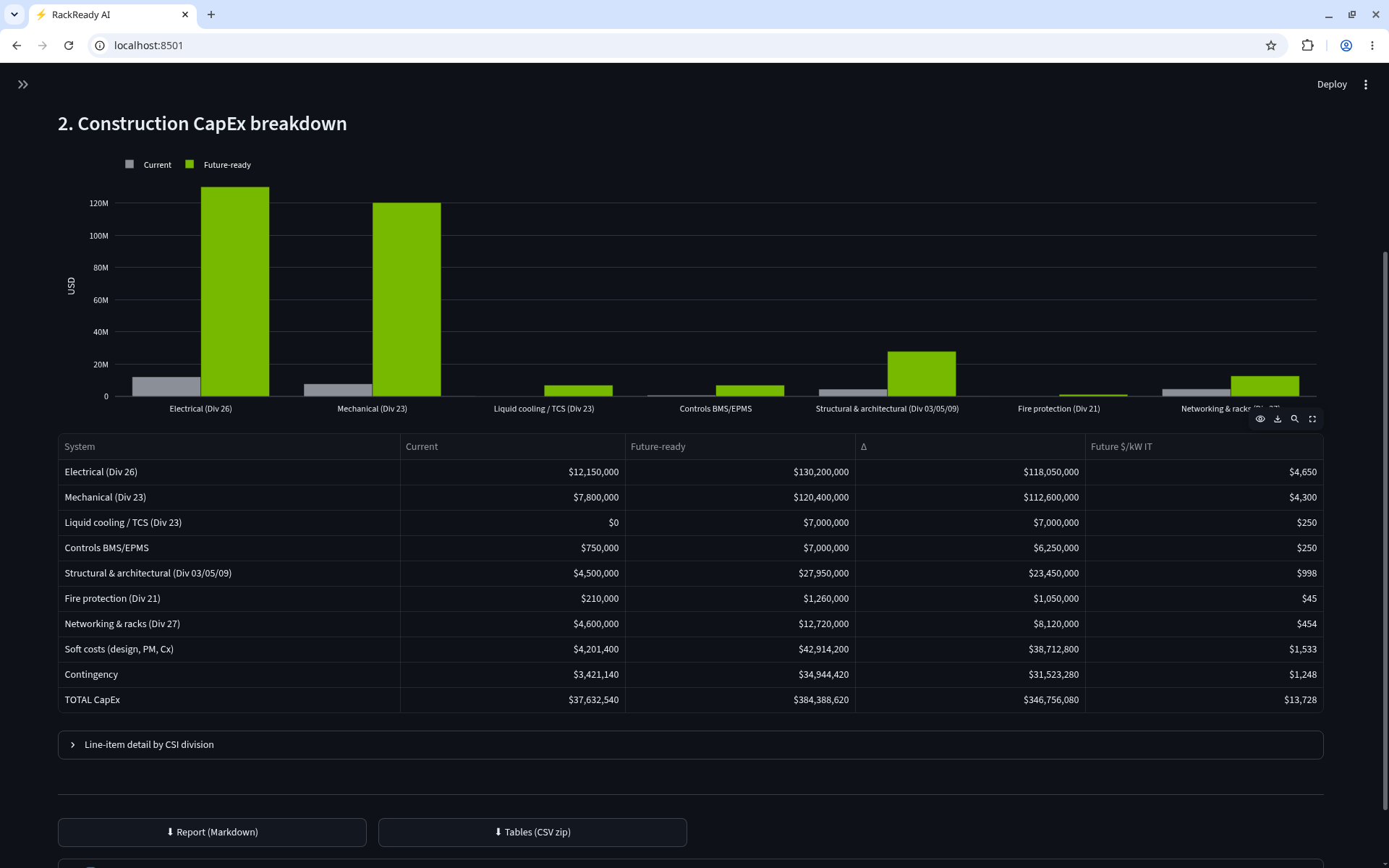
- 💰 Costs: 13 end-to-end cost lines, from facility, land and utility to GPU hardware, AI fabric, commissioning and spares. Each has an "Include in total" tick box. The total is always the sum of the ticked lines, everywhere.
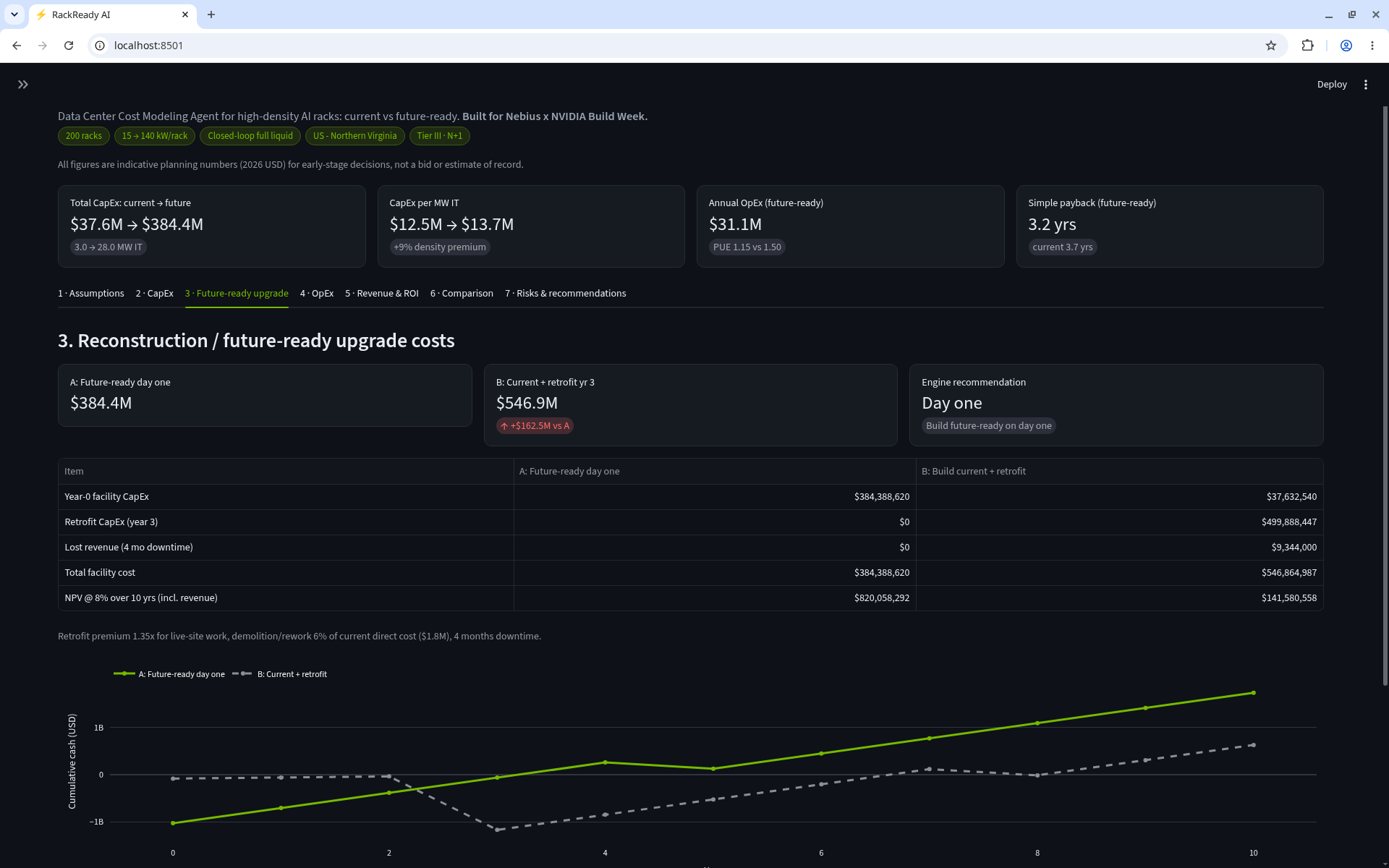
- 🔮 Future-ready: for 5, 10 or 15 years out (230 kW, 600 kW and 1 MW racks), it compares retrofitting later, building in provisions now and building the full future design on day one, and lists every provision with the reason it pays.
- 📐 Design calculations: utility MVA, MV switchgear, transformers, generators and fuel, UPS, A/B rack feeds, busway loading, cooling tons, CDUs, coolant flow, NFPA 13/20/22/2001 fire protection, water, stormwater, fiber, floor loading and land. Each step shows its formula, inputs and code basis.
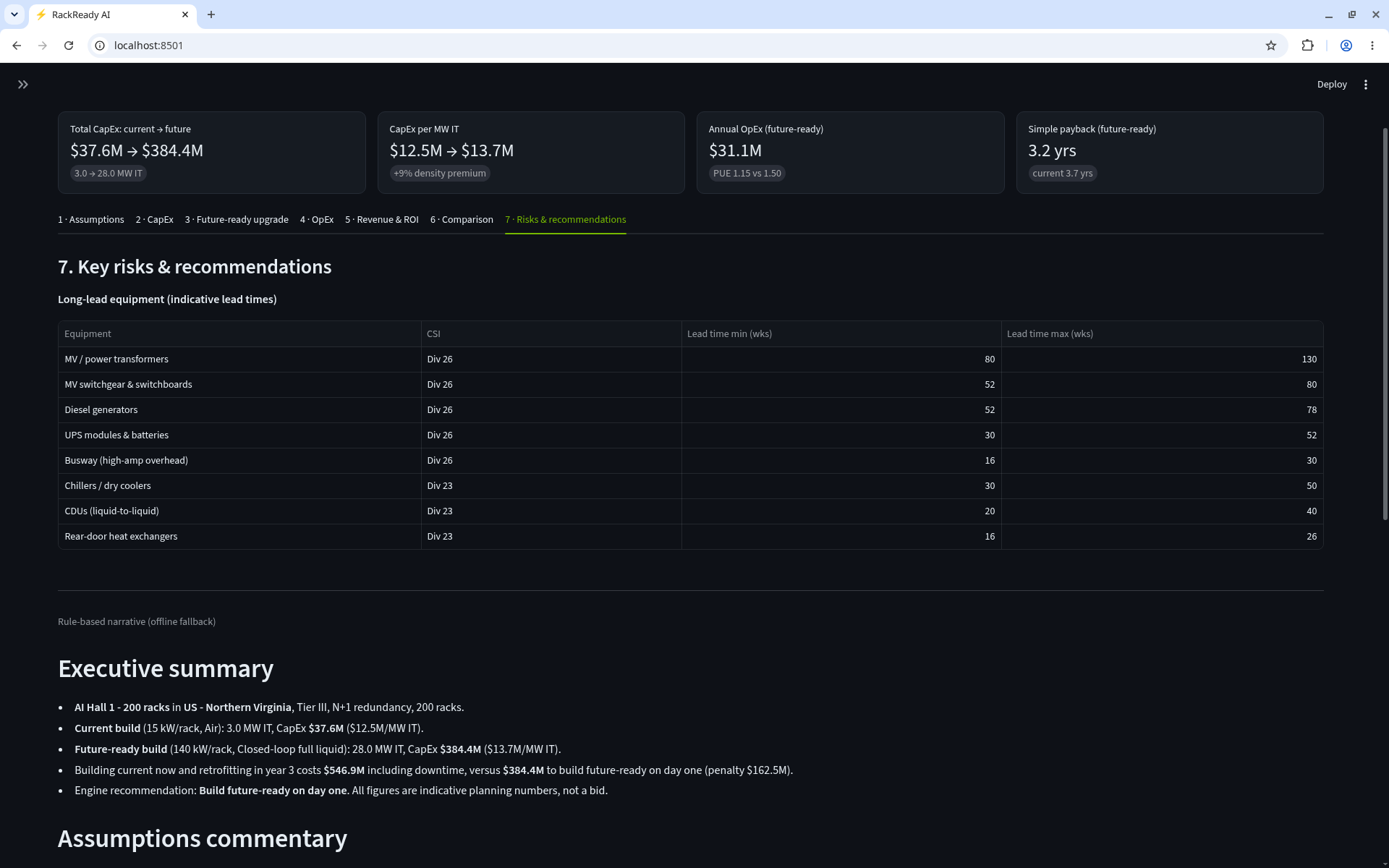
- 🗓️ Schedule & risks: a Gantt chart that scales with MW, what sets the finish, and when to send each RFQ and place each order. A risk register switches on from your inputs (power, transmission, community, water, gas, financing, equipment slots, labor), with proven fixes.
- 📜 Codes & procurement: the latest code editions, checked on the publishers' sites, a "confirm locally" checklist and US lead times and tariff risk for 11 long-lead packages, with verified suppliers listed alphabetically.
- 🏗️ Build & commission: L1-L5 commissioning, the liquid-loop hard stop, load banks, integrated-test failure scenarios, handoffs and QA checklists.
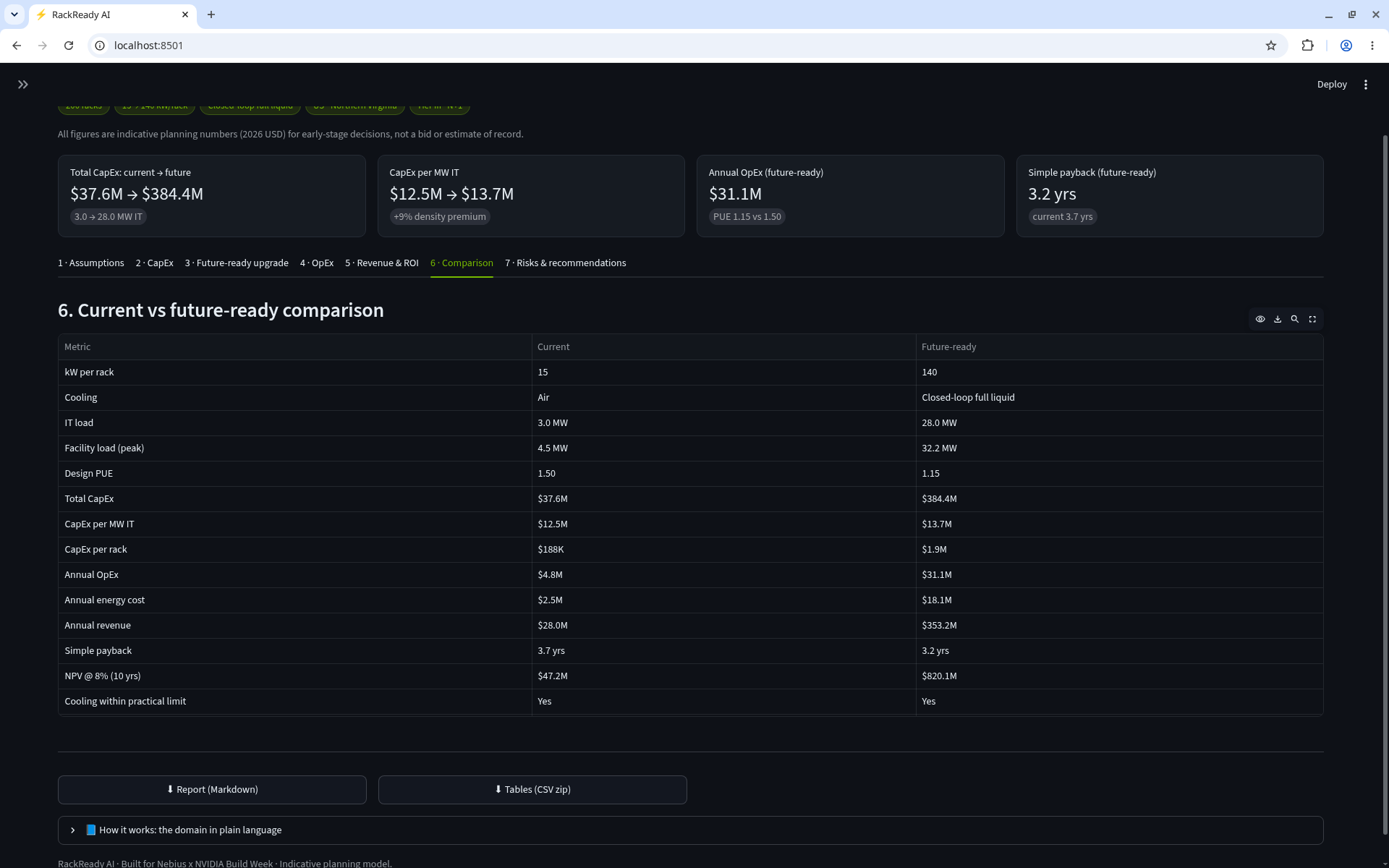
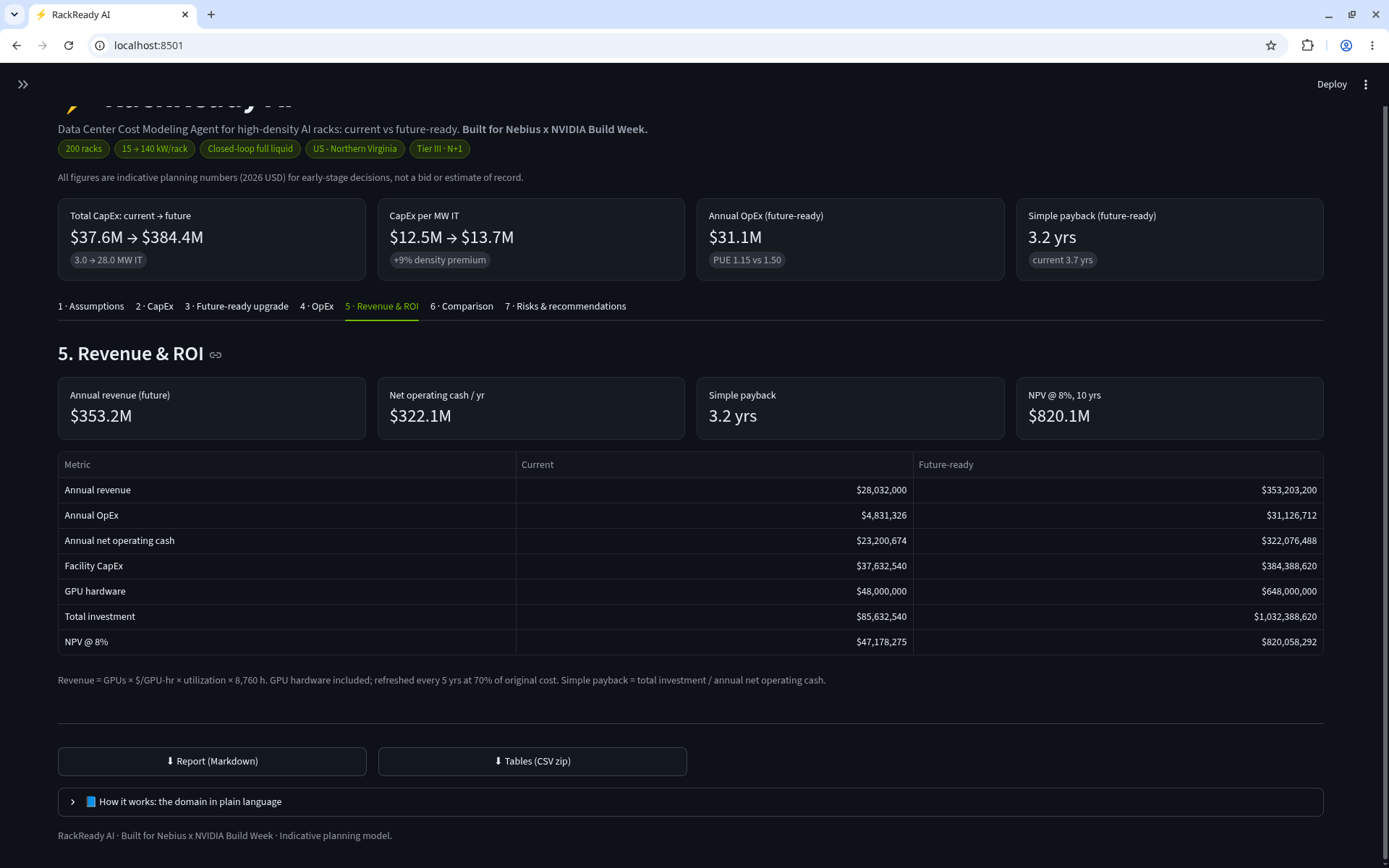
- 📈 Operations & ROI: opex, revenue, NPV, payback and cash flow.
- 📚 Assumptions & sources: benchmark checks against public 2025-26 data.
Auto-D2C: above 45 kW/rack, every design switches to direct-to-chip liquid cooling. Why Nemotron: the engine computes every number. Nemotron (nvidia/Nemotron-3.5-Super-VL) on Nebius Token Factory turns the results into a plain-English brief on what to build now and the main risks. It is told never to change a number; if the call fails, a rule-based summary is shown. Exports: one-page PDF, checklist PDF, full Markdown report and CSV tables.
Default preset: 100 MW greenfield GB300 NVL72 campus, N+1
- 741 racks on D2C, PUE 1.20, 156 MVA, 50 × 3 MW generators, 30,024 tons, 67 CDUs.
- $2.33B with the default lines ($23.3M/MW). $6.08B with every line ticked, including GPUs and fabric. Payback about 3.1 years.
- Ready for IT about 41–51 months from start. The transformers set the finish, so their RFQ goes out now.
- 10-year verdict: build in provisions now for $1.02B present cost, vs $1.23B to retrofit later.
How we built it
- Python and Streamlit, with a deterministic engine (design, cost lines, schedule, commissioning, codes, procurement) and an AI layer.
- The engine owns every number. Nemotron receives the results as JSON over Token Factory's OpenAI-compatible API, streamed, with reasoning stripped, and is told never to change or invent a figure.
- Verified: every value, range, code edition and supplier source is listed with its public link in
docs/VERIFICATION.md. - Tested: 135 automated tests, including:
- a fuzz test over every project type × platform × redundancy × horizon plus random edge inputs (no errors, no NaN, no negative lines, totals always add up, the PDF always one page);
- hand-worked code examples;
- AppTest on every preset, platform and tab.
- Compliance: licenses, privacy (no personal data, no analytics), accessibility (WCAG AA contrast), a secret scan of the full git history and plain-language Terms of use are in
docs/COMPLIANCE.mdandTERMS.md.
Challenges we ran into
- Making it true. Many common figures failed checking:
- generators sized at kW/0.8;
- clean-agent quantities missing the specific-volume term;
- tower make-up at 1.5 gpm per 100 tons (physics gives about 3);
- a 4-hour generator test (NFPA 110 requires 2 hours).
All are corrected.
- One total everywhere. We added network, fiber, racks, commissioning and spares without double counting by carving them out of the facility cost so everything adds back to the same number.
- Honest schedules. In 2026 the power chain, not construction, sets the finish, so the app gives a range, never a single date.
- Edge cases. The fuzz test caught negative cost lines on one-rack sites. Redundancy savings are now capped.
Accomplishments that we're proud of
- Every number traces to a formula, a code, a public source or a labelled assumption.
- Design, full project cost, schedule, procurement, commissioning and the future-ready decision live in one screen, in seconds.
What we learned
- PUE is an annual energy ratio, not a peak multiplier, and liquid cooling never captures 100% of the heat.
- Grid capacity and long-lead equipment decide the schedule, and community and water issues can stop a project before either does.
- A reasoning model shines when it explains numbers instead of computing them.
Limitations and what's next
Limitations
- Early budget estimate (±30–50%) from generic public benchmarks, not site quotes.
- US codes, procurement and suppliers only; other locations change only cost, land and power price factors.
- No site-specific utility or interconnection data. Schedules are month ranges that depend on the utility and the AHJ.
- The AI text can be wrong; every number comes from the engine. A licensed engineer and the AHJ must review any design.
Next
- Site and utility inputs, local cost data for more locations and more GPU platforms.
- Excel export and phased campus builds.
- Nemotron answering what-if questions by calling the engine as a tool.
Early budget estimate (±30–50%), not a bid, and not engineering, legal or financial advice. A licensed engineer and the authority having jurisdiction must review any design. NVIDIA, Nebius and product names are trademarks of their owners; this project is not affiliated with or endorsed by them.

Log in or sign up for Devpost to join the conversation.