-
-
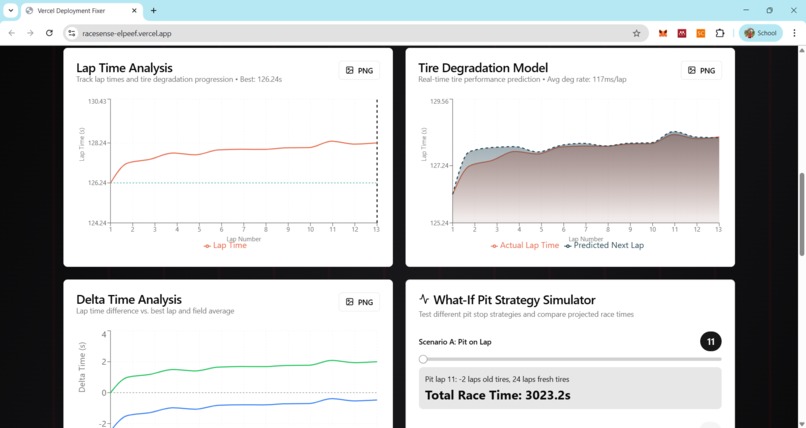
Charts Analysis
-
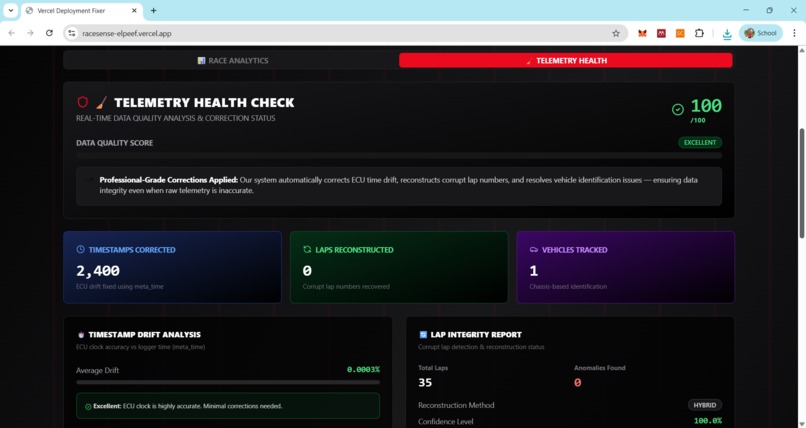
Telemetry Health
-
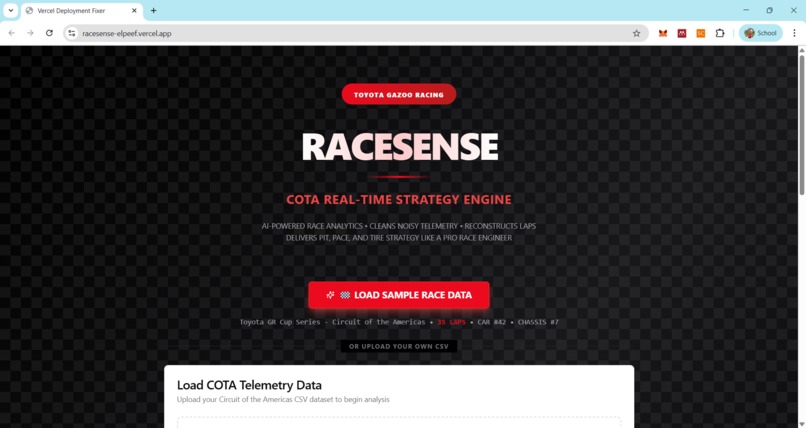
The homepage UI
-
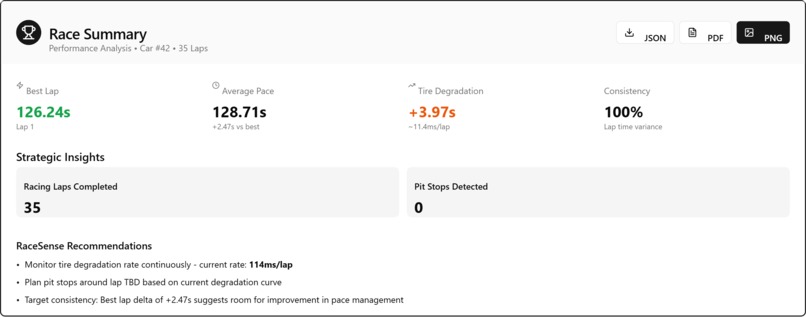
Race Summary


🏎️ Project Story – RaceSense: COTA Real-Time Strategy Engine
🌟 About the Project
🎯 Inspiration
This project was born literally within hours after I found out that the telemetry competition dataset had gone public. At the same time, I’m currently deep in my dissertation, while also being a full-time husband and dad. So the biggest challenge was obvious: limited time, limited energy, but unlimited curiosity.
I’ve always been fascinated by how race engineers make split-second decisions based on messy, imperfect data. When I saw the known issues in this dataset—drifting ECU timestamps, missing lap counts (sometimes even jumping to 32768), inconsistent car IDs—I instantly felt: “Okay, this is the perfect playground for data engineering and real-time reasoning.”
🏗️ How I Built the Project
The project was built through a fast but structured approach:
- Understanding the Telemetry Chaos
COTA telemetry comes with several issues:
Inaccurate ECU timestamps
Missing or corrupted lap numbers
Car numbers assigned inconsistently
Lap and telemetry files not always aligned
So I started by finding the most stable signals: speed, longitudinal acceleration, GPS traces—and used them as anchors to reconstruct reliable lap boundaries.
- Constructing a Clean Lap Model
To build the “RaceSense Engine,” I set up a pipeline:
a. Timestamp Normalization Deriving a more trustworthy time axis using meta_time (receiver time) + drift compensation.
b. Lap Boundary Reconstruction
Detect lap start via GPS loop closure
Cross-check with speed troughs + location clustering
Rebuild lap numbers sequentially and consistently
c. Vehicle Identity Resolver
Prioritizing chassis number as the stable ID
Automatically detecting updated car numbers across sessions
- AI-Powered Racing Insights
Once the data was clean, I built an analysis layer that can generate:
Pace delta analytics
Tire degradation estimation
Pit window optimization
Fuel burn modeling
Sector-level microstrategy insights
This project focuses on the core engine, not a full race simulator. The priority is simple: 👉 Clean noisy telemetry, reconstruct laps accurately, and extract real-time strategy insights.
🧠 What I Learned
Motorsport telemetry is extremely dirty by nature—and that’s what makes it fun.
Data engineering matters far more than fancy modeling—garbage in, garbage out.
Race analytics must be fast and precise, just like the sport itself.
Even with limited time, focusing on core value produces meaningful results.
🧩 Challenges
Very tight timeline. I worked on this in micro-gaps between dissertation revisions, family duties, and everything in between.
Dataset inconsistency. Timestamp drift and corrupted lap counts made reconstruction more complex than expected.
Balancing ideal vs practical. Building a full race model wasn’t realistic in such a short time, so I focused on the most impactful components.
🚀 Conclusion
RaceSense was built from a mix of:
love for data,
passion for motorsport,
a bit of acute stress,
and extremely limited time.
The result is a cleaning + reconstruction + strategy engine that can serve as the foundation for advanced racing analytics.
With further development, RaceSense could evolve into:
a race engineer assistant,
pit strategy advisor,
driver training analytics tool,
or a multi-track real-time telemetry engine.
Built With
- next
- react
- tailwind
- typescript
- vercel

Log in or sign up for Devpost to join the conversation.