-
-
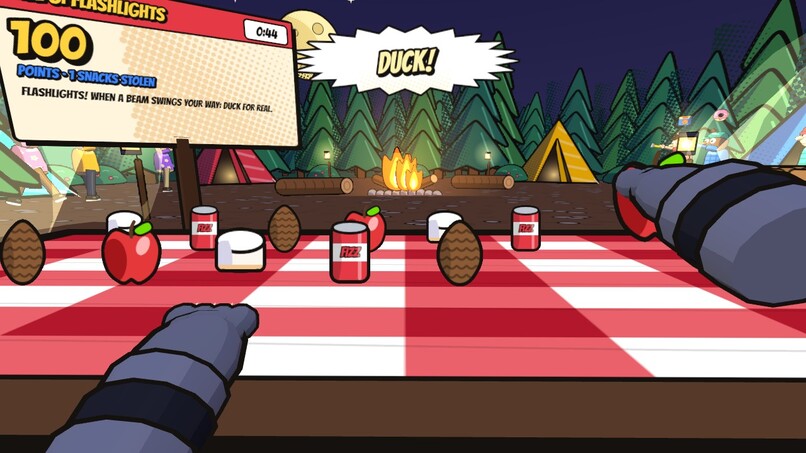
In VR: your raccoon paws, the picnic table and the pop-up comic world
-
Raccoon Rampage: a WebXR comic arcade game for Meta Quest
-
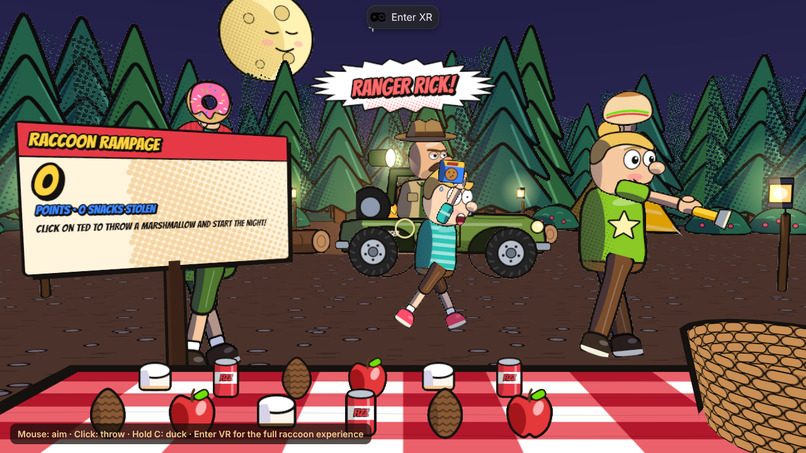
The campsite at night: hit campers with snacks before Ranger Rick shows up
Inspiration
Every camper has seen it happen: a raccoon shows up at night and steals your snacks. I flipped the roles. In VR, you are the raccoon. I wanted a game anyone understands in five seconds, that you play with nothing but your hands, that works sitting on a sofa or a bus seat, and that makes people laugh. I also love comics, so the whole world looks like a pop-up comic book you can step into.
What it does
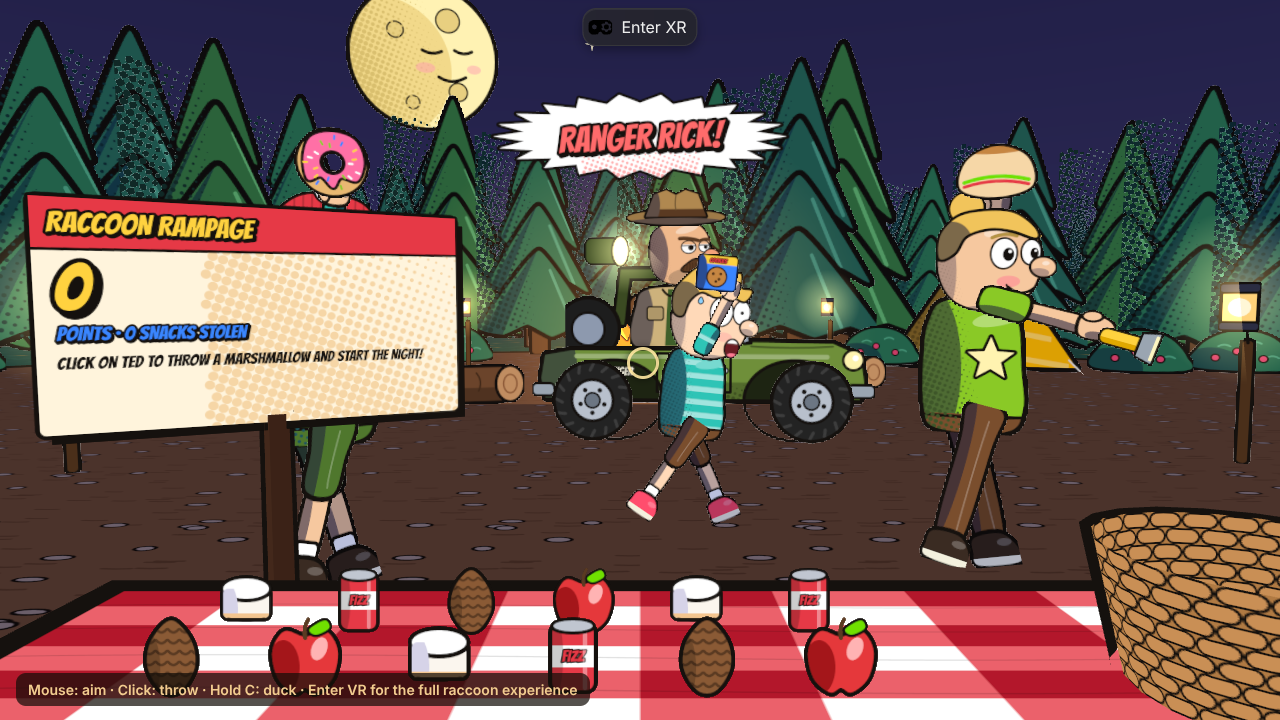
Raccoon Rampage is a hands-first WebXR arcade game for Meta Quest in a hand-drawn comic style. You sit behind a picnic table at a campsite at night and your hands become raccoon paws. Pinch a marshmallow, can, pinecone or apple on the table, swing your hand and let go to throw it at the campers walking by. Every hit goes BONK! (with a comic burst), the camper's face turns to shock, and their snack flies into your stash.
- Tutorial: hit Ted, the camper by the fire, to start the night.
- Wave 1, Snack Thieves: quick hits in a row build a combo multiplier.
- Wave 2, Rush Hour: fast kids are worth double.
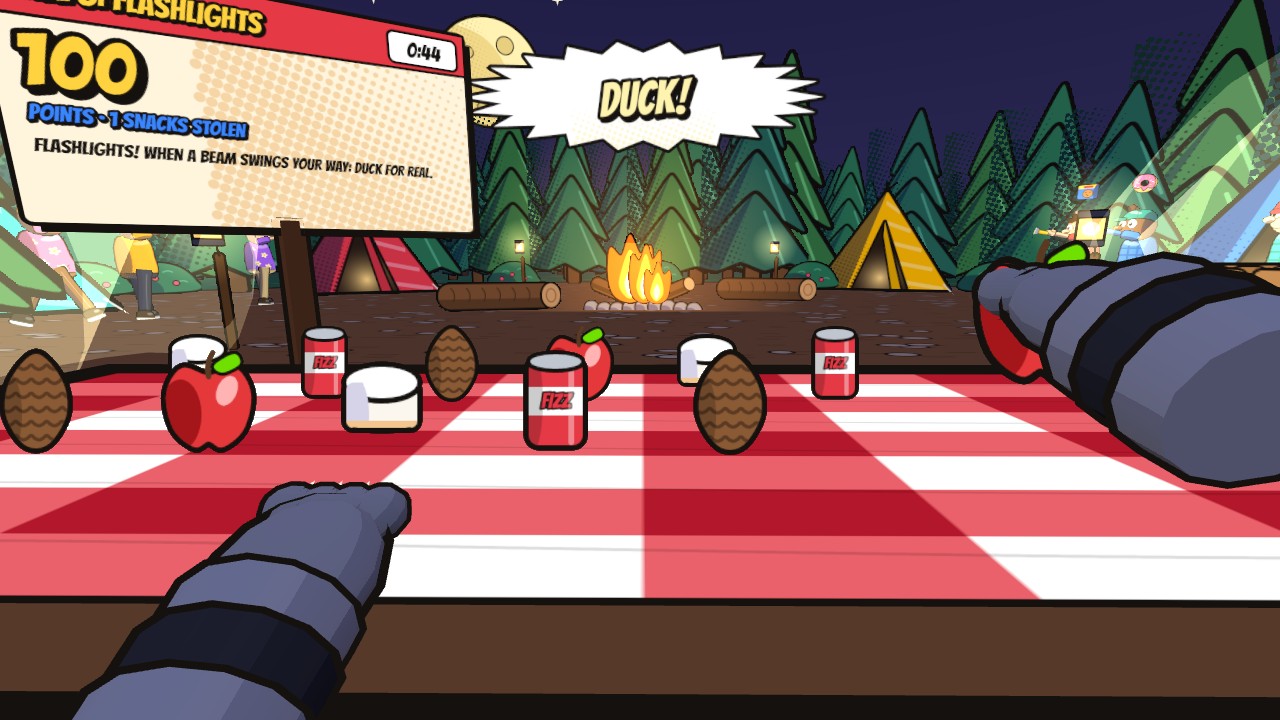
- Wave 3, Flashlights: when a beam swings your way you have to hide: cover your eyes with both paws or duck a little, or you lose snacks.
- Boss, Ranger Rick: he drives his jeep across the camp and throws nets at you (hide or get stunned). A hit on his hat counts double. At half health he gets angry, drives faster and switches on a searchlight.
- Victory makes it rain snacks, and your best score is saved on the device.
No controllers are needed at any point (controllers still work if you prefer them). A full night takes about four minutes. It runs directly in the Meta Quest Browser with no install, and also on desktop with a mouse.
How I built it
- Meta Immersive Web SDK (IWSDK) with its ECS architecture (one game system) and WebXR hand tracking. A pinch is detected from the thumb-tip and index-tip joints with hysteresis, with the WebXR select event as a fallback. Grabbing and throwing use the hand's grip pose.
- Throwing physics: I track the hand's grip pose over the last frames, take the release velocity and simulate a ballistic flight with sub-stepping. Hand releases get a small boost because seated wrist flicks are shorter than full arm throws, and a light aim assist (about 14°) bends good throws onto a target and leads moving campers by their flight time. Simply opening your hand without a swing puts the snack back on the table.
- Seated by design: the resting head height is calibrated per session, so a small 15 cm duck counts whether you sit or stand. Covering your eyes with both paws is an alternative that needs no body movement at all. Every interaction happens within arm's reach.
- Comic art drawn in code. At start-up the game paints every character, prop and backdrop onto canvases: thick ink outlines, flat colours, cool night-time cel shadows and halftone dots, with a bundled comic font for the lettering. In VR they become paper cut-outs and puppets that always turn to face you. The trees stand in layers that get bluer with distance, so the camp reads like a pop-up book with real depth. The picnic table and your raccoon paws are 3D with toon shading and ink outlines.
- Performance: the static backdrop is merged into one mesh per texture (a handful of draw calls), cut-outs use alpha-to-coverage for clean edges, and all sound effects are synthesized with the Web Audio API. There are no model, image or audio files to download.
- I tested everything in the IWSDK Meta Quest 3 emulator (IWER) with emulated hand tracking and a scripted "bot player" that drives the headset and both hands. The demo video was recorded that way, frame by frame.
Challenges I ran into
- Throwing without buttons: a pinch has no clear "release button", so I needed hysteresis on the finger distance and a velocity check, otherwise snacks dropped or flew off by accident.
- Seated hiding: my first version expected a deep, standing duck. Calibrating the head height per session and adding "cover your eyes" made it work seated, and I fixed a bug where a long duck slowly stopped counting.
- Making flat comic art work in VR: layering, puppets that turn towards the viewer and solid 3D objects where your hands are made it feel like stepping into a comic.
- Performance: my first version ran at about 1.5 fps in the software-rendered emulator. Merging the static geometry and switching materials gave roughly an 8× improvement.
Accomplishments that I'm proud of
- A complete hands-only game loop with a tutorial, three waves, a two-phase boss fight, scoring, combos and a high score.
- A distinctive hand-drawn comic look with zero external art assets, so the whole game loads fast in the Quest browser.
- Comfort-friendly: you sit still, there's no artificial locomotion, and every move fits in a two-foot radius.
What I learned
- How IWSDK's ECS, hand input and XR session handling fit together, and how to test hand interactions without a headset by using the emulator.
- Small details like snack sounds that rise in pitch with the combo matter more for "fun" than big features.
What's next for Raccoon Rampage
- More levels (a beach and a city park), more boss types and seasonal events.
- Gaze-assisted aiming and a passthrough mode where your real table becomes the picnic table.
- Online leaderboards and a two-player mode where a second raccoon helps.
Built With
- hand-tracking
- html5
- iwsdk
- three.js
- typescript
- vite
- web-audio-api
- webxr

Log in or sign up for Devpost to join the conversation.