-
-
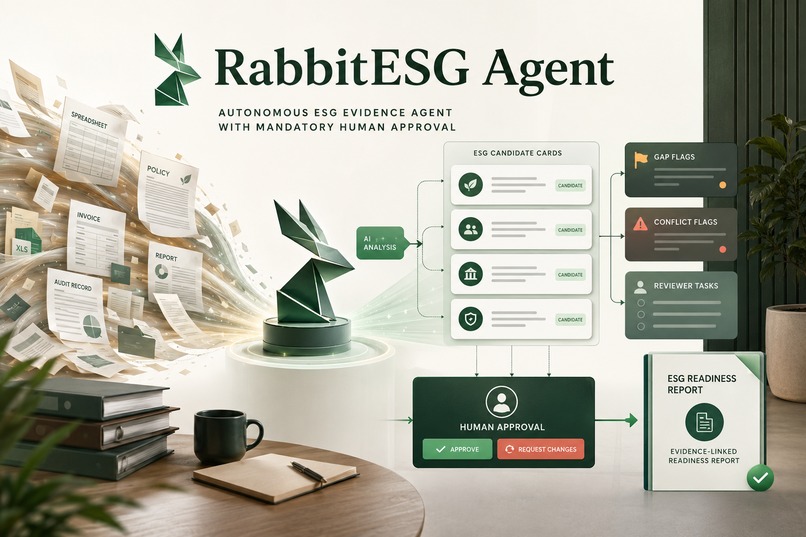
RabbitESG Agent — Evidence-first ESG intelligence with human decision authority
-
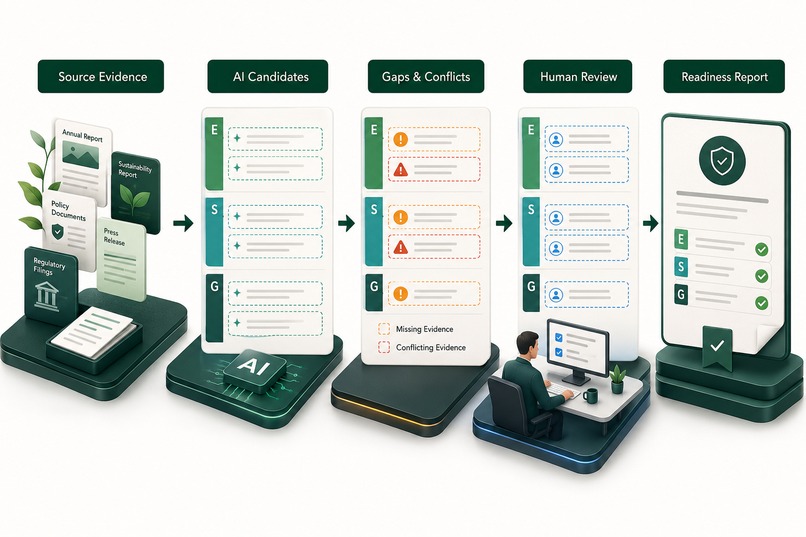
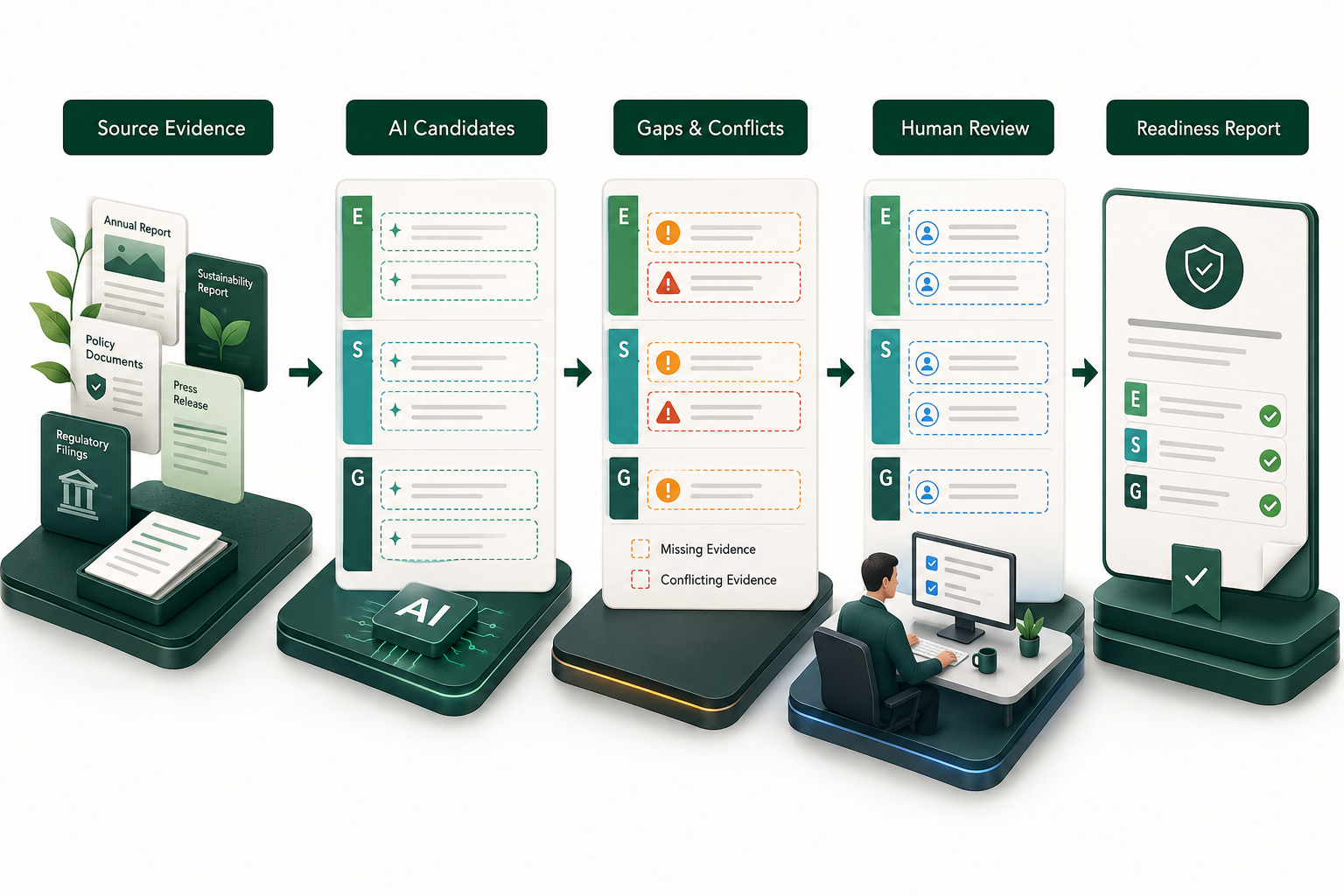
End-to-end agentic workflow — From evidence upload to reviewable ESG readiness results
-
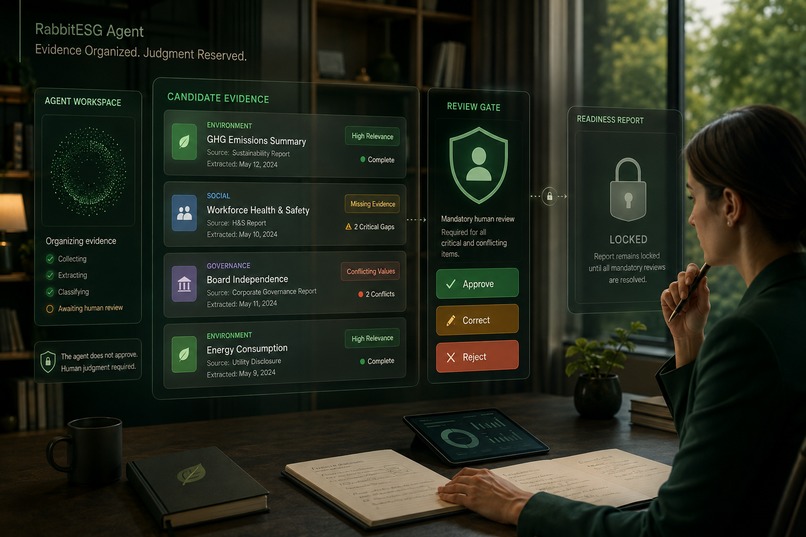
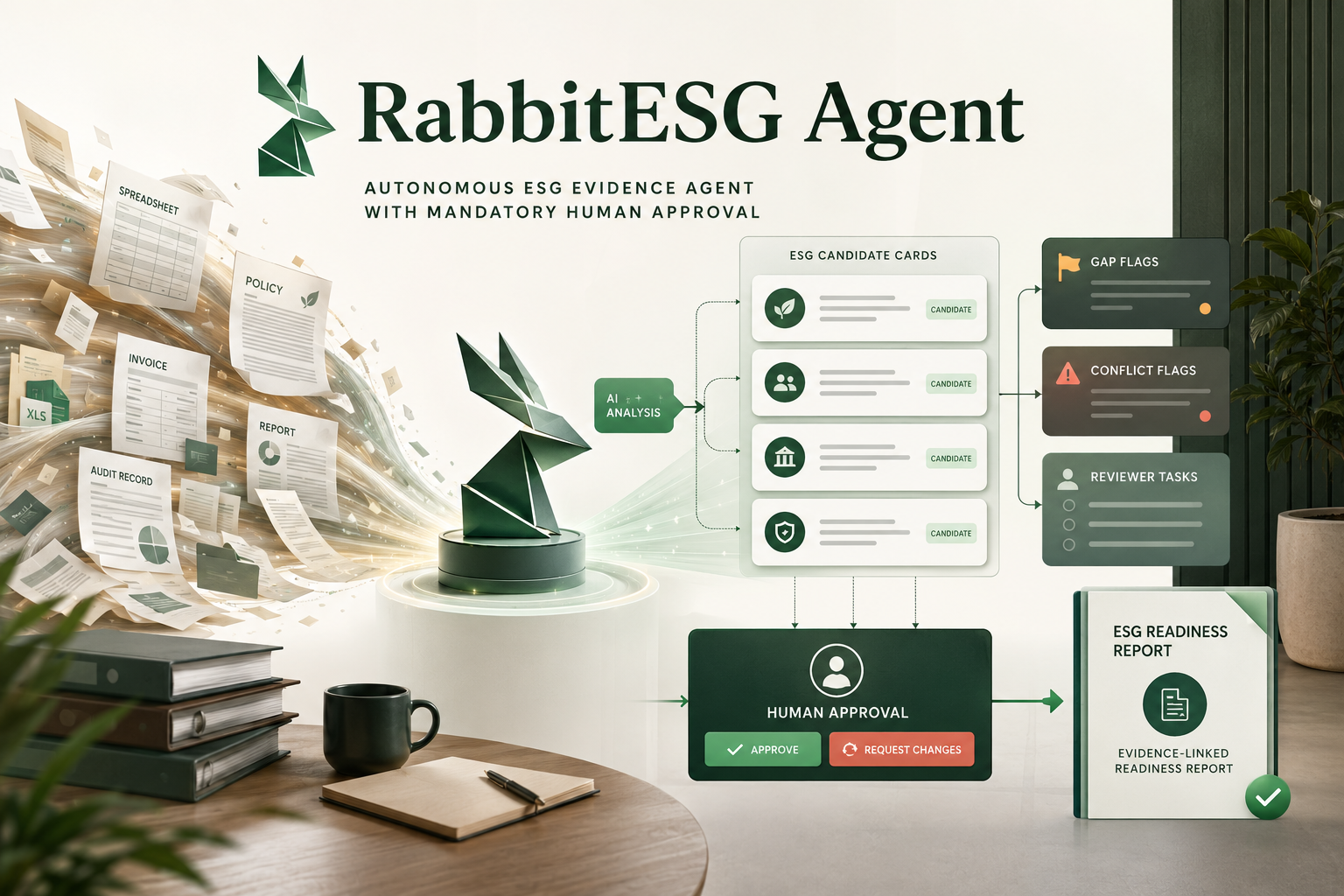
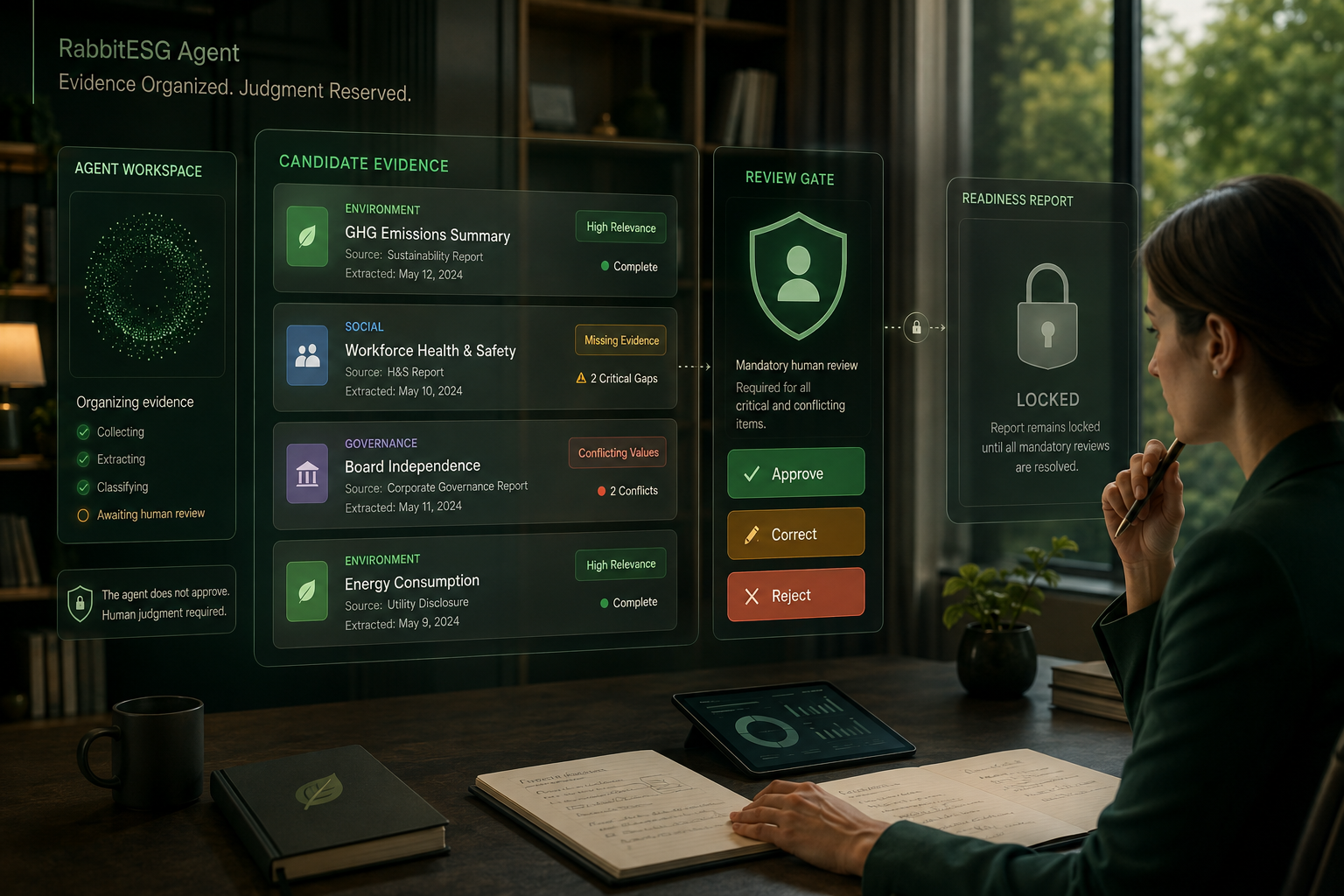
Concept visualization — Governed ESG evidence review and decision-support workspace
-
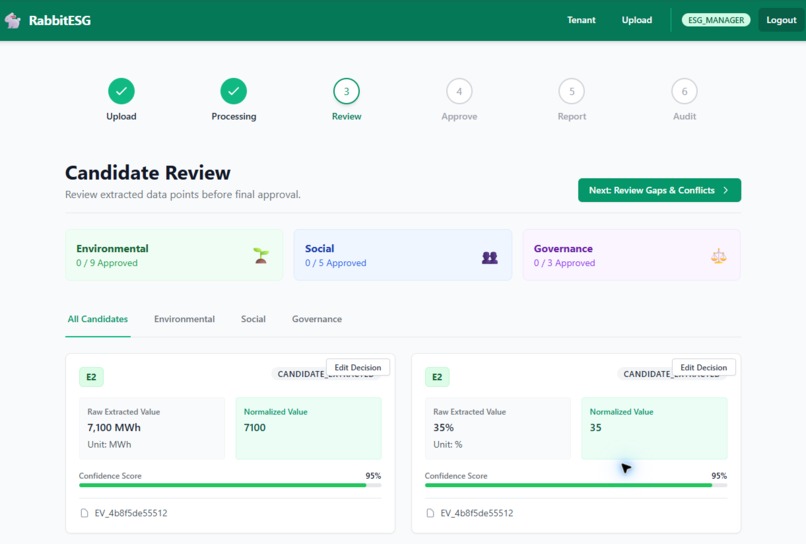
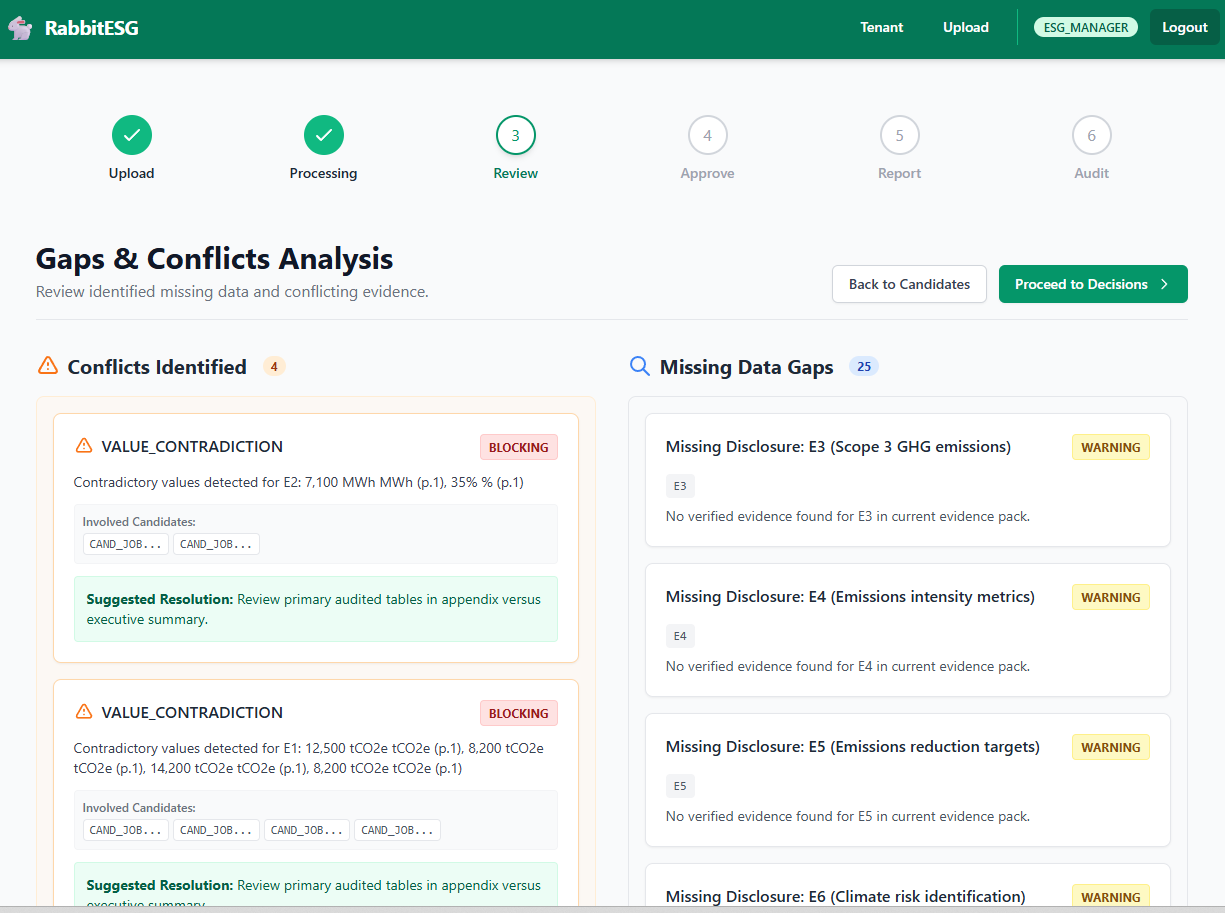
Live application — Conflict review before human approval and readiness reporting
-
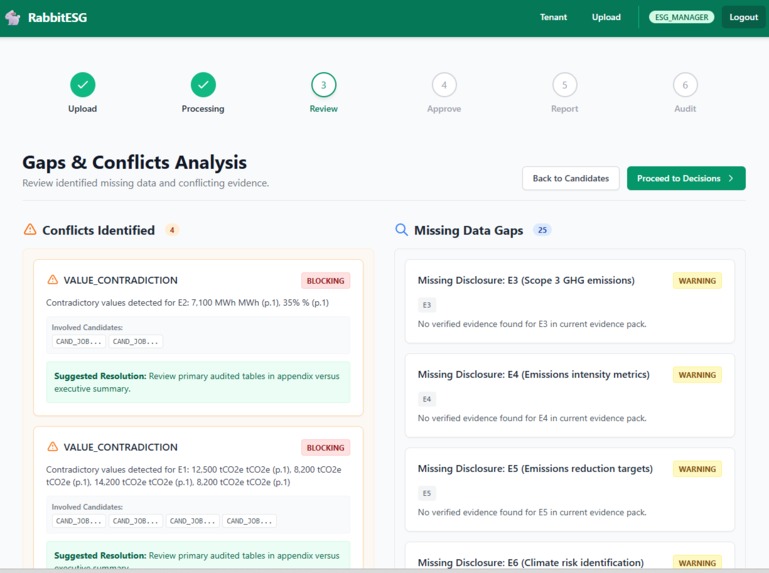
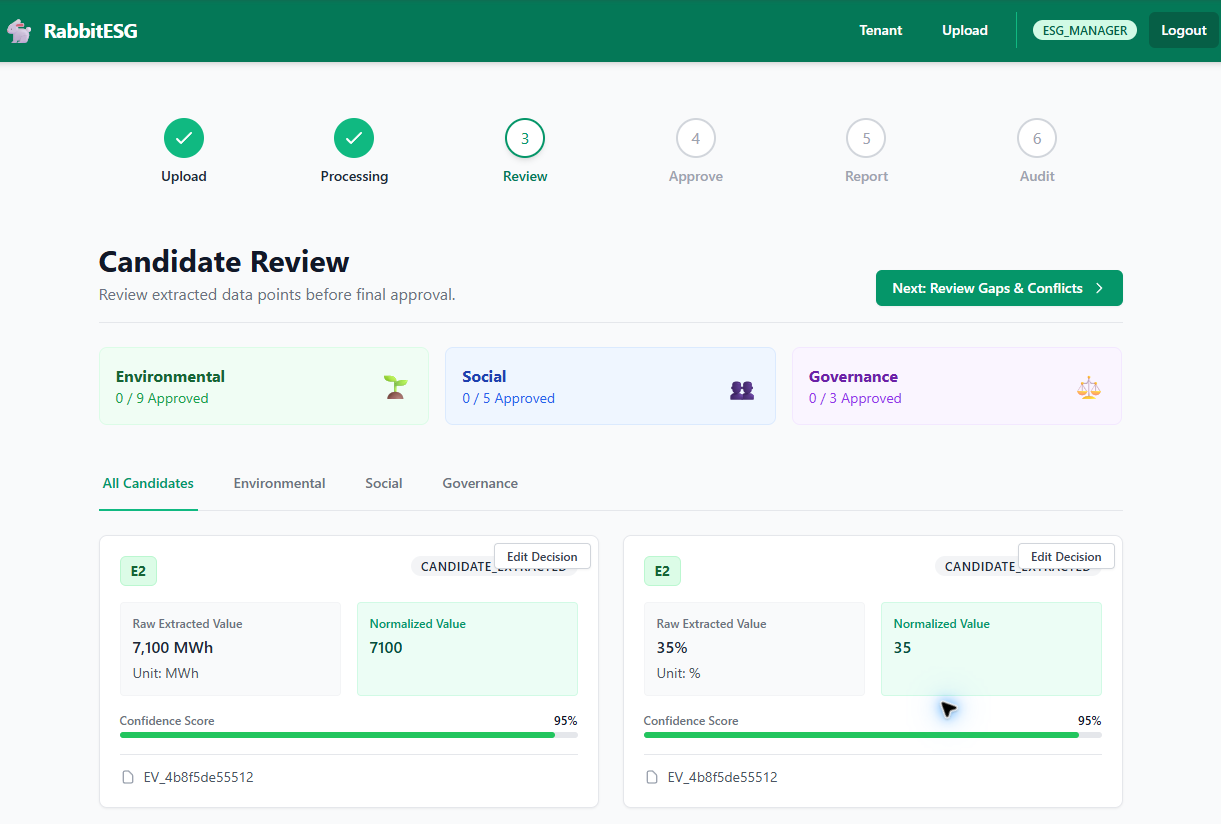
Live application — Agentic evidence analysis with extracted facts, gaps, and review tasks
-
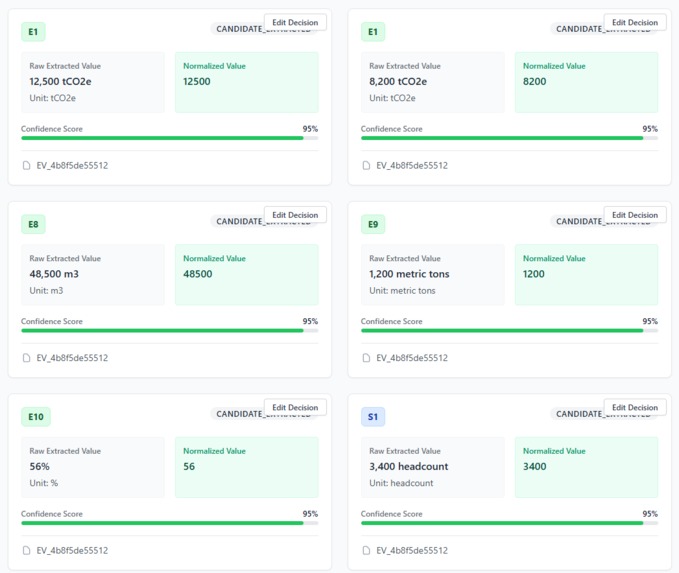
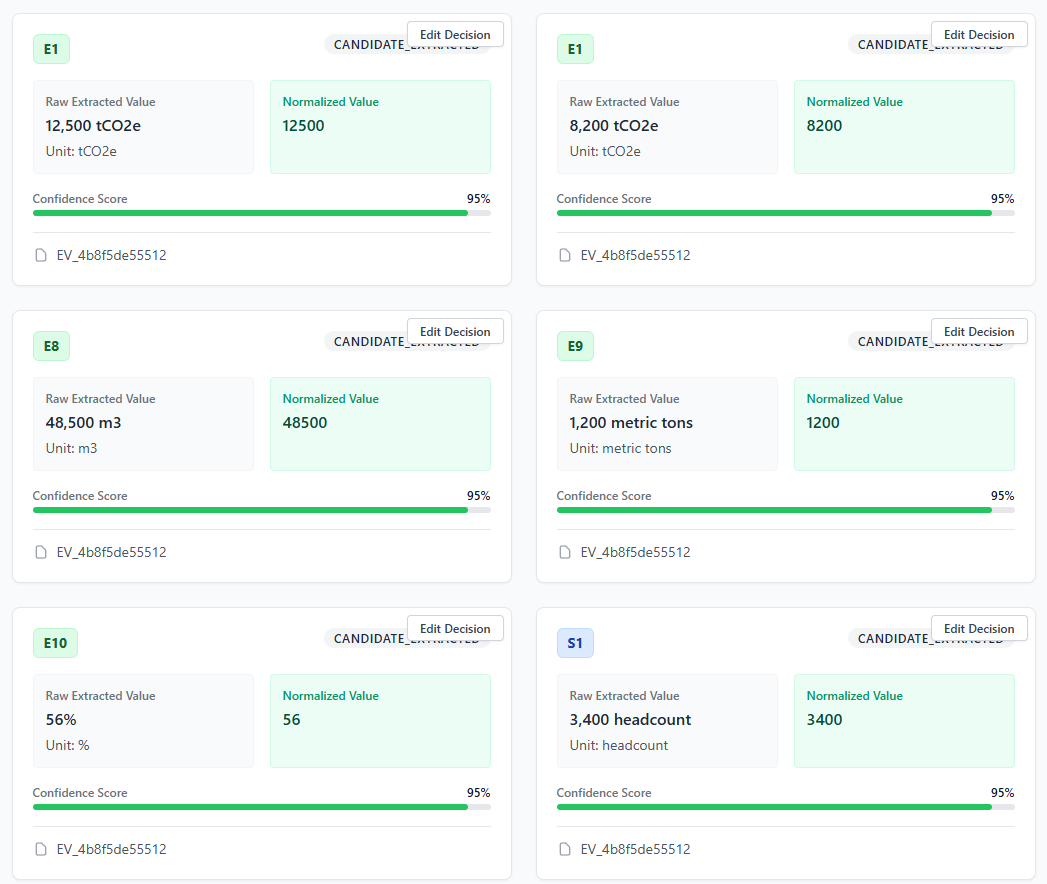
Live application — Evidence mapped across ESG indicators for transparent human review
Inspiration
ESG assessment remains surprisingly manual. Organizations hold sustainability reports, policies, spreadsheets, presentations, certificates, and operational records, yet transforming this fragmented evidence into a structured ESG assessment requires substantial human effort.
RabbitESG Agent began with one question:
Can an AI agent perform the evidence-intensive work while keeping humans in control of ESG decisions?
Our goal is to make ESG assessment simpler for users while making the intelligence behind it more rigorous, traceable, and useful.
What it does
RabbitESG Agent transforms fragmented organizational evidence into structured, reviewable ESG intelligence.
Users upload evidence in formats including PDF, DOCX, PPTX, XLSX, PNG, and JPEG. RabbitESG Agent then:
- Validates uploaded evidence and preserves its provenance
- Extracts structured, source-linked facts
- Maps evidence to relevant ESG indicators
- Identifies missing evidence, gaps, uncertainty, and potential conflicts
- Creates review tasks for human verification
- Generates an ESG readiness assessment
- Maintains an auditable connection between evidence and conclusions
The current framework evaluates 36 ESG indicators organized as 12 × 3 indicators.
RabbitESG Agent does not replace human judgment:
AI performs the intelligence-intensive work. Humans retain decision authority.
How we built it
RabbitESG Agent is an evidence-first, governed agentic AI system.
The core workflow is:
Upload evidence → Validate and process → Extract facts → Map evidence → Detect gaps and conflicts → Human review → Readiness assessment → Audit record
We separated the system into two strictly isolated architectural layers:
- Application layer — user interface, authentication, evidence intake, workflow state, storage, review interfaces, and results
- Intelligence layer — protected AI interpretation, evidence reasoning, indicator mapping, and decision-support logic
A controlled gateway connects these layers so protected intelligence is never exposed through the public application.
The runtime uses Google Agent Development Kit (ADK) to structure the agent workflow and Gemini 3.5 Flash through Vertex AI for bounded evidence interpretation.
The deployed cloud architecture uses:
- Cloud Run for application and agent services
- Cloud Tasks for asynchronous workflow execution
- Cloud Storage for submitted evidence
- Firestore for structured workflow and assessment data
- Secret Manager for protected credentials and configuration
Uploaded evidence is validated, assigned a SHA-256 hash, and connected to subsequent facts and assessment records. This preserves provenance from the original source through human review and final reporting.
Codex supported implementation, test automation, documentation, and security review during development. It is not part of the production ESG decision workflow.
Challenges we ran into
One of our most important challenges was preventing AI from becoming an uncontrolled ESG decision maker.
Real ESG evidence is often:
- Incomplete
- Duplicated
- Outdated
- Inconsistent
- Contradictory
A model can produce a confident response even when the underlying evidence is weak. We therefore designed RabbitESG Agent around evidence provenance, uncertainty handling, conflict detection, human approval, and auditability rather than asking an AI model to produce an unexplained ESG score.
Another challenge was keeping the user experience simple while substantial intelligence operates behind the scenes.
For the user, the workflow remains:
Provide evidence → Review findings → Resolve issues → Receive an assessment
The architectural and governance complexity stays inside the controlled system.
Accomplishments that we're proud of
RabbitESG Agent became more than a document chatbot.
We built an end-to-end agentic evidence workflow:
Documents → Structured facts → ESG indicators → Gaps and conflicts → Human decisions → Readiness assessment → Audit trail
The MVP supports:
- Multiple evidence formats
- Asynchronous evidence processing
- Structured, source-linked fact extraction
- Mapping across 36 ESG indicators
- Gap, uncertainty, and conflict identification
- Human review and approval
- ESG readiness reporting
- Auditable workflow records
- Explicit separation between the public application and protected intelligence
We also hardened the implementation with automated tests covering the core workflow, contracts, authentication boundaries, production configuration, and architectural controls.
What we learned
We learned that applying AI to ESG is not primarily about generating more text.
The greater opportunity is creating trustworthy connections between:
Evidence → Interpretation → Decision → Accountability
Agentic AI becomes more valuable when it works within a bounded and governed workflow with clear tools, permissions, state transitions, and human decision points.
We also learned that human-in-the-loop design should not be added after the AI workflow is built. For consequential ESG assessments, it must be part of the architecture from the beginning.
What's next for RabbitESG Agent
Our next step is advancing RabbitESG Agent from the hackathon MVP into a production-ready ESG intelligence system.
We plan to:
- Expand evidence ingestion and validation
- Strengthen provenance and auditability
- Improve uncertainty and conflict resolution
- Support additional ESG assessment frameworks
- Develop continuous evidence monitoring
- Improve organizational ESG readiness intelligence
- Preserve human authority over consequential decisions
Over time, organizations will be able to add evidence continuously and understand how their ESG readiness changes as policies, operations, disclosures, and supporting records evolve.
Our longer-term vision is simple:
Make ESG assessment simple outside and intelligent, evidence-driven, and governed inside.


Log in or sign up for Devpost to join the conversation.