-
-
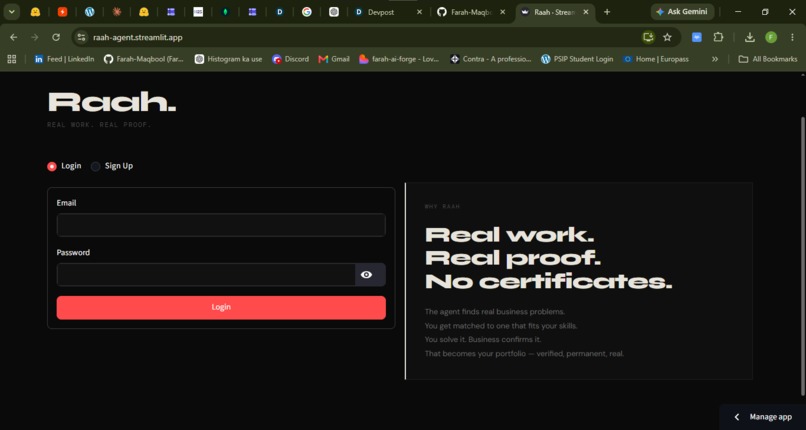
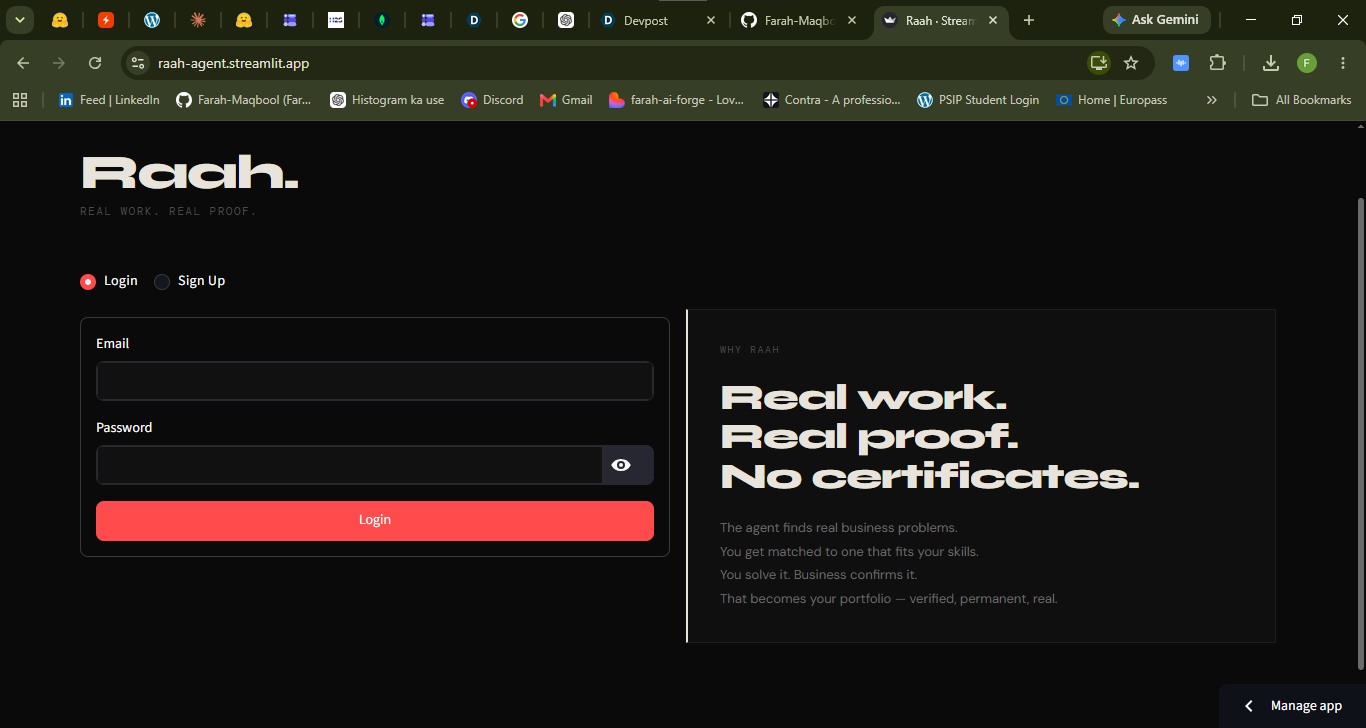
Login and Sign Up page with the Raah brand, authentication form, and the platform value proposition.
-
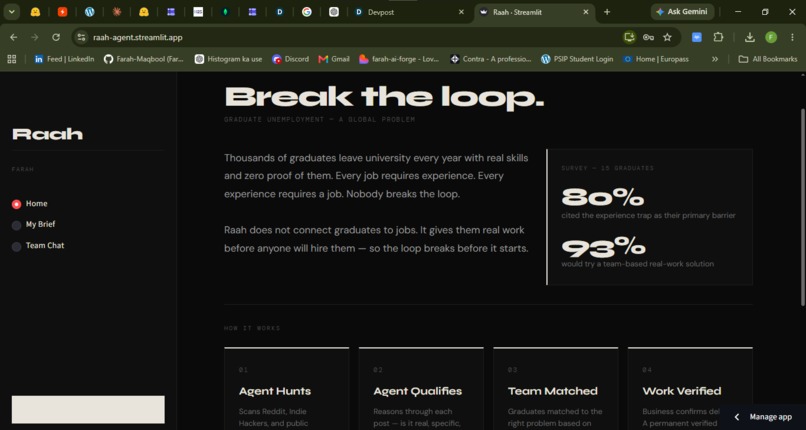
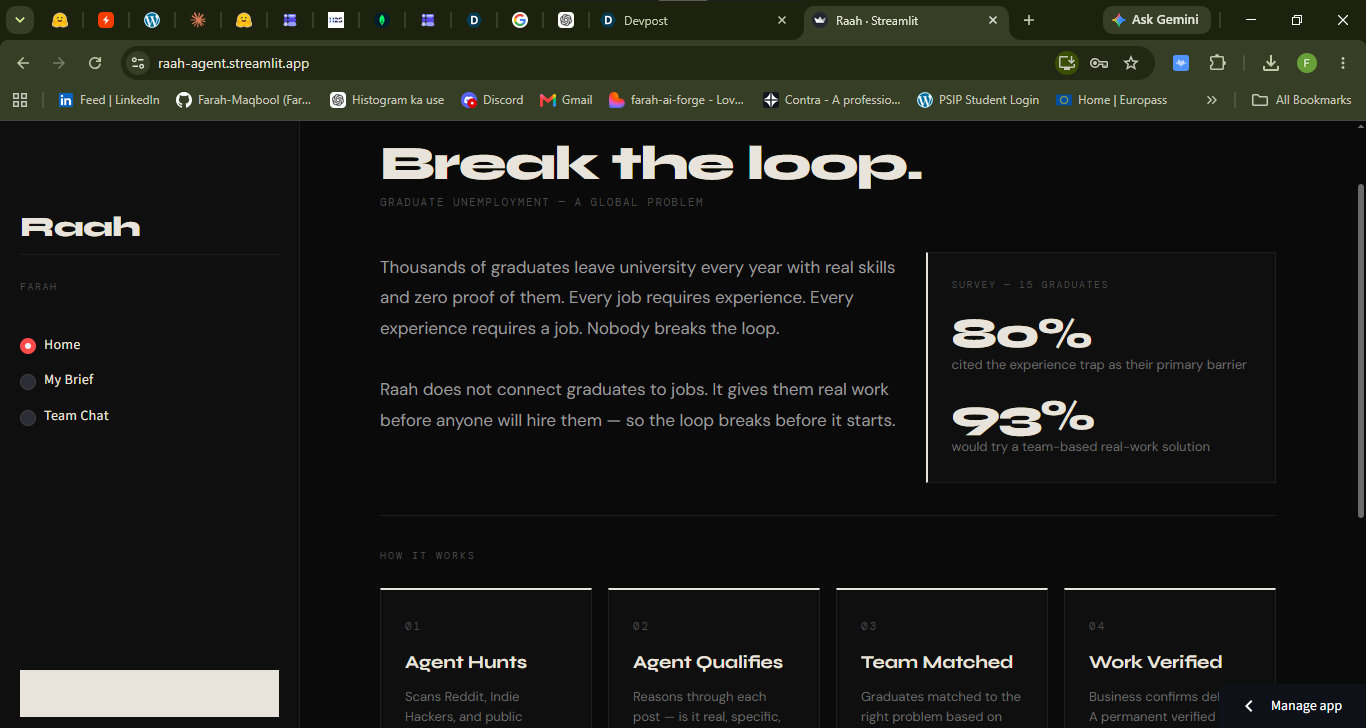
Home page showing the platform mission, real survey data from 15 graduates, and the four-step how it works flow.
-
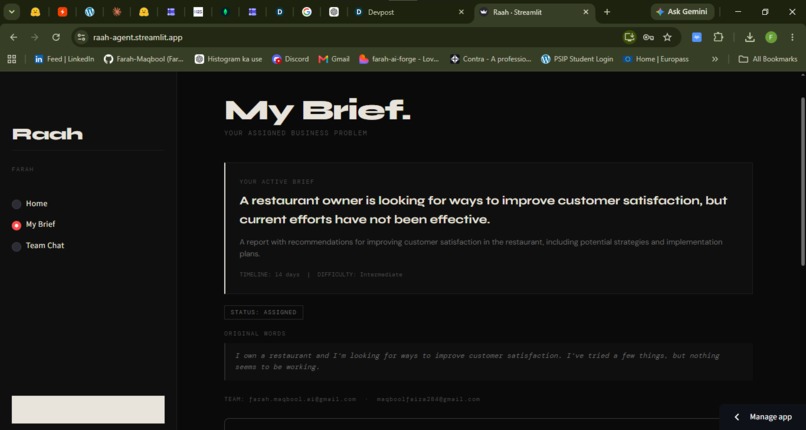
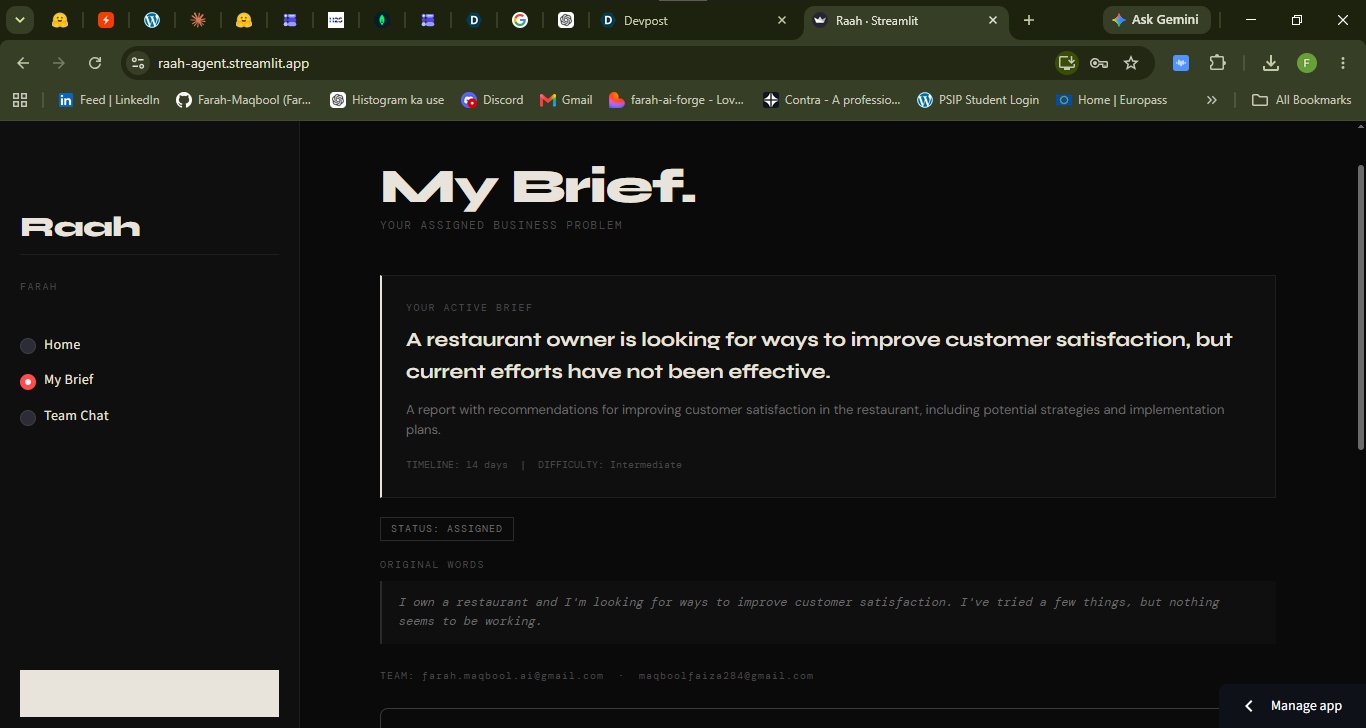
Active assigned brief with problem statement, deliverable, timeline, difficulty, status badge, and words from the business owner
-
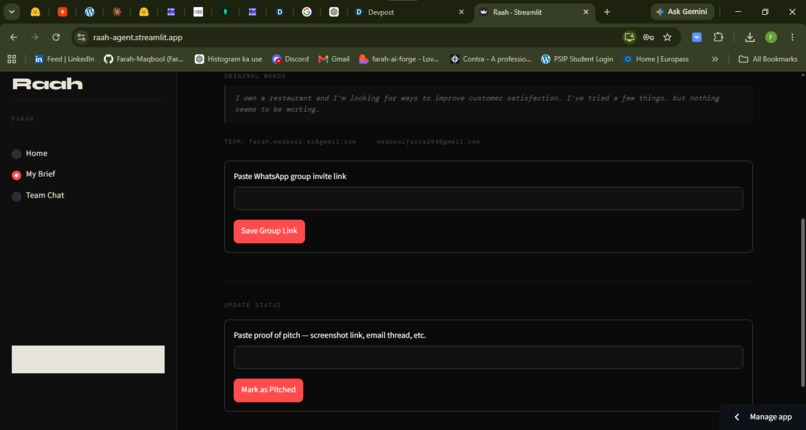
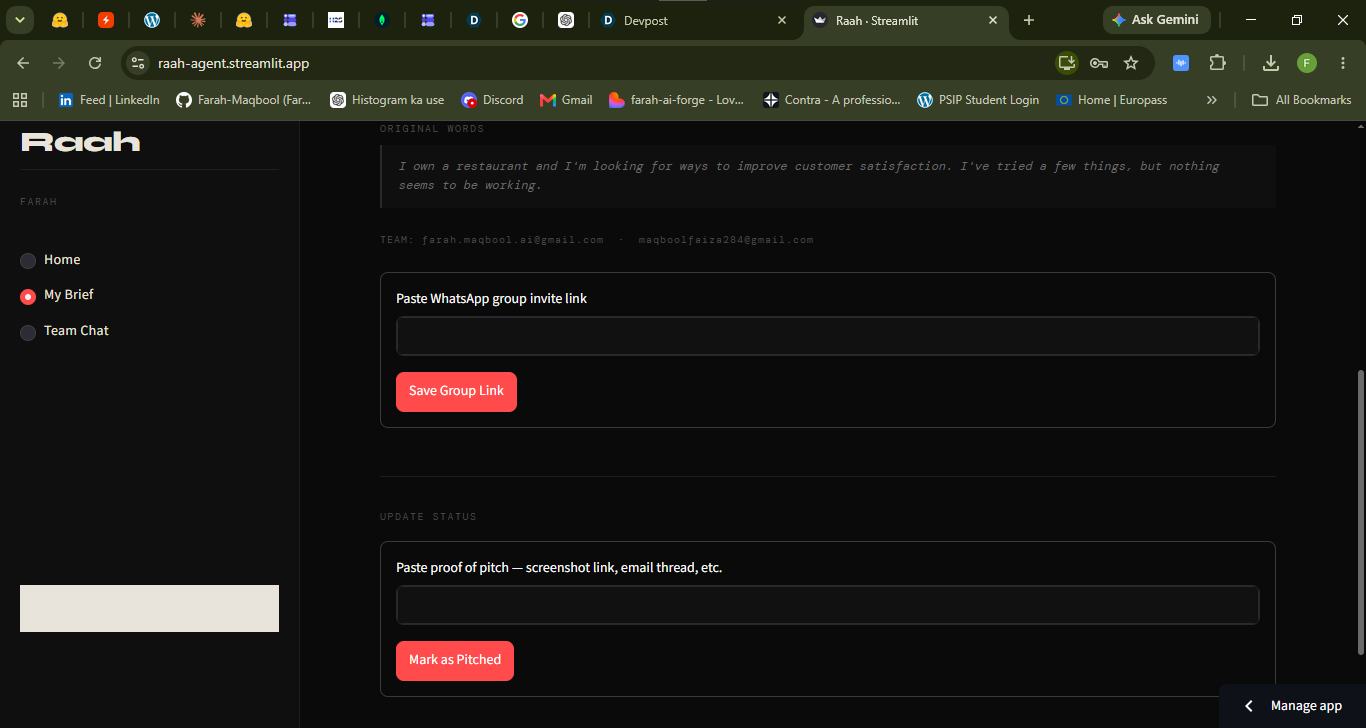
My Brief page showing original business owner words, team members, WhatsApp group link input, and project status update flow
-
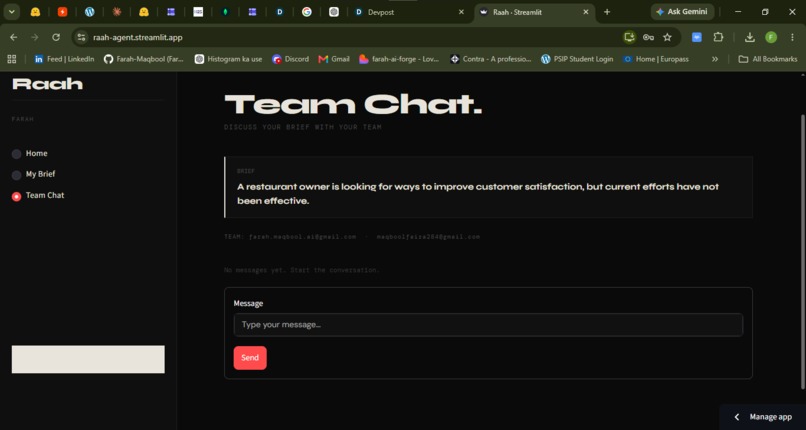
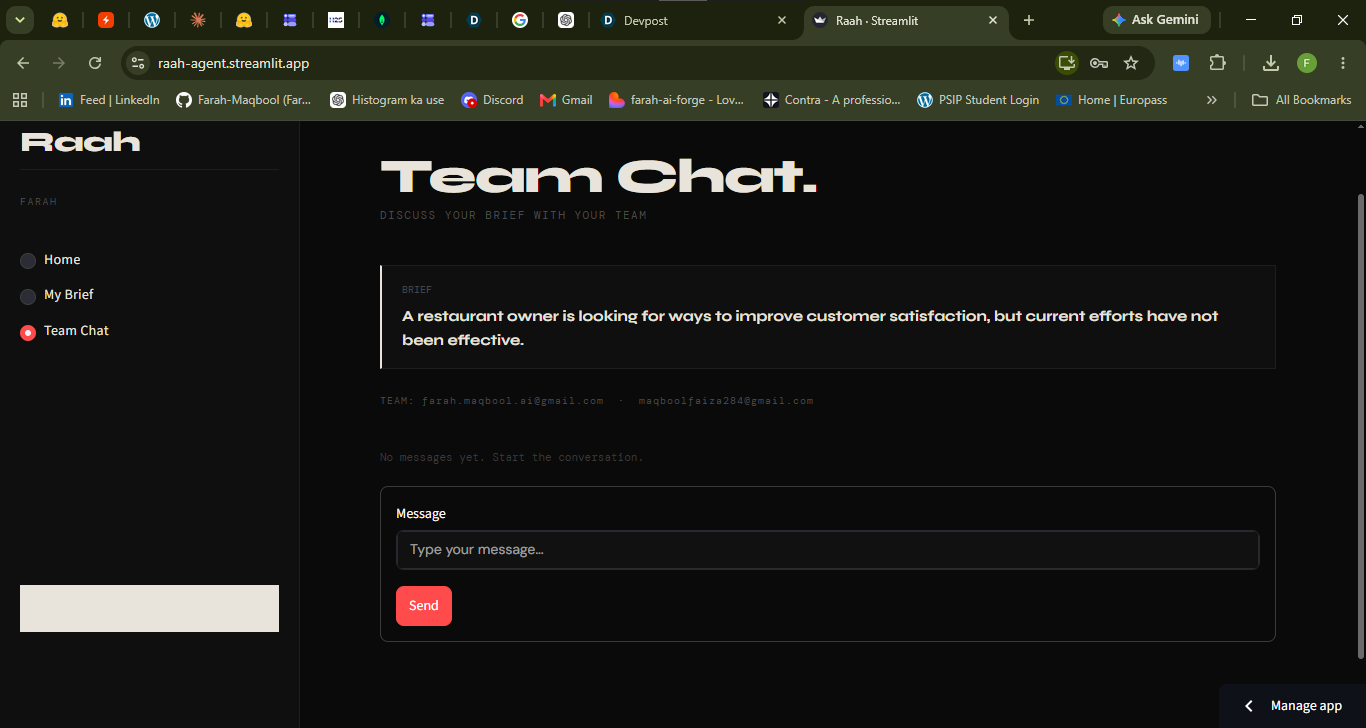
Team Chat page showing an assigned brief, team members, and the message interface for team communication.
-
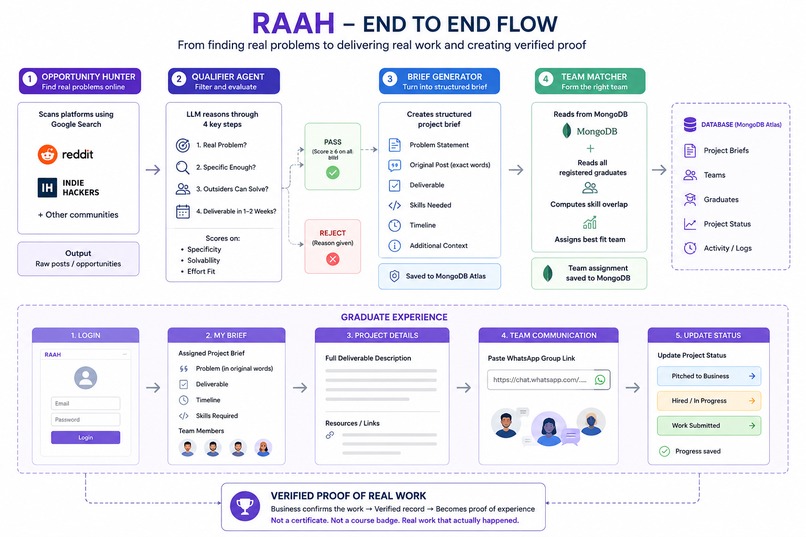
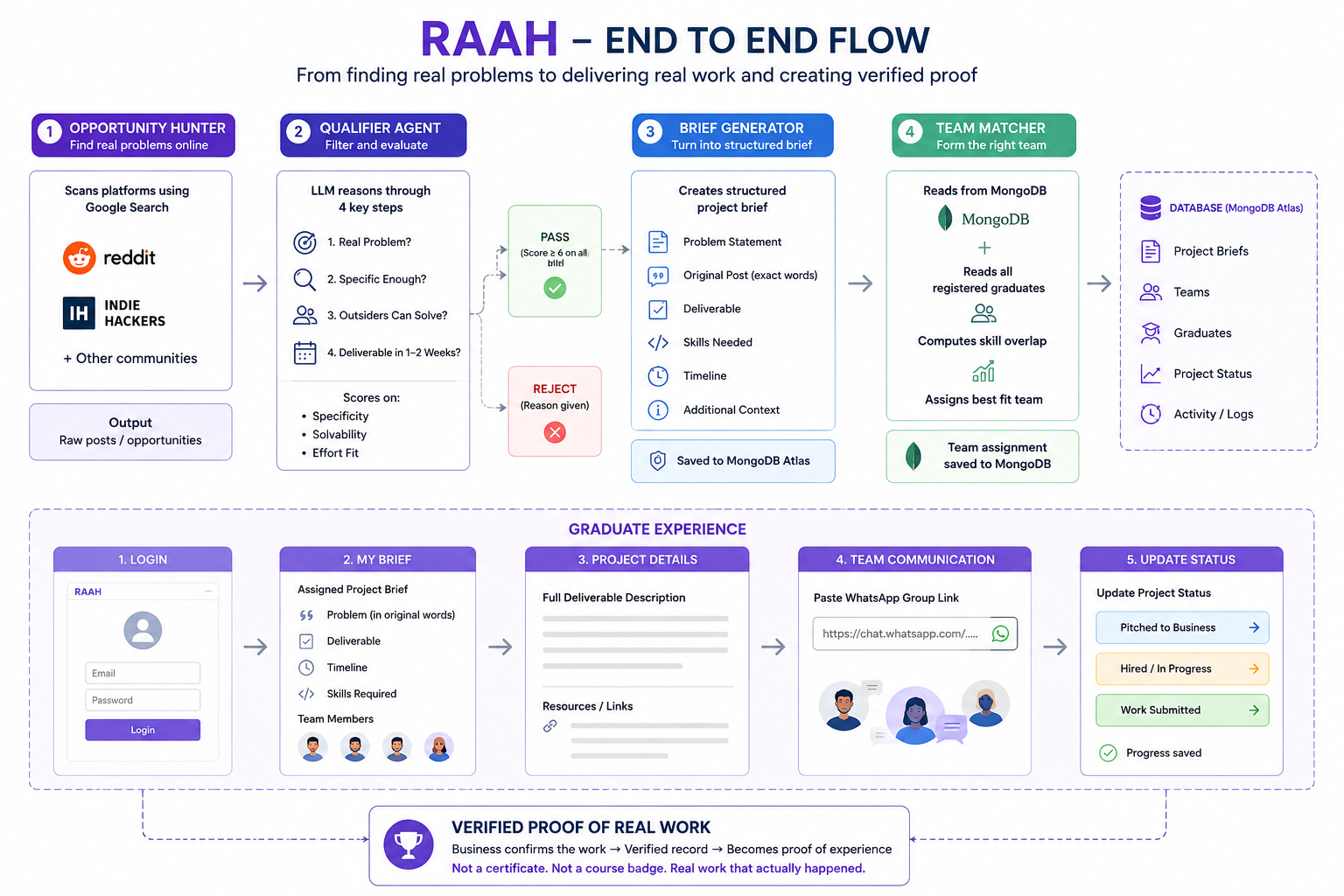
System Flow
Inspiration
93% of graduates we surveyed cited the experience trap as their primary barrier to employment. No experience to get a job. No job to get experience. Every existing solution job boards, internship platforms, online courses assumes you already have something to show. We kept asking: what if the platform found real work for graduates instead of making them compete for it?
That question became Raah.
What it does
Raah is a multi-agent AI system that breaks the graduate experience trap by finding real unsolved business problems and matching student teams to them automatically.
An AI agent scans Reddit, Indie Hackers, and public forums continuously for real business problems posted by real owners. A second agent qualifies each problem through four-step reasoning is it real, specific, solvable by outsiders, and bounded enough for a one to two week project? A third agent generates structured task briefs from every qualified problem. A matching system assigns teams of one to four graduates based on skill overlap.
Graduates log in and see only their assigned brief. They see the original words the business owner wrote, their team members, the full deliverable description, and a WhatsApp group link for communication. They update their status as the project progresses pitched, hired, work submitted. When they deliver and submit, a verified work record is created. Not a certificate. Proof of real work with the original source post as evidence.
How we built it
Agent Pipeline Google ADK 2.0
Three agents run in sequence using the Google ADK 2.0 Workflow class:
- OpportunityHunter: Uses Groq Llama 3.3 70B with Exa and Tavily search tools to discover real business problems posted publicly online.
- Qualifier: Groq Llama 3.3 70B via LiteLLM reasons through each post across four steps and scores on specificity, solvability, and effort fit
- BriefGenerator: Groq Llama 3.3 70B converts qualified posts into structured task briefs preserving the business owner's original words
Why this model split: Groq handles reasoning-heavy agents to preserve Gemini quota and provide fast inference at no cost.
Infrastructure
- MongoDB Atlas stores briefs, user profiles, team assignments, and project status
- bcrypt handles password hashing for user authentication
- Streamlit provides the web interface
- Python matching script assigns teams by skill overlap without LLM calls
- Tavily and EXA for searching
Research foundation
Before writing any code we surveyed 15 graduates. The data confirmed the experience trap was the dominant problem. 93% said they would try a team-based real-work solution. The platform was designed around those findings.
Challenges we ran into
LLM hallucination in the qualifier: When the hunter returned no results the qualifier would invent posts to fill the quota. We solved this with an explicit hard rule in the prompt: if the previous agent found nothing, say so and stop. Do not invent. That single line eliminated the problem.
Gemini quota exhaustion during development: Running three agents in sequence burned through free tier quota quickly. We solved this by moving the reasoning-heavy agents to Groq while keeping only the search agent on Gemini, reducing quota consumption by two thirds.
BRIEF_ID passing between agents: The team matcher agent was hallucinating source URLs instead of copying them from the database. We replaced the LLM-based matching entirely with a pure Python skill-overlap algorithm that reads directly from MongoDB. More reliable, faster, and uses no API quota.
Two-sided marketplace cold start: Businesses need to have problems in the system before graduates can be matched. We broke this by having the agent find problems from public forums rather than requiring businesses to post on the platform. Businesses do not need to know Raah exists for their problems to appear.
Accomplishments that we're proud of
The agent qualification reasoning is genuinely accurate. It rejects vague posts, survey questions, and problems requiring internal access. It passes specific, bounded, outsider-solvable problems. The reasoning is visible step by step in the output not a black box.
The platform was built on real research. The 93% figures came from actual conversations with actual graduates who described their experience in their own words. The product decisions followed the data.
The complete loop works end to end agent finds problem, team gets matched, team sees assigned brief, team updates status, team submits work.
What we learned
The agent is the product. UI, database, and matching logic are infrastructure. The entire value of Raah depends on whether the agent finds real problems and qualifies them honestly. Prompt engineering for the qualifier went through more iterations than any other part of the codebase.
Two-sided marketplace problems are structural. The agent finding problems from public sources rather than requiring business registration is what makes Raah viable at zero business adoption.
The experience trap is partly a confidence problem. Several surveyed graduates had not applied widely not because opportunities did not exist but because rejection felt inevitable before trying. A platform that gives one real verified win changes that trajectory.
What's next for Raah
Raah is currently a working prototype. The agent pipeline, team matching, and project status tracking are functional. What comes next is building the full product on top of this foundation:
- Proper authentication system with secure sessions
- Full web application with dedicated user dashboards
- Mobile-friendly interface
- Verified work record page a permanent public URL showing the real problem, the team, and the business confirmation
- Automated scheduling so the pipeline runs continuously without manual execution
- Employer access to search and verify graduate work records
- Notification system for team updates and status changes
- Expansion beyond skill matching to include team chemistry signals
The core intelligence is built and working. The full platform is next.

Log in or sign up for Devpost to join the conversation.