-
-
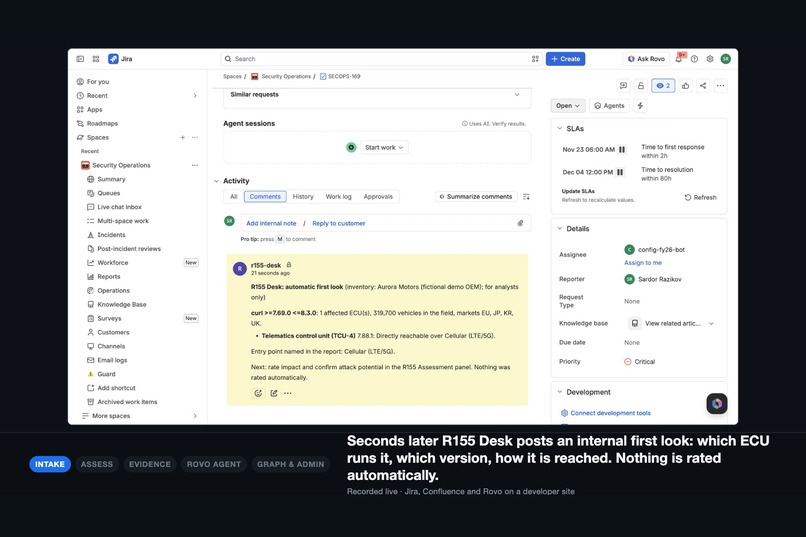
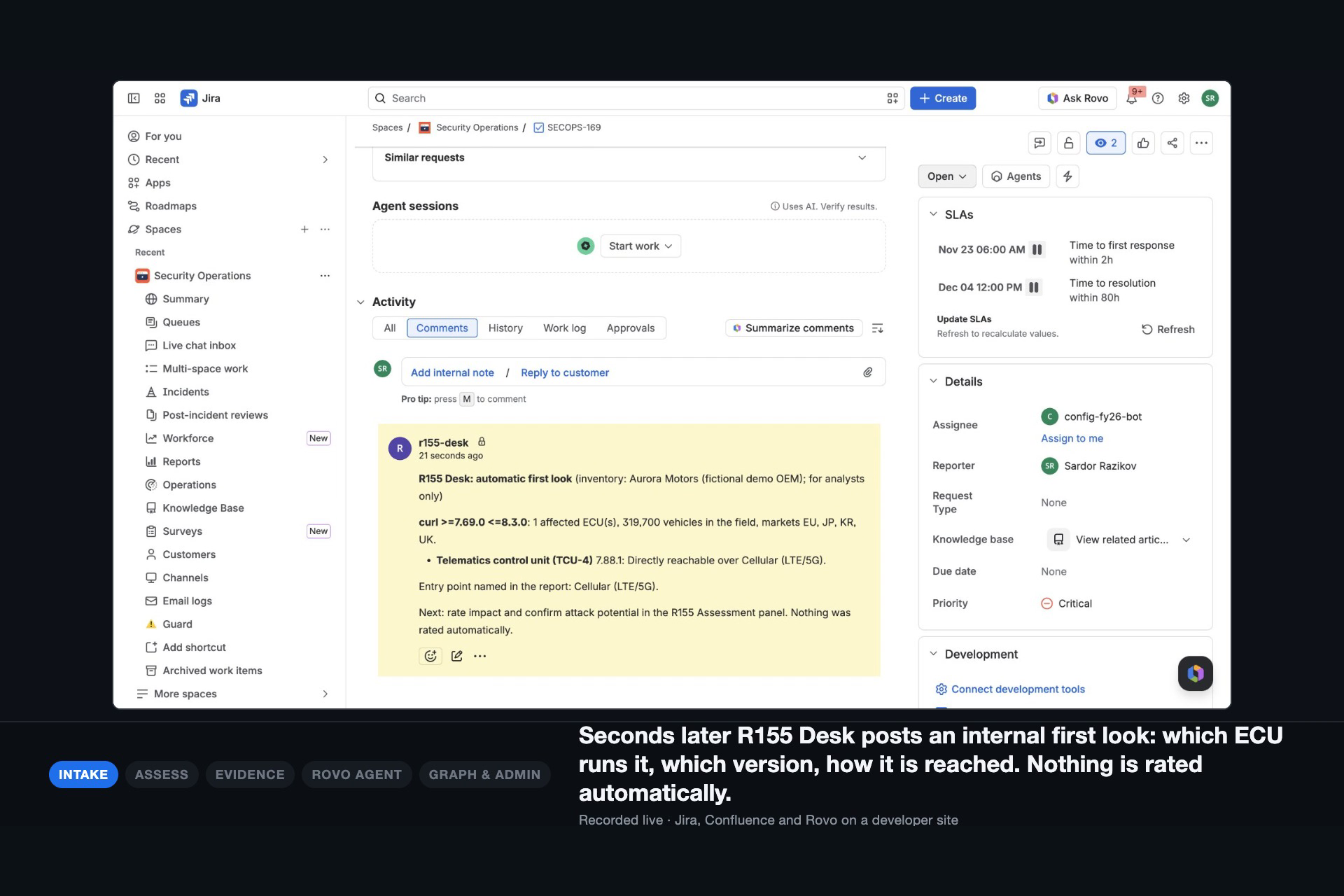
Seconds after a supplier advisory arrives, R155 Desk posts an internal first look: affected ECU, version, vehicles, entry point.
-
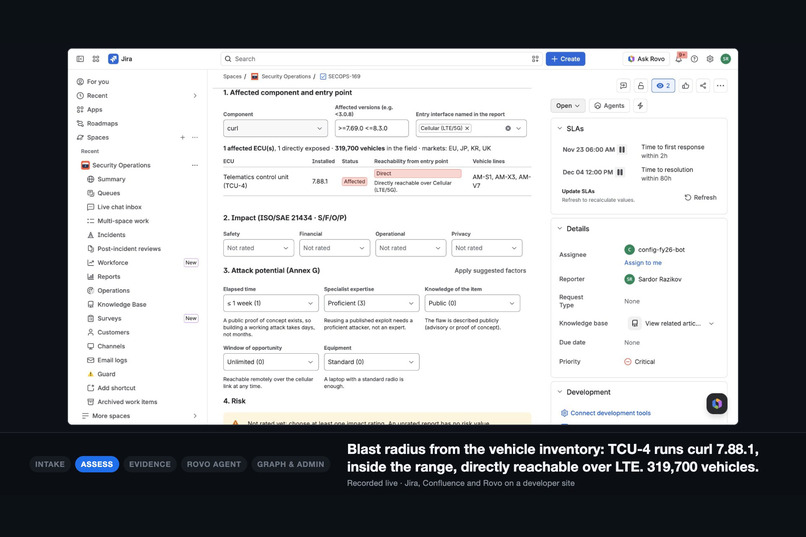
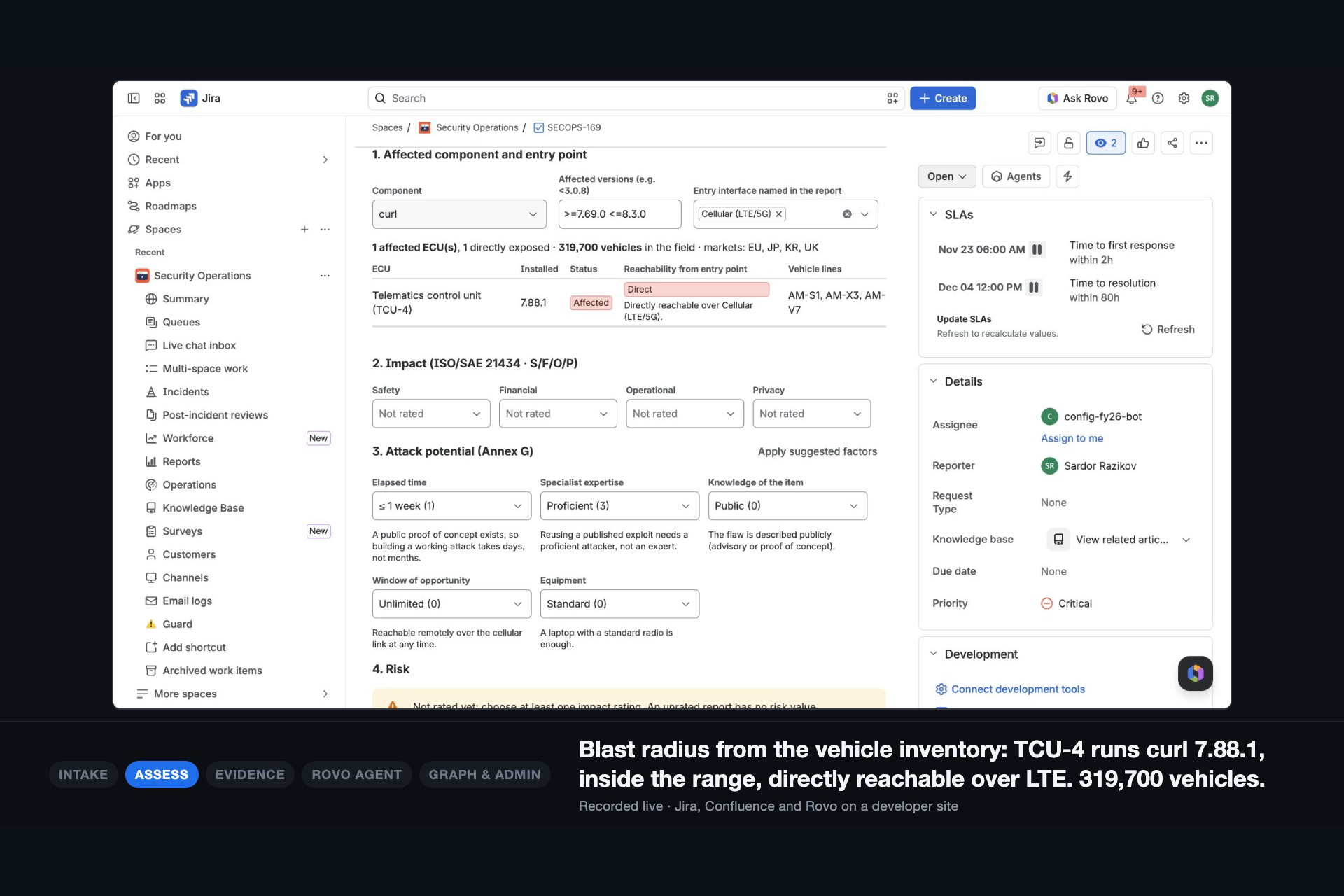
Blast radius: TCU-4 runs curl 7.88.1 inside the reported range, directly reachable over LTE. 319,700 vehicles in 4 markets.
-
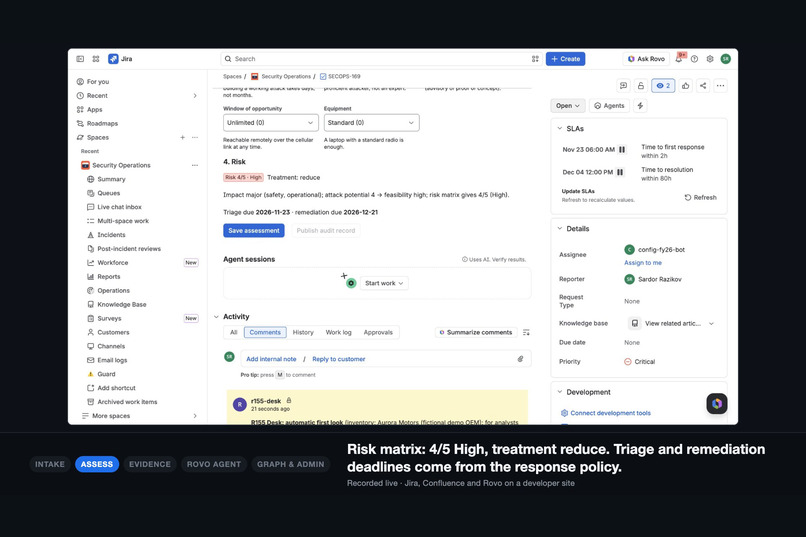
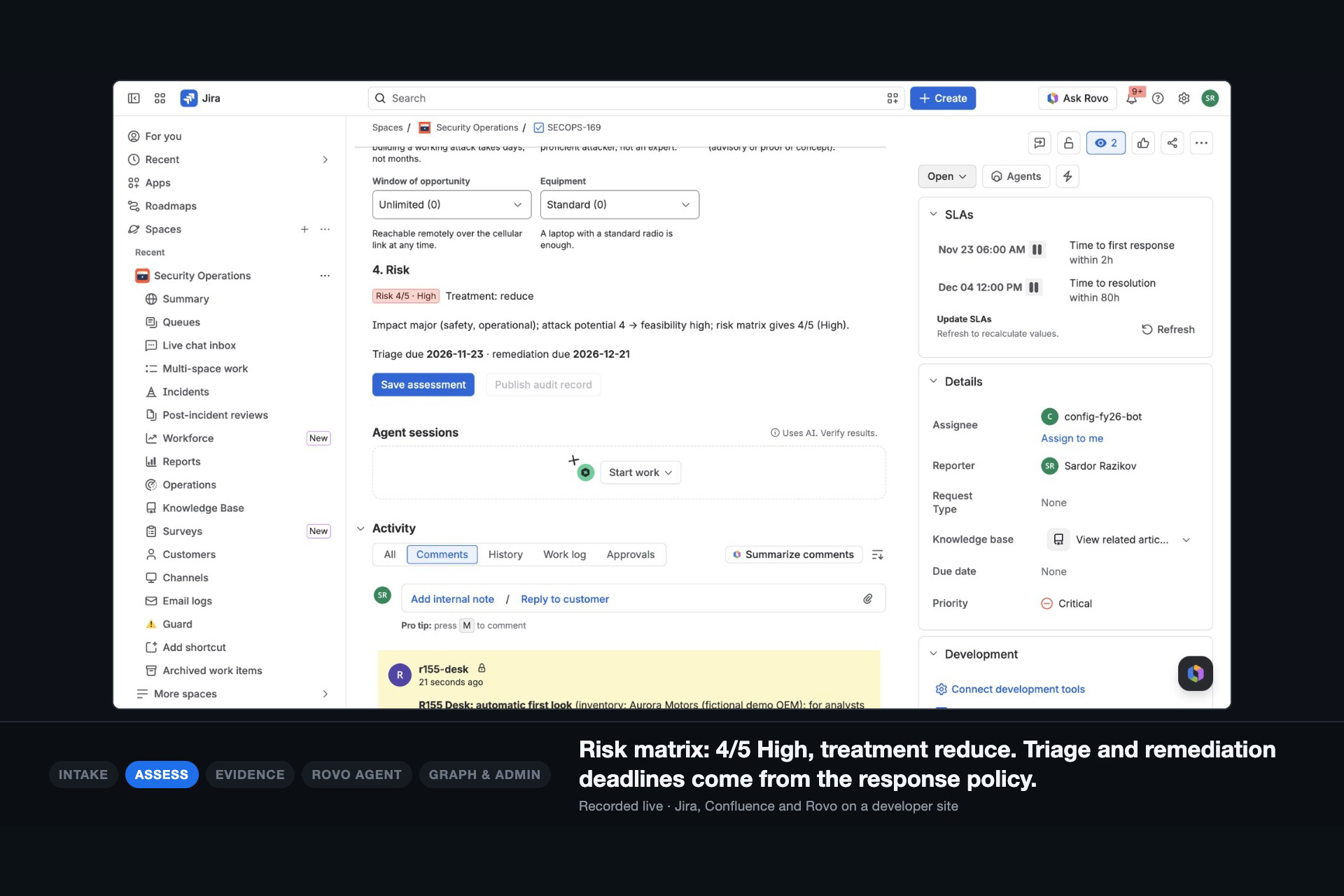
ISO/SAE 21434 risk 4/5 High with treatment and deadlines; attack potential pre-filled with a reason per factor.
-
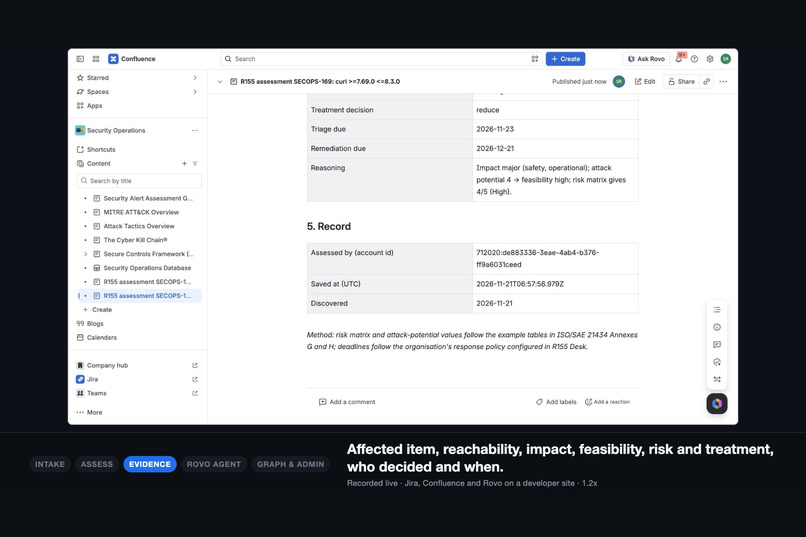
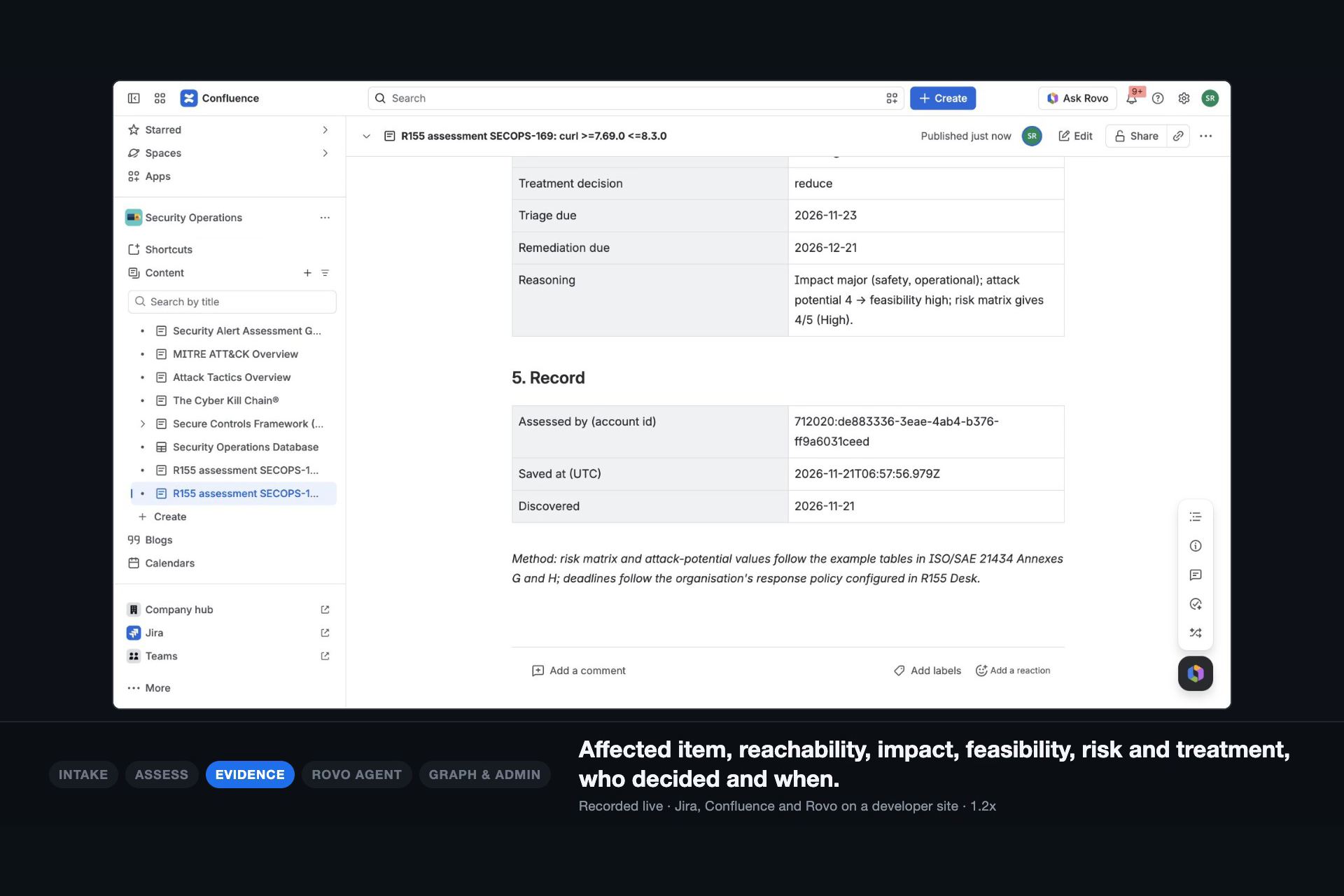
Audit record in Confluence: affected item, reachability, impact, feasibility, risk, who decided and when.
-
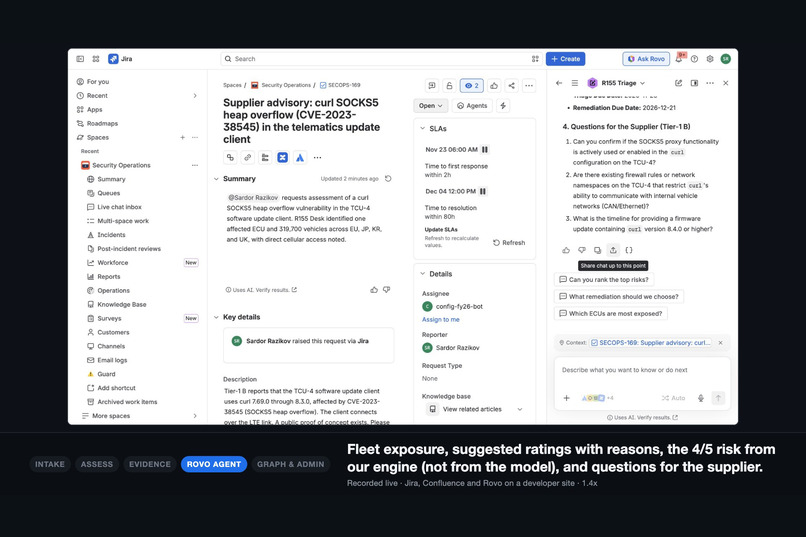
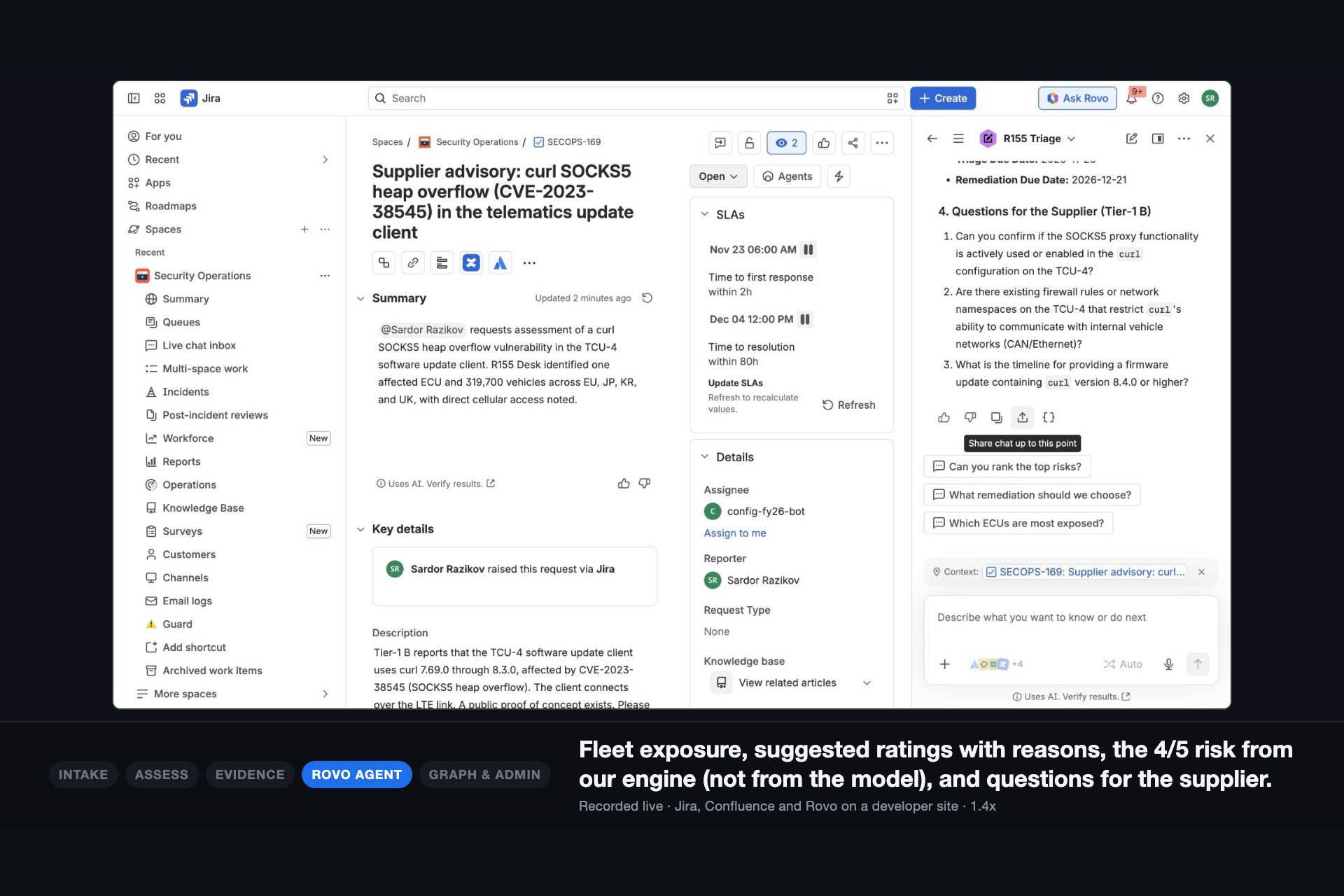
R155 Triage Rovo agent: fleet exposure, ratings with reasons, risk from the app's engine, questions for the supplier.
-
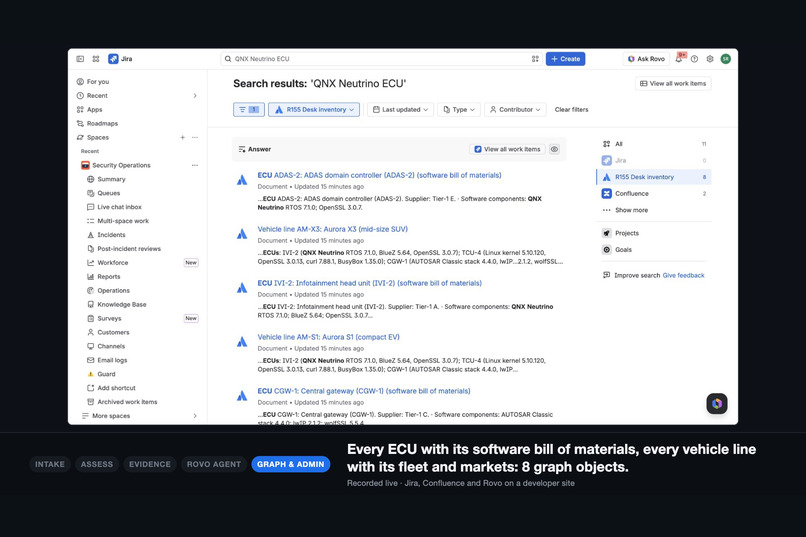
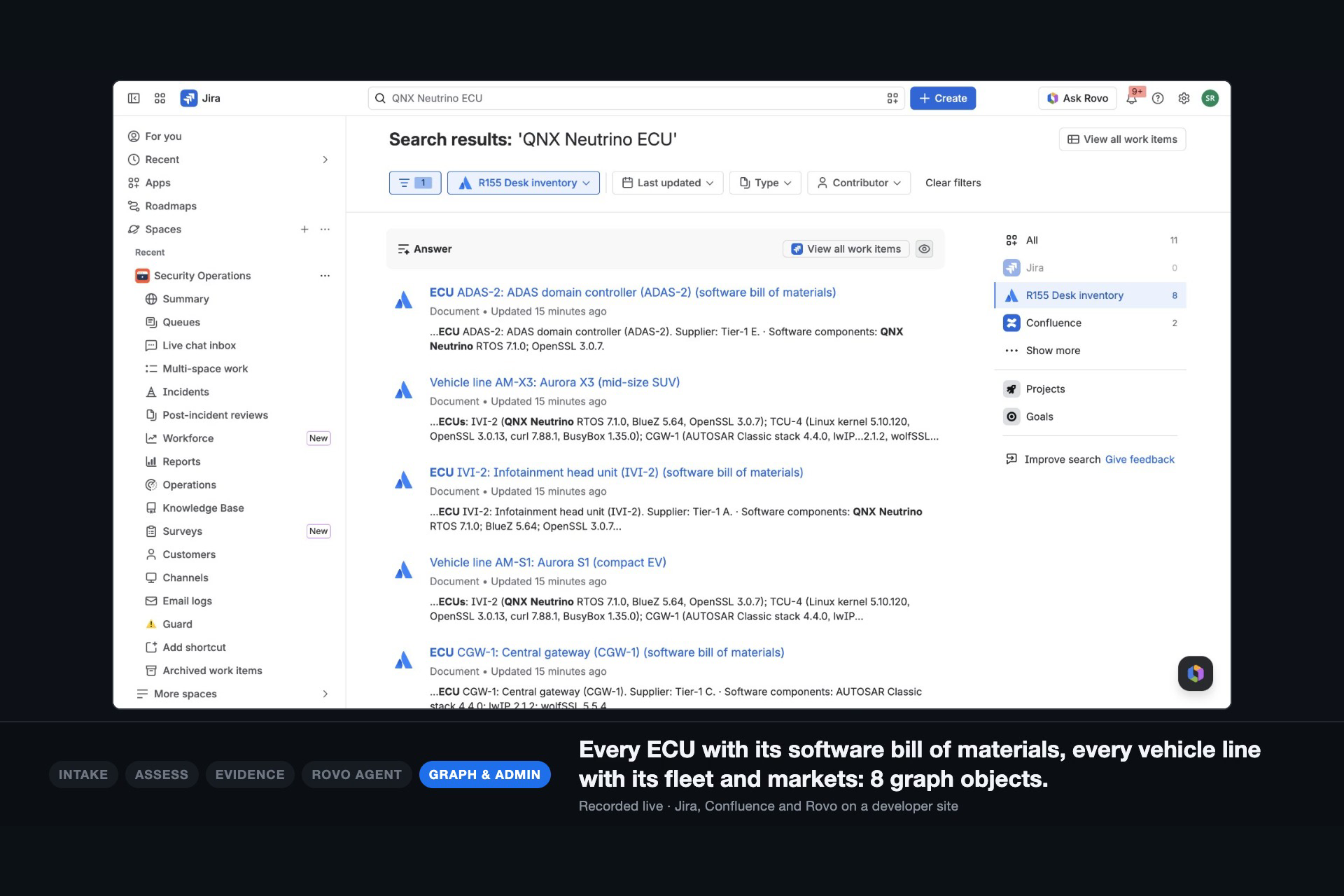
Teamwork Graph connector: ECUs with their software and vehicle lines with fleet and markets, found by Rovo Search.
-
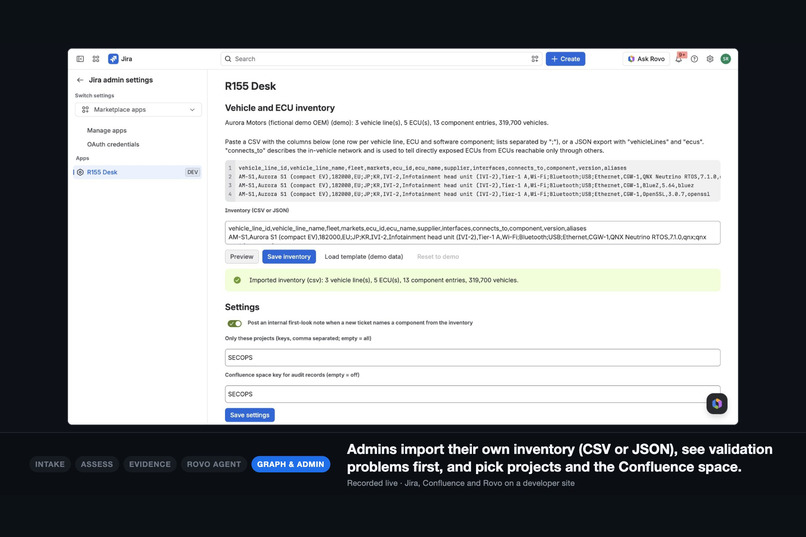
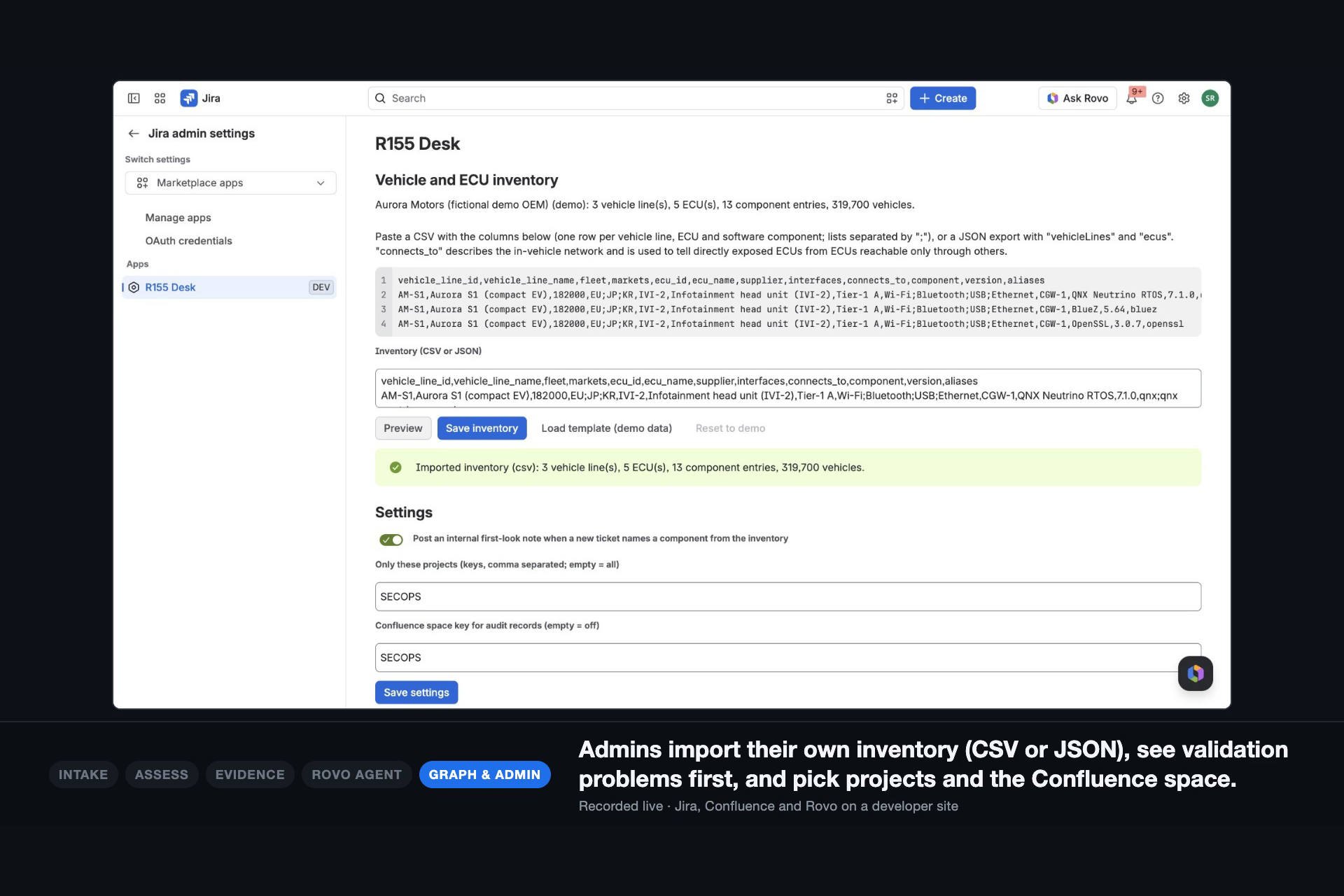
Admin page: import your own vehicle and ECU inventory as CSV or JSON, preview validation, pick projects and Confluence space.
Inspiration
Since July 2024, new vehicles sold in the EU (and in Japan and Korea under the same UN regulation) need a certified cyber security management system under UN R155. Every reported flaw in a vehicle's software becomes a regulatory event: the product security team must find out which ECUs run the component, which versions, in how many vehicles and markets, how reachable it is, rate the risk with ISO/SAE 21434, meet deadlines, and keep evidence for the type-approval auditor. In practice this happens in spreadsheets of ECUs and software versions, with the risk maths done by hand. I took part in a real disclosure to an automotive software vendor this year, and saw how much of that work is context-gathering rather than judgement.
What it does
R155 Desk brings the fleet into Jira Service Management as context for every vulnerability ticket.
- First look (trigger): when a ticket names a component from the inventory, an internal note appears within seconds: affected ECUs with installed versions inside the reported range, vehicles in the field, markets, and the entry point named in the report. Nothing is rated automatically.
- R155 Assessment panel: component and version range detected from the text (for example "curl 7.69.0 through 8.3.0"), blast radius, and reachability per ECU: "Direct" when the ECU itself exposes the reported interface, "Via other ECUs" with the path through the in-vehicle network, or "No path". Impact ratings (safety, financial, operational, privacy), attack potential pre-filled with a reason for every factor, risk value 1 to 5, treatment, triage and remediation deadlines. An unrated report shows "Not rated yet", never a reassuring 1/5.
- Evidence: the assessment is stored on the issue with the history of earlier ratings, and one click writes an audit record page to Confluence.
- R155 Triage Rovo agent and MCP tools: three actions (read the assessment, find affected assets, compute the risk). The agent proposes ratings with reasons and asks the supplier the right questions, but the risk value always comes from the app's engine, not from the language model.
- Teamwork Graph connector: ECUs with their software bill of materials and vehicle lines with fleet and markets become graph documents, so Rovo Search and Chat can answer "which ECUs run QNX?".
- Admin page: import your own inventory as CSV or JSON with a preview of validation problems, choose projects and the Confluence space.
How I built it
Forge (Node.js 24 runtime) with UI Kit. Modules: jira:issuePanel, jira:adminPage, trigger (avi:jira:created:issue), action x3, rovo:agent, rovo:mcp, graph:connector; Jira REST (issue properties, internal comments), Confluence REST v2, Forge KVS, @forge/teamwork-graph. Jira is required and Confluence optional (app.compatibility). The domain logic is pure JavaScript in src/domain with 26 unit tests: Annex G attack potential and bands, Annex H risk matrix, version ranges, breadth-first reachability search, CSV import and validation, comment and audit rendering, graph objects. The same engine runs in the panel (live recalculation), on the server (recomputed before saving) and behind the Rovo actions. Writes from the admin page check Jira admin permission on the server. No external backend and no egress.
Challenges
- The agent's first answer blamed an ECU that does not have the interface named in the report. That became the reachability feature: it now distinguishes direct exposure from multi-hop paths.
- The agent read "elapsed time" as the age of the report. The prompt now defines every Annex G factor, and the app supplies suggested factors with reasons.
- Forge screens agent prompts; offensive wording was rejected intermittently, so the prompt uses neutral compliance language.
Accomplishments
A complete loop on a real site: ticket in, first look in 3 seconds, assessment, Confluence evidence, Rovo agent, MCP tools, and the inventory searchable through Teamwork Graph. The agent's risk value matched the panel exactly in the recorded run.
What I learned
Context beats generation for compliance work: the most valuable thing an AI agent can do here is call a deterministic, auditable engine and explain the result.
What's next
Import from SBOM formats (CycloneDX, SPDX), map ECUs to Jira Assets, response-policy editor, supplier notification workflow, and a Marketplace listing.
Built With
- confluence
- forge
- javascript
- jira-service-management
- mcp
- node.js
- rovo
- teamwork-graph
- ui-kit
