Inspiration
Our shared interest in healthcare led us to research areas of development in mental health. As university students, we were dismayed to find out that the number of post-secondary students with mental health concerns has been increasing in recent years. Collectively, we were able to identify a gap in the mental health support system on-campus, which encouraged us to explore potential solutions that could fulfill this unmet need. In this hackathon, our mission was to create a solution that could address the mental health priorities of university students and simplify the process of accessing support for one of the most prevalent mental illnesses, depression.
What it does
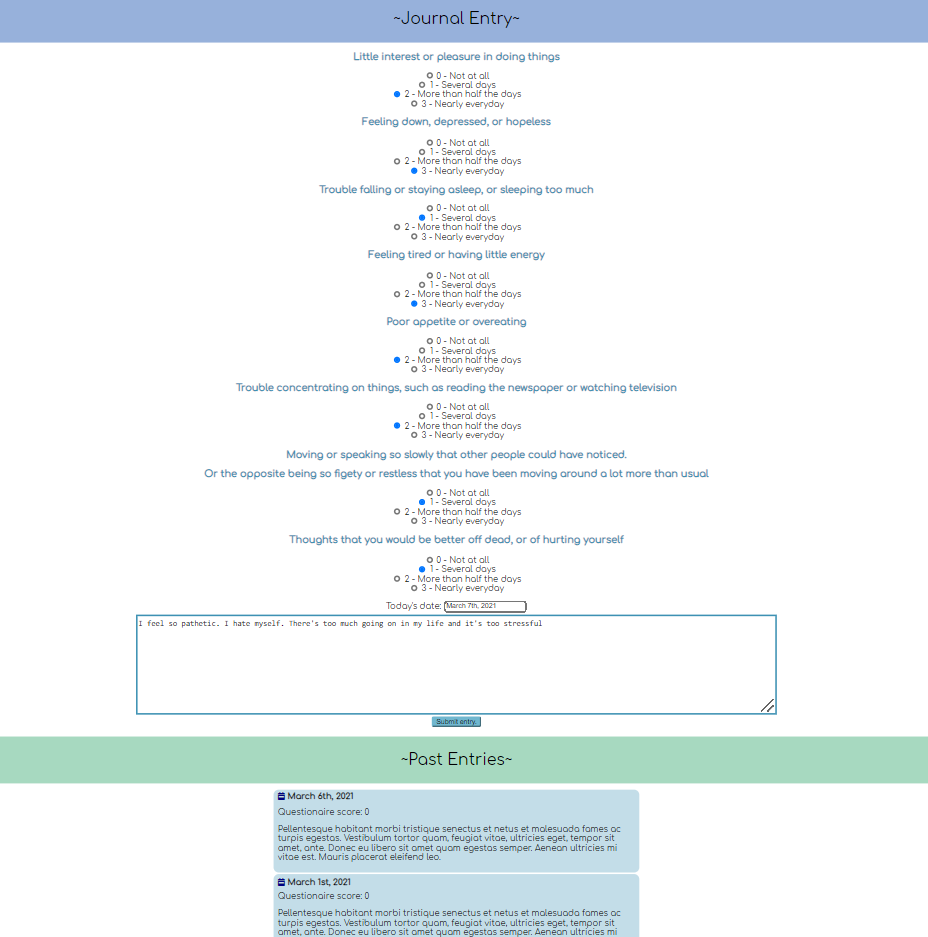
We created a simple app using Django, a python web app framework. Using our web-based application, students will complete journal entries and fill out the Patient Health Questionnaire-9 (PHQ-9), a validated screening tool for depression. Our machine learning algorithm searches for words/phrases that are indicators of depression from patients journal entries and calculate the frequency of these words to formulate a quantitative framework for detecting mild, moderate and/or severe depression reported as a numerical score.
How we built it
Our prediction tool consists of two parts: (1) a questionnaire that asks student related questions and; (2) the journal users posted. The questionnaire (PHQ-9) is a validated screening tool for depression.
PHQ-9 Score - Depression Severity 1-4 - Minimal 5-9 - Mild 10-14 - Moderate 15-19 - Moderately severe 20-27 - Severe
Students will complete the questionnaire, which will be used to compliment the journal component of our prediction tool. We identified key words in the literature that have been identified as indicators of depression (“predictors”). We incorporated these keywords into our machine learning algorithm so it would be able to identify potential markers of depression in journal entries. This additional feature was implemented to improve the accuracy of our predictions.
Challenges we ran into
One major challenge was that we all came from different majors and therefore didn’t necessarily have the same background knowledge on some of the technologies. But this was also an asset to our team because we each brought a unique perspective to the table!
With the majority of our cohort coming from life science backgrounds, a major challenge we faced was the lack of familiarity with machine learning, web programming in Python and Django in particular. Hence, there was a steep learning curve to familiarize ourselves with the basics of the framework (lots of youtube videos :)). We created a basic mockup of the user interface for adding journal entries using HTML, CSS and vanilla JS and then translated over Django and ML modules ultimately.
Accomplishments that we're proud of
We are proud to have started creating a platform that could truly help our peers and one that we can see being implemented on our campus. We were able to learn new technologies in record time and build a model within such a short time frame, while collaborating with each other remotely.
What we learned
As a group, we learned a lot of valuable insights about machine learning from the workshops hosted by TechXplore. We also individually gained many insights from each other since we all came from diverse backgrounds with different experiences and skill sets to share among us.
What's next for R.E.A.D. (Realtime Ecological Assessment of Depression)
Future iterations of our app will result in greater sensitivity and specificity of our detection algorithm. Our aim is to incorporate the language used in peer-to-peer social support communications and the frequency of participation to further refine our application's ability to detect mild, moderate and/or severe depression. We also plan to expand our application in its ability to detect other states of mental illness such as generalized anxiety disorder, which is also common among university students. Moreover, we aim to integrate this application as part of the university's education services platform to increase accessibility and promote mental health and self-care as a normalized activity in daily routine.
Built With
- css
- django
- html
- machine-learning
- python
- tensorflow
- vanilla


Log in or sign up for Devpost to join the conversation.