-
-
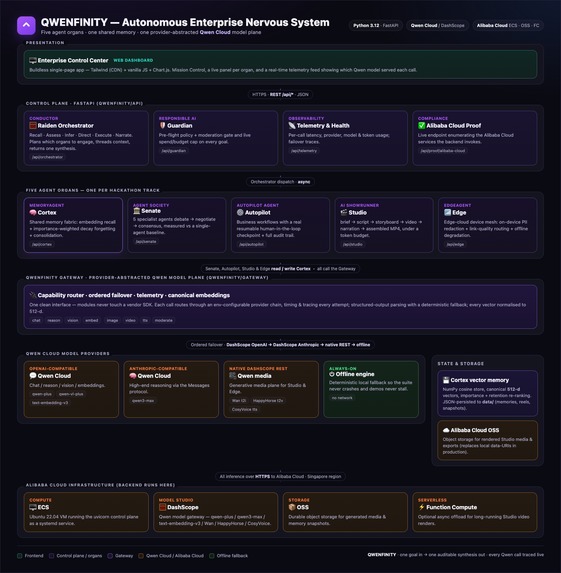
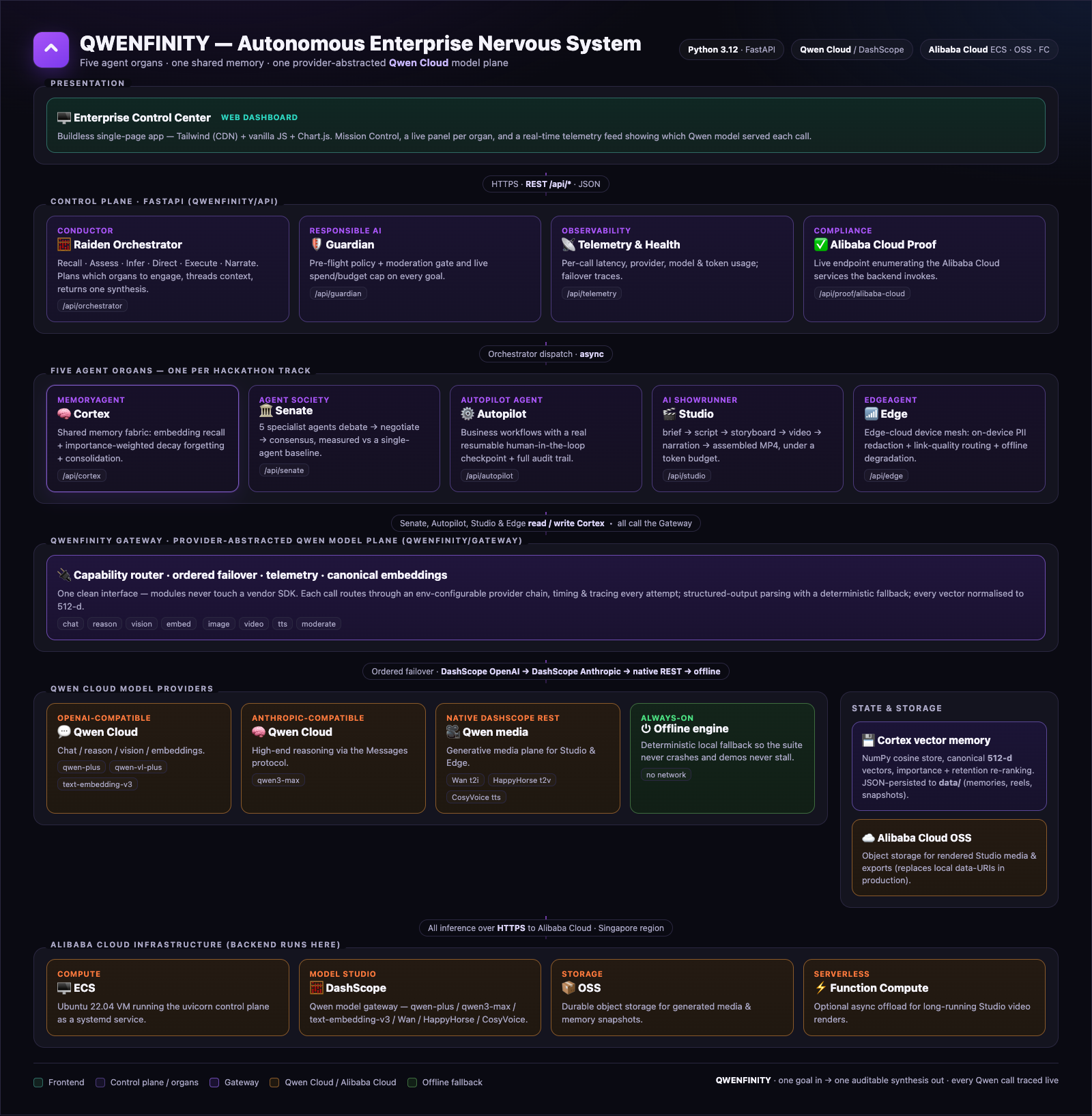
architecture diagram
-
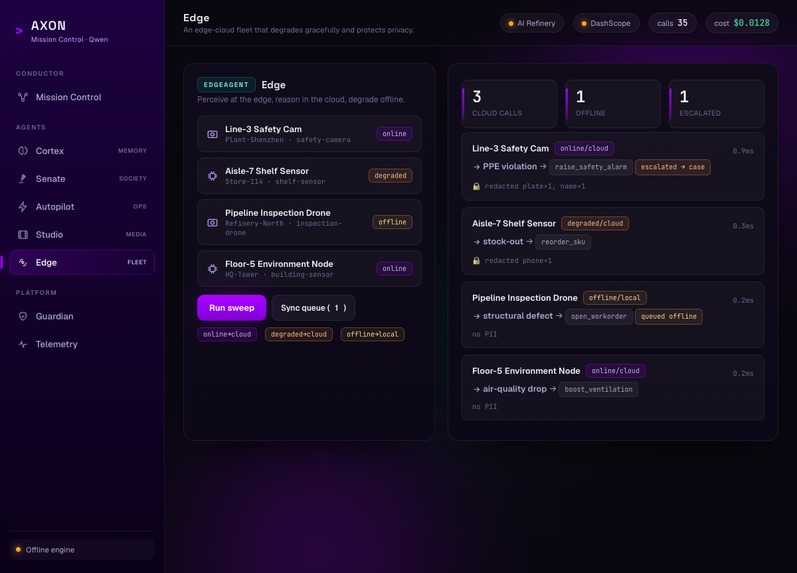
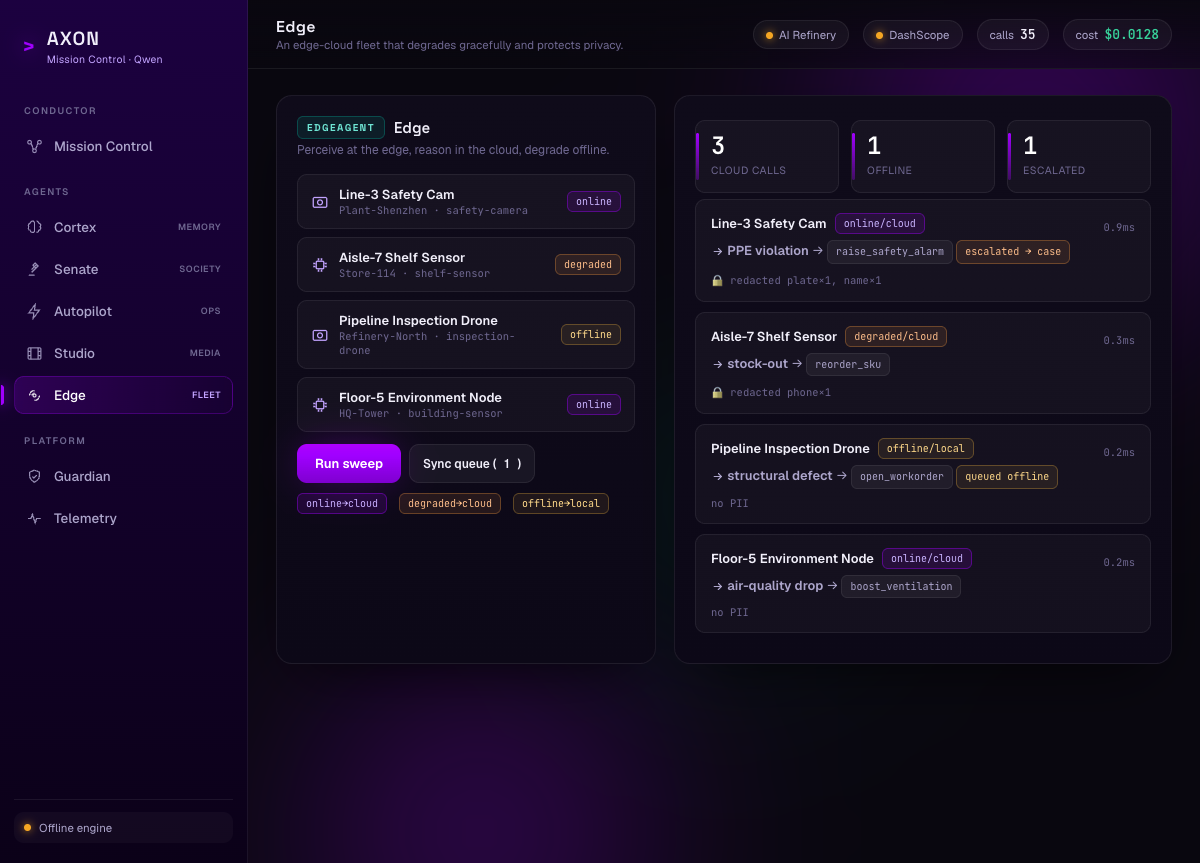
Edge mesh + on-device PII redaction
-
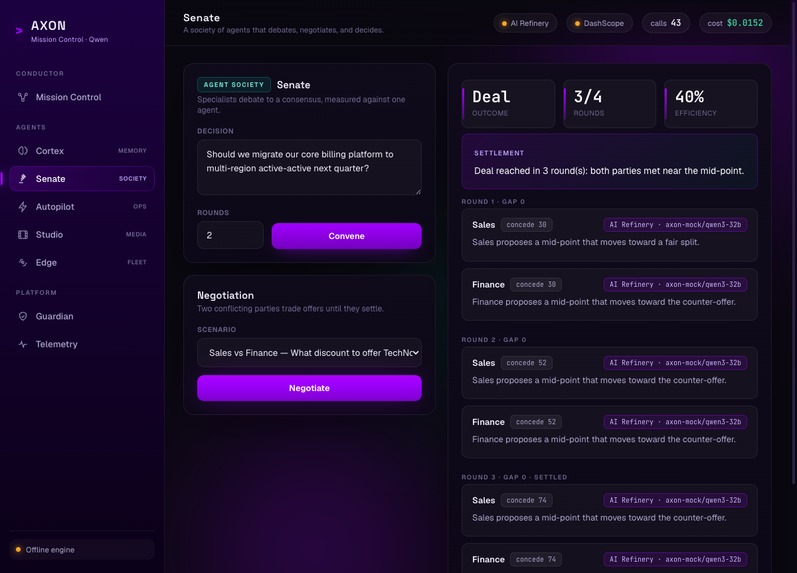
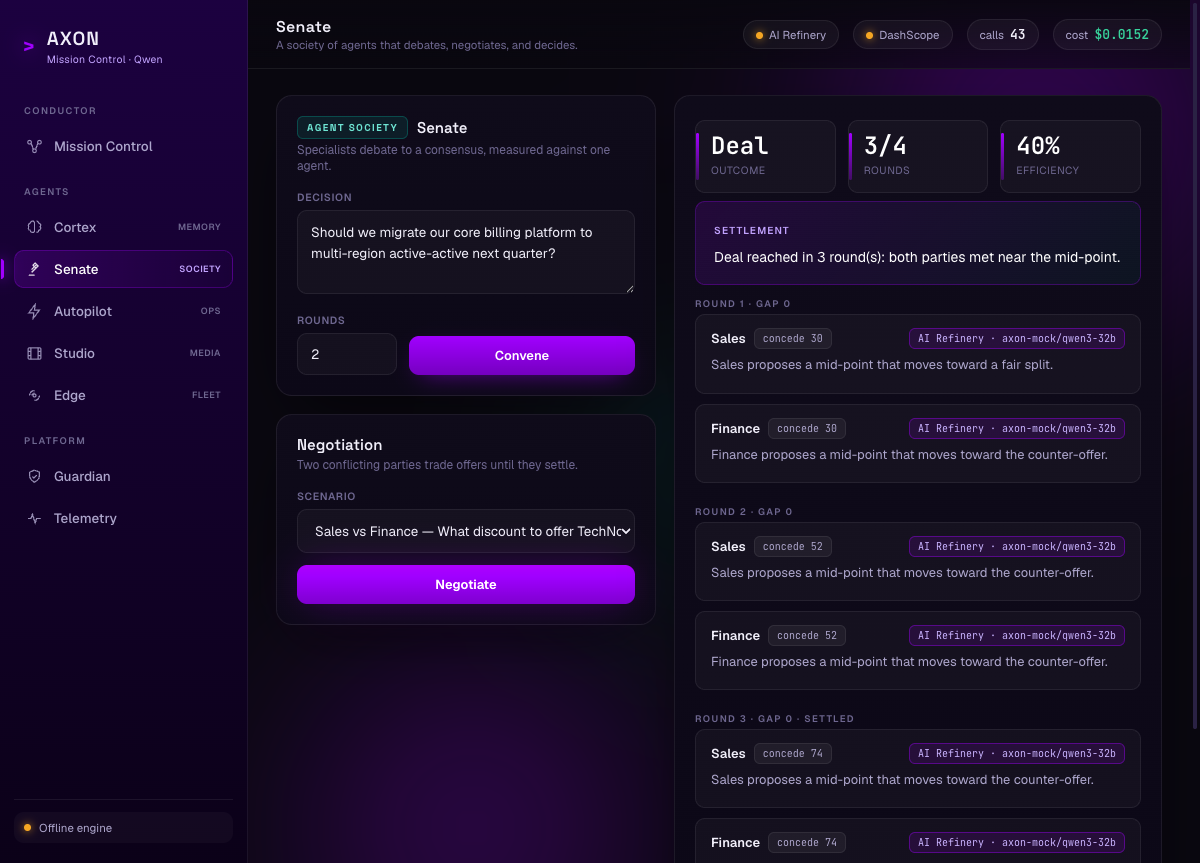
Agent Society debate + uplift metrics
-
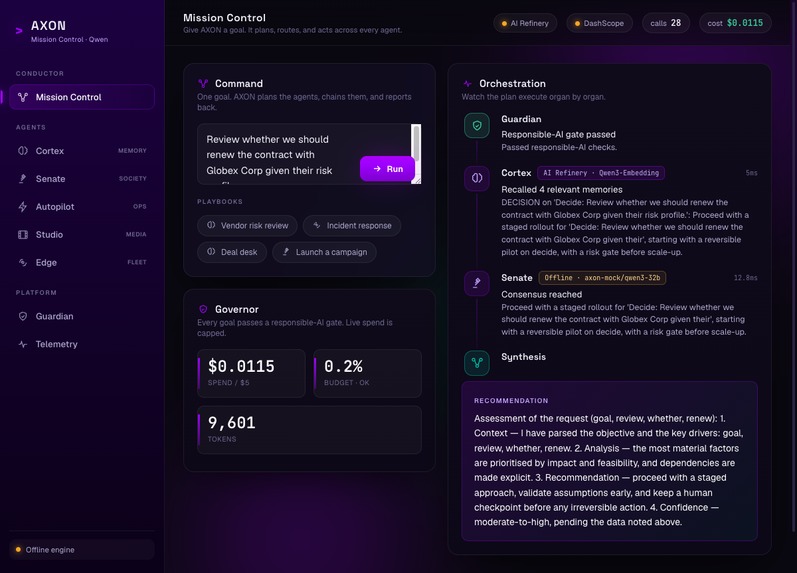
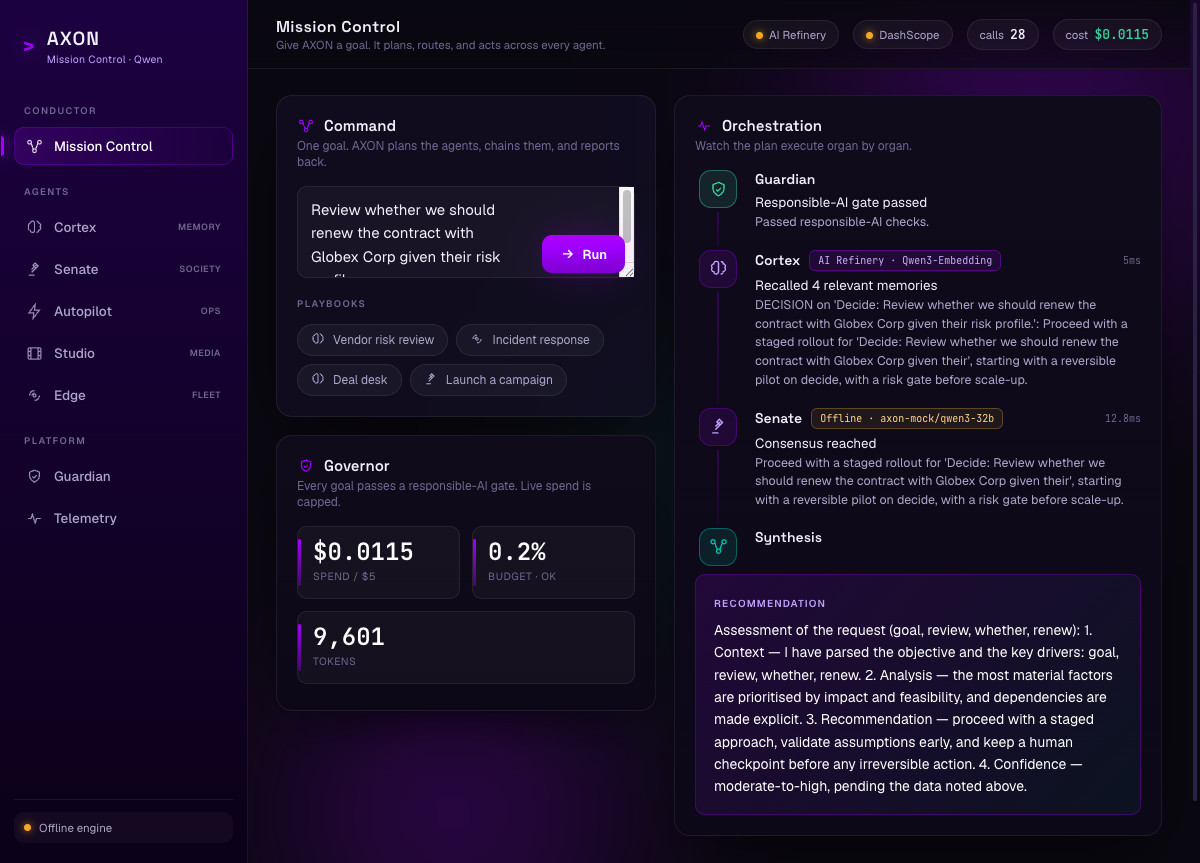
Mission Control / Raiden orchestration
Inspiration
Inspiration
Every enterprise already runs on a dozen disconnected AI tools that forget each other's context the moment a task crosses a team boundary. Memory lives in one silo, decisions in another, operations in a third, content in a fourth — and the edge is an island. Nobody can see, or trust, why the AI did what it did.
We looked at the five hackathon tracks and realised they aren't five products — they are the five organs of one autonomous enterprise: a memory, a decision-making body, operational hands, a communications studio, and senses at the edge. So we built one suite where those organs share memory, telemetry, and a single Qwen Cloud model plane, conducted by an orchestrator we call Raiden — Recall, Assess, Infer, Direct, Execute, Narrate.
What it does
QWENFINITY is one FastAPI control plane with a live enterprise dashboard. You give it one goal; Raiden plans which organs to engage and returns a single synthesis:
- 🧠 Cortex (memory). An org-wide memory fabric: embedding recall ranked by
cosine × importance × retention × frequency, with importance-weighted decay forgetting (pinned compliance memories are never forgotten) and consolidation. - 🏛 Senate (decisions). Five specialist agents — Analyst, Strategist, Risk Officer, Engineer, Devil's Advocate — debate over N rounds; a Facilitator negotiates consensus. It runs a single-agent baseline side-by-side and reports the uplift.
- ⚙️ Autopilot (operations). Real business workflows (invoice→payment, alert→remediation, résumé→interview, inquiry→quote). High-stakes steps suspend the live coroutine at a human checkpoint and resume on approval — genuine human-in-the-loop across HTTP requests, with a full audit trail and Qwen-VL document intake.
- 🎬 Studio (communications). A topic becomes a finished vertical video: script + visual keywords + hashtags → voiceover → per-segment footage → timed subtitles → an assembled MP4 (captions burned in, audio muxed with ffmpeg) — all inside a token budget it reports back.
- 📡 Edge (senses). An edge-cloud device mesh: devices redact PII on-device, then choose their inference path from live link quality (online→cloud, degraded→cloud+timeout, offline→on-device) and degrade gracefully with zero network.
Every organ sits on the QWENFINITY Gateway — one Qwen Cloud model plane that speaks both the OpenAI and the Anthropic wire protocols to Alibaba Cloud DashScope, calls native DashScope REST for generative media, and drops to a deterministic offline engine so the suite is always fully functional. The dashboard shows which Qwen model served each request, live.
How we built it
- Backend: Python 3.12 + FastAPI (async throughout), one router per organ.
- Model plane — Qwen Cloud / Alibaba Cloud DashScope (Singapore):
- OpenAI-compatible endpoint →
qwen-plus,qwen-vl-plus,text-embedding-v3 - Anthropic-compatible endpoint →
qwen3-max - Native DashScope REST → Wan (image), HappyHorse (video), CosyVoice (speech) for the Studio & Edge media plane
- OpenAI-compatible endpoint →
- Gateway: a provider-abstracted capability router (
chat,reason,vision,embed,image,video,tts,moderate) with ordered failover, structured-JSON parsing, per-call telemetry, and embeddings canonicalised to 512-d so the memory store never mixes dimensions. - Memory: a NumPy cosine vector store persisted to disk — portable, no external DB.
- Frontend: a buildless single-page dashboard (Tailwind CDN + vanilla JS + Chart.js) — zero build step, runs anywhere.
- Deploy: Alibaba Cloud ECS runs the uvicorn control plane; OSS stores generated
media; Function Compute optionally runs async video renders. The backend proves its
Alibaba Cloud usage live at
GET /api/proof/alibaba-cloud.
Challenges we ran into
- One interface, many protocols. Making the same suite speak OpenAI and Anthropic wire formats to Qwen — and fail over between them without any module knowing — took a strict capability abstraction.
- Real human-in-the-loop. Pausing a workflow mid-execution and resuming it across
two separate HTTP requests meant suspending a live
asynciocoroutine on a Future, not re-running a script. - Mixed embedding dimensions. Different providers/offline paths return different vector sizes; we enforce a canonical 512-d so recall never breaks.
- Always-on demos. We built a deterministic offline engine so a slow network never stalls a demo — and the same code upgrades to live Qwen Cloud the moment a key exists.
What we learned
Dual-protocol access to Qwen on Qwen Cloud, the DashScope async task queue for generative media, importance-weighted forgetting, resumable HITL coroutines, and how a single provider-abstraction turns five separate demos into one coherent, governable platform.
What's next
OSS-backed media delivery, Function Compute for heavy renders, GraphRAG memory, and learned routing for which Senate agents to convene per decision.
What it does
How we built it
Challenges we ran into
Accomplishments that we're proud of
What we learned
What's next for QWENFINITY - Autonomous Enterprise Nervous System
Built With
- alibaba-cloud
- chart.js
- cosyvoice
- dashscope
- ecs
- fastapi
- ffmpeg
- function-compute
- happyhorse
- httpx
- javascript
- numpy
- oss
- pillow
- python
- qwen
- qwen-cloud
- qwen-plus
- qwen-vl
- qwen3-max
- rest
- tailwindcss
- text-embedding-v3
- uvicorn
- wan


Log in or sign up for Devpost to join the conversation.