Inspiration
The inspiration for Qwen3-TTS came from recognizing the limitations of existing text-to-speech solutions: high latency that breaks conversational flow, complex voice customization requiring technical expertise, and closed-source models that limit innovation. We envisioned a platform where creators could generate natural, expressive speech in real-time—breaking the "100ms barrier" that has long constrained interactive applications. The goal was to democratize professional voice synthesis, making it accessible to content creators, developers, and businesses without requiring audio editing skills or expensive voice talent.
What it does
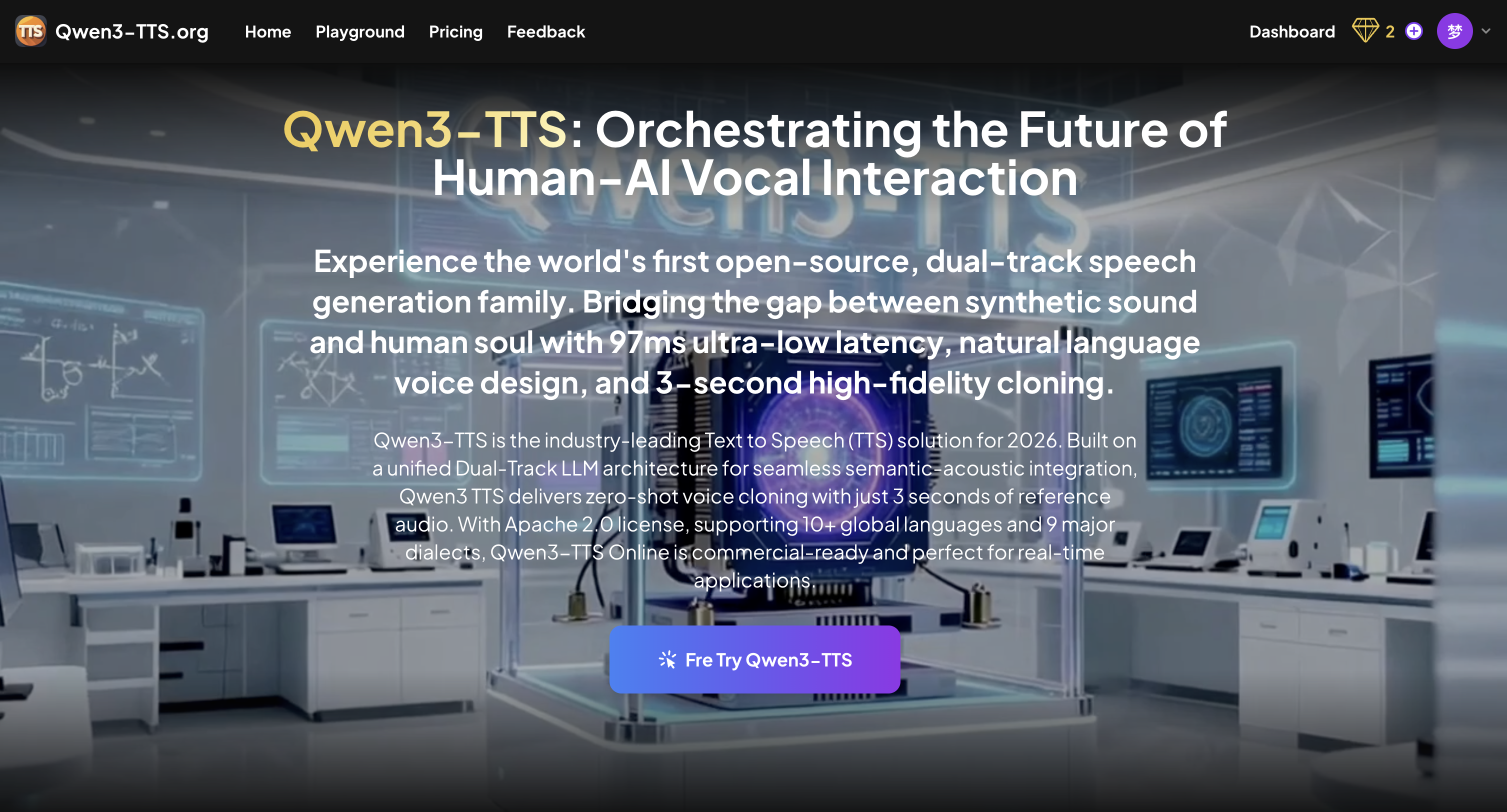
Qwen3-TTS transforms text into high-quality, natural-sounding speech with three revolutionary capabilities: ultra-low latency generation at 97ms (breaking the traditional 100ms barrier), rapid voice cloning in just 3 seconds from reference audio, and natural language voice design where users describe desired voice characteristics in plain text. The platform supports 10+ international languages and 9 Chinese dialects, delivering professional-grade audio synthesis with natural intonation and emotional expression. Built on an open-source foundation model (Apache 2.0 License), Qwen3-TTS enables real-time applications like interactive NPCs, live customer service bots, podcast narration, video voiceovers, and simultaneous interpretation—all without requiring traditional voice recording or audio editing expertise.
How I built it
Qwen3-TTS is built on a unified foundation model architecture that integrates voice cloning, system voice selection, and voice design into a single pipeline. The platform leverages optimized GPU kernels and streamable inference to achieve 97ms first-packet latency. We developed a web-based interface using Next.js and React, implementing real-time audio generation with polling mechanisms for task status tracking. The backend integrates with the Qwen3-TTS API, handling audio file processing, voice cloning from reference audio, and natural language voice design interpretation. We implemented user authentication, credit-based billing, and GDPR-compliant consent management. The entire platform is designed for scalability, supporting both cloud-based deployment and local development environments through open-source model weights and API integration.
Challenges I ran into
One of the biggest challenges was achieving ultra-low latency while maintaining high audio quality. Optimizing the inference pipeline to break the 100ms barrier required careful balancing of model complexity, GPU utilization, and streaming techniques. Another significant challenge was implementing natural language voice design—interpreting user descriptions like "a middle-aged female professor with a slight British accent" into actionable voice parameters required extensive prompt engineering and model fine-tuning. Handling real-time audio generation with proper error handling, queue management, and user feedback also presented complexity, especially for anonymous users requiring human verification. Additionally, ensuring multilingual support across diverse languages and dialects while maintaining consistent voice personality required careful model training and testing.
Accomplishments that I'm proud of
I'm most proud of breaking the "100ms barrier" with 97ms first-packet latency, making Qwen3-TTS one of the fastest text-to-speech solutions available. The 3-second voice cloning capability represents a significant advancement in rapid voice adaptation. The natural language voice design feature is particularly innovative, allowing users to create unique voice personas through simple text descriptions—something that wasn't possible with previous TTS systems. Building a fully open-source platform (Apache 2.0 License) that empowers developers and creators worldwide is also a major achievement. The multilingual support covering 10+ languages and 9 Chinese dialects demonstrates the model's versatility. Finally, creating a user-friendly web interface that makes professional voice synthesis accessible to non-technical users without requiring audio editing skills is something I'm proud of.
What I learned
Through building Qwen3-TTS, I learned the critical importance of latency optimization in real-time applications—every millisecond matters when creating conversational experiences. I gained deep insights into voice synthesis model architecture, understanding how to balance quality, speed, and resource efficiency. The project taught me about the complexities of multilingual model training and maintaining voice consistency across different languages and dialects. I learned valuable lessons about user experience design, particularly how to make complex AI capabilities accessible through intuitive interfaces. The open-source development process taught me about community collaboration and the importance of transparency in AI development. Additionally, I learned about scalable system architecture, handling concurrent requests, queue management, and implementing robust error handling for production AI applications.
What's next for Qwen3-TTS Text to Speech – Open-Source AI Voice Generator
The roadmap for Qwen3-TTS includes further latency reduction, aiming to push below 50ms for even more responsive real-time applications. We plan to expand voice design capabilities with more granular control over emotional expression, speaking style, and vocal characteristics. Enhanced multilingual support with additional languages and improved dialect accuracy is in development. We're working on batch processing capabilities for large-scale content creation and improved API integration for developers. Advanced features like voice emotion control, speaking rate adjustment, and background music integration are planned. We're also exploring edge deployment options for even lower latency and improved privacy. Community-driven improvements through open-source contributions will continue to enhance the platform, and we're developing educational resources to help users maximize the platform's capabilities. Long-term, we envision Qwen3-TTS becoming the standard for real-time, high-quality voice synthesis across industries.
Built With
- mysql
- next.js
- openai

Log in or sign up for Devpost to join the conversation.