💡 Inspiration
Short dramas (微短剧) are one of the fastest-growing entertainment formats in the world, and the clear next frontier is localizing them for Southeast Asia. But production is still slow, manual, and expensive: writers, storyboard artists, camera, voice actors, and an editor for every 60-second episode.
I wanted to collapse that entire pipeline into a single autonomous agent — and to solve the localization problem natively, so one production run yields a Mandarin episode that a Malaysian or global audience can watch with subtitles in their own language.
🎬 What it does
Give Qwen Showrunner a one-line premise and it autonomously:
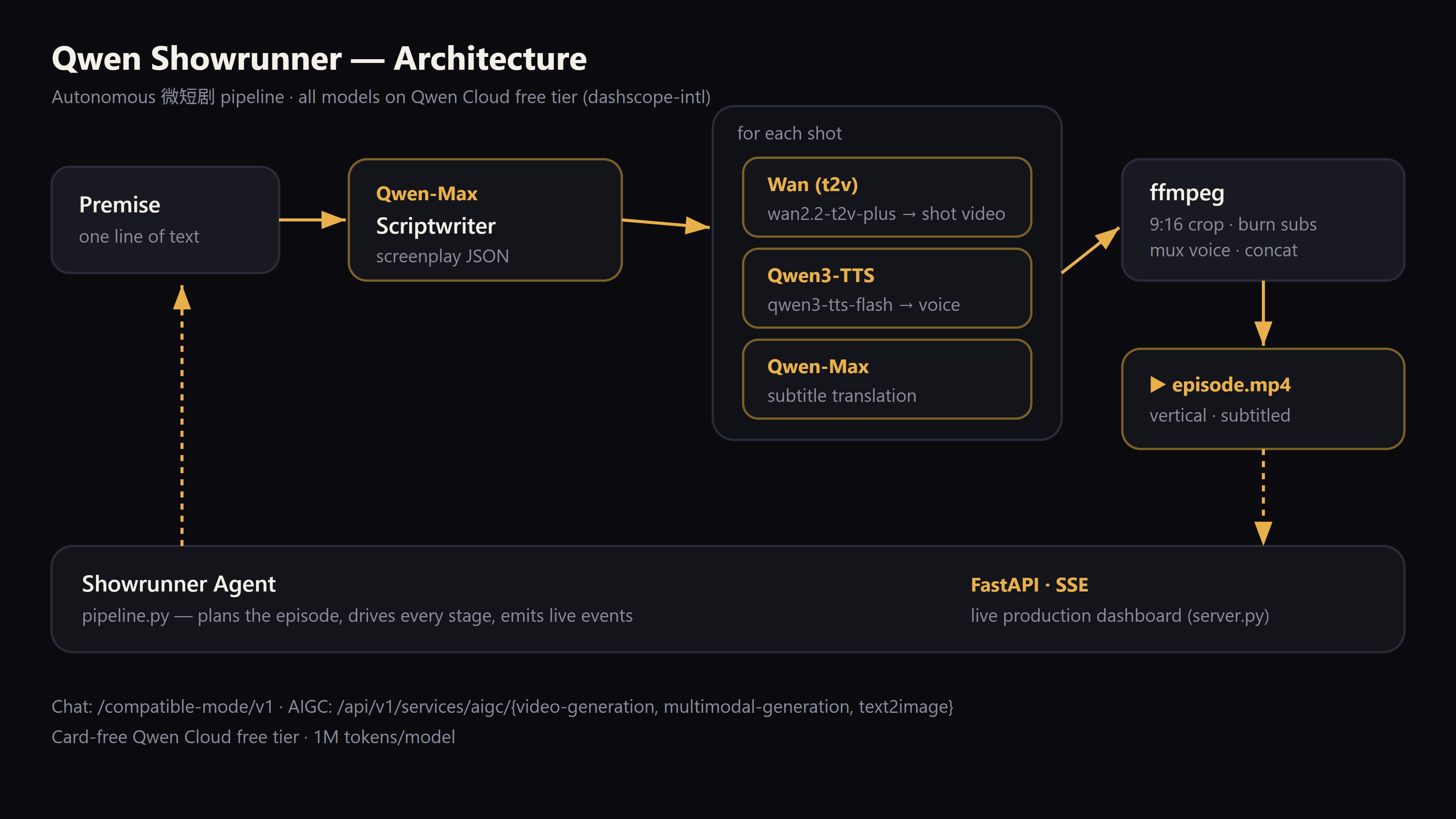
- Writes the screenplay — title, characters (with assigned voices), and a shot-by-shot script, as validated structured JSON.
- Films every shot — a text-to-video prompt per scene rendered with Wan.
- Voices every character — Qwen3-TTS in the chosen spoken language.
- Localizes — subtitles generated as a faithful translation into a different language (e.g. spoken 中文, subtitled English).
- Edits the final cut — ffmpeg crops each shot to vertical 9:16, burns
subtitles, syncs the voice, and concatenates into one
episode.mp4.
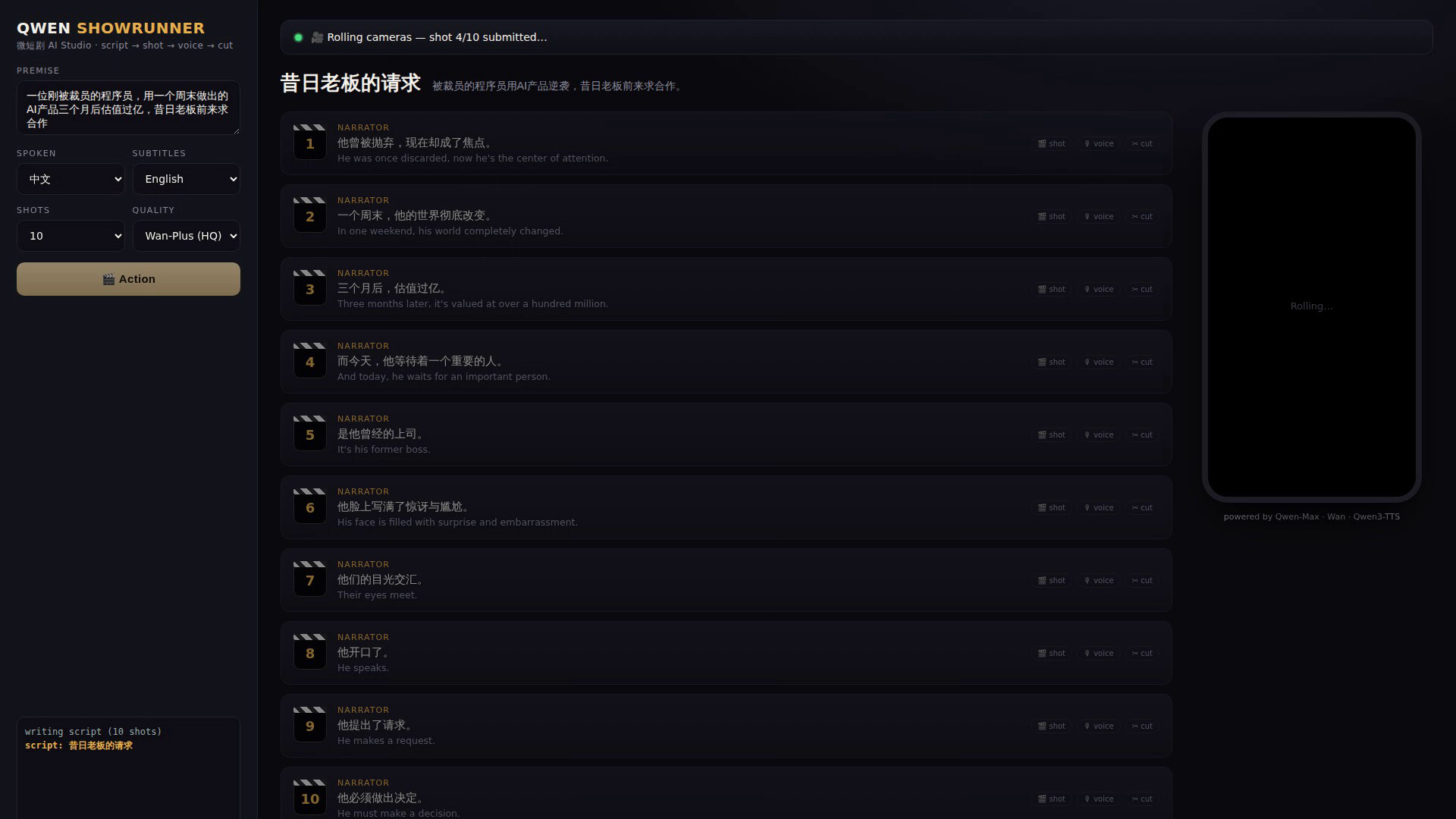
A one-command CLI or a live production dashboard (watch each shot get filmed, voiced, and cut in real time, then play the episode in a phone frame).
🛠️ How I built it
Everything runs on Qwen Cloud (Alibaba Cloud Model Studio), dashscope-intl,
on the free tier:
| Stage | Qwen Cloud model | Endpoint |
|---|---|---|
| Script / direction | qwen-max |
/compatible-mode/v1/chat/completions |
| Shot video | wan2.2-t2v-plus / wan2.1-t2v-turbo |
/aigc/video-generation/video-synthesis |
| Voices | qwen3-tts-flash |
/aigc/multimodal-generation/generation |
| Storyboard image | wan2.2-t2i-flash |
/aigc/text2image/image-synthesis |
- Orchestration: a Python "showrunner agent" (
pipeline.py) plans the episode and drives each stage, emitting events over a queue. - Dashboard: FastAPI + Server-Sent Events; a background thread runs the pipeline and streams progress to a cinematic control-room UI.
- Post-production: ffmpeg filtergraphs for scaling/cropping to 9:16, burning wrapped multilingual subtitles (CJK-capable font), padding audio/video to length, and concatenating shots.
🎯 Track alignment (AI Showrunner)
The track asks for an agent that autonomously handles the complete short-drama pipeline — scriptwriting, storyboarding, video generation (Wan), and post-production editing. Qwen Showrunner does all four, end to end, with Wan as the video engine and multimodal orchestration (LLM + video + speech + translation) as the core — while maximizing output quality under the free-tier token budget.
🌏 Why it matters (real-world value)
The spoken/subtitle language split makes this a localization engine, not just a video generator — directly targeting the SEA short-drama expansion. A studio could produce a Mandarin episode and ship English- and Malay-subtitled cuts from the same run, in about a minute, at near-zero marginal cost.
🧗 Challenges
- Mapping Beijing-region model names to their
dashscope-intlequivalents (wanx2.1-*→wan2.2-*,qwen-tts→qwen3-tts-flash, which requires sync calls) — solved by probing the live API. - ffmpeg filtergraph correctness on Windows: single
-filter_complex, quoted + escaped font paths for burned CJK subtitles, and duration-matched audio/video.
🏆 Accomplishments
- A genuinely autonomous premise → finished episode pipeline, all on free Qwen quota.
- Native bilingual localization (spoken vs subtitle language) built in.
- A live dashboard that makes the agent's work legible shot by shot.
🔭 What's next
- Image-to-video shot continuity (storyboard frame → Wan i2v) for character consistency.
- Multi-voice casting and background music.
- Batch series production and a publish step.


Log in or sign up for Devpost to join the conversation.