QwenPipelineGuard — Devpost submission copy (Qwen Cloud Global AI Hackathon, Track 4: Autopilot Agent)
Tagline
When a GitLab pipeline goes red, a Qwen-powered agent reads the logs like a senior engineer, pinpoints the exact root cause, and posts a diff-ready fix to your merge request — in seconds, zero clicks.
Inspiration
Every engineer knows the 2 AM ritual: a pipeline fails, you open the job, scroll hundreds of log lines, and eventually find the one line that matters — a missing env var, a dependency clash, a flaky test. It's tedious, interrupt-driven, and scales terribly across a team. We wanted an autopilot agent that does the scrolling for us: reads the logs, isolates the actual cause (not "build failed"), and proposes the fix as a patch you can apply immediately.
What it does
QwenPipelineGuard watches your GitLab CI pipelines. On every failure it:
- Fetches the pipeline, its jobs, and the failing job logs through MCP tools.
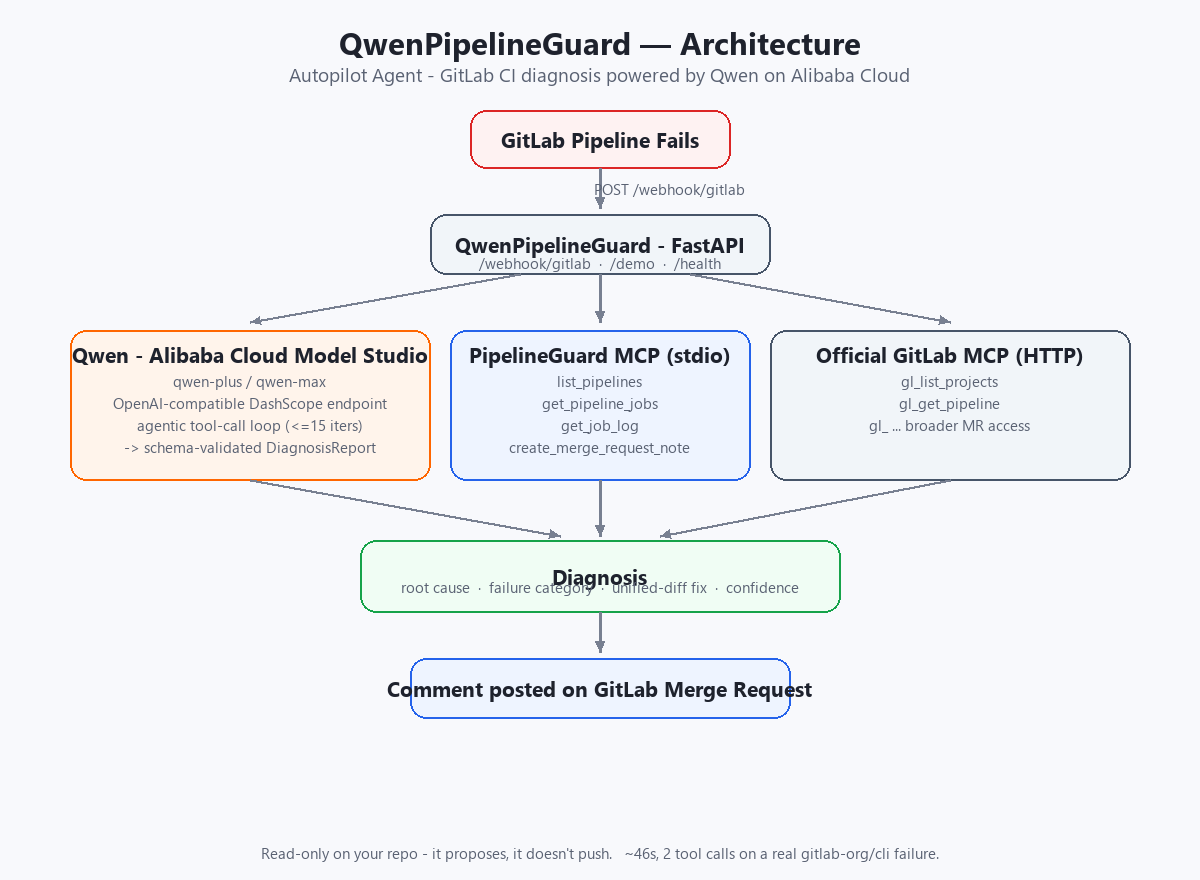
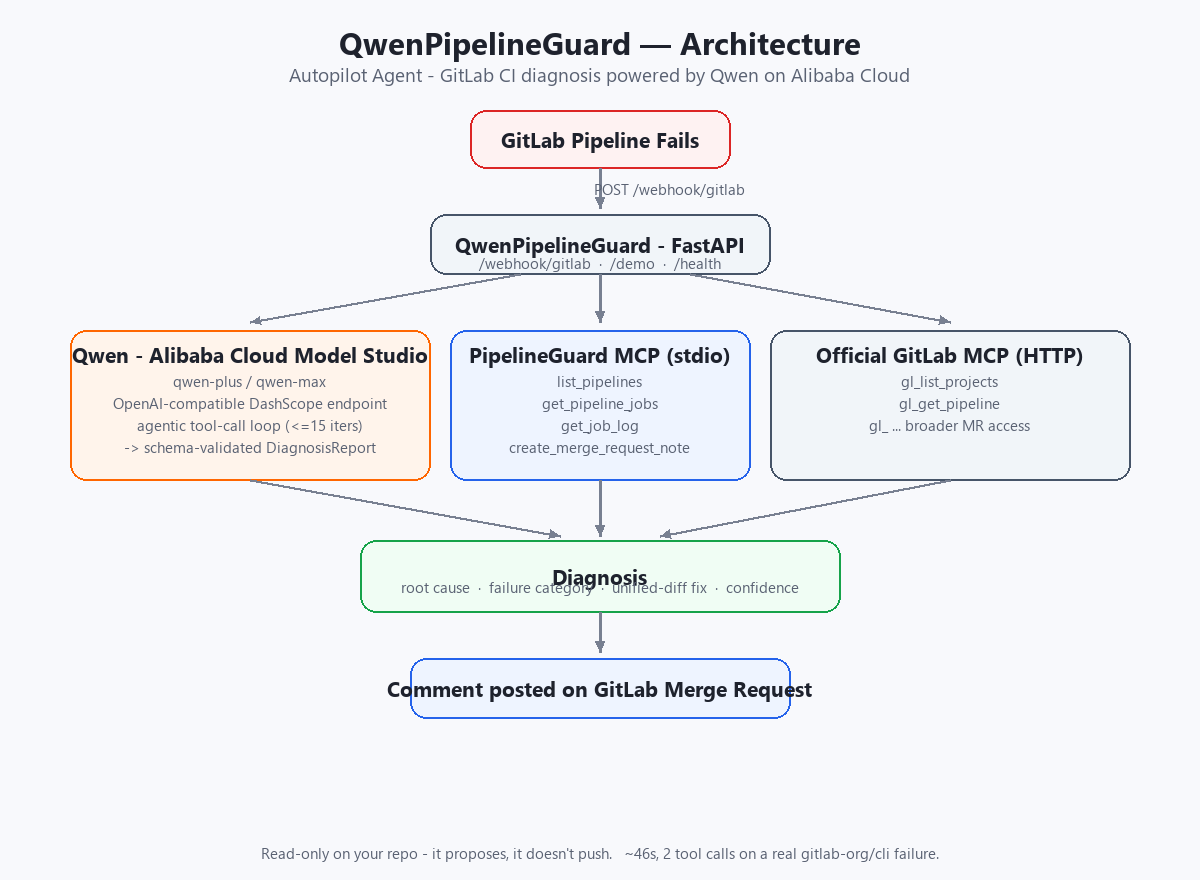
- Reasons over them with Qwen (qwen-plus / qwen-max) in an agentic tool-call loop — it decides which tools to call and when it has enough context.
- Produces a structured diagnosis: the precise root cause, a failure category (env / dependency / flaky / code / config), and a fix proposal as a unified diff with a confidence level.
- Comments the findings directly on the associated merge request, so the whole team sees them instantly.
Verified end-to-end against a real failed gitlab-org/cli pipeline: ~46 seconds, 2 tool calls, correct root cause identified.
How we built it
The core is a dual-MCP architecture that lets Qwen talk to GitLab through clean, typed tools instead of brittle prompt-parsing:
- A purpose-built MCP server (
pipelineguard.mcp_server, stdio) exposing GitLab tools:list_pipelines,get_pipeline_jobs,get_job_log,find_merge_request_by_sha,create_merge_request_note. - The official GitLab MCP server (Streamable HTTP,
gl_tool prefix) for broader project/MR access.
The agent (pipelineguard/qwen_agent.py) runs on Qwen via Alibaba Cloud Model Studio's OpenAI-compatible DashScope endpoint (https://dashscope-intl.aliyuncs.com/compatible-mode/v1) — no Alibaba SDK needed, just the openai package. MCP tools are converted from JSON Schema to OpenAI function-calling format, the loop is bounded (≤15 iterations), and it returns a schema-validated DiagnosisReport. It's wrapped in a FastAPI webhook server (/webhook/gitlab, /demo, /health) and deploys to Alibaba Cloud ECS.
Challenges we ran into
Porting the agent from a Gemini backend to Qwen's tool-calling loop meant reconciling function-call formats and streaming quirks, and keeping the diagnosis output schema-stable across models. Converting MCP JSON-Schema tools into OpenAI-compatible function definitions that Qwen calls reliably took iteration.
Accomplishments that we're proud of
It's not a toy demo — it ran end-to-end on a real failed pipeline in gitlab-org/cli and found the correct root cause in ~46 seconds using just 2 tool calls. It's read-only on your repo (it proposes, it doesn't push), and the whole diagnosis is powered by Qwen on Alibaba Cloud.
What we learned
MCP is a clean seam for giving an LLM real, typed access to a system of record (GitLab), and Qwen's OpenAI-compatible endpoint makes it a drop-in agentic reasoner with no vendor SDK lock-in.
What's next for QwenPipelineGuard
Multi-provider CI (GitHub Actions, CircleCI), auto-opening fix MRs behind human approval, and a historical "why did this break before?" memory over past diagnoses.
Built with
python, qwen, alibaba-cloud, dashscope, model-context-protocol, fastapi, gitlab, openai
Proof of deployment
- Code file using Qwen Cloud APIs:
pipelineguard/qwen_agent.pyanddocs/alibaba-cloud-proof.py(both call the DashScope compatible-mode endpoint). - Screenshot of running resources on Alibaba Cloud: Qwen Cloud / Model Studio console (attached).
Built With
- alibaba-cloud
- dashscope
- fastapi
- gitlab
- model-context-protocol
- openai
- python
- qwen


Log in or sign up for Devpost to join the conversation.