-
-
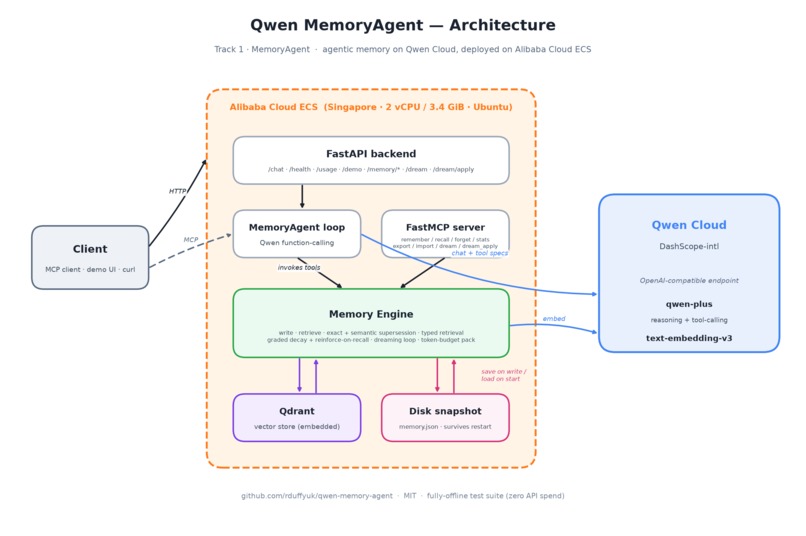
architecture
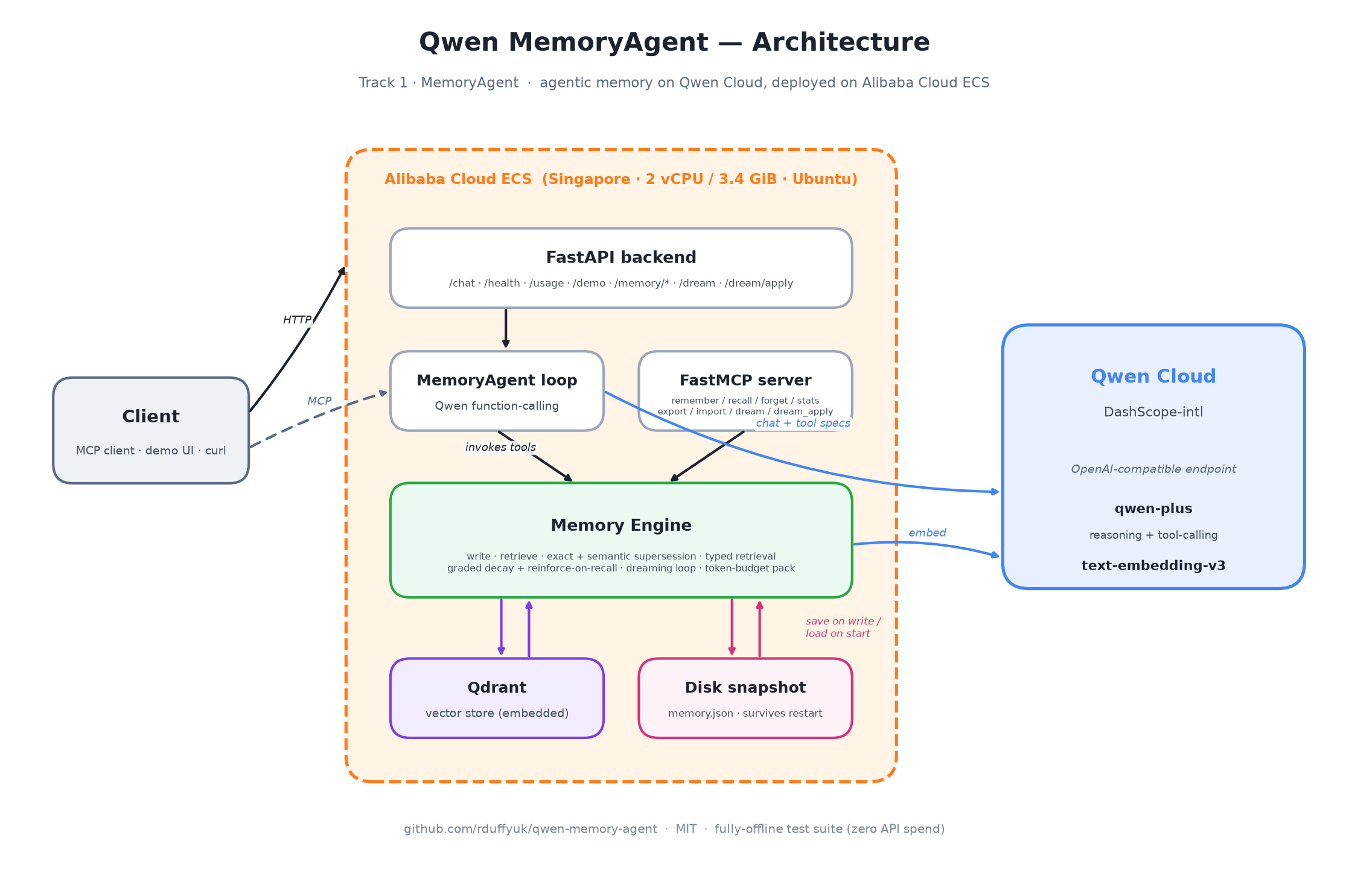
What inspired it
Every agent that talks to a user more than once hits the same wall: where do memories live, when should stale ones be dropped, and how do you fit the right memories into a limited context window? Most "memory" demos either stuff the whole history into the prompt — expensive, and it drags in outdated facts — or do naive top-k RAG, which has no notion of "this preference was replaced last week." I wanted to treat memory as a measurable engineering problem, not a party trick, and prove the behaviour with numbers.
What it does
Qwen MemoryAgent is a persistent-memory agent on Qwen Cloud that accumulates experience across sessions and makes increasingly accurate decisions:
- Agentic memory via Qwen function-calling. The agent itself decides when to
call
remember/recall/forgetthrough Qwen's tool-calling — it's an agent with memory, not a database with an LLM bolted on. - Supersession-aware forgetting. When a new fact contradicts an older one,
the old record is retired (
superseded_by) so retrieval stops surfacing the stale value. An exact(subject, type)match handles the clean case; a cosine-similarity pass catches near-paraphrases the model filed under a different subject. - Graded decay + reinforce-on-recall. Memories fade over time on a per-type half-life unless recall reinforces them — so the working set stays focused on what's still used, and truly stale memories are forgotten. Pinned types (user preferences) never decay.
- Budget-constrained recall. Retrieval scores memories by \( \alpha\cdot\text{cosine} + \beta\cdot\text{recency} + \gamma\cdot\text{effective salience} + \delta\cdot\text{type prior} \) and greedily packs them until a configurable token budget is hit.
- Real token observability. Every answer reports what it actually cost
(
GET /usage+ ausagefield per/chat), using Qwen's realusageobject rather than estimates. - Portable memory. Export the store to a human-readable
MEMORY.mdindex and a JSON snapshot; import to restore it — memory survives restarts and moves between machines. - MCP-native. The memory tools are a FastMCP server, so any MCP client can drive the same engine.
How I built it
A FastAPI backend runs the agent loop, a FastMCP server, and the memory engine,
backed by Qdrant, deployed on Alibaba Cloud ECS (Singapore). It calls
Qwen Cloud / DashScope over the OpenAI-compatible endpoint — qwen-plus for
the reasoning loop, text-embedding-v3 for vectors. The whole test suite is
fully offline (mocked Qwen + in-memory Qdrant), so development cost zero API
credits. I worked architecture-first on one model and handed bounded, spec'd
implementation to a second via a handoff lane gated by pytest, test-integrity,
and mutation testing.
The benchmark (the proof)
Synthetic multi-session personas state preferences, update some (the supersession test), and inject distractors; a held-out query set asks for the current preference. Four systems are scored — B0 no-memory, B1 full-history stuffing, B2 naive top-k, B3 ours — on context recall (retrieval-level, model-free) and staleness rate (retrieved context contains a superseded fact; lower is better), across a shrinking token budget with all systems competing under the same ceiling.
| Budget | 8 | 16 | 32 | 64 |
|---|---|---|---|---|
| B1 full-history — recall / stale | 0.000 / 0.250 | 0.375 / 0.250 | 0.958 / 0.250 | 1.000 / 0.250 |
| B2 naive top-k — recall / stale | 0.875 / 0.125 | 1.000 / 0.250 | 1.000 / 0.250 | 1.000 / 0.250 |
| B3 ours — recall / stale | 1.000 / 0.000 | 1.000 / 0.000 | 1.000 / 0.000 | 1.000 / 0.000 |
(B0 no-memory scores 0.000 recall at every budget — it retrieves nothing.)
B3 holds context recall 1.000 and staleness 0.000 at every budget. The sharpest finding is what happens to the baseline: B2's staleness rises with budget (0.125 → 0.250). With no supersession, giving naive RAG more room actively pulls retired facts back in. Only B3 stays current and small — measured, not asserted.
The harder proof (including the misses)
Recall benchmarks saturate, so I also measured whether the agent uses memory.
Ten multi-session scenarios seed constraints (including superseded ones) and
demand a decision in a later session, each graded by three independent
oracles: the decision outcome, the store state via /memory/export, and
recall-before-decision in the tool-call trace. A lucky guess that never consulted
memory scores zero.
Live on the ECS deployment, against real Qwen with a fresh store:
task_success 0.60 — inside the 40–60% band MemoryArena (arXiv 2602.16313)
reports for agents that ace passive recall. I publish the number and the full
triage: three named defects — decision turns that skip recall, a generic-subject
supersession collision, and a sub-threshold paraphrase band — each with a
designed fix in the README and docs/design/memory-governance.md.
The gap between recall 1.000 and active use 0.60 is the finding. Measured, not asserted, including the misses.
What I learned
- Mutation testing earns its keep. All-passing behavioural tests still left numeric constants (decay half-lives, a token-fallback branch) un-pinned — the mutation gate caught each one.
- Benchmark honesty is a discipline. My first graded run disproved the headline because a distractor's keyword collided with the staleness metric. The engine was right; the measuring stick was contaminated. Fixing the instrument, not the result, is the job.
- Subject assignment is the weak joint. Supersession depends on the model
choosing a stable
subjectkey, and it doesn't always — which is exactly why the cosine path exists, and exactly where the remaining failures live. - Two different token numbers do two different jobs —
tiktokenfor packing a budget, the API's realusagefor measuring spend. Conflating them hides cost.
Challenges
Keeping the whole thing testable and zero-spend on a finite free credit budget; a cardless ECS deploy (solved via the free trial); and shipping to Singapore over UK-latency SSH.


Log in or sign up for Devpost to join the conversation.