-
-
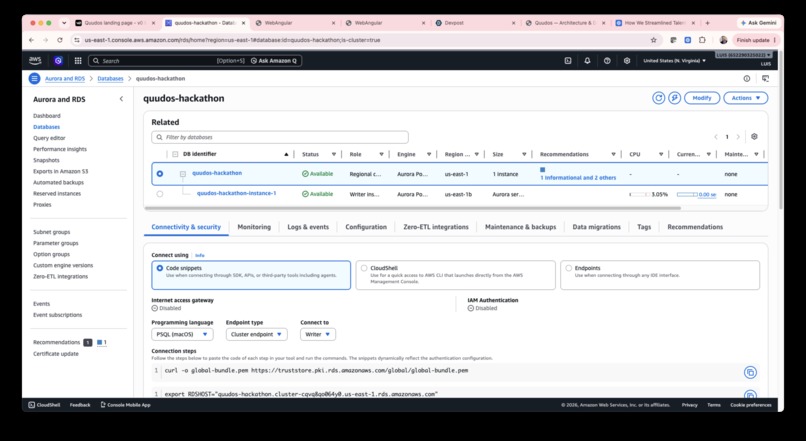
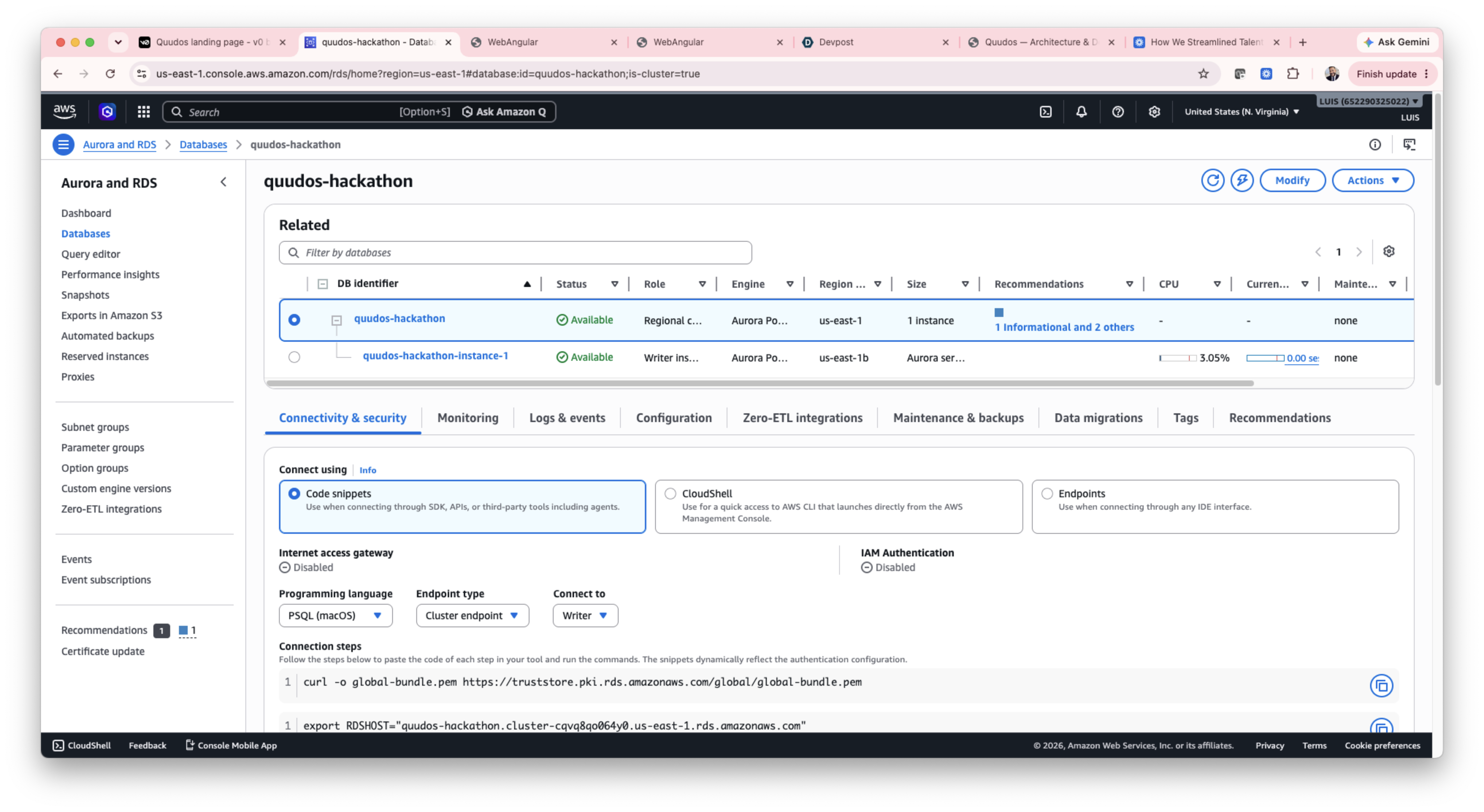
AWS Aurora PostgreSQL
-
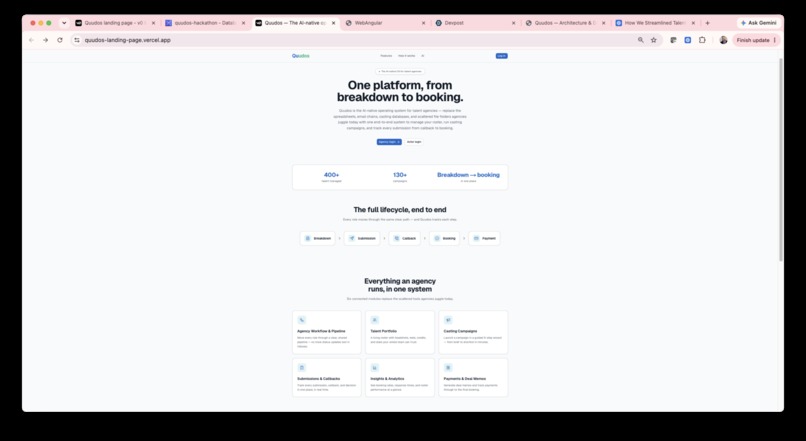
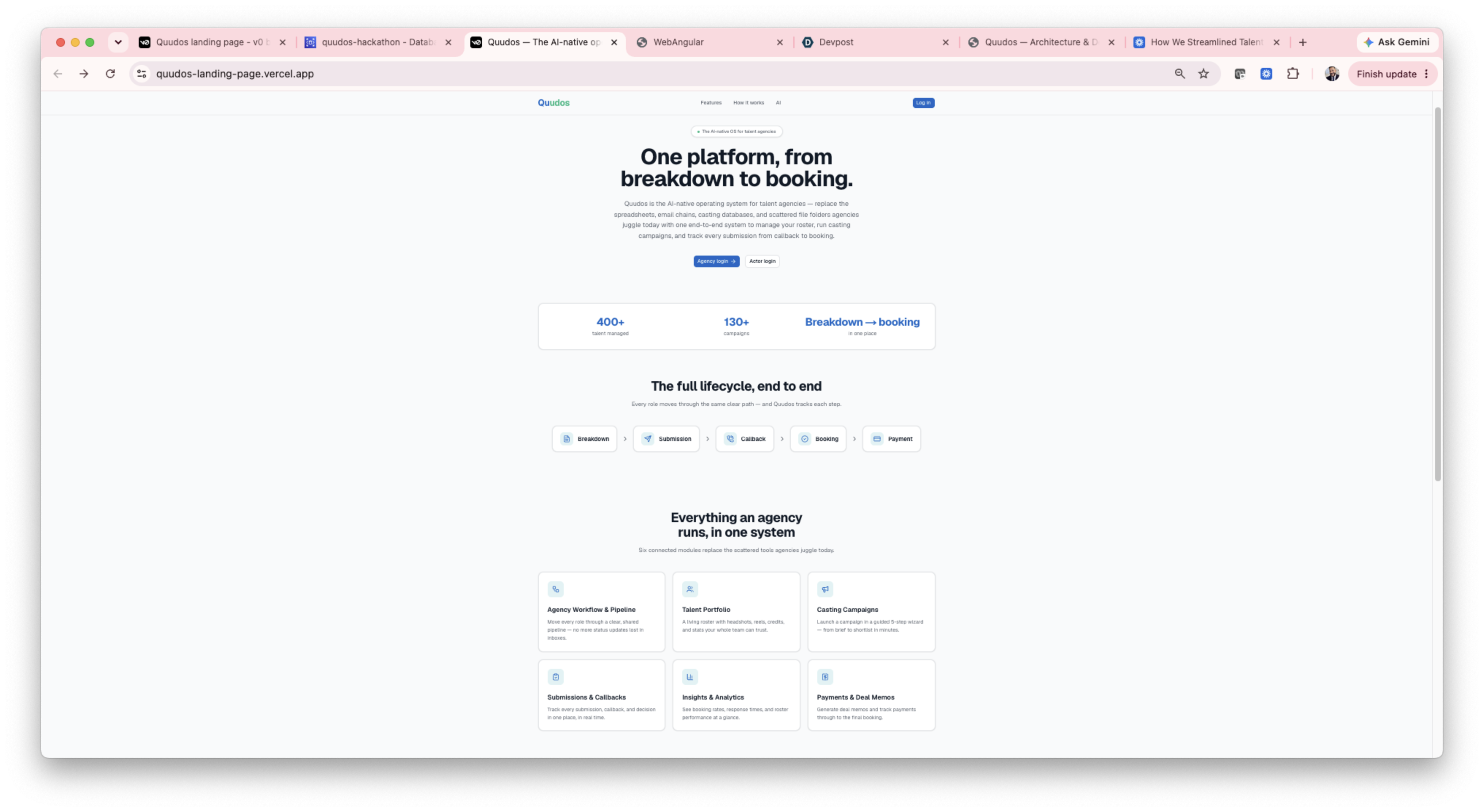
Quudos Landing Page
-
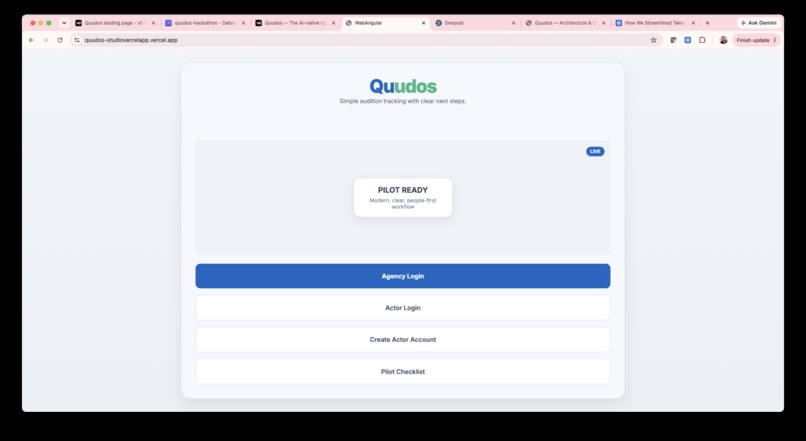
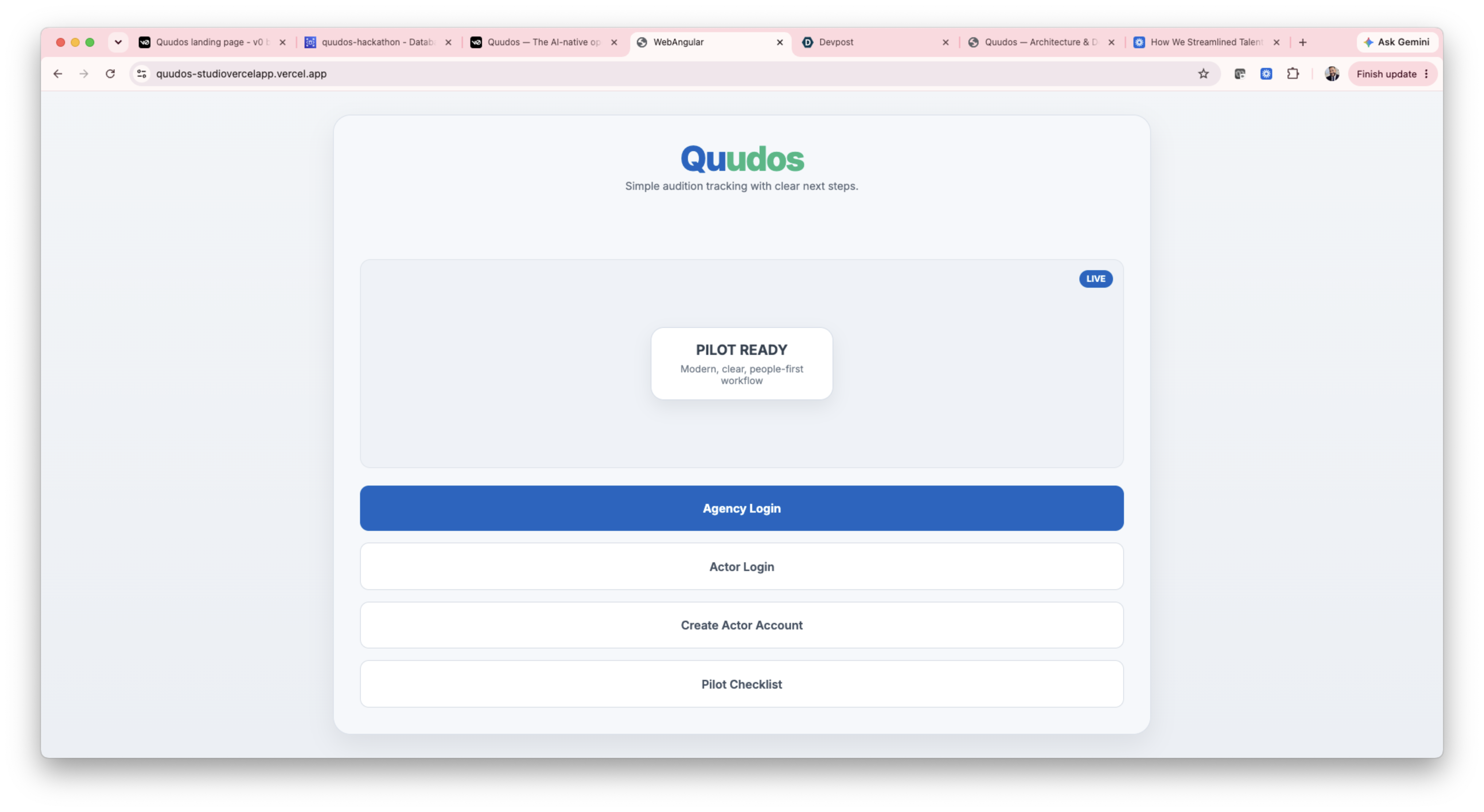
Quudos Login
-
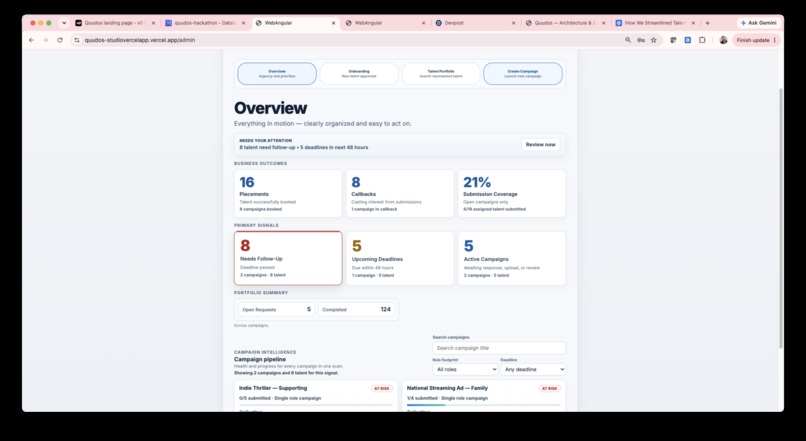
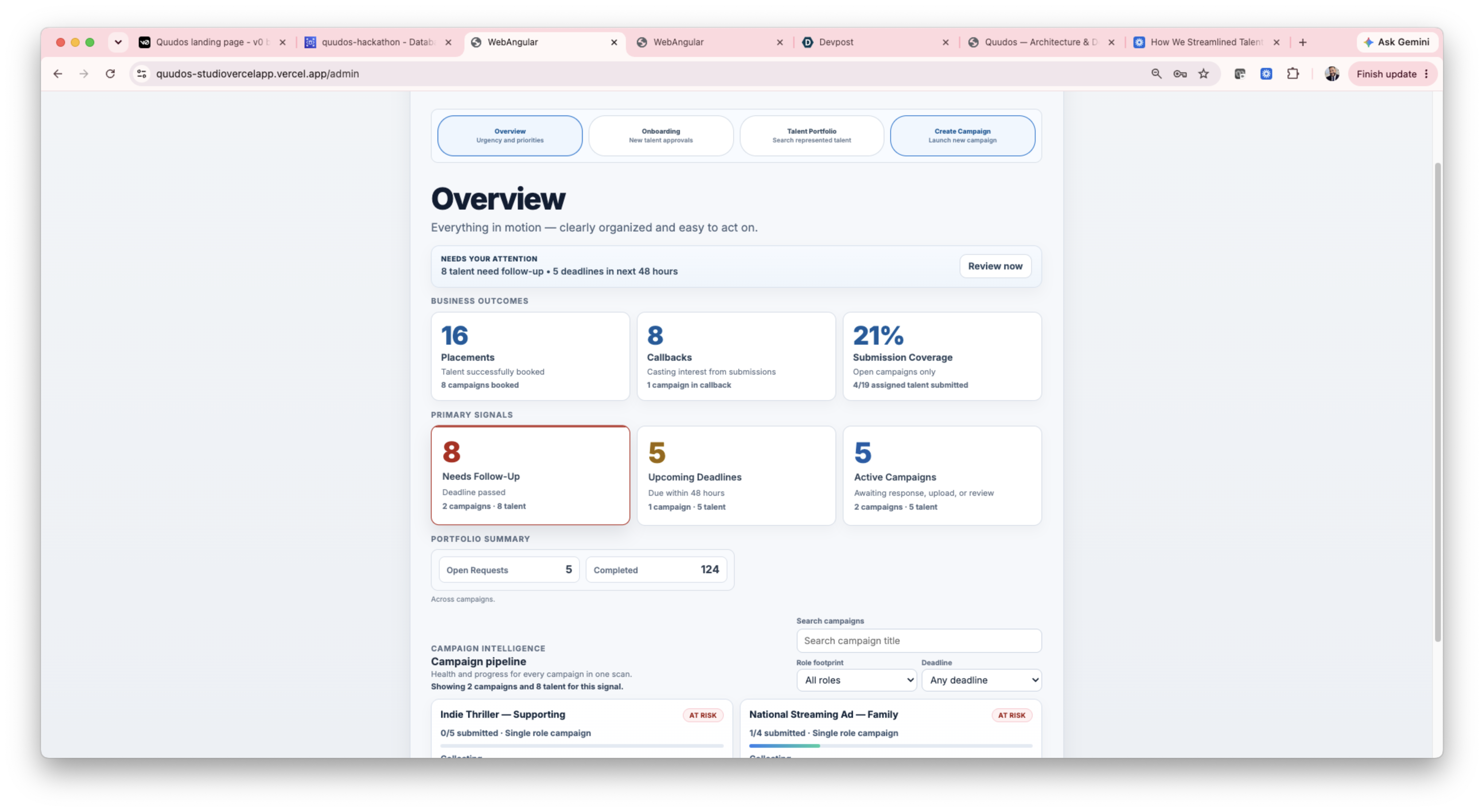
Talent Agency Main Dashboard
-
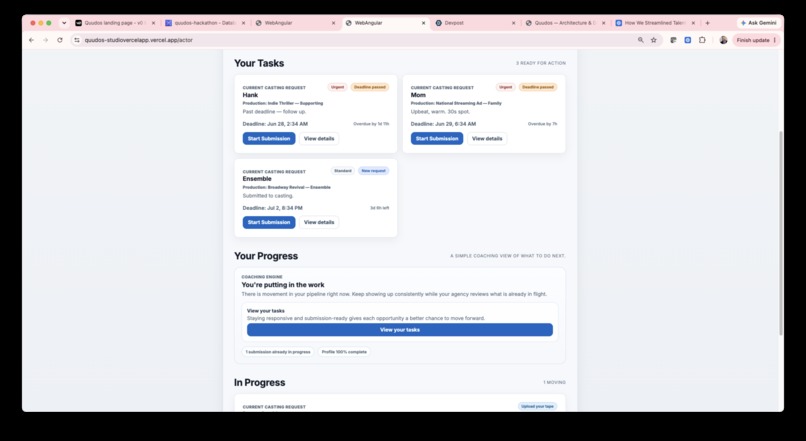
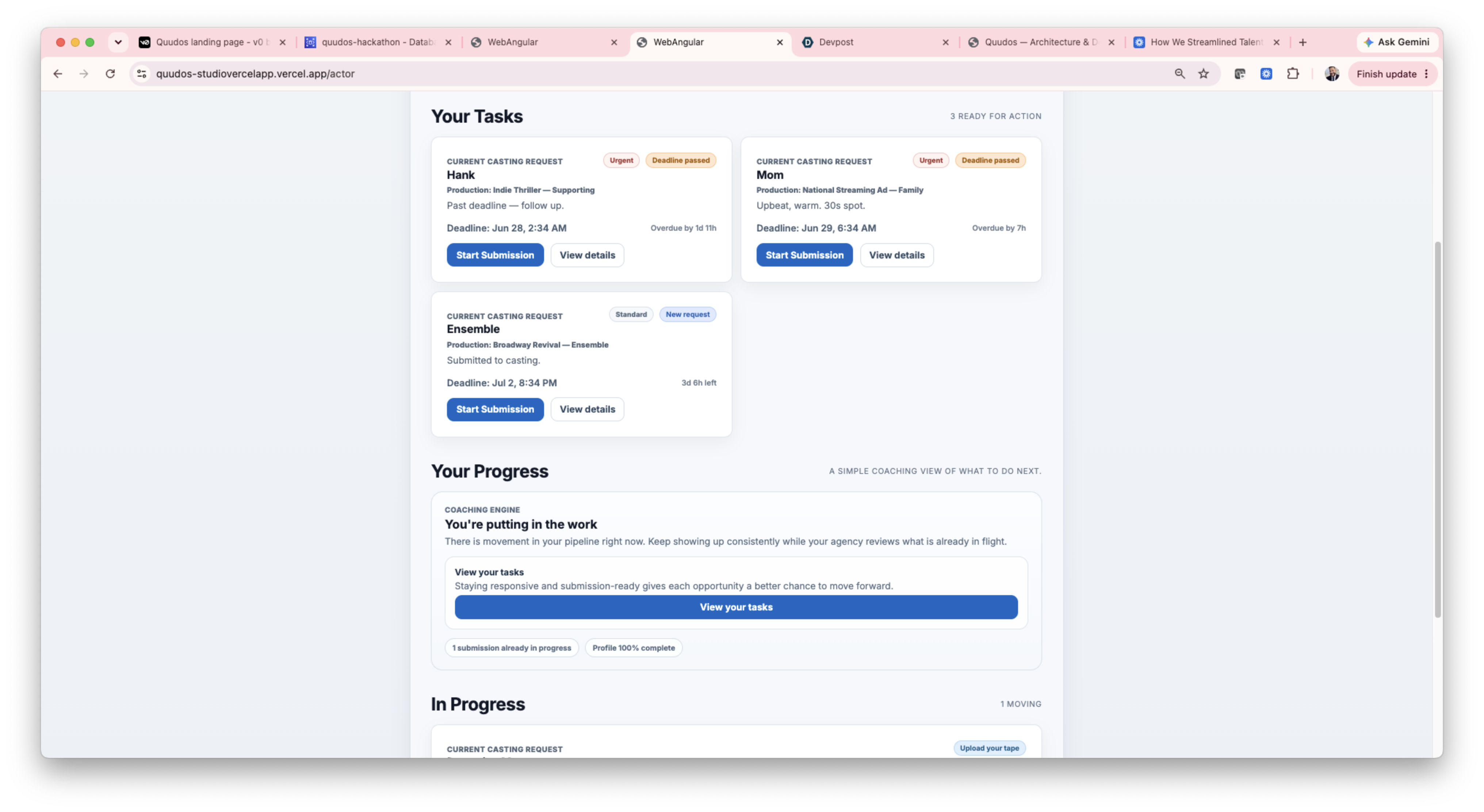
Actor Main Dashboard
Inspiration
This one's personal. Five years ago my daughter started acting, and our family lived the chaos — auditions in text threads, headshots scattered across folders, nothing ever in one place. I started talking to talent agencies in New York and LA, and they all said the same thing: they're still managing their talent by hand, and it doesn't scale. I'd carried this idea for years — and v0 and AWS finally gave me the push and the tools to build it.
What it does
Quudos is the AI-native operating system for talent agencies — one platform to run casting end to end:
- Overview / control tower — placements, callbacks, active campaigns, and what needs follow-up.
- Talent Portfolio — the represented roster with headshots, union status, eligibility, and availability.
- Onboarding — review and approve new talent representation requests.
- Casting Campaigns — a guided 5-step wizard to launch a campaign and assign talent.
- Submissions & Callbacks — track every submission through the full lifecycle: accepted → uploaded → submitted → callback → booked.
The model is free for actors (so they reach more agencies and casting directors) and monetized on the agency side.
How we built it
- Frontend: an Angular single-page app on Vercel, with a v0-built marketing landing page in front of it.
- API: a NestJS (Node) service using
node-postgreswith connection pooling, transactions, and advisory locks. - Primary database: Amazon Aurora PostgreSQL (Serverless v2) in us-east-1 — the system of record for every agency, talent profile, campaign, role, submission, and lifecycle event.
- Auth: a managed JWT provider for identity; all application data lives in Aurora.
Which AWS database — and why
Amazon Aurora PostgreSQL (Serverless v2). Casting is deeply relational, so we modeled it deliberately: organizations → users → actor_profiles/actor_media, and workflow_items (campaigns) → campaign_roles → assignments (submissions) → campaign_events. Status is enforced with PostgreSQL enums (campaign lifecycle DRAFT → COLLECTING_SUBMISSIONS → SUBMITTED_TO_CASTING → CALLBACK → BOOKED → CLOSED; submissions AWAITING_ACCEPT → ACCEPTED → UPLOADED → SUBMITTED → REVIEWED), and the API uses transactions and pg_advisory_lock for safe concurrent updates. Aurora Serverless v2 scales the same architecture from a solo agent to thousands of bookings.
Built during the submission period
Quudos existed before on hosted Postgres. For this hackathon, during the submission period, we provisioned Aurora Serverless v2, recreated the schema and migrated the data onto Aurora, repointed the API's DATABASE_URL to the Aurora cluster, and deployed the stack on Vercel (with a v0 landing page).
Challenges we ran into
Aligning a relational, multi-tenant casting model with a clean serverless deployment — and proving the AWS database integration end to end (Vercel frontend → API → Aurora) under SSL and public-access networking.
What we learned
- node-postgres + Aurora is seamless — Aurora speaks standard Postgres, so the data layer moved over with a connection-string change, not a rewrite.
- A real relational model is a feature, not overhead — enums, transactions, and advisory locks make the casting workflow trustworthy, which is exactly what agencies need.
- The "zero stack" is real — Vercel for the front end and Aurora for the back end gave us a production-shaped app fast.
What's next
Free-for-actors access connecting talent to multiple agencies and casting directors, a casting-director portal, an integrated payments/deal-memo module, AI (brief generation + booking-probability scoring trained on outcome data), and Aurora DSQL for multi-region scale — taking Quudos from breakdown all the way to payment. Two agencies in NY/LA are already lined up to use it.
What it does
Built With
- amazon
- angular.js
- aurora
- html
- nestjs
- node-postgres
- node.js
- postgresql
- railway
- supabase
- typescript
- v0
- vercel

Log in or sign up for Devpost to join the conversation.