-
Example Ayah
Inspiration
The Qur'an is a noble book as Allah SWT mentioned. However, incorrect stopping points during recitation (known as waqf/ibtida) can severely alter its meaning — sometimes even reversing rulings or misattributing words to Allah. Learning where to stop correctly traditionally takes years of study in Arabic grammar (nahw), morphology (sarf), and recitation sciences (tajweed). We wanted to democratize access to this knowledge by building an intelligent assistant that helps anyone instantly analyze and correct their stops during Qur'anic recitation.
What it does
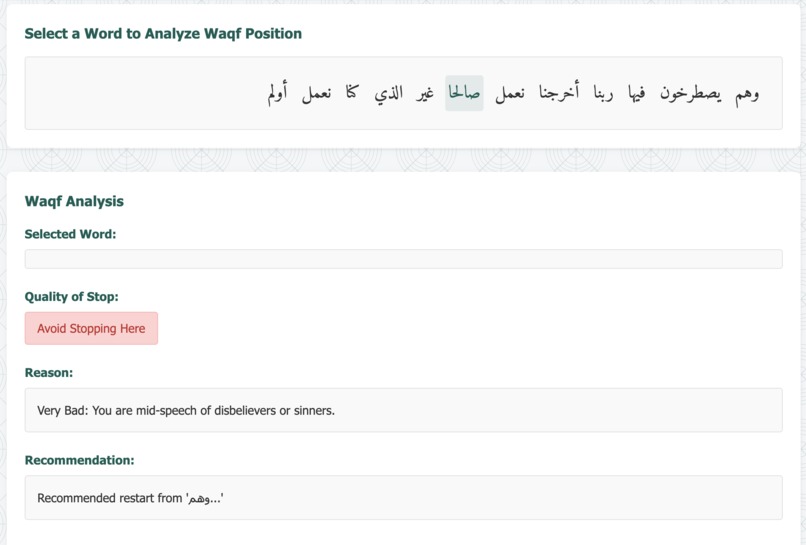
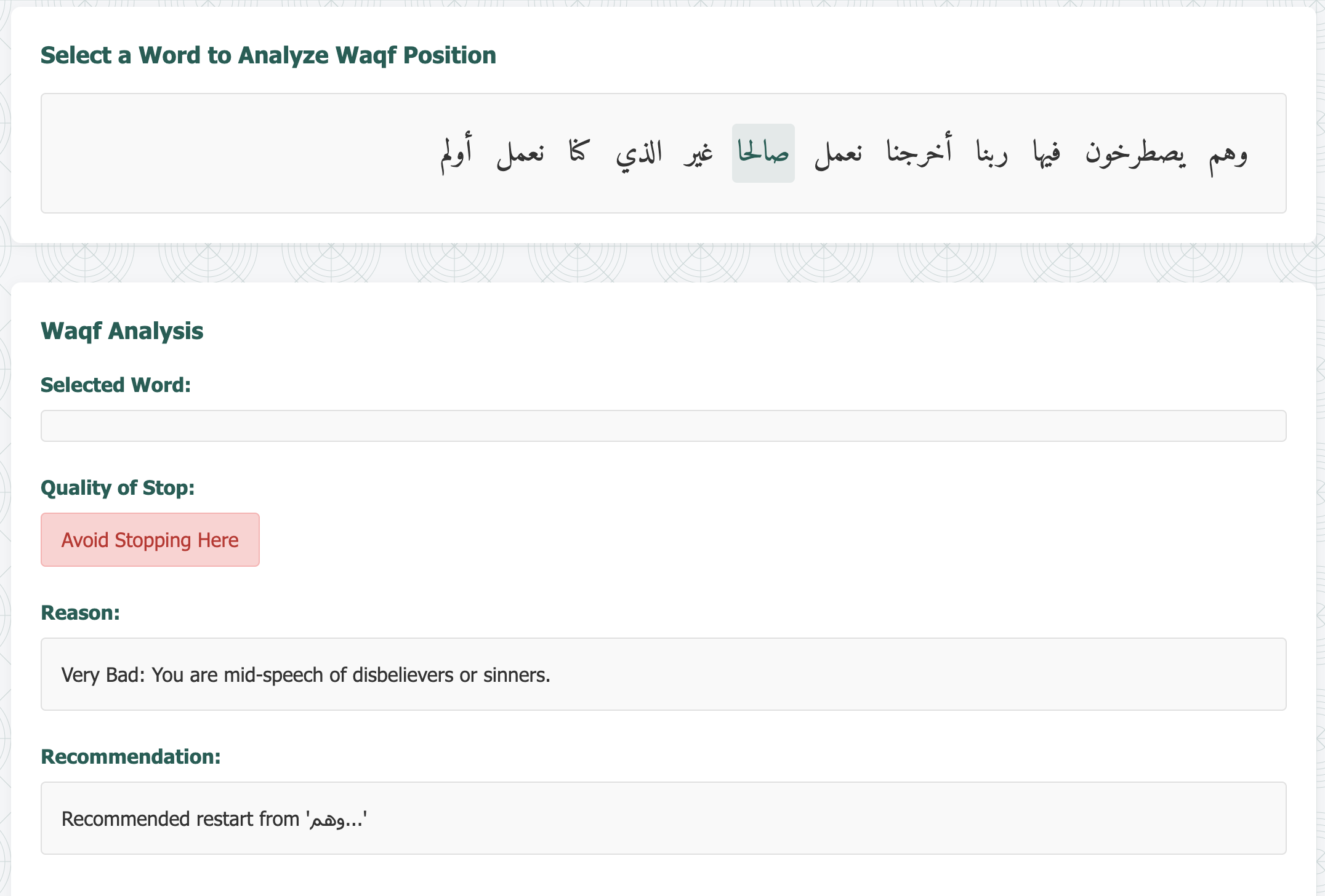
Quranic Waqf Analyzer allows a user to: Input a Qur'anic ayah (verse). Select any word where they intend to stop. Receive instant feedback: Whether the stop is excellent, good, risky, or dangerous. A natural-language explanation of why the stop is good or bad. A recommended restart point if needed.
How we built it
FastAPI was used to build a lightweight, fast backend. The frontend uses vanilla JavaScript for interactive word-by-word analysis. We engineered a custom semantic analysis engine combining: Arabic natural language rules (waqf/ibtidaa science). Grammar pattern matching to detect incomplete phrases (e.g., mubtada', mawsool, maddaaf structures). A lightweight rule-based NLP model trained on labeled waqf cases (using curated data and waqf textbooks). We also implemented error detection for theological red flags (e.g., stopping mid-quote in a way that distorts belief).
Challenges we ran into
Semantic understanding in Arabic is complex — word order is flexible, and meaning can shift drastically based on context. Detecting danger stops like speech attribution (قالوا ربنا) required careful pattern crafting. Preprocessing Arabic text (normalizing diacritics, handling prefixes like و, ف, ثم) was trickier than expected. Balancing accuracy with real-time speed without needing a huge ML model.
Accomplishments that we're proud of
Created a fully working prototype that simulates Qur'an waqf scholars. Built an interactive, intuitive UI for users to click words and get instant feedback. Crafted a lightweight semantic engine that detects both grammatical and theological errors. Designed the system to be expandable for future AI fine-tuning or dataset training.
What we learned
Building an AI system doesn't always require large models — smart rule engineering and domain knowledge can sometimes be more powerful and efficient. Arabic NLP is an extremely rich and challenging field — tiny mistakes in morphology can lead to massive changes in meaning.
What's next for Quran Waqf
Tarteel AI, want to adopt the idea? lol

Log in or sign up for Devpost to join the conversation.