-
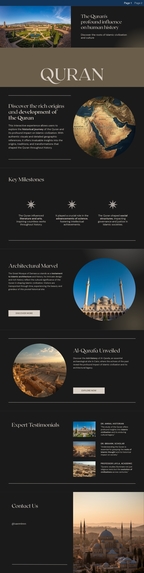
demo represent
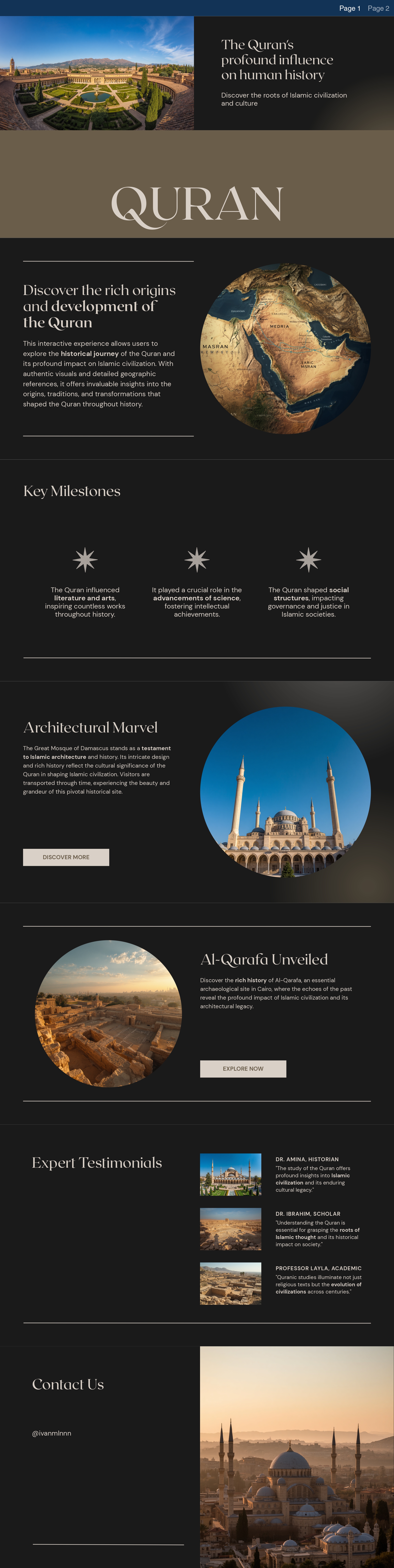
Inspiration
Quran History was inspired by a simple idea: Islamic history is not just something to read in a textbook. Many important events happened in real places, and those places are connected to verses of the Quran and authentic narrations.
We wanted to create a more immersive way to explore that connection — allowing people to discover the places, events, Quranic references, and historical context through an interactive digital experience.
What it does
Quran History is an interactive historical web experience that connects important locations and events in Islamic history with their Quranic references and related authentic hadith.
Users can explore locations such as Mount Sinai, Al-Aqsa, the Red Sea, Cave Hira, Badr, Uhud, Khandaq, and the early migration to Abyssinia.
Instead of simply reading a list of historical events, users explore them through an interactive map, cinematic storytelling, timelines, visual scenes, Quranic verses, translations, and source references.
Our goal is to make Islamic history easier to explore, understand, and remember.
How we built it
We built Quran History as an interactive web experience focused on storytelling and visual exploration.
The interface uses modern web technologies, responsive design, interactive animations, maps, and scroll-driven storytelling to connect historical locations with their stories and sources.
We also designed the architecture so the Quran reading experience can be connected to the official Quran Foundation / Quran.com API, allowing users to access Quran text, translations, audio, and other Quran resources directly.
We paid special attention to separating Quranic text, translations, historical context, and interpretation so that the experience remains respectful and transparent.
Challenges we ran into
One of our biggest challenges was balancing a modern, immersive Web3-inspired visual experience with the seriousness and authenticity of Islamic history.
Another challenge was handling historical accuracy. We did not want to create fictional visuals or present speculation as historical fact.
We also had to think carefully about Quranic text and hadith references. Religious content requires much more care than ordinary website content, so we focused on using reliable sources and clearly distinguishing between revelation, authenticated hadith, and historical interpretation.
Accomplishments that we're proud of
We are proud of turning Islamic history into an interactive experience rather than a conventional information website.
We created a visual system where locations, historical events, Quranic references, and exploration are connected together.
We are especially proud of the idea of making the user feel like they are travelling through history — moving from one location and event to another instead of simply scrolling through articles.
Most importantly, we built Quran History with the intention of making technology serve education and historical understanding.
What we learned
We learned that building an immersive experience is not only about adding more animations or visual effects.
The story has to come first.
We also learned that working with religious and historical content requires careful source verification, clear context, and responsibility in how information is presented.
From the technical side, we learned more about interactive storytelling, responsive design, API integration, and how maps and animation can be combined to create a more engaging educational experience.
What's next for Quran History
Our next goal is to turn Quran History into a much larger interactive Islamic history platform.
We want to integrate the official Quran API for a complete Quran reading experience, including search, translations, tafsir, and audio recitation.
We also want to expand the historical database with more locations, events, authentic hadith references, scholarly sources, and historical timelines.
In the future, we envision Quran History becoming an interactive digital atlas where anyone can explore the Quran, Islamic history, and the places connected to them — from anywhere in the world.
Built With
- css
- javascript
- react
- secure-hosting
- tailwind


Log in or sign up for Devpost to join the conversation.