-
-
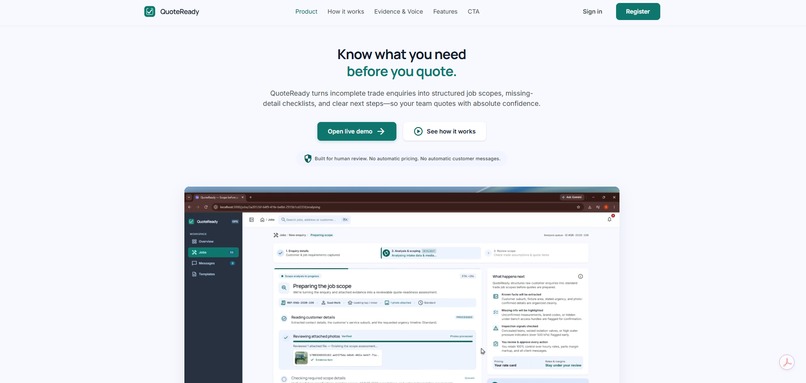
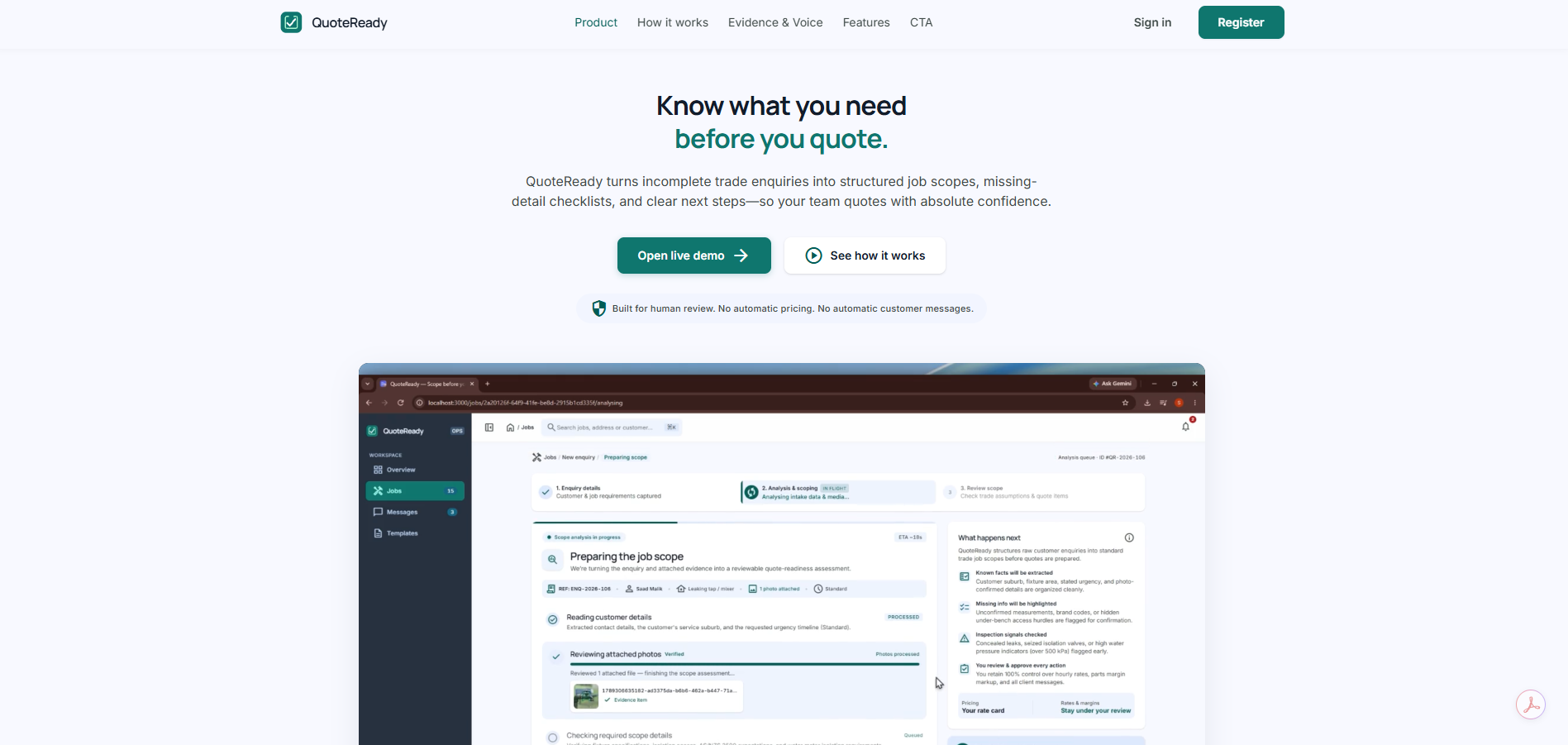
Landing Page
-
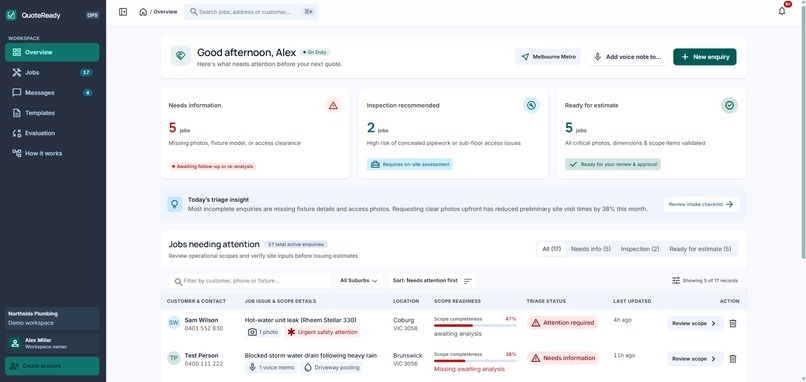
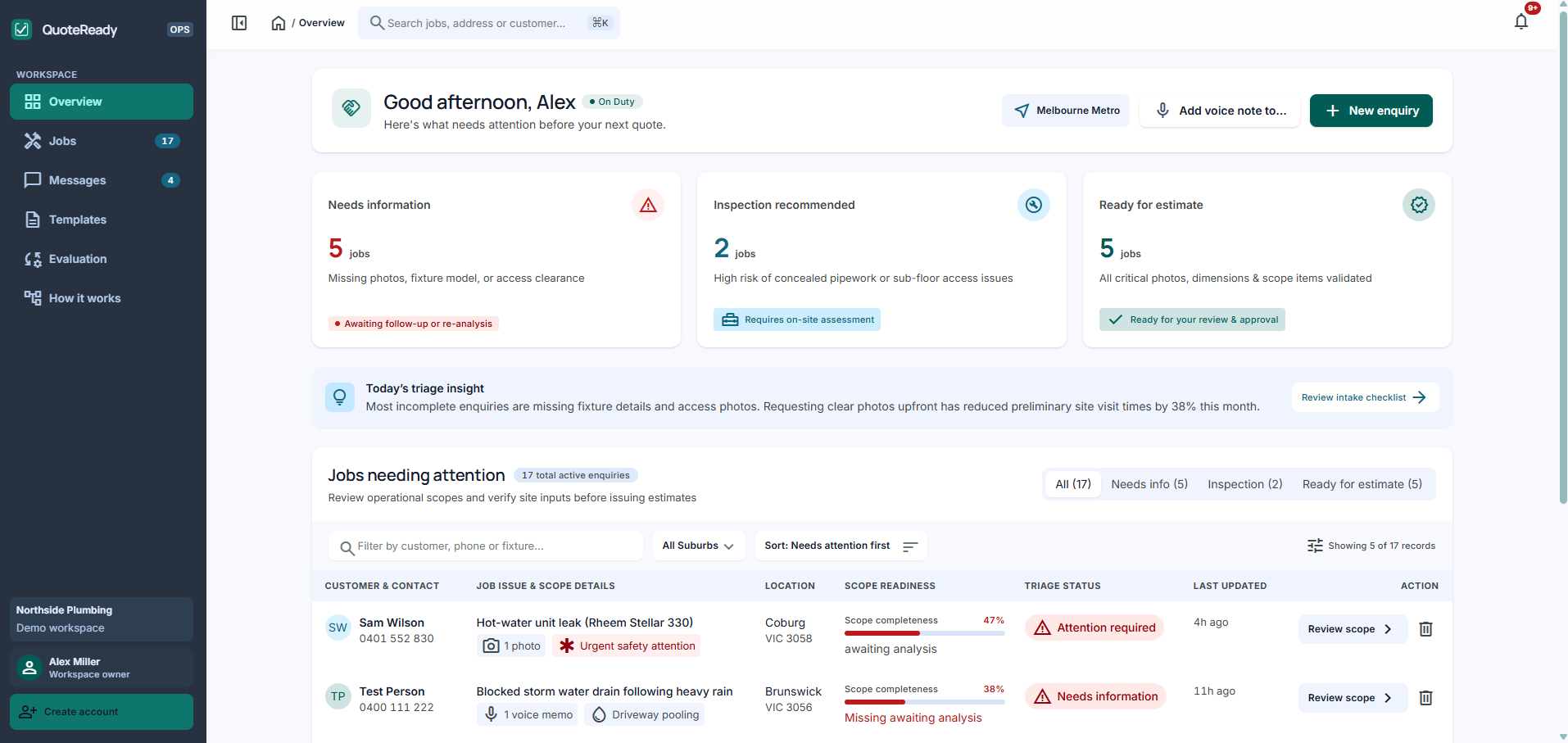
Dashboard
-
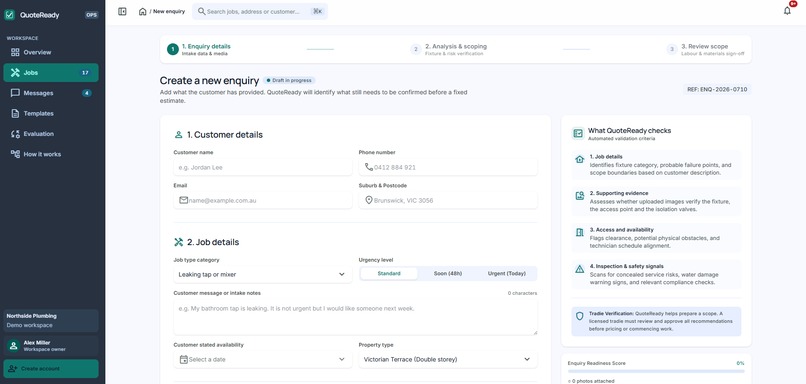
Enquiry Form
-
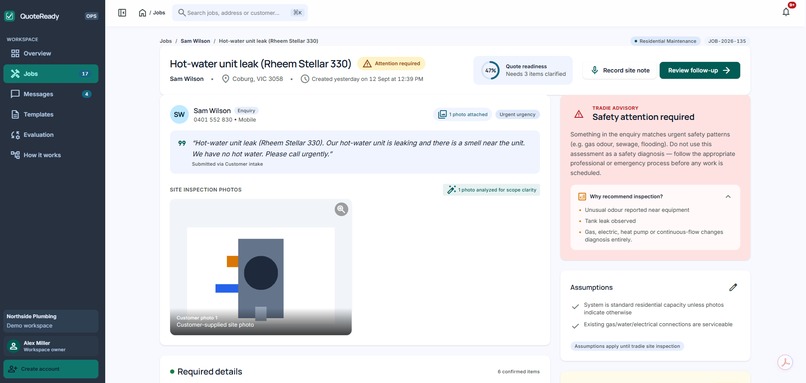
Enquiry Page
-
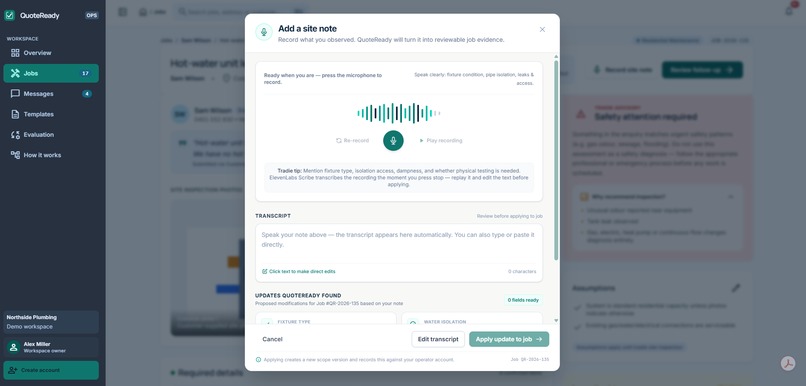
Voice Note
-
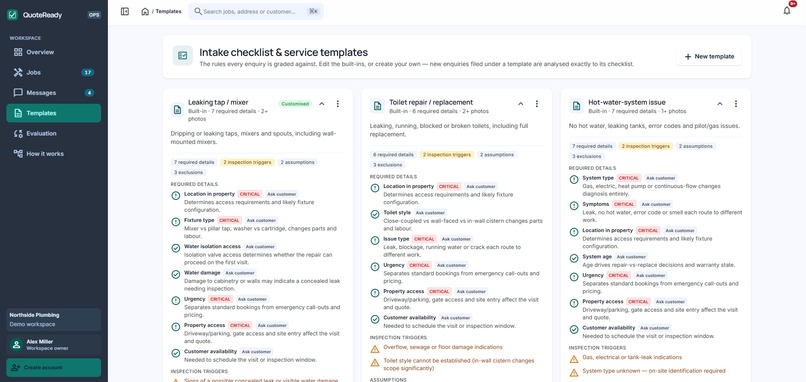
Templates
QuoteReady: AI-Powered Trade Quote Readiness
Track 1: Improving an Existing Business Capability
Inspiration
Small trade businesses are often expected to quote from a short message, a photo, or a rushed call. Before committing to a fixed price, a tradie still needs to understand the actual scope, missing information, access requirements, and possible safety concerns.
Getting this wrong can mean underquoted work, wasted site visits, lost margin, and scope disputes. We did not want to build another generic chatbot, AI receptionist, or automatic quote generator. We built the step before the quote: a way to decide whether there is enough evidence to responsibly commit to a price.
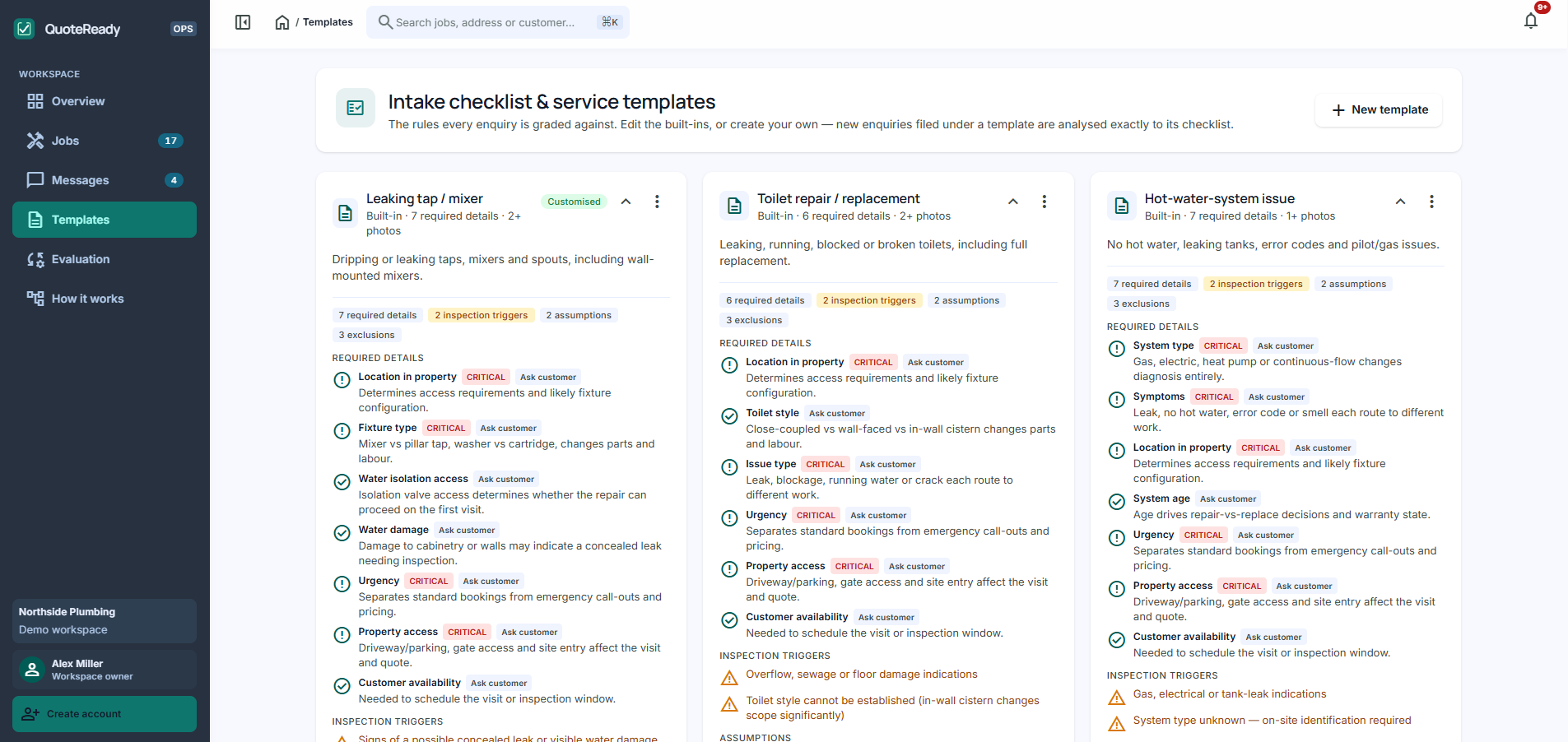
For the hackathon, we focused on three plumbing templates—leaking taps, toilets, and hot-water issues—while keeping the system template-driven for future trades.
What it does
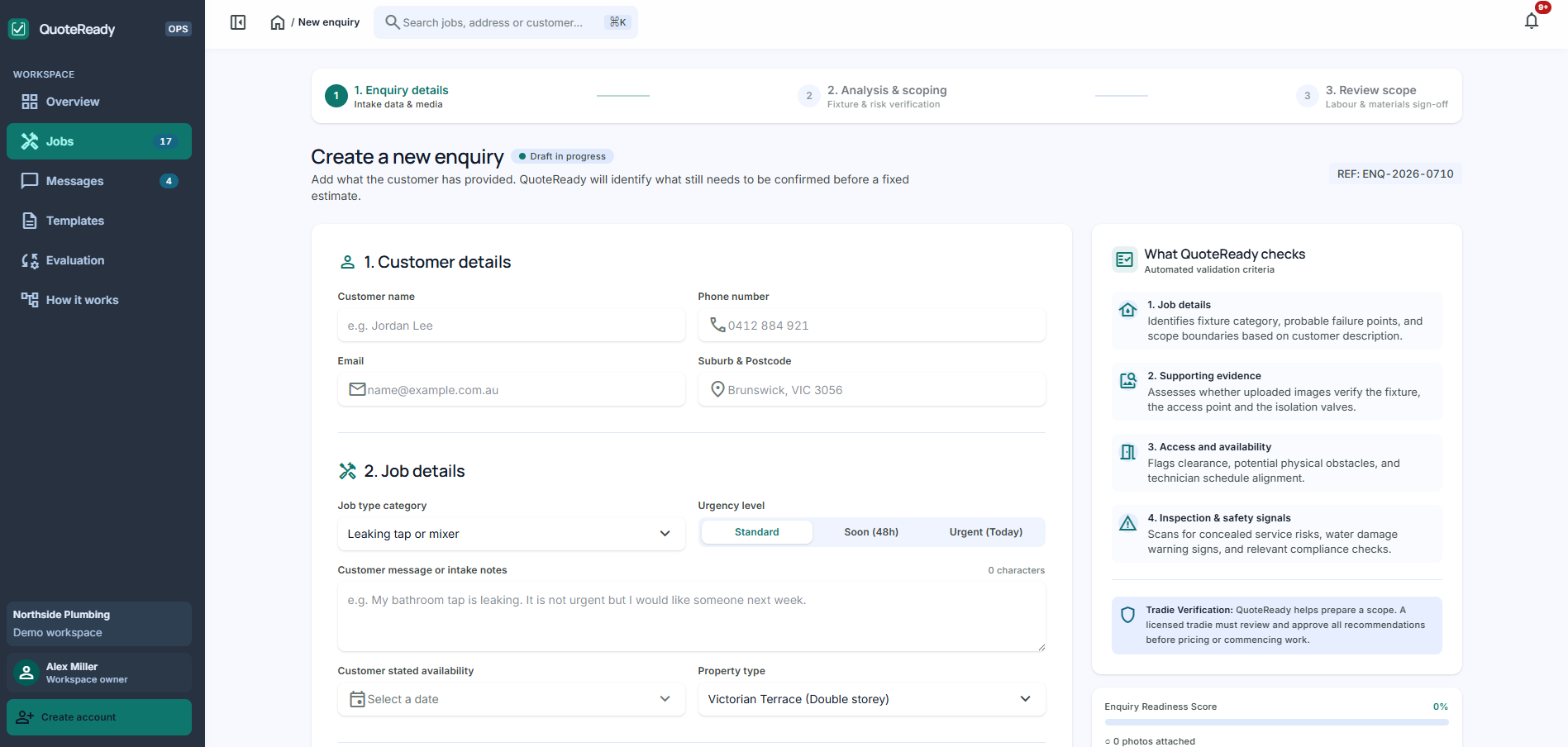
QuoteReady turns fragmented enquiries into a structured, reviewable job scope.
- Accepts customer text, photos, call details, and spoken site notes
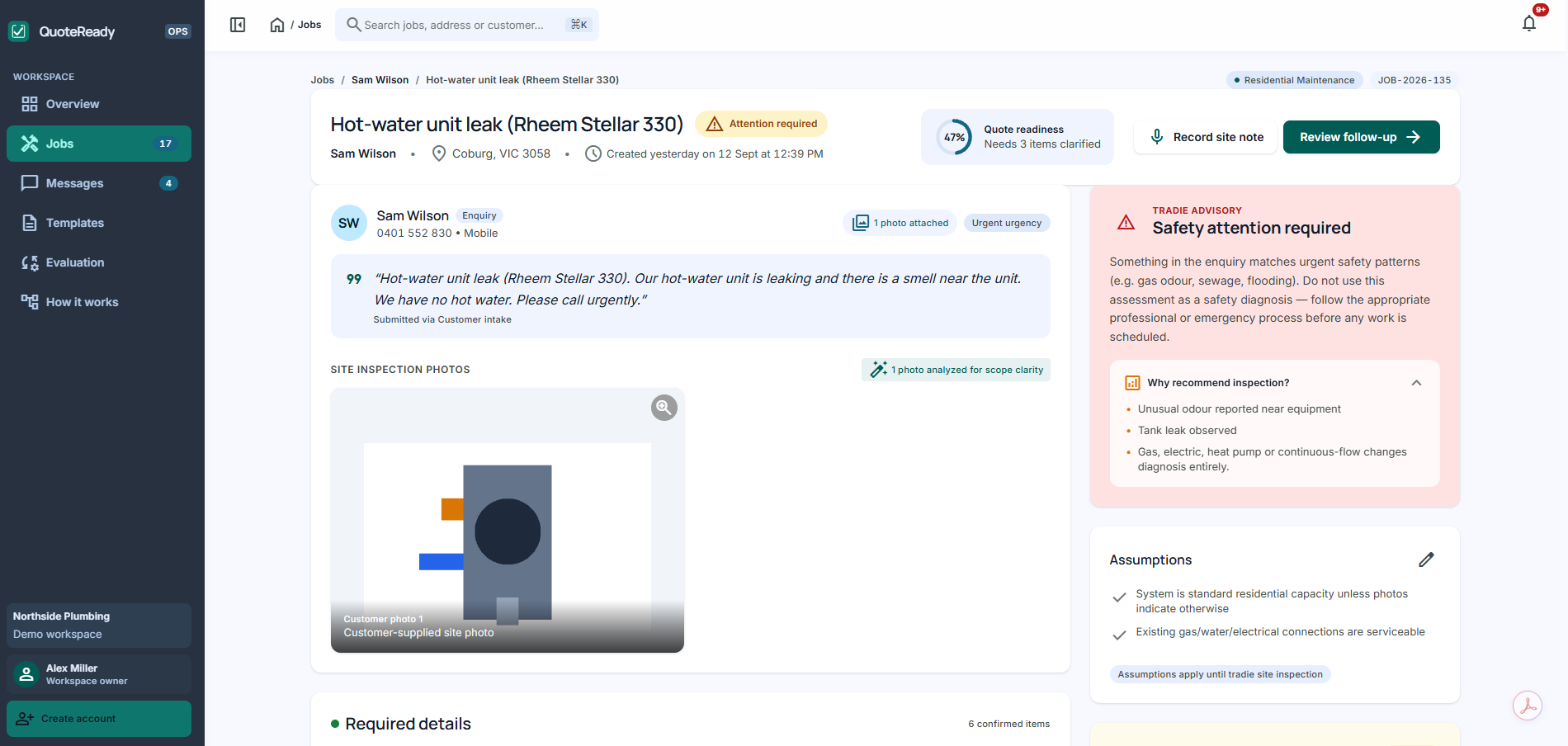
- Extracts known facts, missing details, evidence, assumptions, and risk signals
- Calculates an explainable quote-readiness score
- Recommends: request more information, book an inspection, or prepare an owner-reviewed estimate
- Creates editable customer follow-up drafts
- Records approvals, evidence, scope changes, and audit events
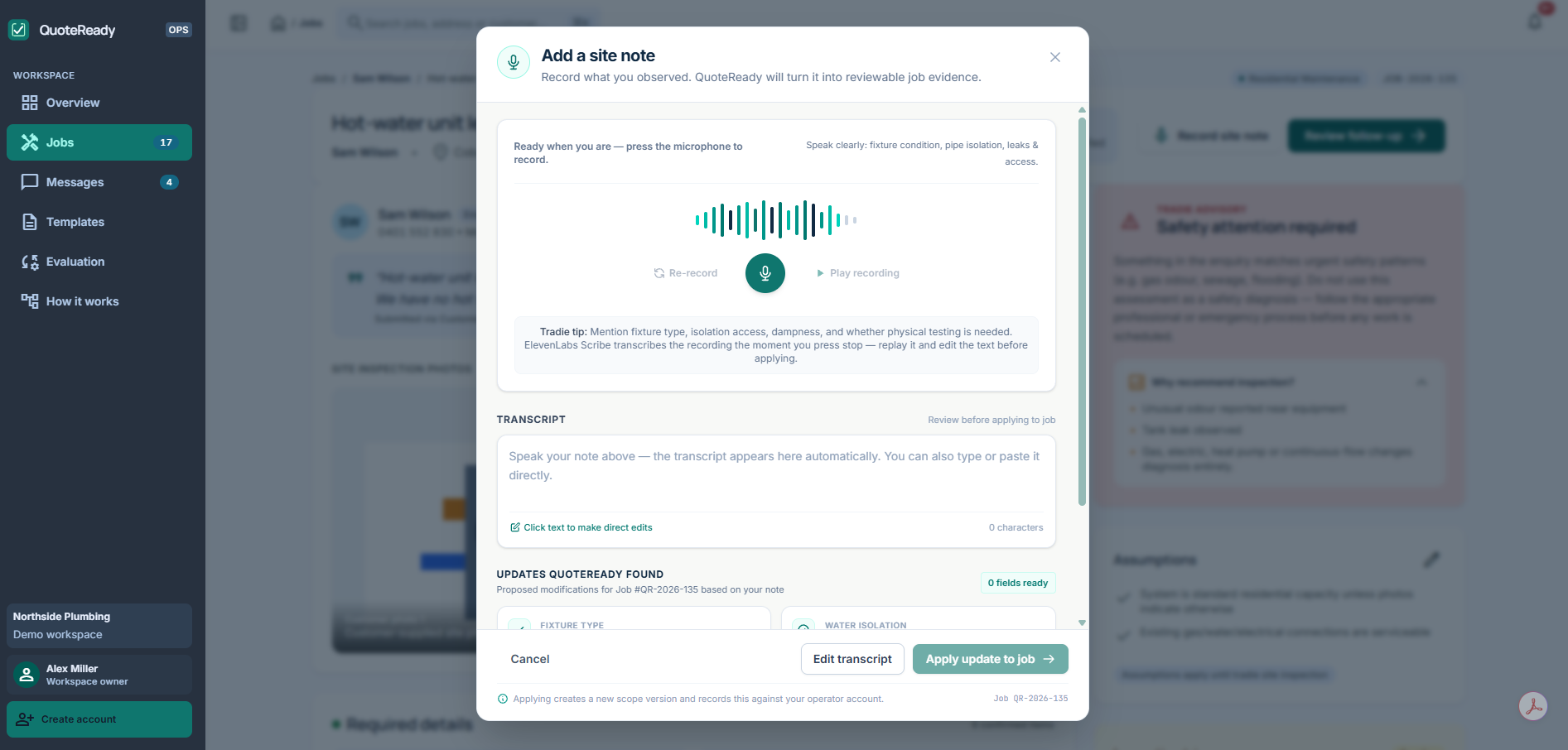
- Turns ElevenLabs voice notes into structured field evidence that can update the recommendation
AI interprets. Deterministic rules decide. Humans approve.
QuoteReady does not diagnose faults, set prices, create binding quotes, or automatically contact customers. Every price is operator-entered and every customer-facing action requires approval.
How we built it
We built QuoteReady with Next.js, TypeScript, Tailwind, Supabase, Gemini, LangGraph, ElevenLabs, Zod, Vitest, and Vercel.
Gemini 3.6 Flash processes enquiry text and photos in one multimodal request, extracting structured facts, evidence sources, certainty labels, and possible risk signals. Its output is treated as untrusted input and validated with Zod.
A deterministic rules engine—not the LLM—calculates readiness:
[ \text{Readiness} = 0.25D + 0.25E + 0.20A + 0.15C + 0.15R ]
where (D) is details, (E) evidence, (A) access, (C) confirmation, and (R) risk. Missing critical information, inspection conditions, and safety patterns can cap readiness or reroute the next action.
LangGraph orchestrates a fixed workflow:
Validate input → Gemini extraction → Zod validation → rules and safety checks
→ cited guidance retrieval → operator wording → scope version + audit event
We also created a curated 46-note service playbook. Notes are embedded with gemini-embedding-001, stored in Supabase pgvector, and retrieved through vector search with a keyword fallback. Retrieval is advisory only: it can improve guidance, but cannot change readiness, safety routing, or the recommended action.
ElevenLabs Scribe powers spoken site notes. A tradie can record an observation, review the transcript and fact changes, then apply it as a new immutable scope version. The updated evidence re-runs readiness, safety rules, and guidance.
Challenges we ran into
The biggest challenge was making AI helpful without allowing it to make a commercial or safety decision.
We solved this by separating AI interpretation from deterministic rules. Gemini can read messy enquiries, photos, and voice transcripts, but it cannot set a price, clear a safety issue, send a customer message, or decide that a job is safe to quote.
We also wanted ElevenLabs to be more than a microphone button. Spoken site notes now become structured evidence that can change a scope recommendation after human approval.
Accomplishments that we're proud of
- Built a live end-to-end workflow from enquiry to approved follow-up and versioned field update
- Created a deterministic, explainable readiness engine instead of an LLM-generated score
- Added raw-text safety pattern routing, so important customer language is not lost in AI paraphrasing
- Built cited retrieval that is technically real but isolated from high-impact decisions
- Made ElevenLabs voice notes a core operational workflow, not a cosmetic feature
- Added 10 labelled evaluation scenarios, 91 automated tests, and 96.2% statement coverage on the decision layer
- Added per-run latency, token, and estimated-cost telemetry
What we learned
The best AI workflow is not always the most autonomous one. For high-impact business decisions, AI is strongest when it interprets unstructured information while deterministic rules and humans control repeatable, accountable decisions.
We also learned that a small, curated, cited knowledge base is more useful than a huge unverified corpus, and that voice becomes valuable when it captures field information that would otherwise never reach the system.
What's next for QuoteReady
- Add route-level authentication, stronger tenant controls, rate limiting, and spend caps
- Evaluate extraction using independently labelled real-world trade enquiries
- Add web form, SMS, email, and field-service-platform integrations
- Add reviewed playbook-management workflows
- Expand verified templates to electricians, HVAC technicians, painters, landscapers, and other trades
- Integrate approved scope packs with existing quoting, job-management, and invoicing tools
QuoteReady does not replace a tradie’s judgement. It makes the invisible parts of quoting—missing facts, assumptions, evidence, risk, and next actions—visible before a business commits to a price.
Built With
- ai-agents
- embeddings
- generative-ai
- google-gemini
- langchain
- langgraph
- nextjs
- pgvector
- postgresql
- rag
- react
- speech-to-text
- supabase
- tailwindcss
- typescript
- vitest


Log in or sign up for Devpost to join the conversation.