-
-
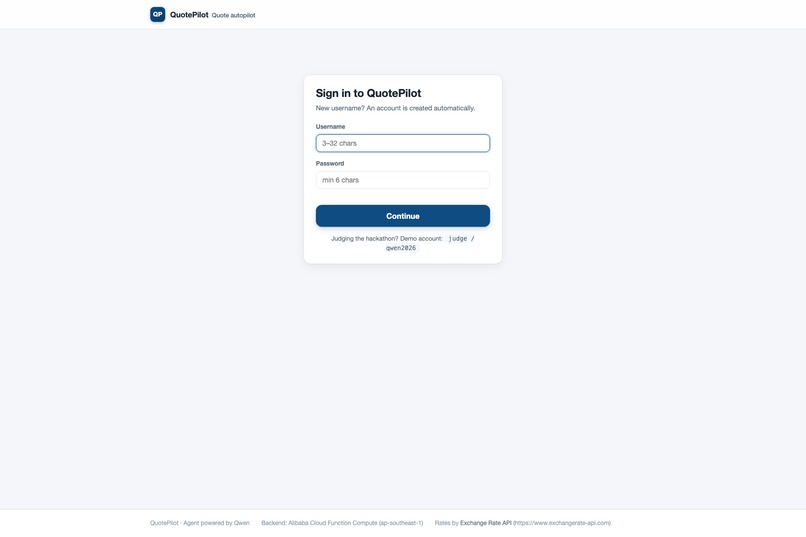
Sign in or auto-signup. Judges: use the public demo account shown on the login card.
-
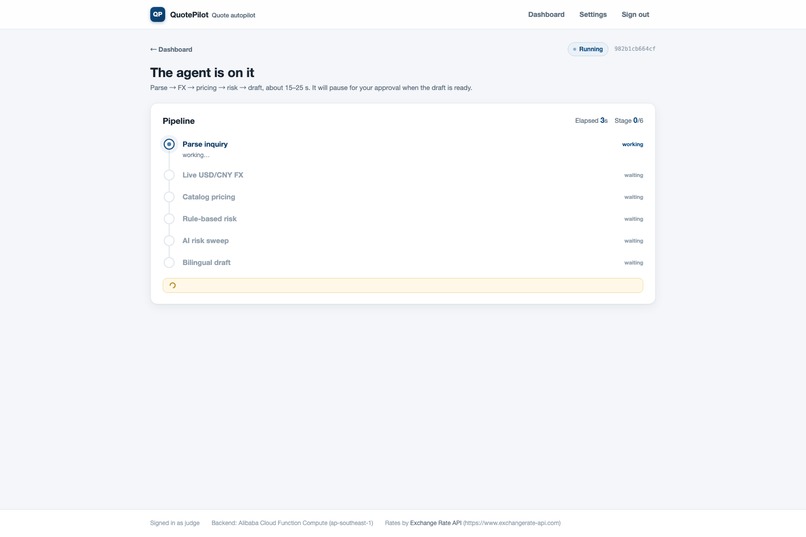
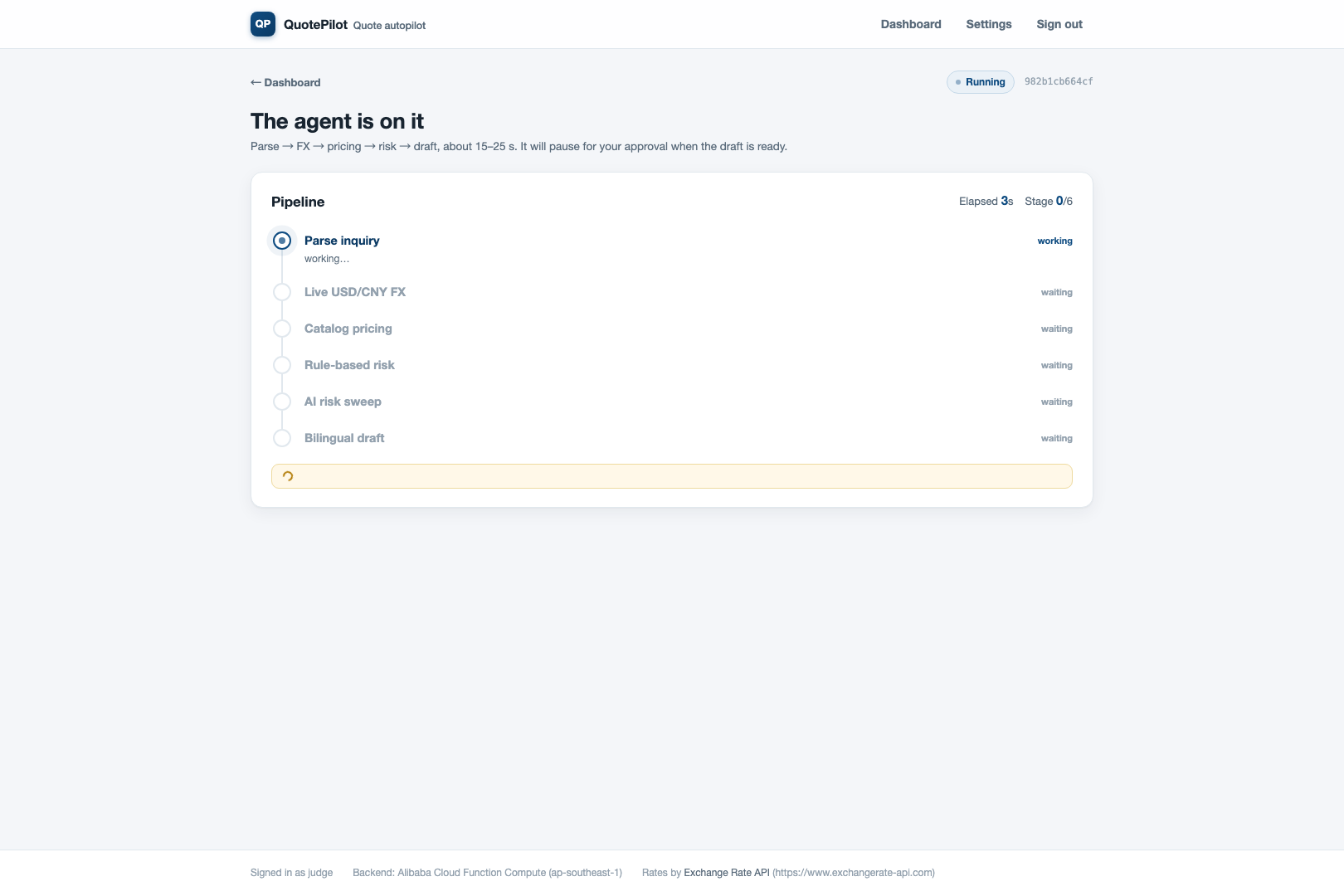
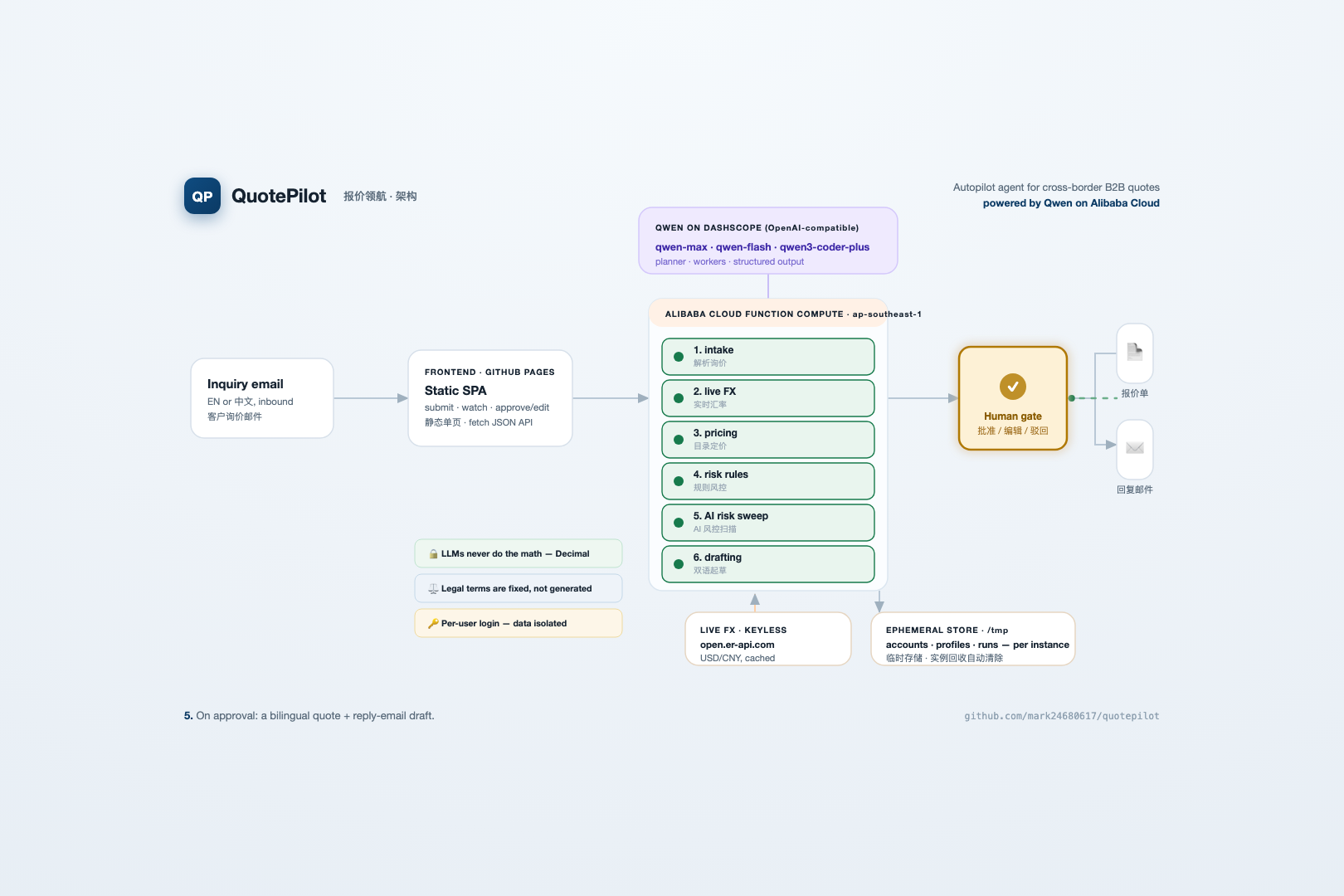
A six-stage agent pipeline runs live on Alibaba Cloud Function Compute — three Qwen models split the work.
-
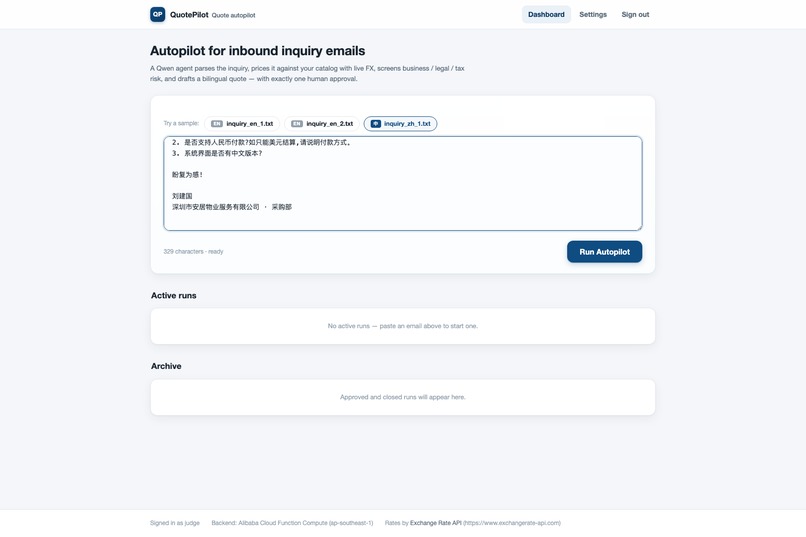
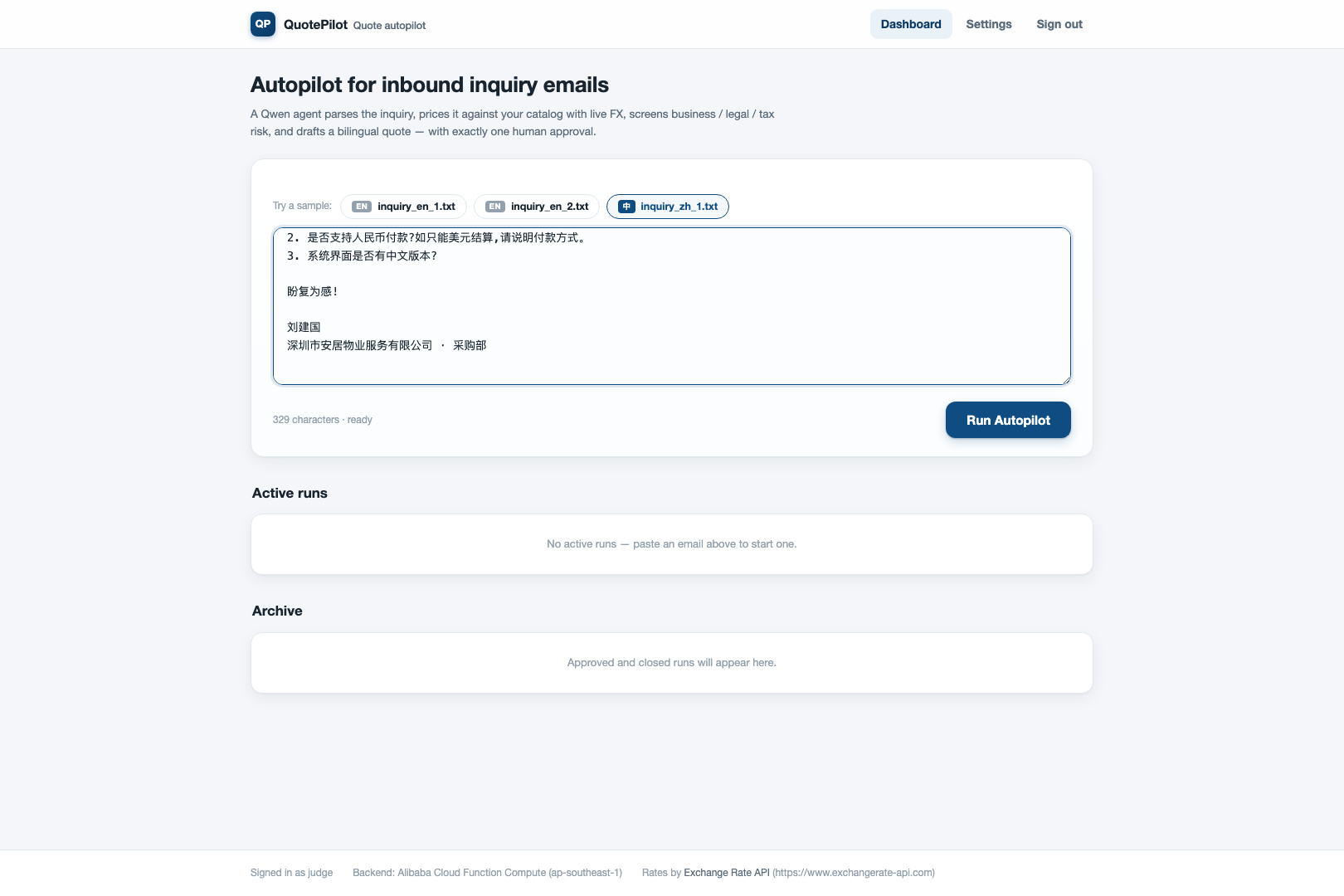
Paste an inbound inquiry — English or 中文. Here: a real Chinese RFQ for 300 rental-property SaaS seats.
-
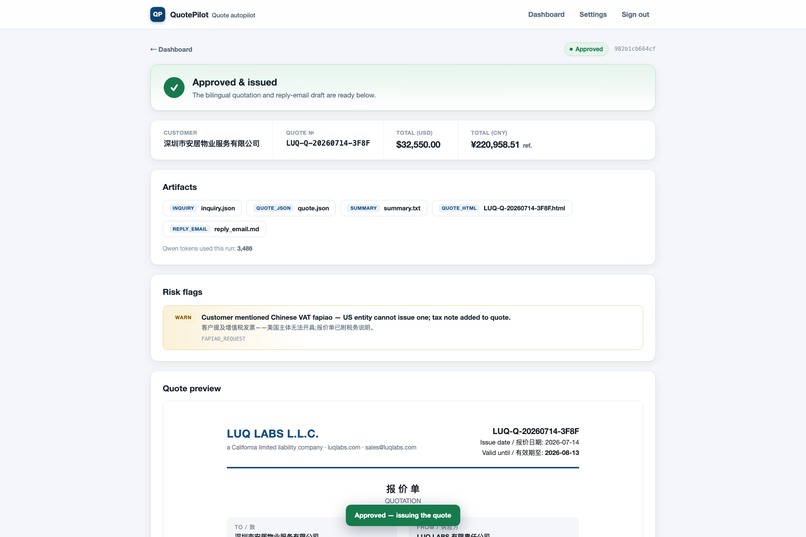
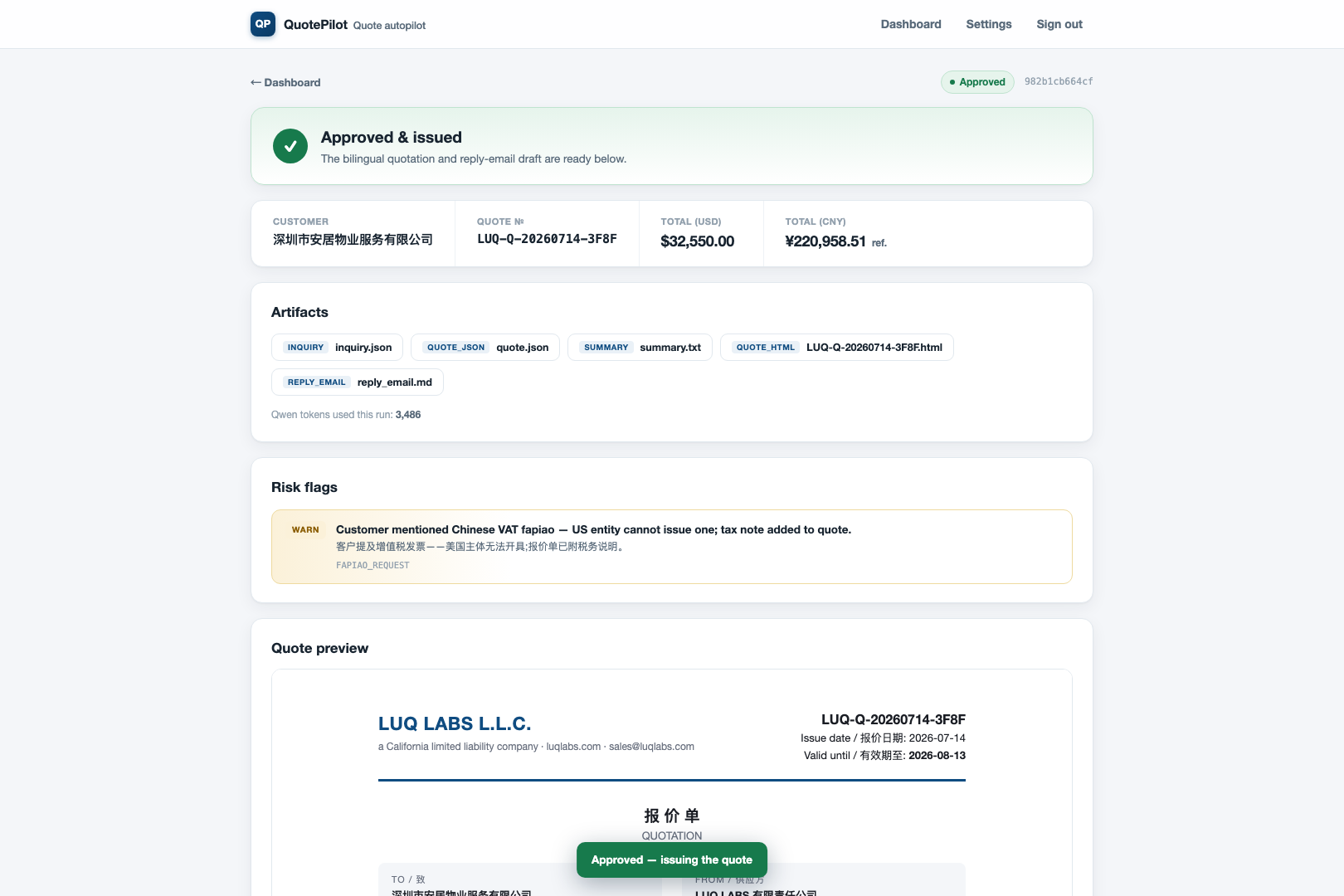
One click to approve: bilingual quotation, reply email, and a full audit trail — this run used ~3,500 Qwen tokens (≈ $0.02).
-
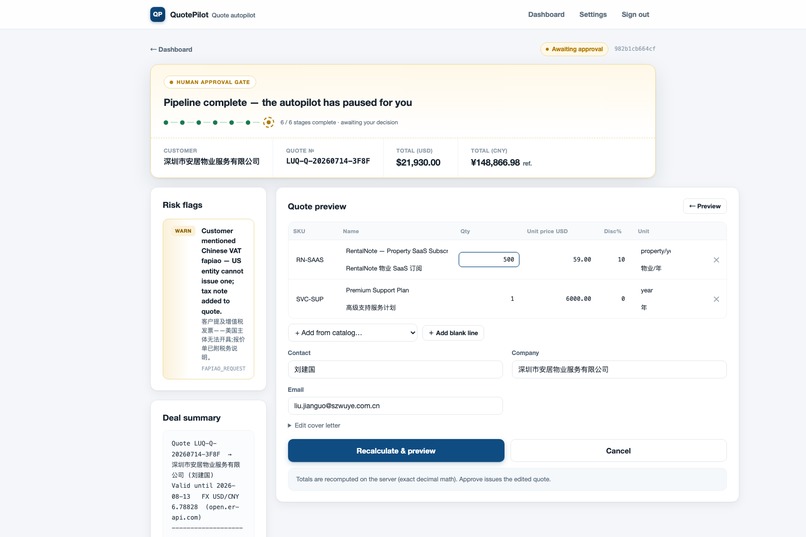
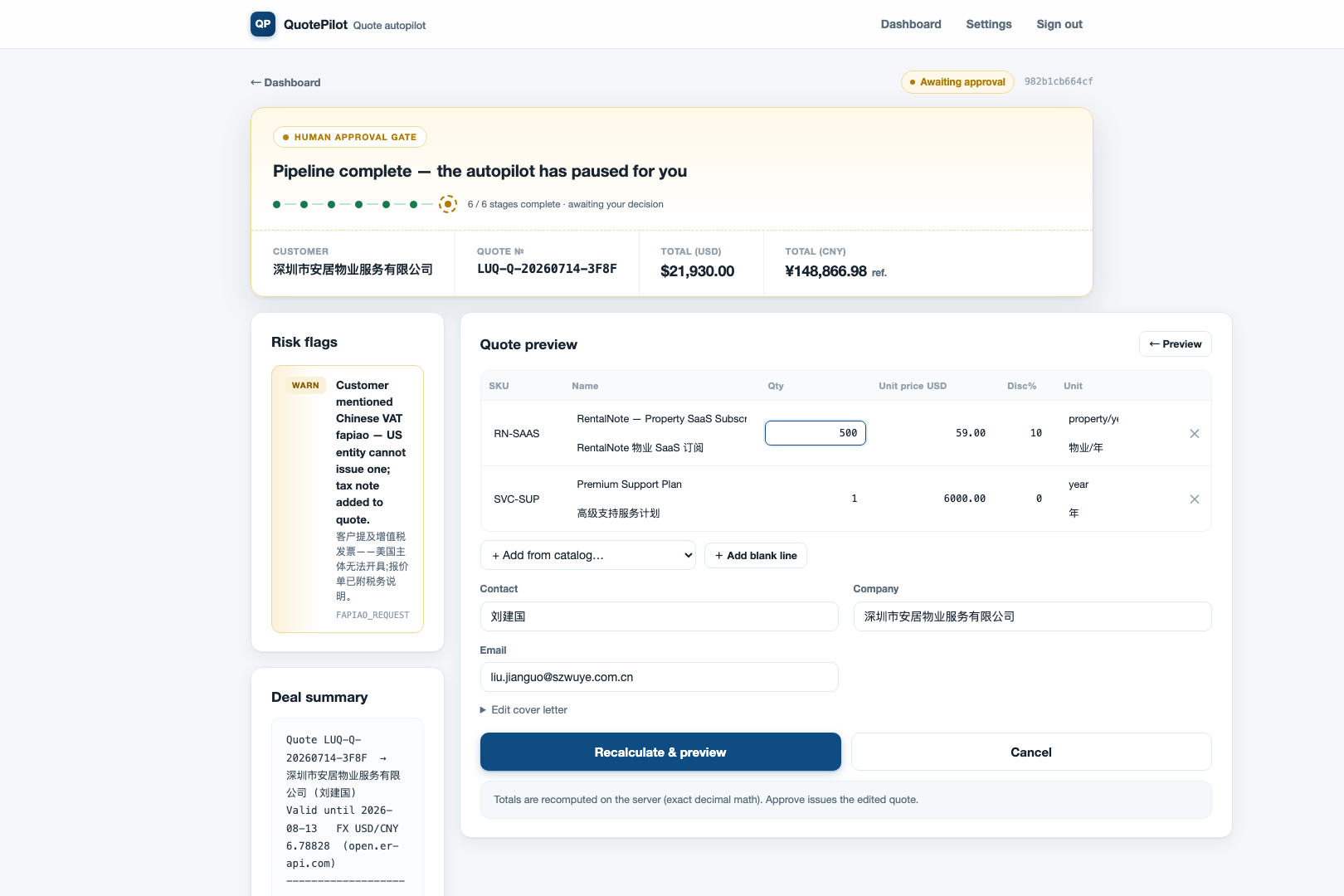
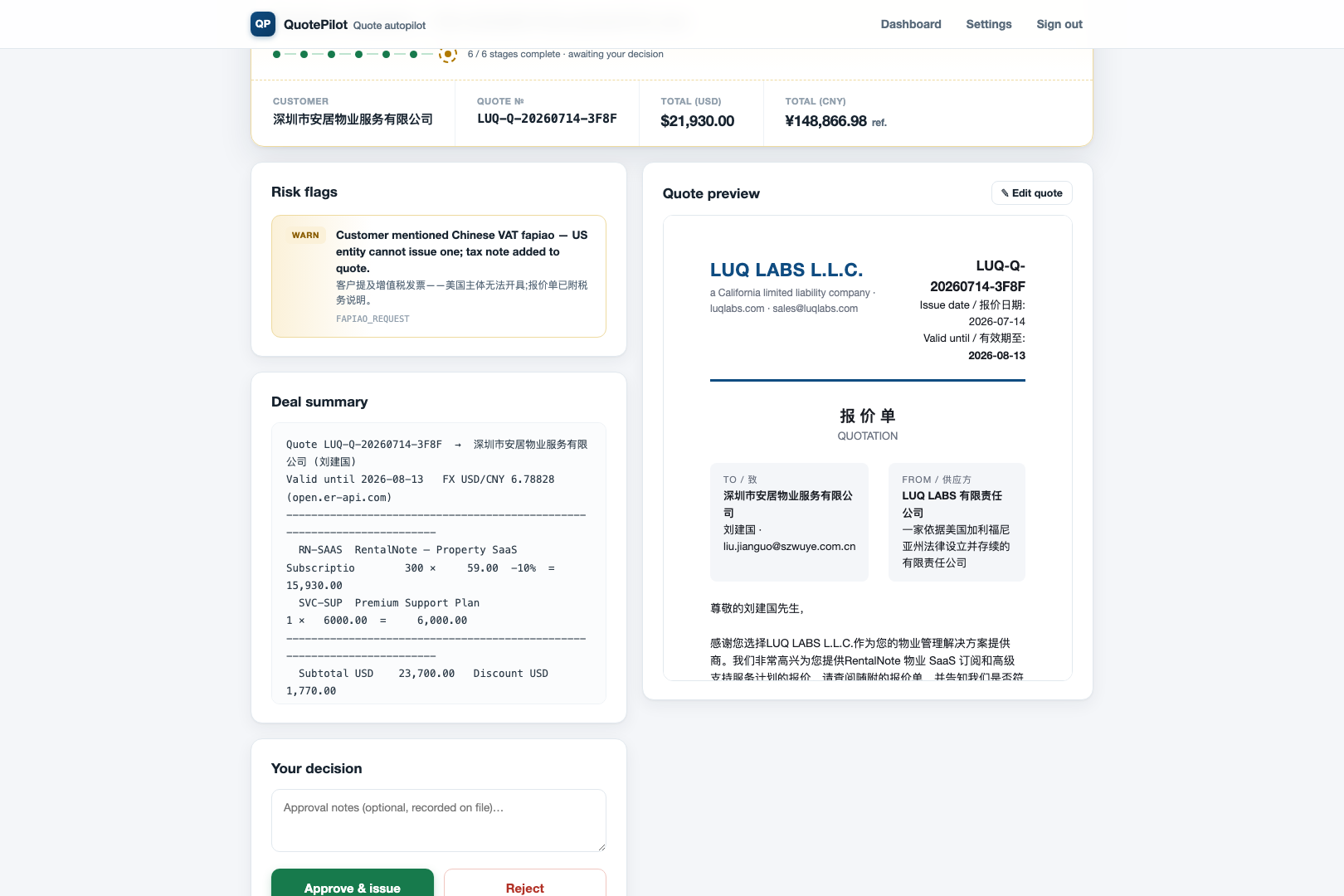
The operator stays in control: edit quantities, prices, or discounts — the server re-prices with exact Decimal math.
-
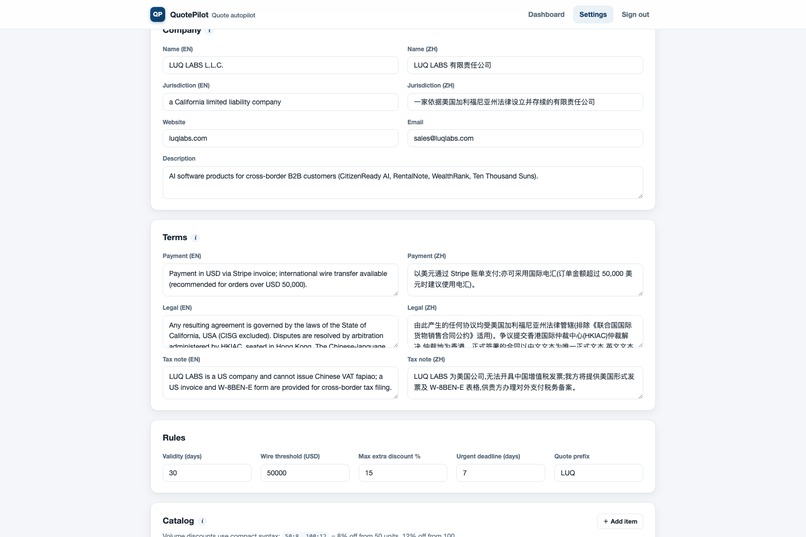
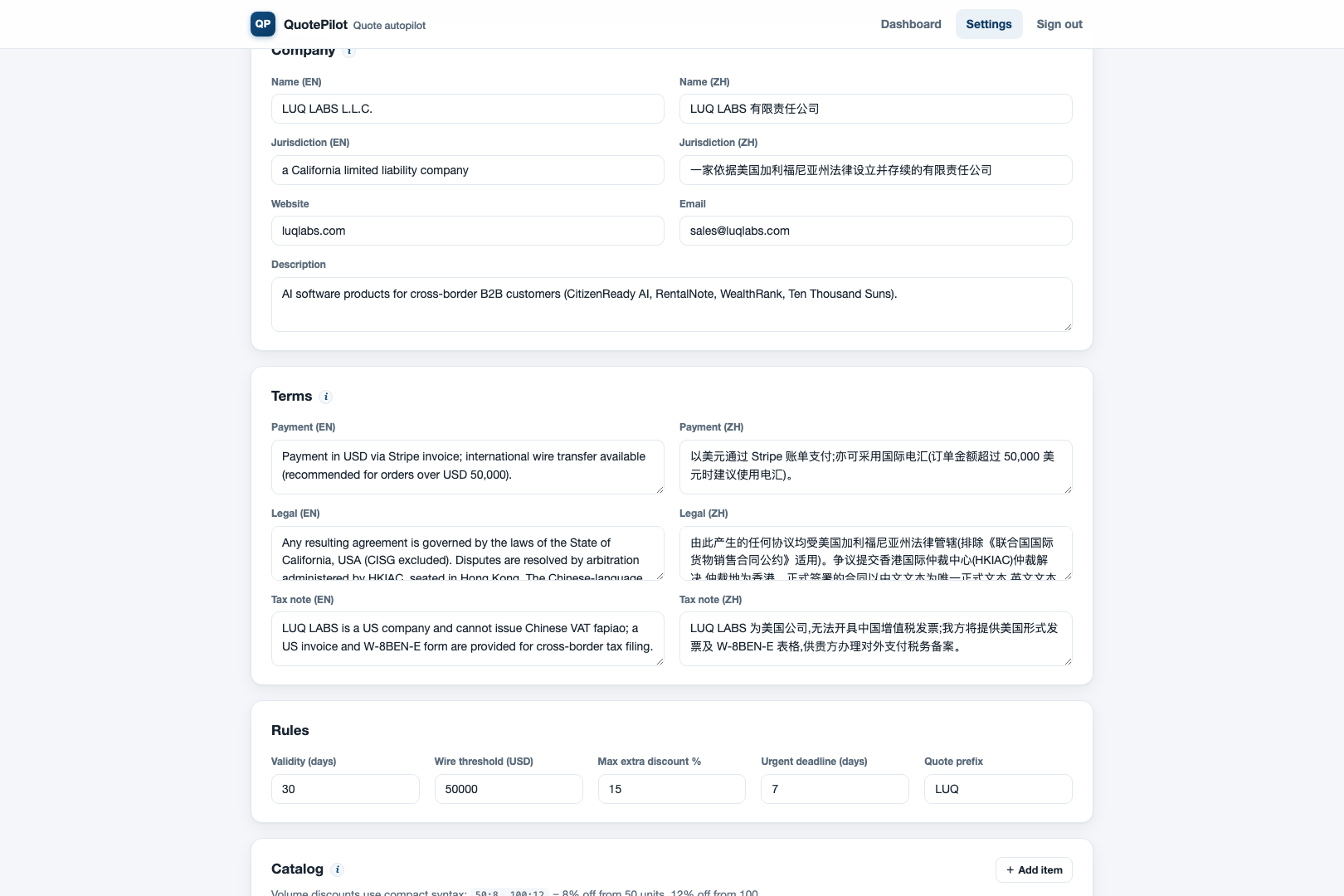
Multi-company by design: every account gets its own profile — identity, terms, rules, catalog — with AI website-import onboarding.
-
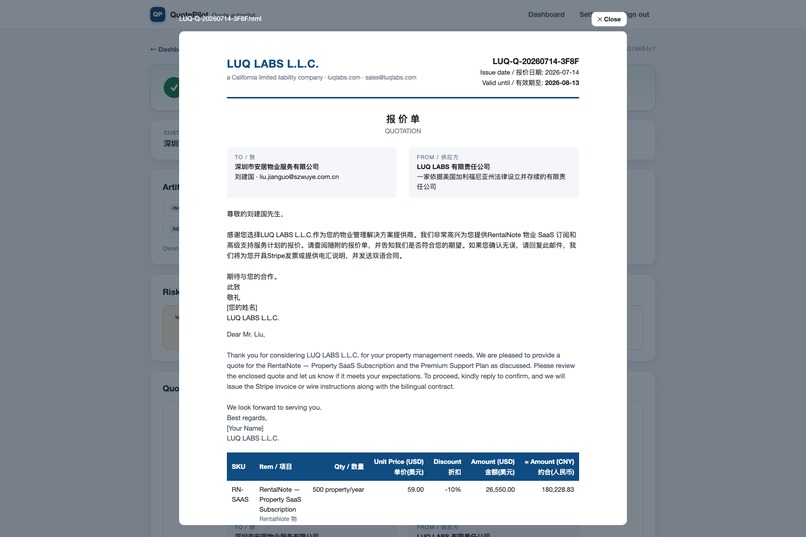
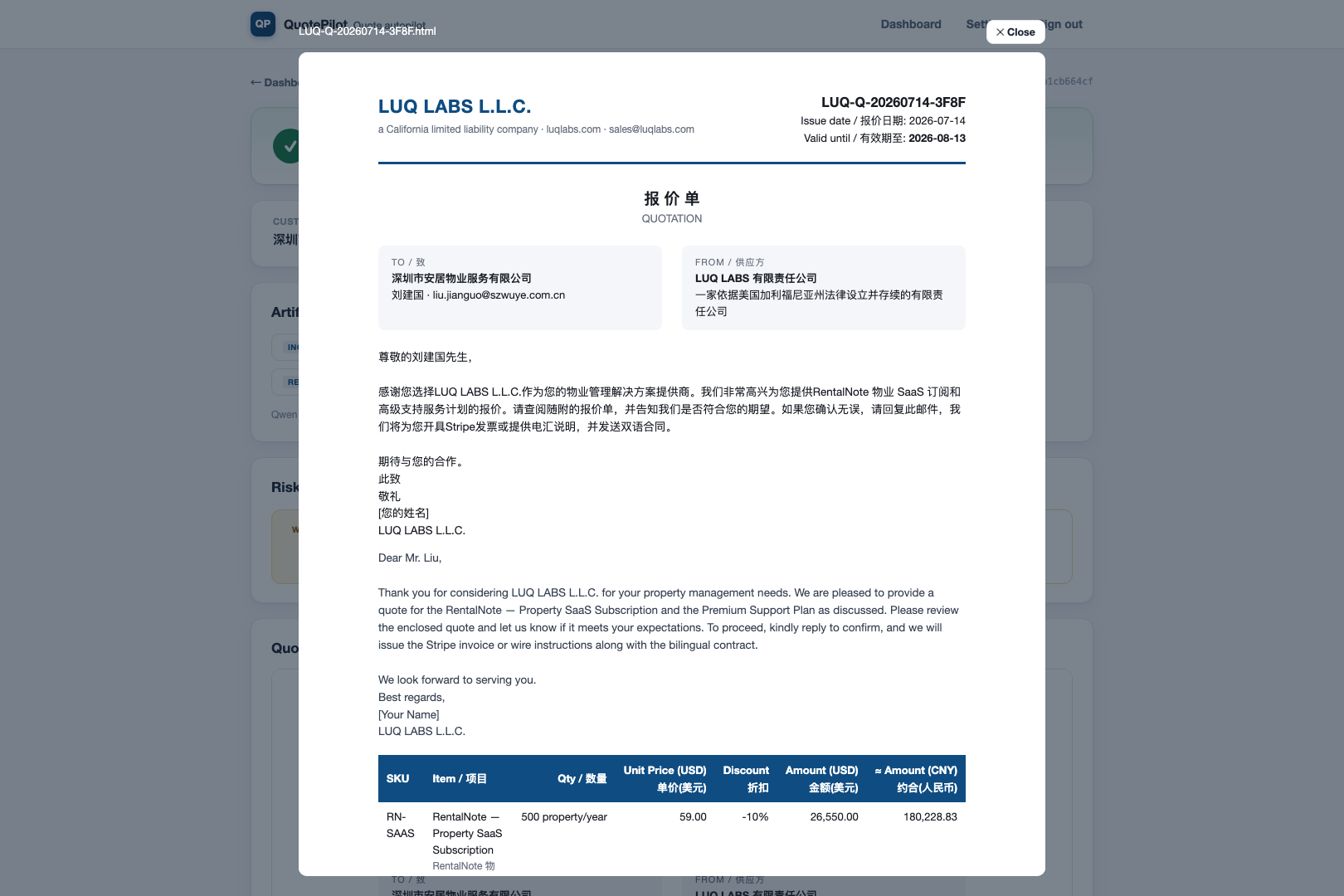
The issued document: a formal EN/中文 quotation carrying the operator's edits, with fixed (never AI-written) legal terms.
-
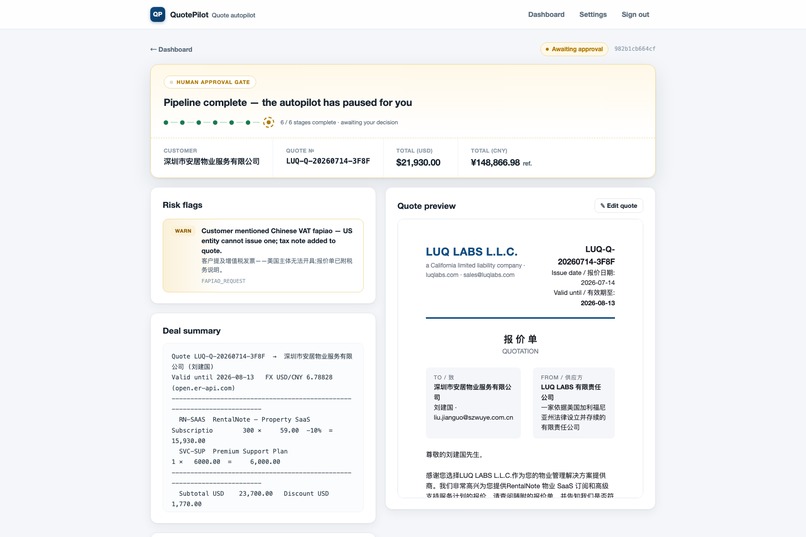
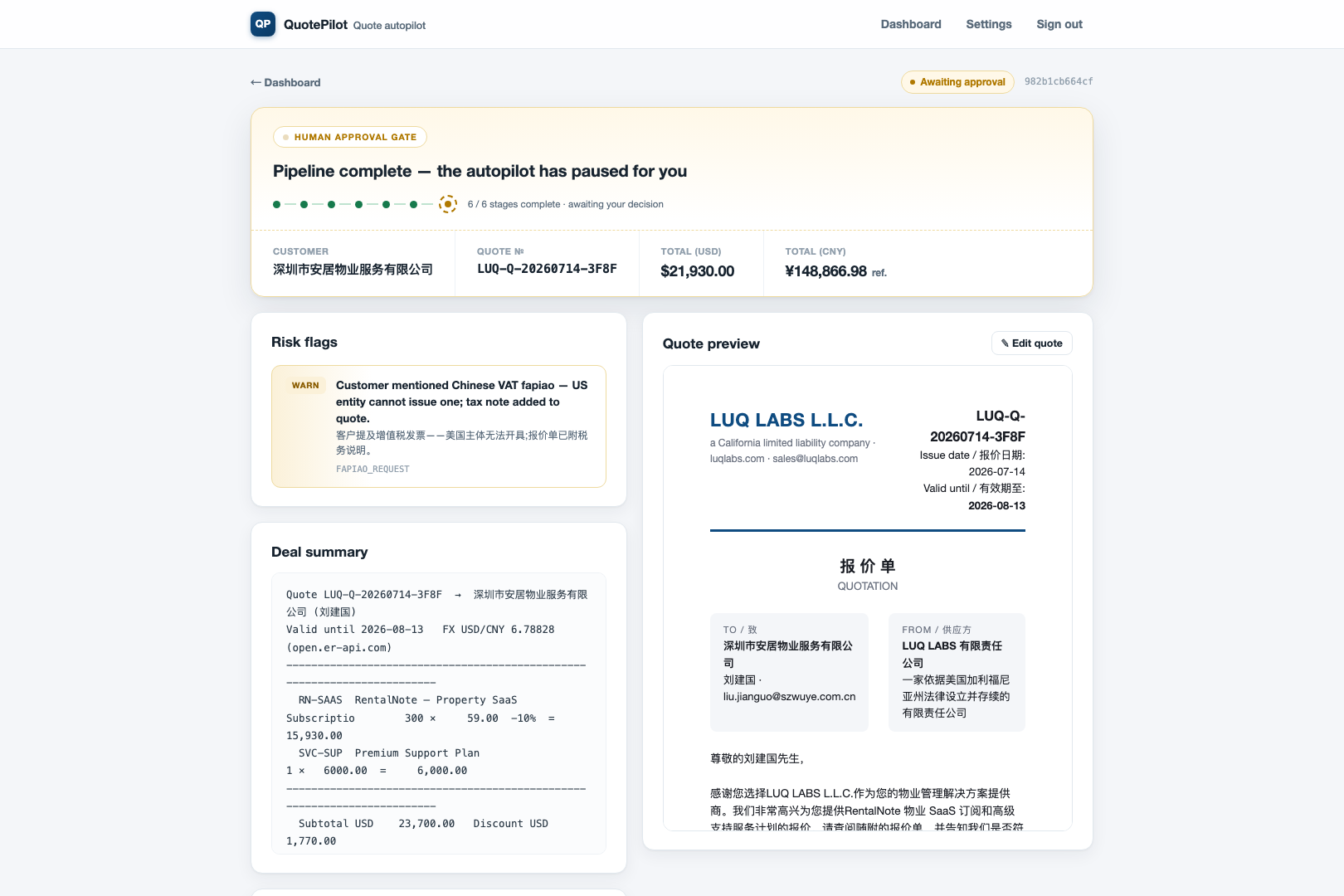
The human gate: the autopilot pauses with risk flags — here it caught a Chinese VAT fapiao request a US entity can't fulfill.
-
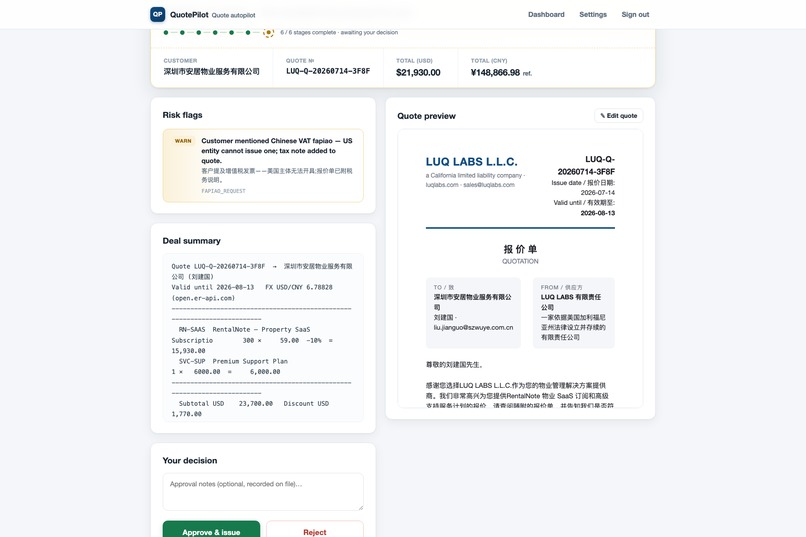
The drafted quotation, previewed in full — bilingual cover letter, line items, and terms, side by side with the deal summary.
-
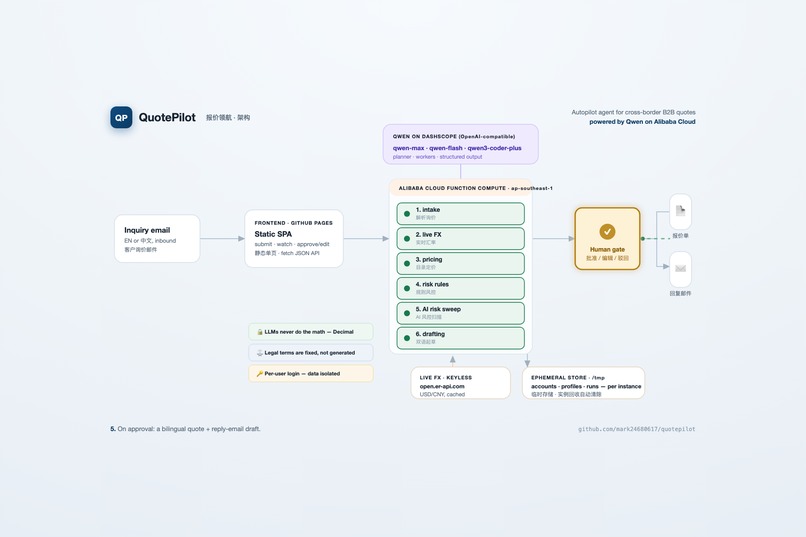
The architecture: static SPA → Alibaba Cloud Function Compute → Qwen on DashScope + keyless FX, with an ephemeral per-instance store.
-
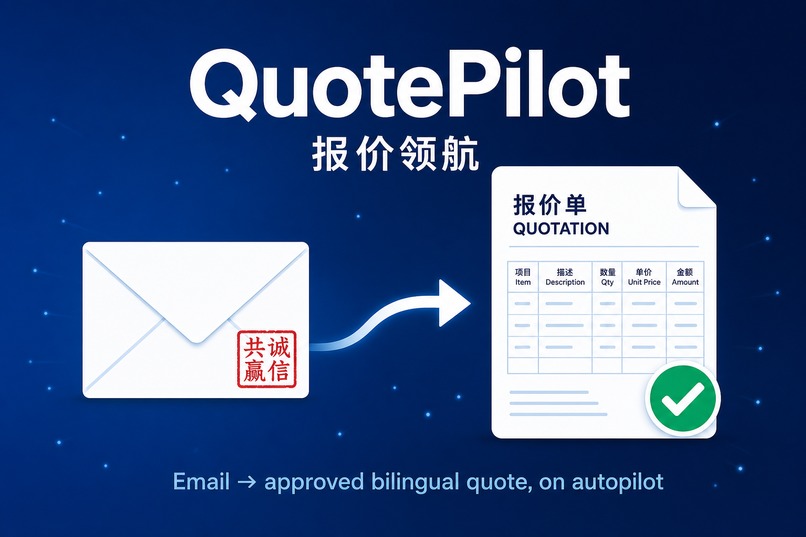
QuotePilot — turns cross-border inquiry emails into approved bilingual quotes, on autopilot.
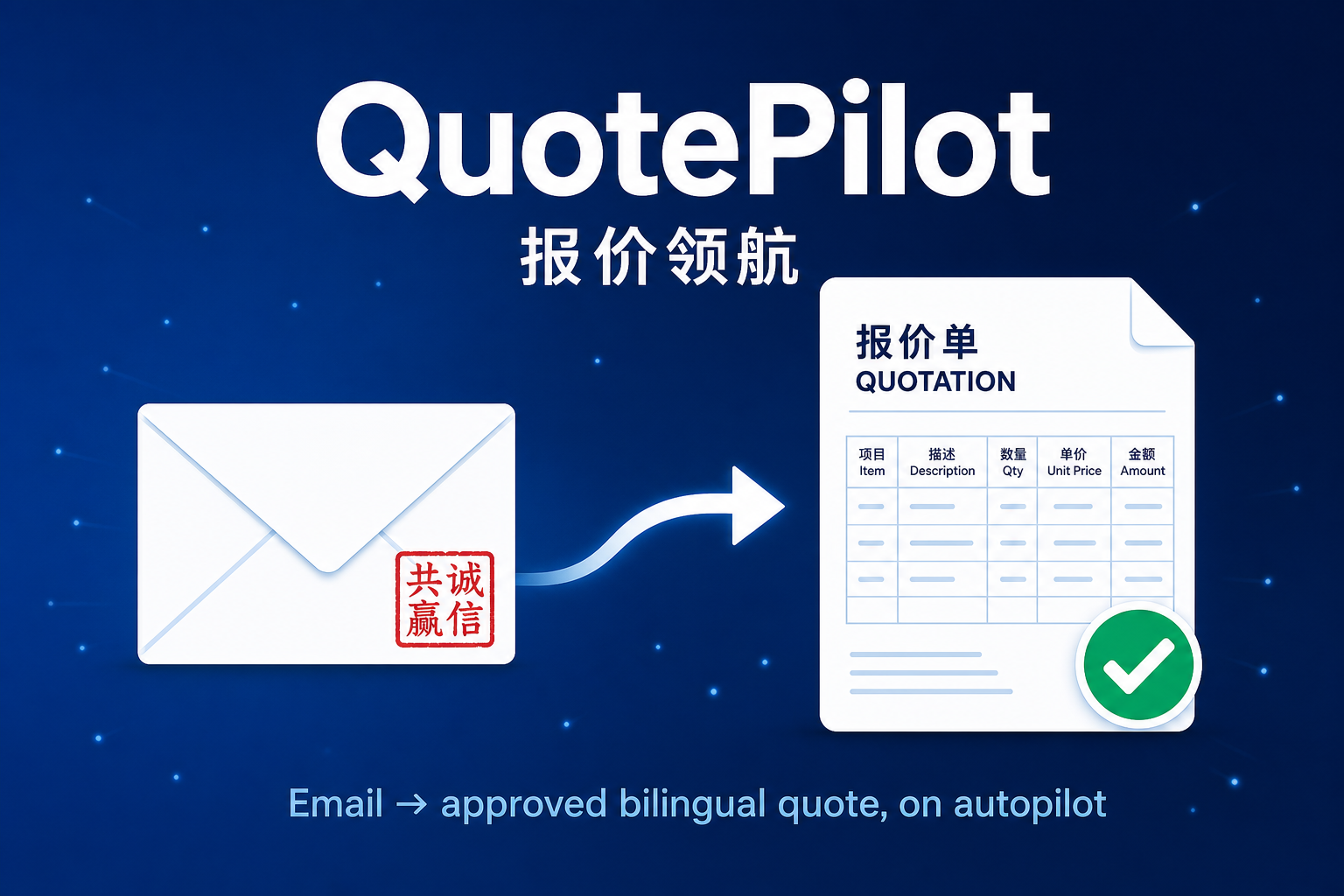
QuotePilot — email → approved bilingual quote, on autopilot
报价领航 · 跨境询价邮件的全自动双语报价助手
- 🔗 Live demo: https://mark24680617.github.io/quotepilot/
- 💻 Repo (MIT): https://github.com/mark24680617/quotepilot
- 🎬 Demo video (<2 min): https://youtu.be/00BlsBs3ba4
- ✍️ Blog post (build story): https://dev.to/markgege/i-had-qwen-build-a-qwen-powered-app-and-sat-in-the-reviewers-chair-4phe
- 🏷️ Track 4 — Autopilot Agent
Try it in 60 seconds (judges)
- Open the live demo and sign in with the public demo account:
judge/qwen2026. - Click the 中 inquiry_zh_1.txt sample chip → Run Autopilot — watch the 6-stage pipeline run live on Alibaba Cloud (~15 s).
- At the human gate: see the bilingual risk flag (the customer asks for a Chinese VAT fapiao a US entity can't issue), then ✎ Edit quote — change a quantity → Recalculate (server-side Decimal math).
- Approve & issue → open the rendered bilingual quotation + ready-to-send reply email.
Or create any username+password — new accounts start with a blank company profile you can fill by hand or with the AI "Import from website" onboarding.
Inspiration
QuotePilot was inspired by the real, expensive, and time-consuming manual workflow faced by US software companies selling to Chinese enterprises. The process typically involves:
- Parsing inbound emails in either English or Chinese.
- Pricing the requested products or services.
- Converting currency (USD to CNY) using live exchange rates.
- Drafting a bilingual (English and Chinese) price quote with correct cross-border legal and tax terms.
- Reviewing and approving the quote before sending it back to the client.
This manual process can take 1-2 hours per inquiry and is prone to costly mistakes, such as incorrect pricing, wrong legal terms, and miscalculated taxes.
What it does
QuotePilot automates this entire workflow, turning an inbound cross-border B2B inquiry email into an approved, bilingual (EN/中文) price quote, with exactly one human approval step. Here's how it works in a single run:
- Intake: The system parses the incoming email.
- Live USD/CNY FX: It fetches the latest exchange rate.
- Catalog Pricing: It maps the requested items to the seller's catalog.
- Rule-Based Risk: It applies predefined risk rules.
- AI Risk Sweep: It uses AI to further assess any potential risks.
- Bilingual Drafting: It drafts the quote in both English and Chinese.
- HUMAN APPROVAL: The operator can approve, reject, or edit the quote.
- Render: The final quote is rendered and sent to the client.
The human-in-the-loop step ensures that the operator can make any necessary adjustments, such as changing quantities, prices, or discounts, before the server re-prices and re-renders the quote.
How we built it
Architecture
- Frontend: A static Single Page Application (SPA) hosted on GitHub Pages.
- Backend: Alibaba Cloud Function Compute 3.0 (custom.debian12, ap-southeast-1).
- API: A JSON API served by the backend, accessed via CORS from the frontend.
- Qwen Models: Integrated via DashScope OpenAI-compatible endpoint.
- Keyless FX: Live USD/CNY exchange rates fetched from a keyless API.
Pipeline
A six-stage agent pipeline, then a human gate, then render:
- Intake — parse the inbound email (EN or 中文).
- Live USD/CNY FX — fetch today's rate (keyless, cached).
- Catalog Pricing — map requests to the seller's catalog.
- Rule-Based Risk — apply deterministic risk rules.
- AI Risk Sweep — an LLM pass for anything the rules missed.
- Bilingual Drafting — draft the cover letter in EN + 中文.
→ Human gate (approve / edit / reject) → Render the bilingual quote document + reply-email draft.
We also built an AgentScope 2.0 agent path where the finalize step is gated
by AgentScope's native permission event (RequireUserConfirmEvent) — the same
human-in-the-loop pause, expressed through the framework.
Model Routing
- Qwen-Max: Used for planning and bilingual drafting.
- Qwen-Flash: Used for extraction and risk sweep workers.
- Qwen3-Coder-Plus: Used for strict structured-output (catalog mapping) and also wrote most of the app.
"Built by Qwen"
The app itself was largely written by Qwen models via a dispatch harness (scripts/qwen_dev.py) with a supervising agent reviewing and accepting output — 14 tasks, ~184k tokens, $0.81 of the $40 credit. The demo video is Qwen too: voiceover by qwen3-tts-flash, recorded programmatically with Playwright.
Cost per quote
A full run (parse → price → risk → bilingual draft) uses ≈3,500 Qwen tokens ≈ $0.02 — the token count is shown in-app after every run.
Safety & correctness
- Decimal Math: All monetary calculations are done using the
Decimaltype in Python to ensure precision. - Fixed Legal Terms: Fixed bilingual clauses (HKIAC arbitration, Chinese text controlling, no-fapiao tax note) are used, and LLMs never write legal terms.
- Authoritative Risk Rules: Rule-based risk flags are authoritative; a "block" flag disables approval.
- Audit Trail: Full JSONL audit trail for every step of the process.
- Per-user auth & data isolation: login-or-signup accounts, per-user company profiles, run ownership enforced server-side (owner-or-admin on view/edit/approve and artifact downloads).
- Hardened public API: per-IP rate limits + a global daily model-budget circuit breaker, SSRF-hardened website import, sandboxed artifact viewing, locked-down CORS — audited as an open-source public deployment (see SECURITY.md). 48 tests green.
These safety measures are crucial for a money and legal document, ensuring that the quotes are accurate, legally sound, and traceable.
Challenges
- fcapp.run Force-Download HTML: Worked around this by using a static frontend and a CORS JSON API.
- Python Version Mismatch: Custom.debian10 shipped with Python 3.7 instead of 3.10, so we switched to debian12.
- SSRF Hardening: Implemented SSRF hardening for the website-import feature.
- Preventing LLMs from Doing Math: Designed the system to prevent LLMs from performing arithmetic, ensuring all calculations are done in code.
- The bug the demo video caught: while filming the edit-then-approve scene we noticed the issued artifact still carried the pre-edit numbers — the orchestrator was rendering its pre-gate quote object. Fixed the same hour, with a regression test. Filming your own demo is a surprisingly good QA pass.
Accomplishments / What's next
- Deployed & Working End-to-End: The system is fully deployed and working end-to-end.
- Editable Quotes: The operator can edit the quote before finalizing.
- Multi-Company Onboarding: Seller identity, terms, rules, and catalog live in an editable CompanyProfile with an AI "import from your website" onboarding.
What's next:
- Real email inbox integration.
- PDF export for the final quote.
- Support for more currencies.


Log in or sign up for Devpost to join the conversation.