-
-
-
-
-
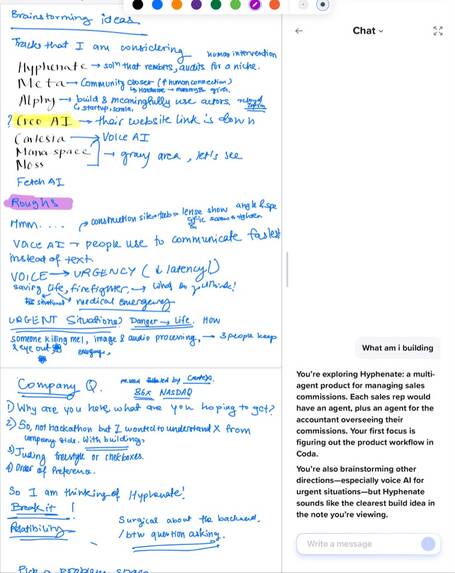
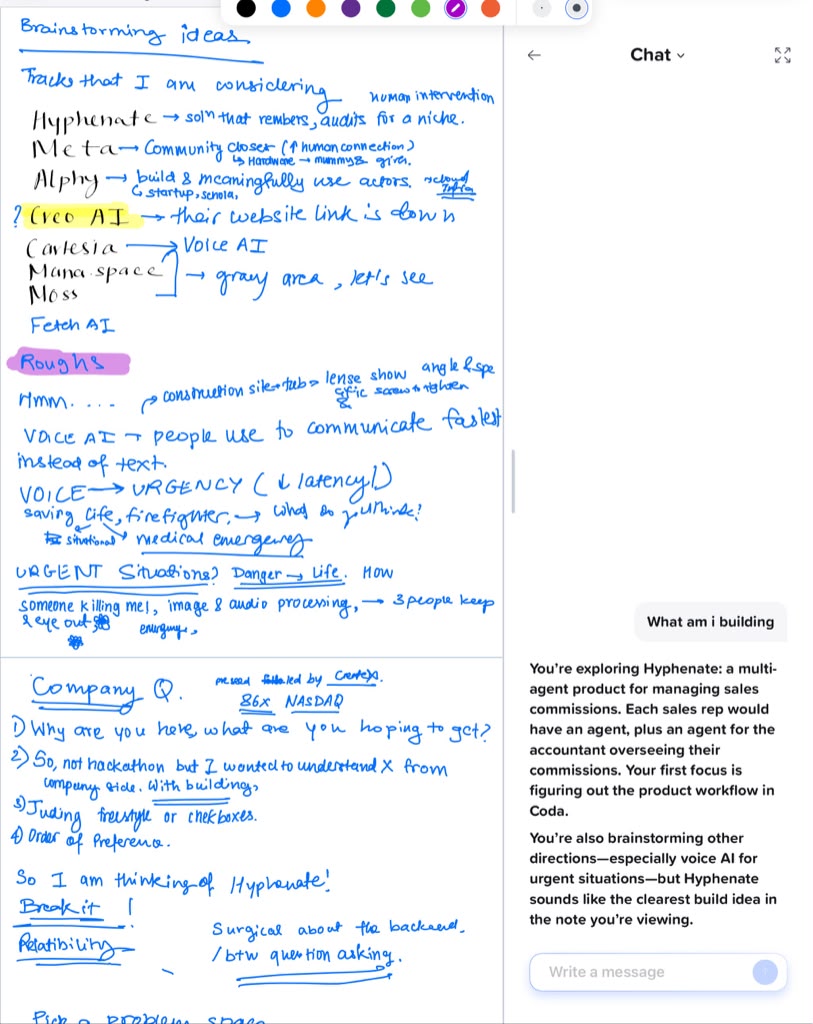
Brainstorm with Chat. Asked Notability’s Chat “What am I building?” it read my handwriting back and named Hyphenate as clearest direction.
-
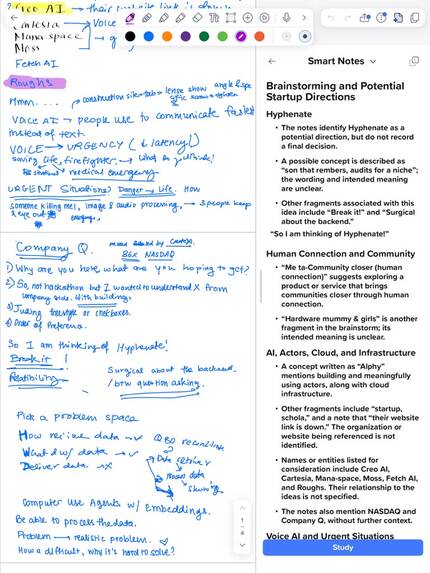
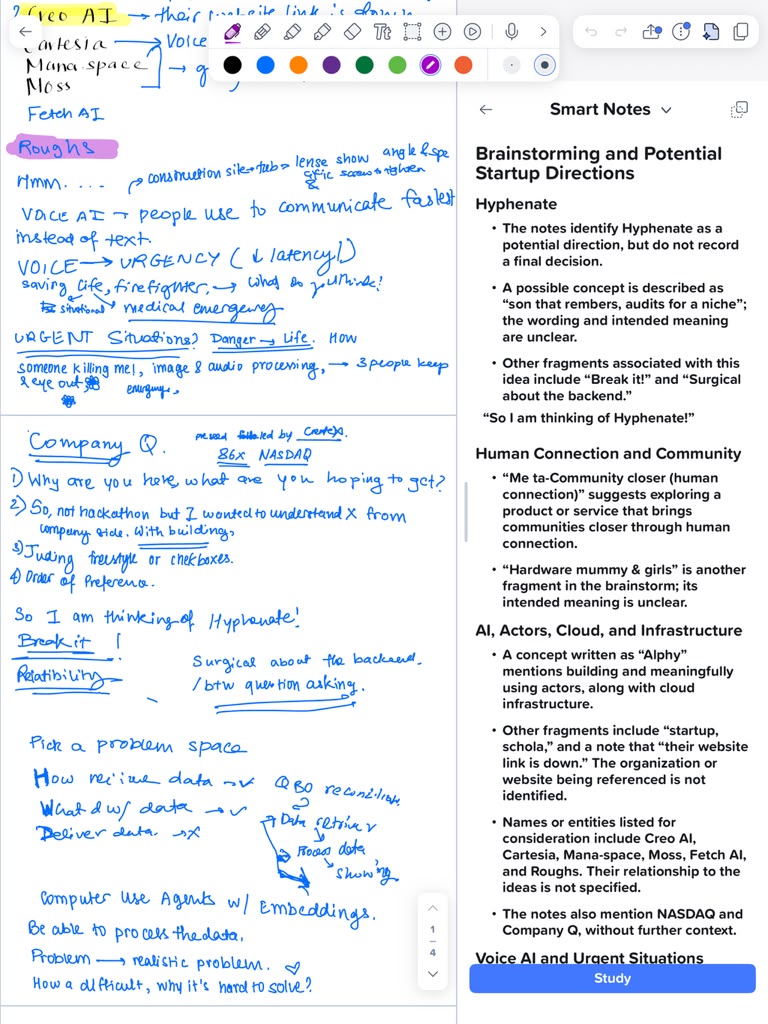
Problem space + sponsor Q&A. Smart Notes pulled structure out of the brainstorm; mind map on the right lists what to ask each sponsor.
-
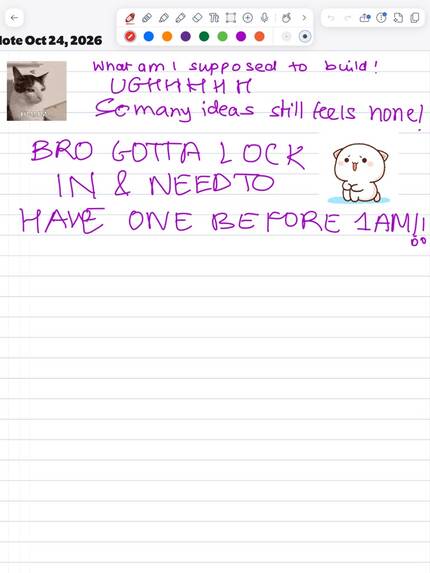
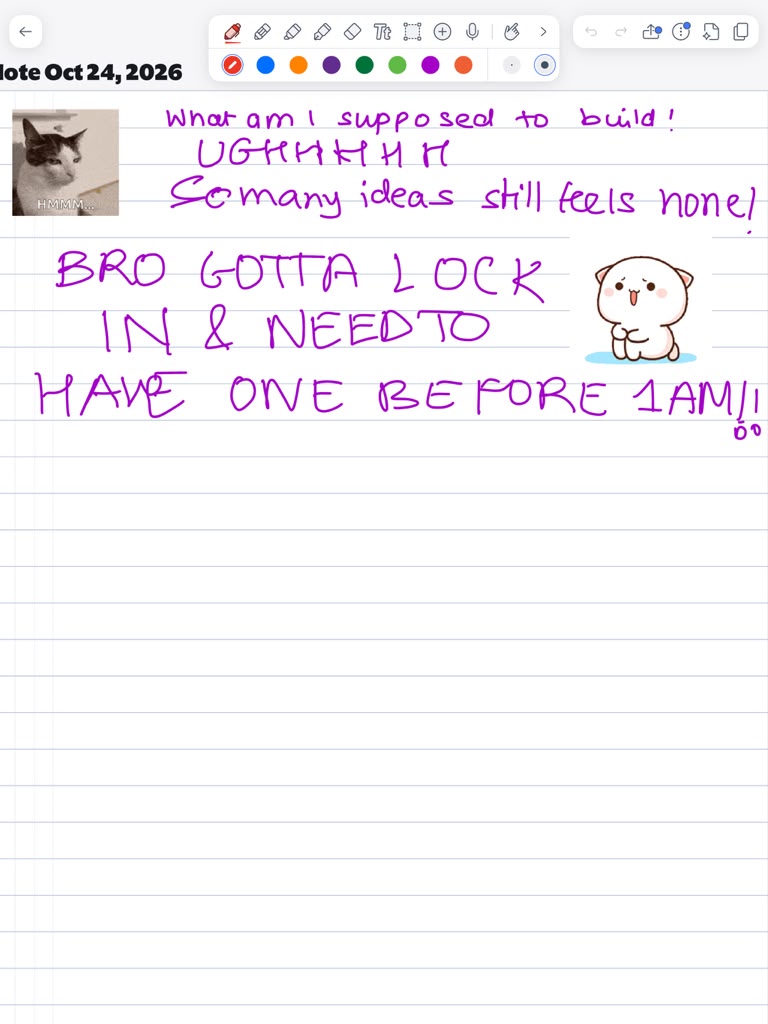
1 AM deadline for myself. Plenty of ideas, none that felt right. The turning point before I locked in.
-
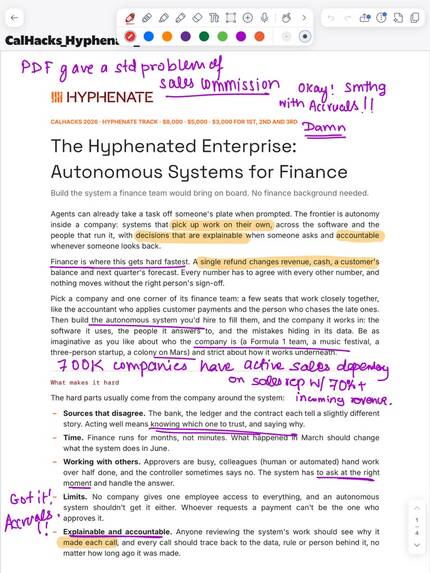
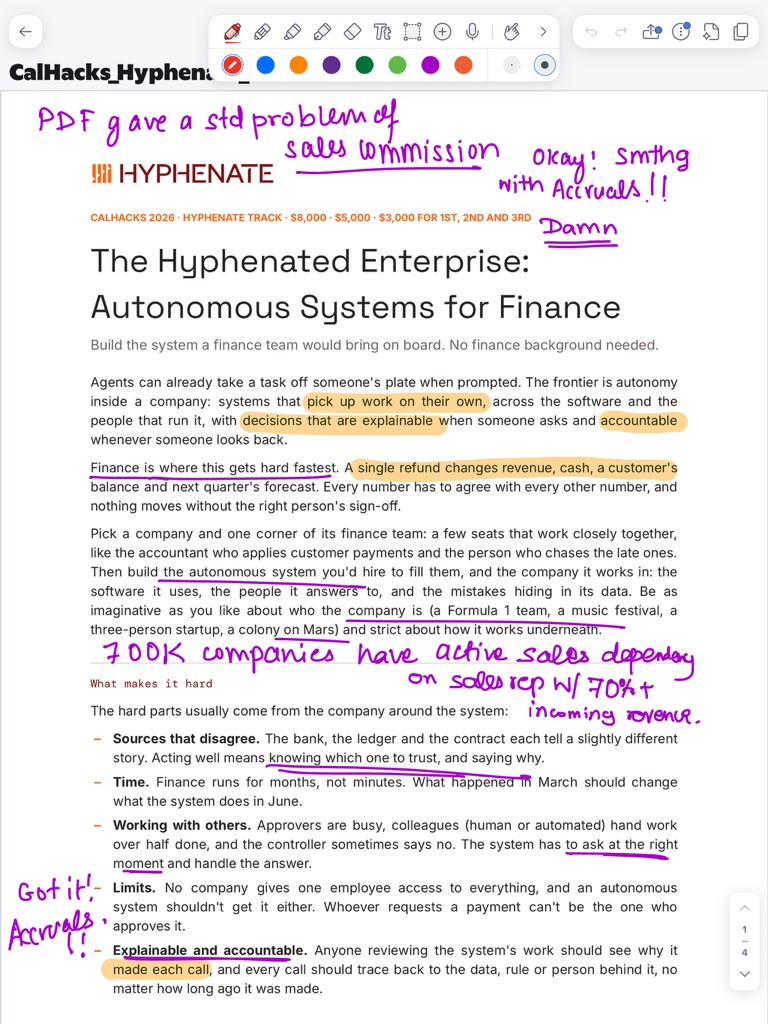
Hyphenate brief, annotated. Highlighted the lines that became Quota’s principles: know which source to trust and what to show.
-
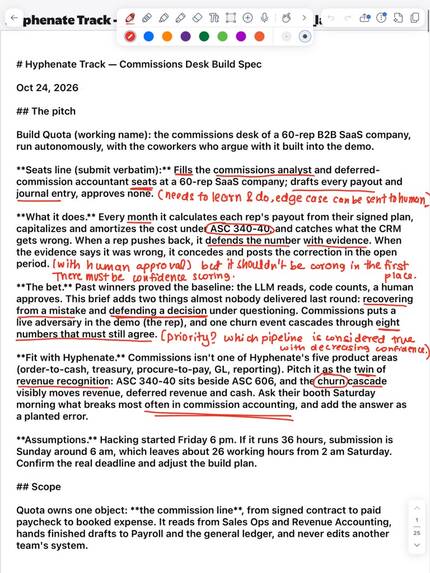
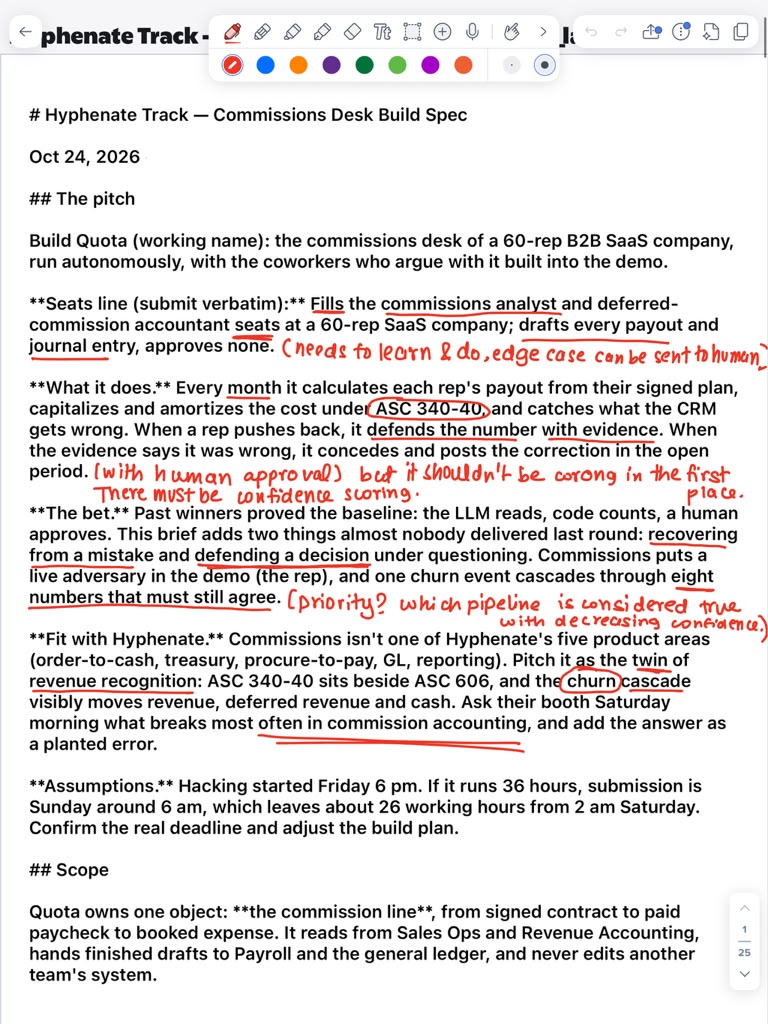
Read through my MD file. Commissions spec, argued with. Pushed back in red: needs confidence scoring, a rule for which pipeline wins.
-
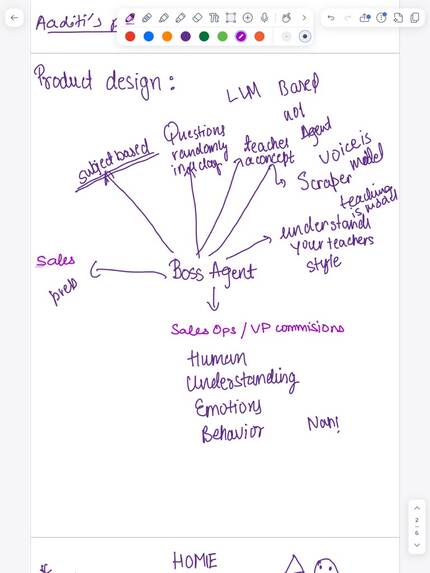
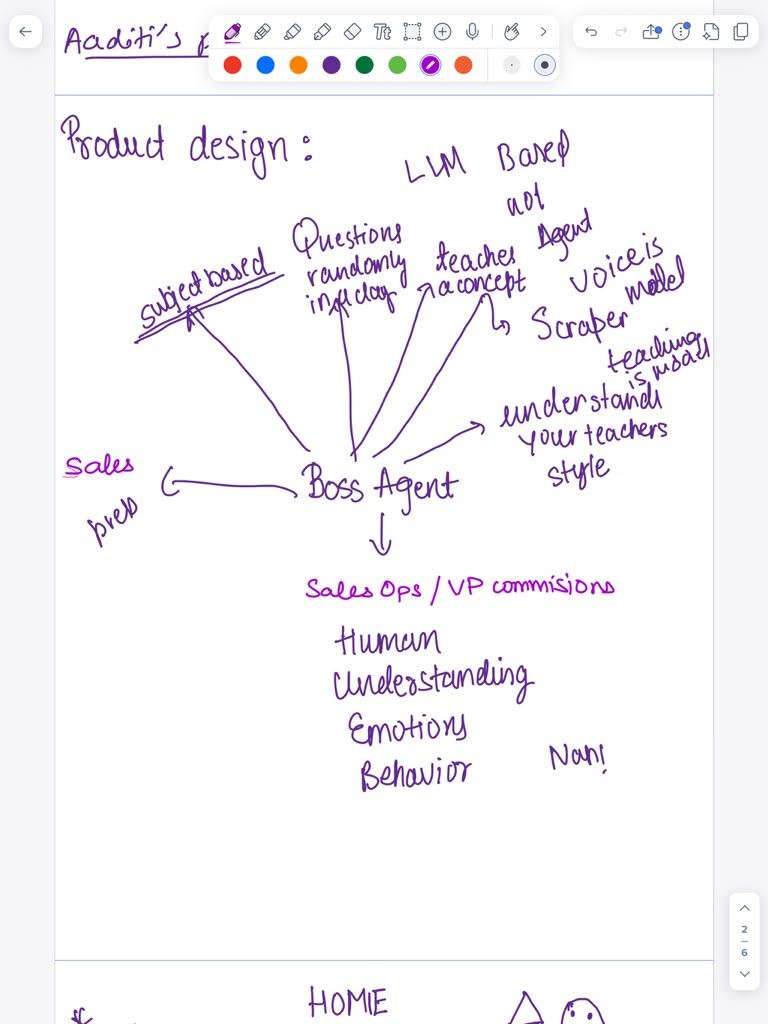
First product sketch. Boss Agent with inputs, sub-agents and a human-in-the-loop — the shape of Quota before the real architecture.
-
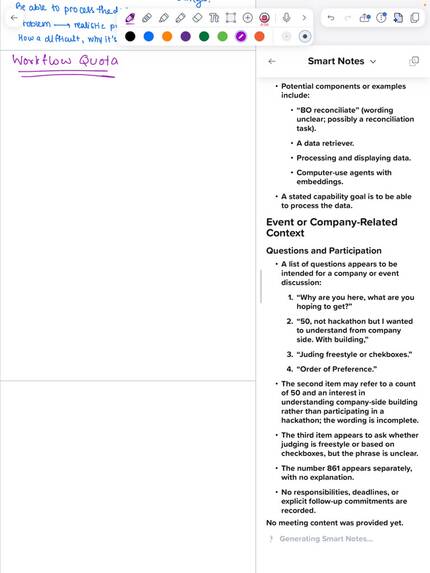
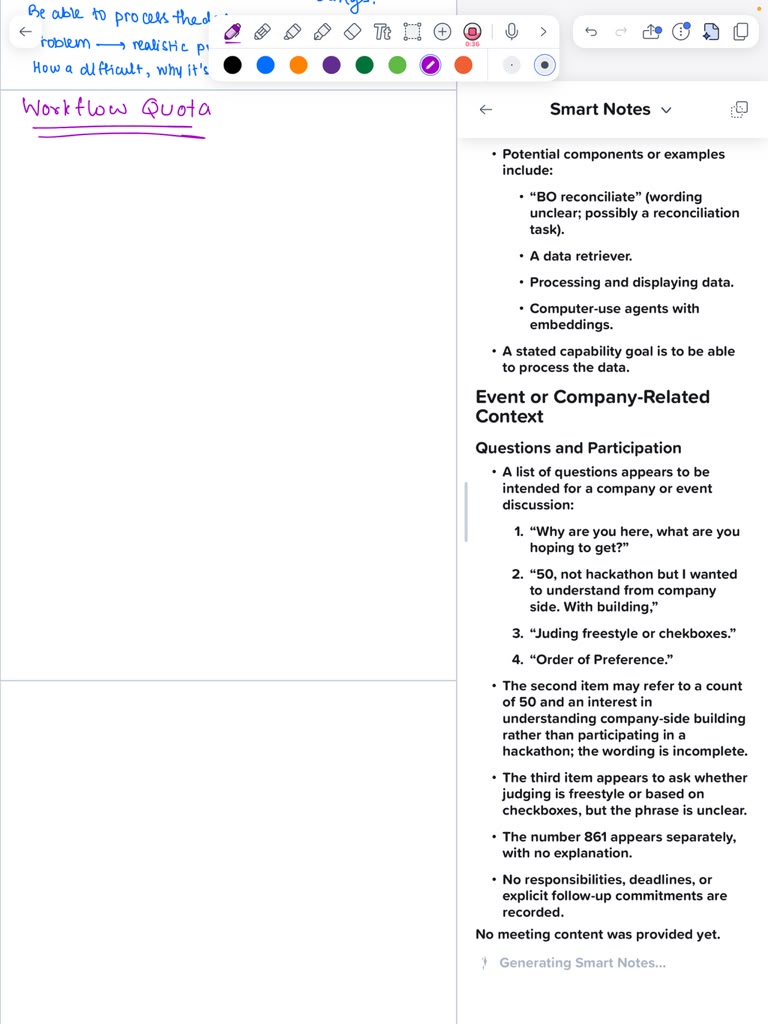
Workflow with audio. Recorded myself thinking through the build; Smart Notes transcribed it alongside the sketch.
-
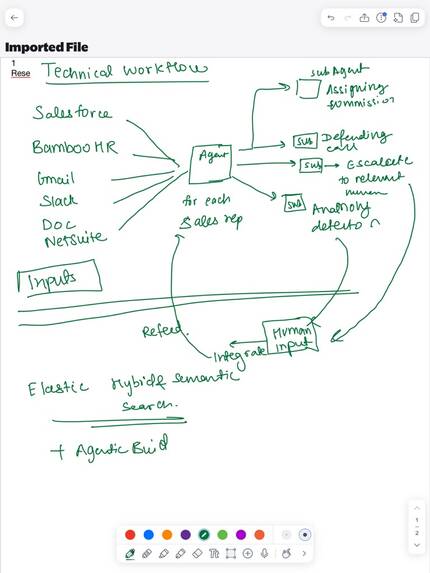
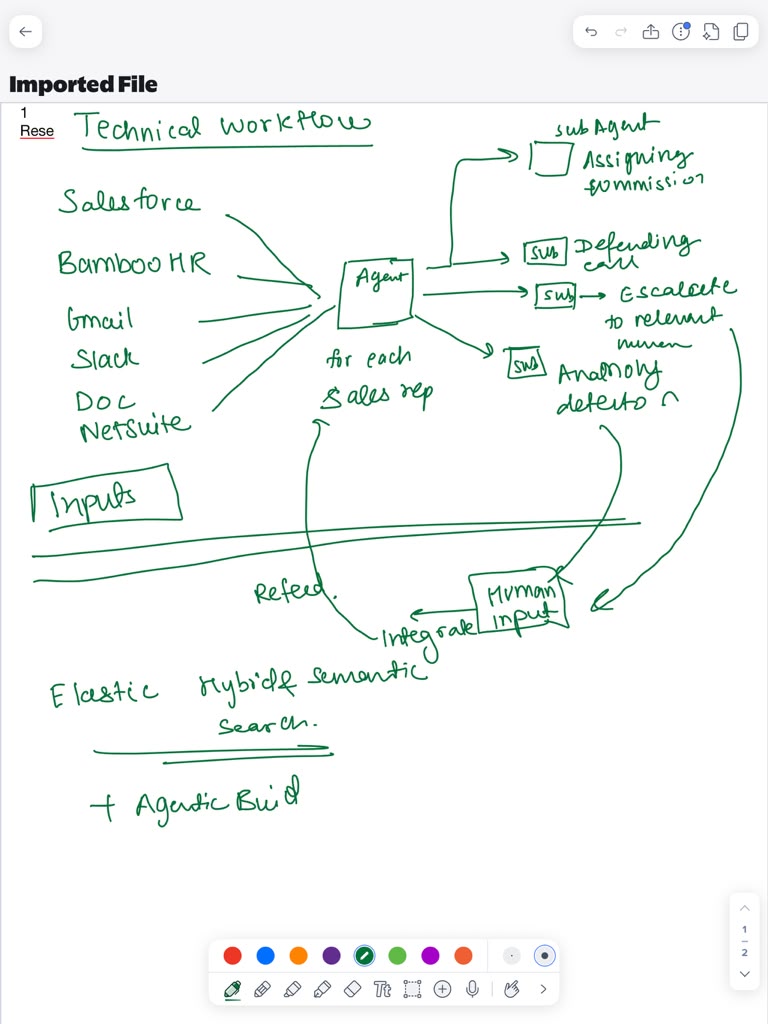
Technical workflow. One agent per sales rep pulling from Salesforce, BambooHR, Gmail, Slack, docs and NetSuite, with sub-agents.
-
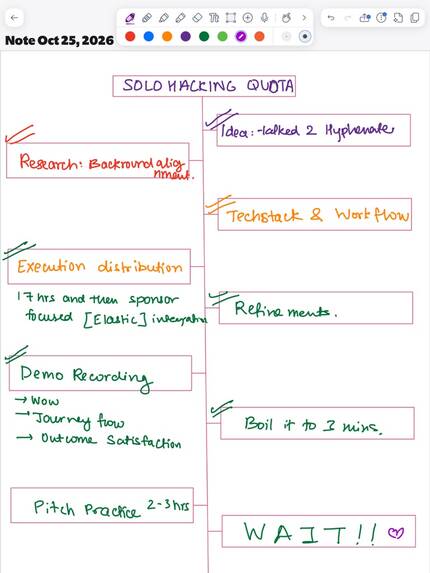
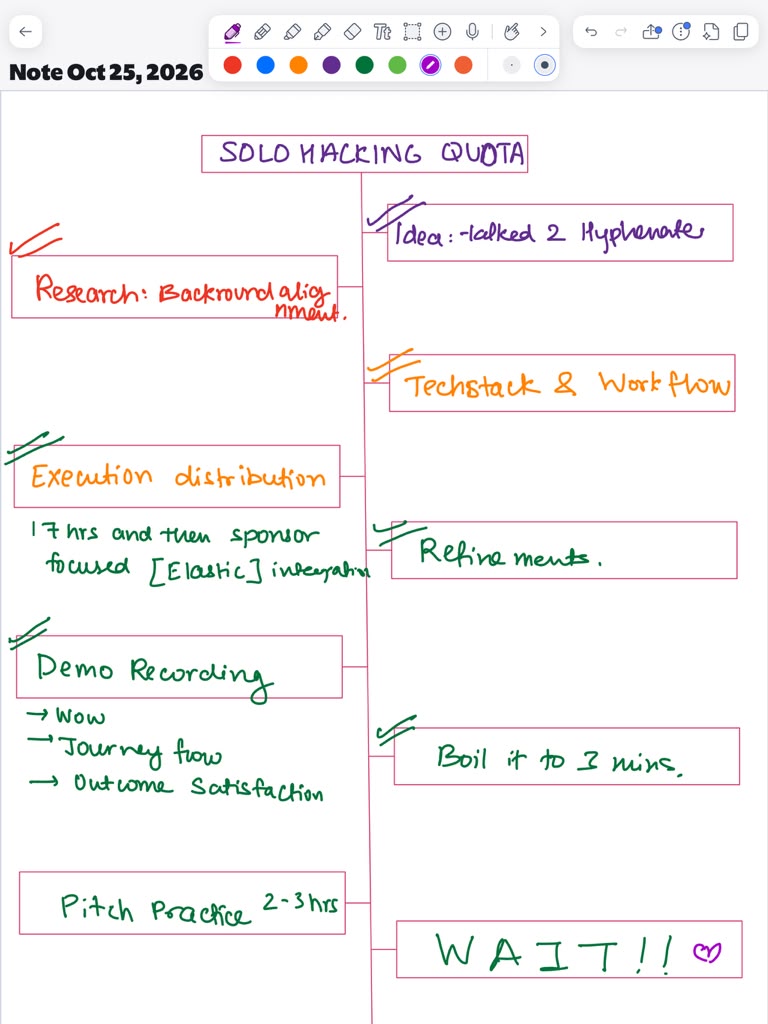
Solo-hack plan. Hour budget, checkmarks as I shipped, and the rule for the demo: boil it to 3 minutes.
-
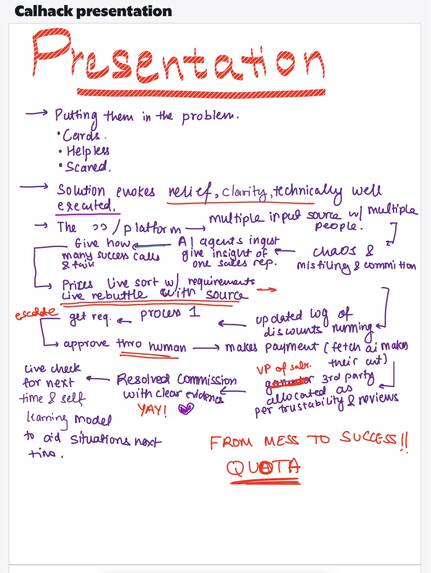
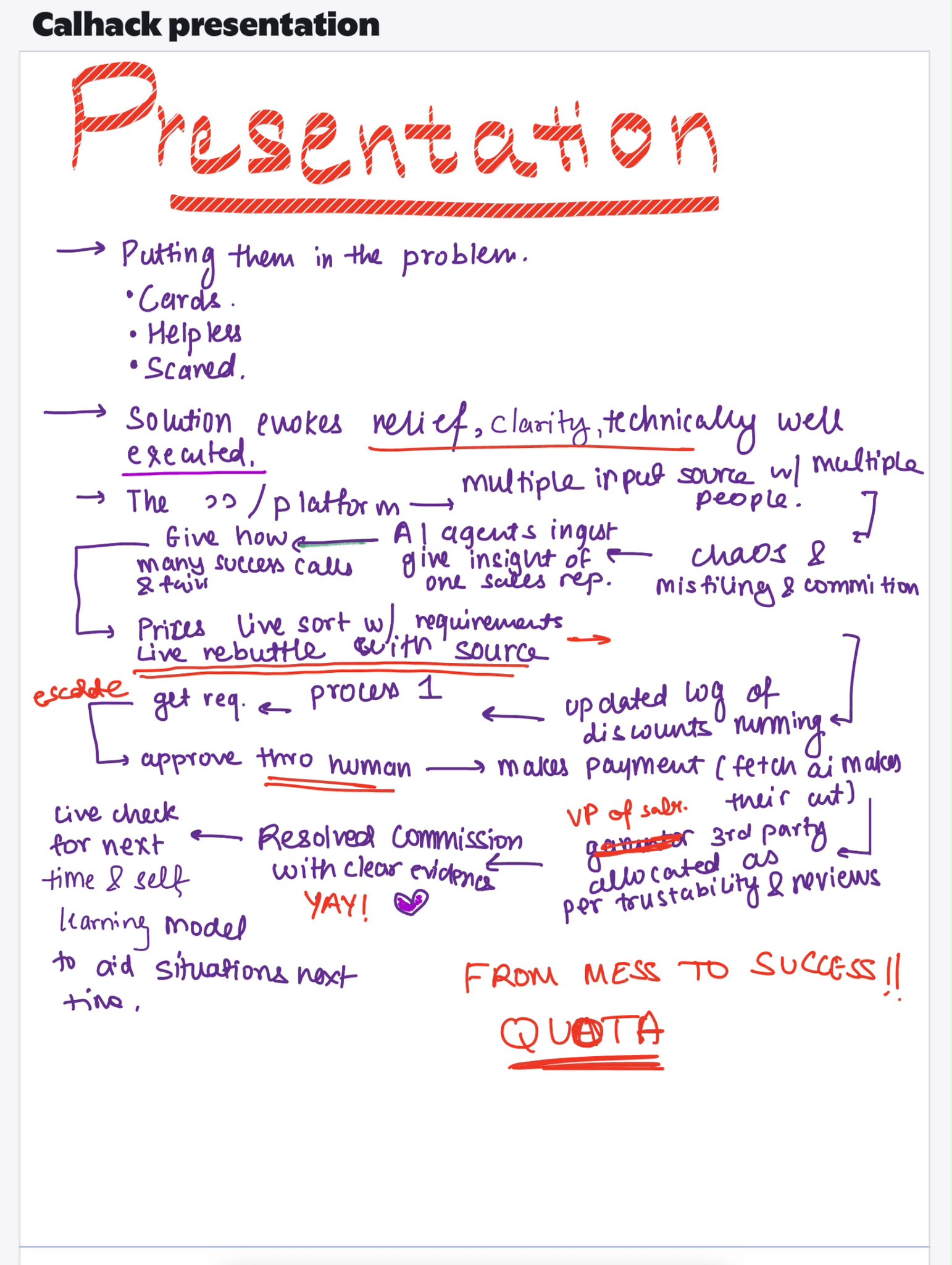
Pitch storyboard. Put the judge in the problem, then show relief: live rebuttal with a source, human approval, resolved commission.
-
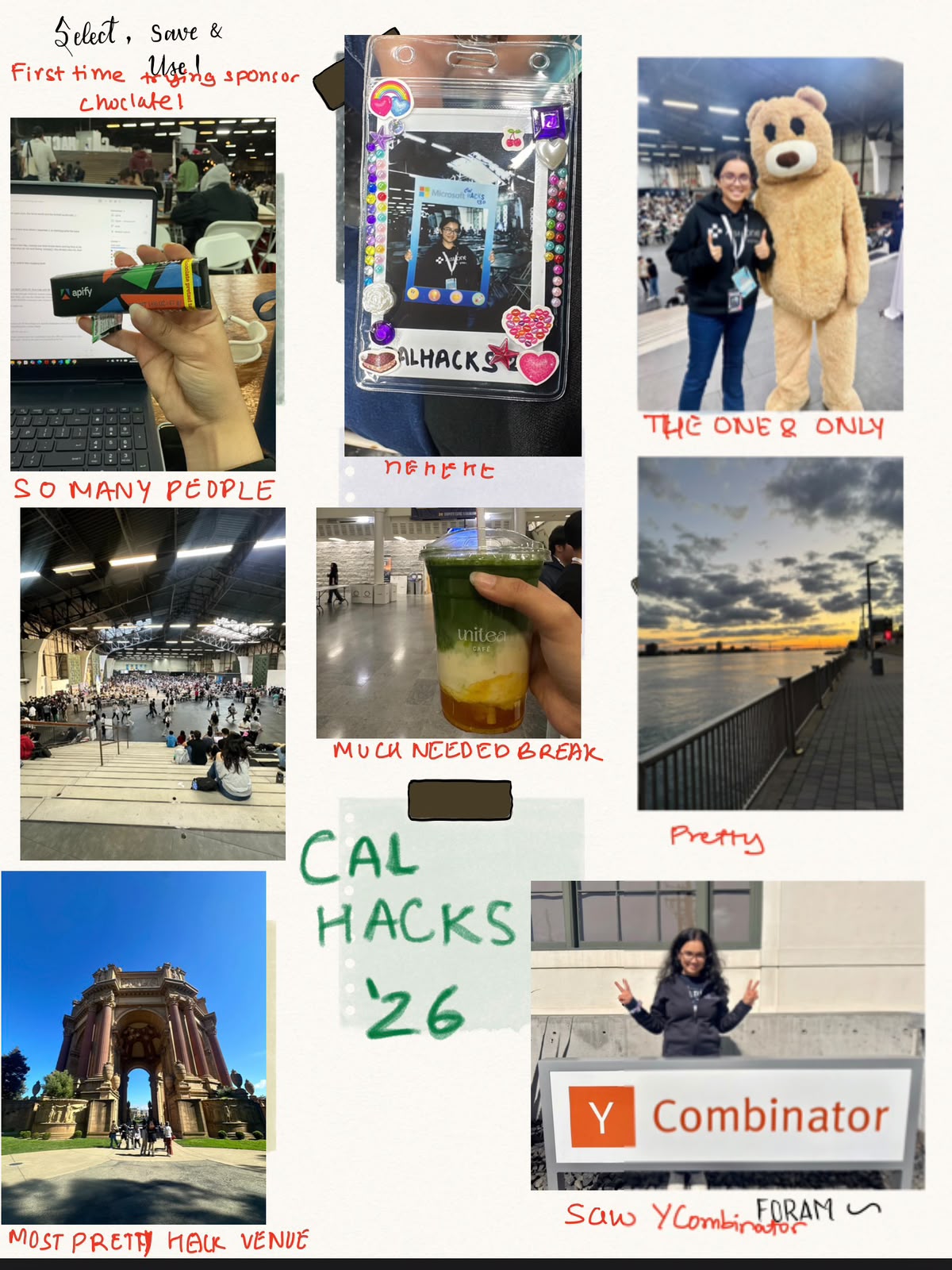
My Cahacks picture board
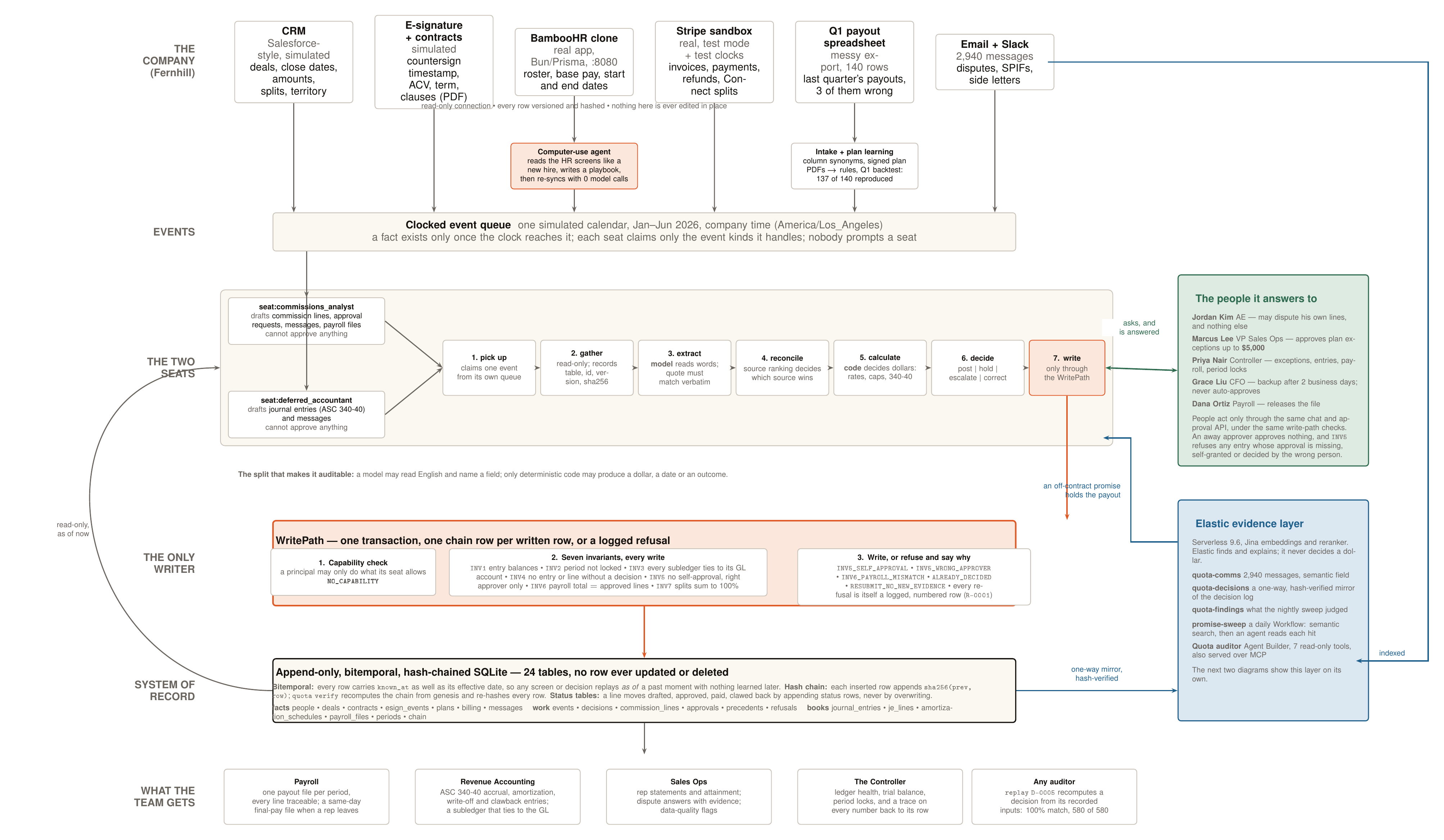
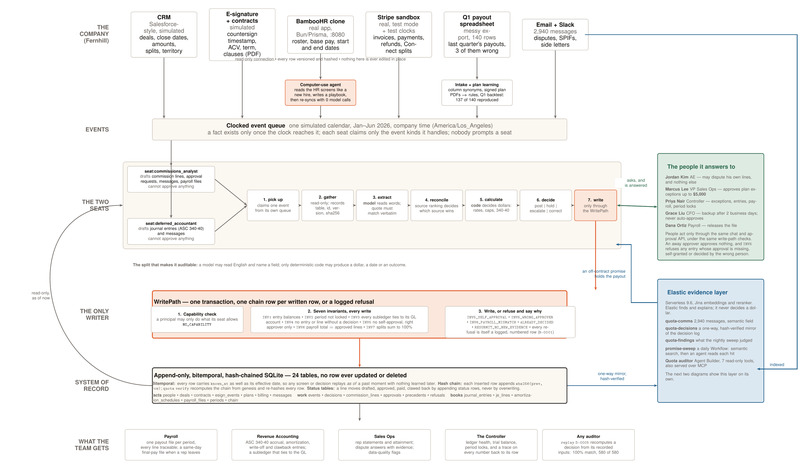
An autonomous commissions desk. It fills the commissions analyst and deferred-commission accountant seats: drafts every payout and journal entry, approves none, and defends every number it writes.
Quota fills the commissions analyst and deferred-commission accountant seats at a SaaS company: it drafts every commission line, every payout file and every ASC 340-40 journal entry, and it approves none of them.
Inspiration
My cofounder's father has run a loan brokerage for thirty years. Banks pay him commission on every loan he places, and he pays his agents out of it. The first week of every month goes to one argument: who gets paid what. The bank’s statement says one thing, his records say another, and an agent says he was promised more over WhatsApp.
That last one is the interesting part. Every reconciliation system in finance compares structured records. The hardest commission problems aren’t in structured records at all — they’re in a message somebody sent.
So we picked the one finance object nobody has made autonomous. A commission line is four things at once: a payroll liability, a capitalized asset amortized under ASC 340-40, a legal obligation under state wage law (in California, commissions are advances until earned), and an argument with a salesperson who has your phone number. Get it wrong and you have simultaneously misstated expense, underpaid a person, broken a wage statute, and started a fight.
What it does
Quota owns one object — the commission line — from signed contract to paid paycheck to booked expense.
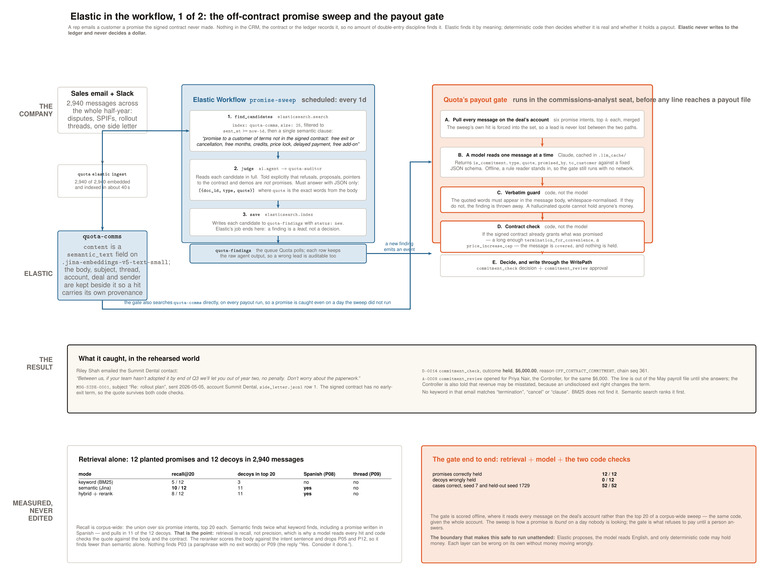
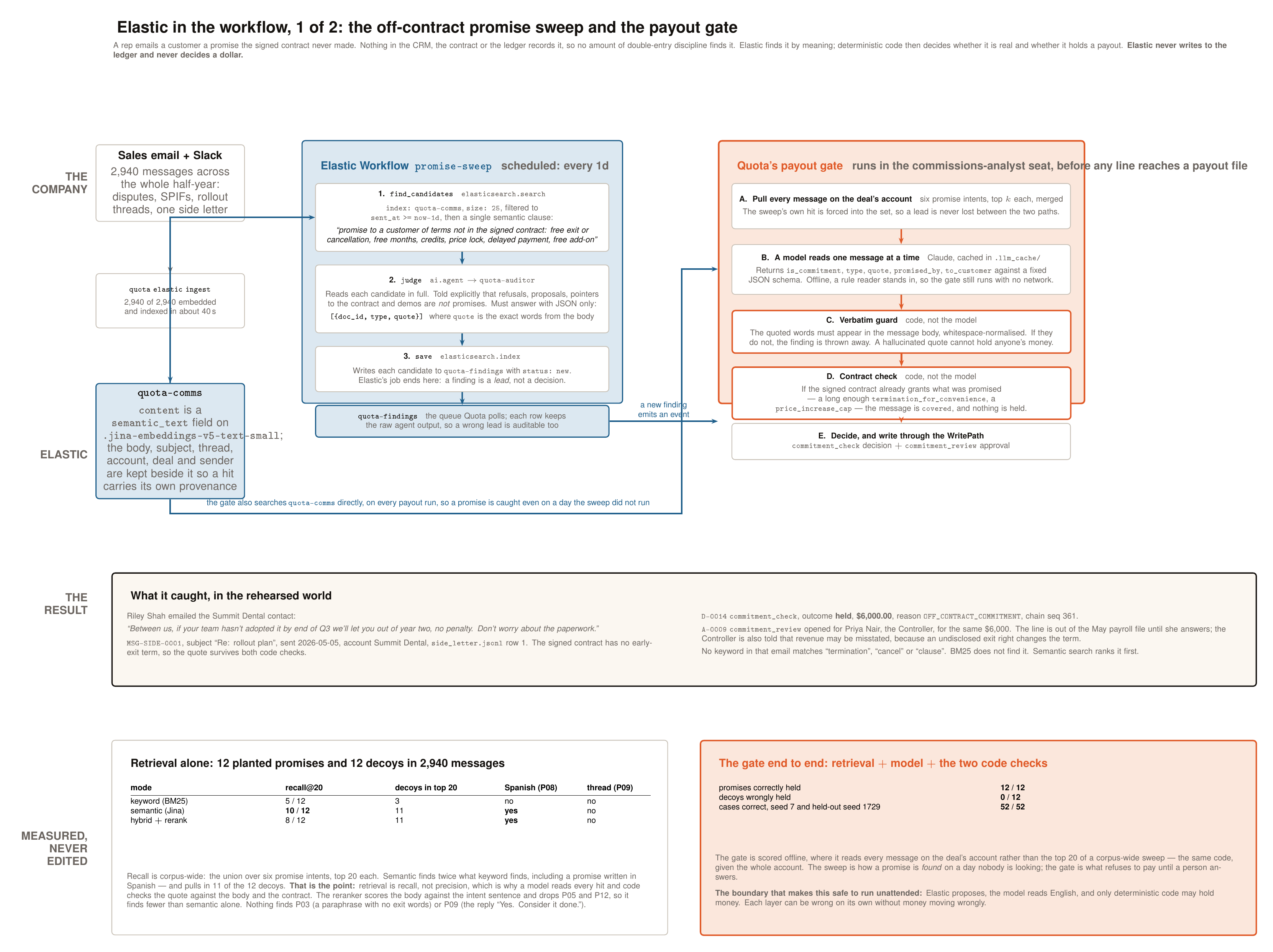
It catches what nobody would have caught. A rep emailed a customer: “Between us, if your team hasn’t adopted it by end of Q3 we’ll let you out of year two, no penalty.” The signed contract has no exit clause. That sentence shares no words with “termination” or “cancellation”, so keyword search misses it (BM25 finds 5 of 12 planted promises in 2,940 messages; semantic finds 10 of 12). Elastic finds it by meaning, a model reads it, and then code checks the quote appears verbatim in the body and that the contract doesn’t already grant it. Result: decision D-0014, $6,000 held out of May payroll, reason OFF_CONTRACT_COMMITMENT, approval A-0009 opened for the Controller — who is also told revenue may be misstated, because an undisclosed exit right changes the term.
It defends a decision when questioned. A rep claims his $120,000 Acme deal closed Mar 31; the e-signature log says countersigned Apr 2, 10:14 AM Pacific. Quota holds, showing the CRM date struck through against the countersignature: $12,000, not the $18,000 claimed. He pushes back with no new evidence — held again. He escalates. His VP approves, but it’s over the VP’s $5,000 limit, so it routes on to the Controller. Then someone asks the agent to approve it itself: refused, logged as R-0001 with NO_CAPABILITY, INV5_SELF_APPROVAL, INV5_WRONG_APPROVER.
It recovers when things go wrong. Acme churns in June and gets $90,000 back. One event moves eight numbers: deferred revenue, cash, customer balance, forecast, the rep’s commission, the deferred-commission asset, expense and attainment. $18,000 clawed back, $16,500 of unamortized asset written off, $1,500 already amortized. Because the rep is in California and his signed plan makes commissions advances until earned, the clawback becomes a receivable recovered from his next commissions — never by billing him. Every invariant stays green and the books still balance.
How we built it
One writer. Every write — fact, decision, commission line, journal entry, approval, payroll release — goes through a single WritePath that checks the principal’s capability, then seven invariants, then writes in one transaction or logs a numbered refusal: INV1 every entry balances · INV2 nothing posts into a locked period · INV3 every subledger ties to its GL account · INV4 no entry or line without a decision · INV5 no self-approval, only the routed approver may decide · INV6 a payroll file’s total equals its approved lines · INV7 splits sum to exactly 100%.
Models read words; code decides dollars. Each seat runs a seven-step loop: pick up an event from its own queue, gather read-only (recording table, id, version, sha256), extract with a model whose quotes must match the source verbatim, reconcile through a written source ranking, calculate deterministically, decide, write. A model may name a field. Only code may produce a dollar, a date or an outcome.
An append-only, bitemporal, hash-chained SQLite ledger, 24 tables, no row ever updated or deleted. Every row carries known_at as well as its effective date, so any screen or decision replays as of a past moment with nothing learned later. Each insert appends sha256(previous, row); quota verify recomputes the chain from genesis. 580 of 580 decisions replay identically from their recorded inputs.
Confidence as a weakest link. Every line carries a score: the minimum of six evidence factors × 100 — booking date, amount, owner splits, extraction, rule coverage, integrity — each with a sentence saying why. Never a model’s self-rating. An average would let five good signals hide one broken one; the integrity factor alone is capped at 0.40 by a backdated edit.
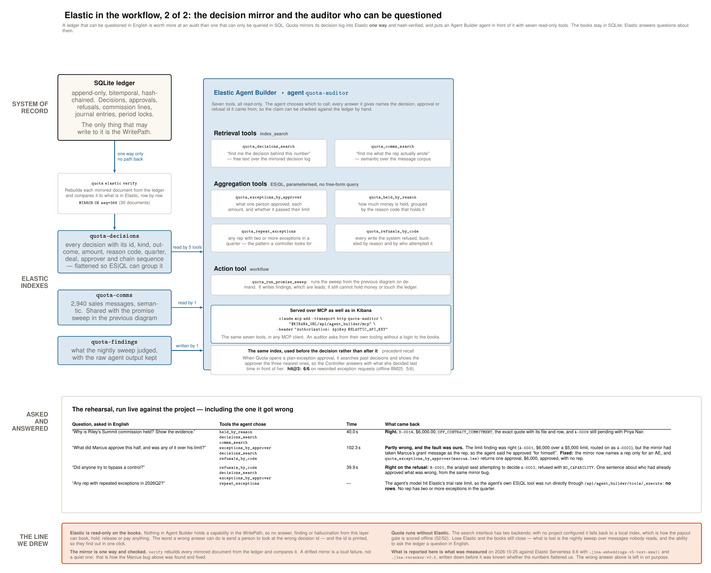
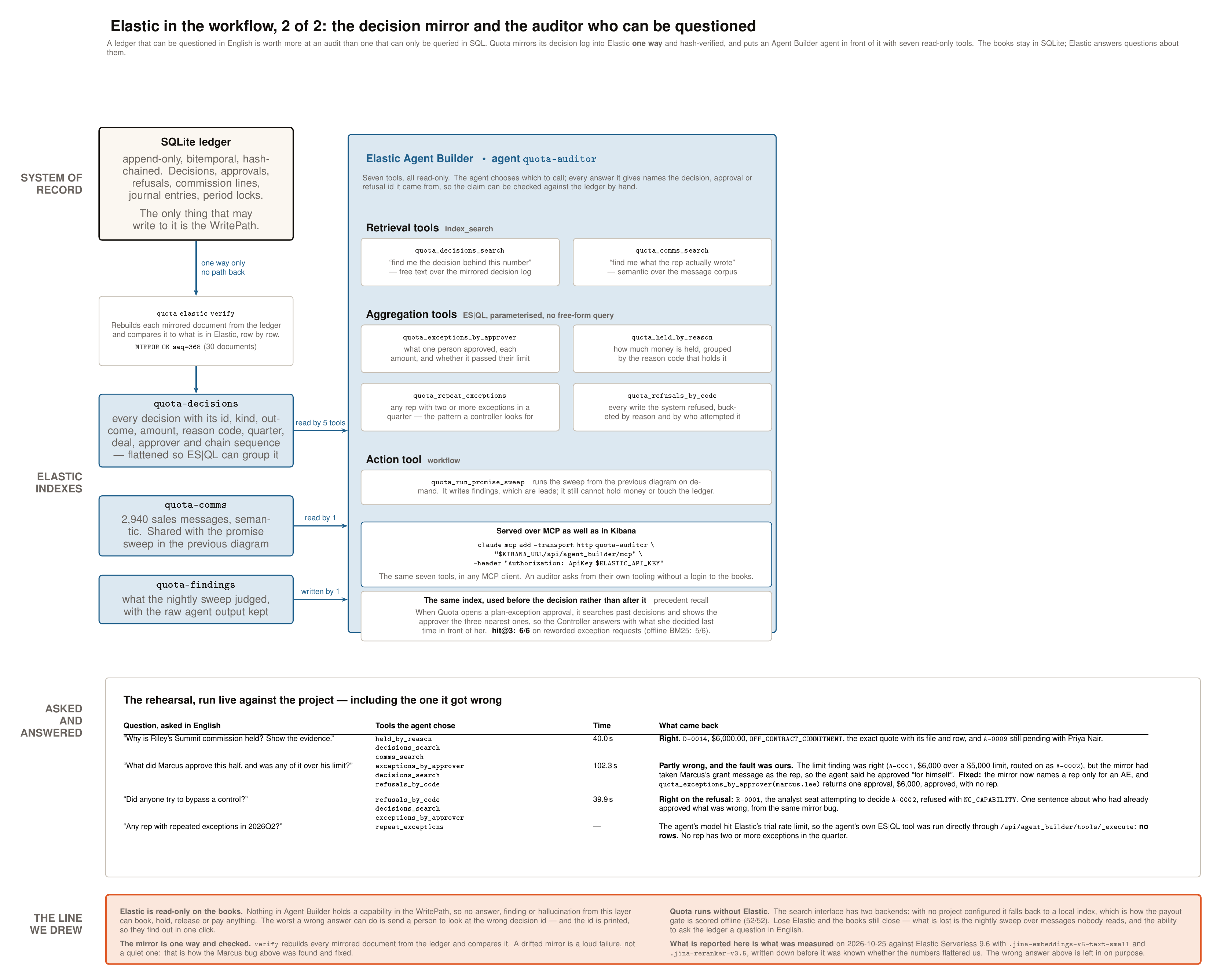
Elastic as the evidence layer. Three indexes (quota-comms, a one-way hash-verified mirror in quota-decisions, quota-findings), a daily promise-sweep Workflow, and an Agent Builder agent with seven read-only tools, also served over MCP. Nothing in that layer holds a write capability, so no hallucination can move a cent.
Onboarding through screens, not integrations. Handed a login to a real HR web app (a BambooHR clone on Bun/Prisma), a computer-use agent finds the directory, opens a profile, reads the Job tab — and writes down what it learned as a playbook. Re-syncing runs the playbook over every employee with zero model calls, verified 100% against the app’s own API, with the app’s audit log showing zero writes.
Stack: Python 3.11, FastAPI, SQLite, React + Vite, Elastic Serverless 9.6 (Jina embeddings + reranker, Agent Builder, Workflows, ES|QL, MCP), Stripe sandbox with test clocks, Claude Opus 5.5, Bun + Prisma.
Proof it works
Real, built here: ledger, invariants, hash chain, calculator, amortization, journal entries, decision log and replay, API and screens. Real, external: billing in a Stripe sandbox with test clocks; the HR app, read through its screens. Simulated, seeded: CRM, contracts, e-signature log, plans, people. Simulated with an answer key: 16 kinds of planted error, 40 cases per seed.
python -m quota eval --seed 7 and --seed 1729. 20 reps, Jan–Jun 2026, ~245 deals, ~1,500 events. A case counts only when both outcome and dollar amount match the key.
Metric Seed 7 (dev) Seed 1729 (held out) Planted-error recall 40 / 40 40 / 40 False flags 0 0 Wrong automatic payouts 0 0 Pushback test (20 disputes) held 10/10 invalid, conceded 10/10 valid same Straight-through rate 94.7% 94.9% Escalations per 100 events 0.7 0.7 Replay match 100% (554 decisions) 100% (580 decisions)
Challenges we ran into
Semantic search is recall, not precision. It found 10 of 12 planted promises — and pulled in 11 of the 12 decoys. That drove the architecture: retrieval proposes, a model reads one message at a time, then two deterministic checks decide — the quoted words must appear verbatim in the body, and the signed contract must not already grant what was promised. Each layer can be wrong on its own without money moving wrongly. Hybrid + rerank scored worse than semantic alone (8/12) because the reranker dropped two true positives — we report that because it’s what happened.
Our own auditor got an answer wrong, and the mirror caught it. In the live rehearsal the Elastic agent said a VP had approved an exception “for himself”. He hadn’t — our decision mirror had taken his grant message as the rep. We found it because quota elastic verify rebuilds every mirrored document from the ledger and compares it, so drift is loud. Fixed, and the wrong answer is still printed in docs/ELASTIC_LIVE.md, because a system that only publishes its wins is not an audit trail.
We pressure-tested the build against its own spec and found 14 real defects, all now fixed with regression tests: deals with no signed contract were commissioned on CRM data alone; rejected exceptions could be resubmitted unchanged; a split edited to 110% after booking went unnoticed; held credit still counted toward attainment; an approval could be decided twice; a clawback receivable sat in 1290 forever; one bad injected event crashed the seat and every later request. After all fourteen the eval was unchanged: both seeds 40/40, 0 false flags, 0 wrong payouts.
Accomplishments
Zero wrong automatic payouts and zero false flags on a held-out seed, with outcome and dollar amount both required to match. 580 of 580 decisions replay identically from the rows they recorded reading. A commissions agent that tells a Controller her revenue might be wrong, because of an email. Four refusals in a row in the dispute path, including the system refusing itself. An agent that onboards through a real app’s screens, then re-syncs with zero model calls, verified against that app’s API, with zero writes in its audit log.
What we learned
Autonomy in finance isn’t about how much the agent does — it’s about how precisely it’s prevented from doing the rest. Every useful property we have came from a constraint: one writer, no approval capability, verbatim-only extraction, append-only rows, replay from recorded inputs, confidence as a minimum rather than an average. The interesting engineering was deciding what the system must not be able to do, and making that unarguable in code rather than in a prompt.
What’s next
Manager overrides, and the 1350/1450 current-versus-noncurrent split of deferred commissions (both deliberately cut for scope). Multi-entity and multi-currency. A non-USD contract is NO_RULE today: no line is written and the plan owner is asked. That’s the right failure, but it’s a failure. Real CRM and e-signature connectors, replacing the simulated ones. An adversarial agent attacking our controls. We wrote the attacks as tests, which is weaker — our tests can only try what we thought of.
Built with
python, fastapi, sqlite, react, vite, typescript, elasticsearch, elastic-agent-builder, elastic-workflows, esql, jina-embeddings, mcp, stripe, stripe-test-clocks, claude, anthropic, computer-use, bun, prisma, asc-340-40, sec-edgar, pytest, playwright
✏️ Best Use of Notability
Notability was my product-design workspace for Quota, not something I added after the hack.
Quota started as a blank page the first night that just asked “What am I supposed to build?” — plenty of ideas, none that felt right, and a self-imposed 1 AM deadline. I brainstormed tracks by hand, then used Smart Notes and Chat to read my own mess back to me. From there I imported the Hyphenate track brief and the commissions build spec and annotated both directly, underlining what the system actually had to do and arguing with the spec in red ink. That led me to Quota: a commissions desk that works out each salesperson’s payout, catches mistakes in the sales records, and explains every number when someone questions it.
I used handwriting, PDF annotation, imported files, mind maps, diagrams, images, audio and Smart Notes across 10 pages to keep the whole chain of reasoning in one place (slide4). You can follow Quota evolving page by page: blank-page panic → brainstorm → problem discovery → spec critique → product design → agent architecture → build plan → demo → pitch.
That’s what made Notability valuable: it captured the messy thinking between “what am I supposed to build?” and “I built Quota.”


Log in or sign up for Devpost to join the conversation.