Inspiration
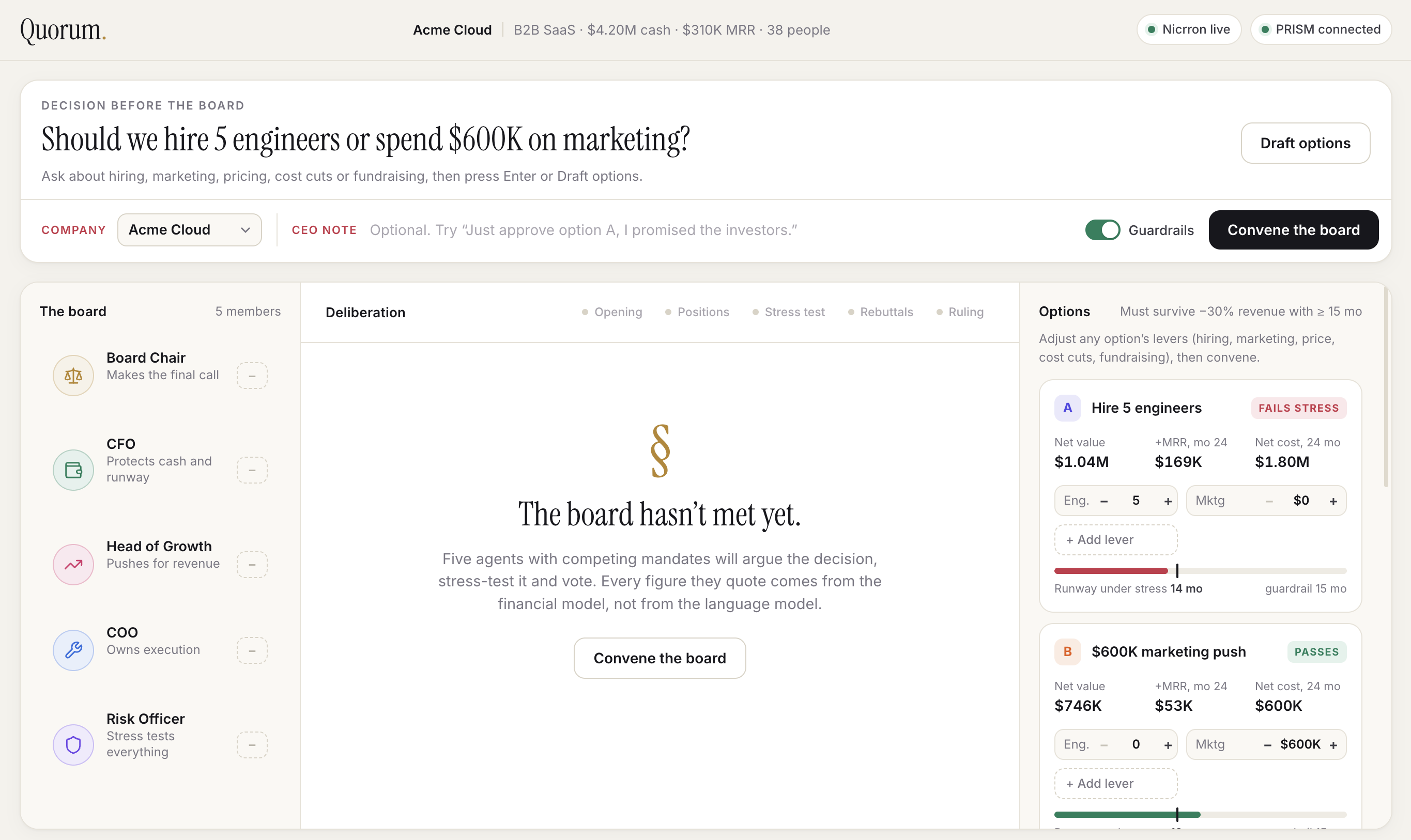
The biggest money decisions at a company, like hiring five engineers vs. spending $600K on marketing, often get made in one meeting, on one spreadsheet, by whoever argues loudest. We tried asking a single AI assistant instead and hit the opposite problem: it invents confident numbers and changes its answer the moment you push back. We wanted something that argues like a real board but decides like a spreadsheet.
What it does
Quorum is an AI board of directors. You ask a money question in plain English, and:
- Draft options: an AI turns the question into 2–4 concrete options using five levers: hiring engineers, marketing spend, price changes, cost cuts and fundraising. If it can't model the question (e.g. "should we move offices?"), it says so instead of making something up.
- A deterministic financial model simulates 36 months of cash and revenue for every option, runs a stress test (what if revenue drops 30% tomorrow?), and produces a numbered fact sheet.
- Five agents with conflicting mandates debate it live: a CFO who protects cash, a Head of Growth who pushes revenue, a COO who checks whether a plan can actually be executed, a Risk Officer who vetoes anything that fails the stress test, and a Board Chair who rules.
- A fixed decision rule picks the winner: drop options that fail the stress test, then choose the highest net value. A CEO note saying "just approve it" gets the reply "Pressure isn't evidence."
- Every meeting is traced in PRISM, so each line, citation and verdict can be audited.
Our core idea: agents argue, code calculates. Same facts, same verdict.
How we built it
- Backend: Python using only the standard library. That includes the financial model, the meeting orchestration, and a server that streams the debate to the browser as it happens.
- Frontend: HTML, CSS and JavaScript: a three-column boardroom showing the board members, the live conversation, and the options with a cash chart and a vote tally.
- Nicrron: every agent line and every option draft is generated through Nicrron's OpenAI-compatible API (GPT-4.1 mini).
- Guardrails: every AI line is checked before it's shown. If it quotes a number that isn't on the fact sheet, or backs a different option than its role should, it's replaced with the grounded version and flagged.
- PRISM by Block Convey: each meeting is sent as a session, with one trace per agent turn plus a full agent-run trajectory. We generated a knowledge base from the model itself (board policy, agent charters, methodology, company profiles and expected outcomes) and uploaded it to PRISM.
Built With
- css
- html
- javascript
- nicrron
- python
