-
-

Main Thumbnail
-
-
-
-
-

Quorum Escrow
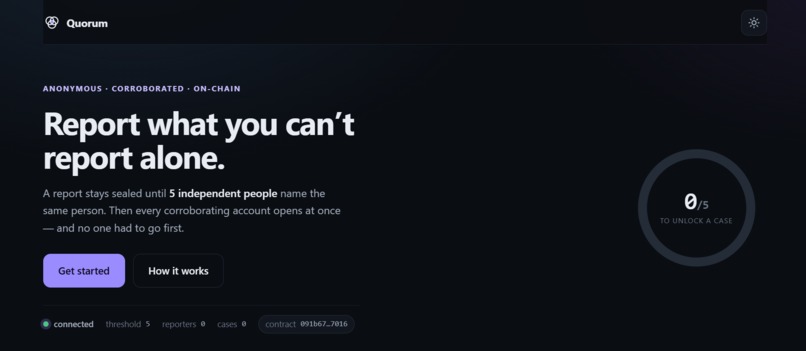
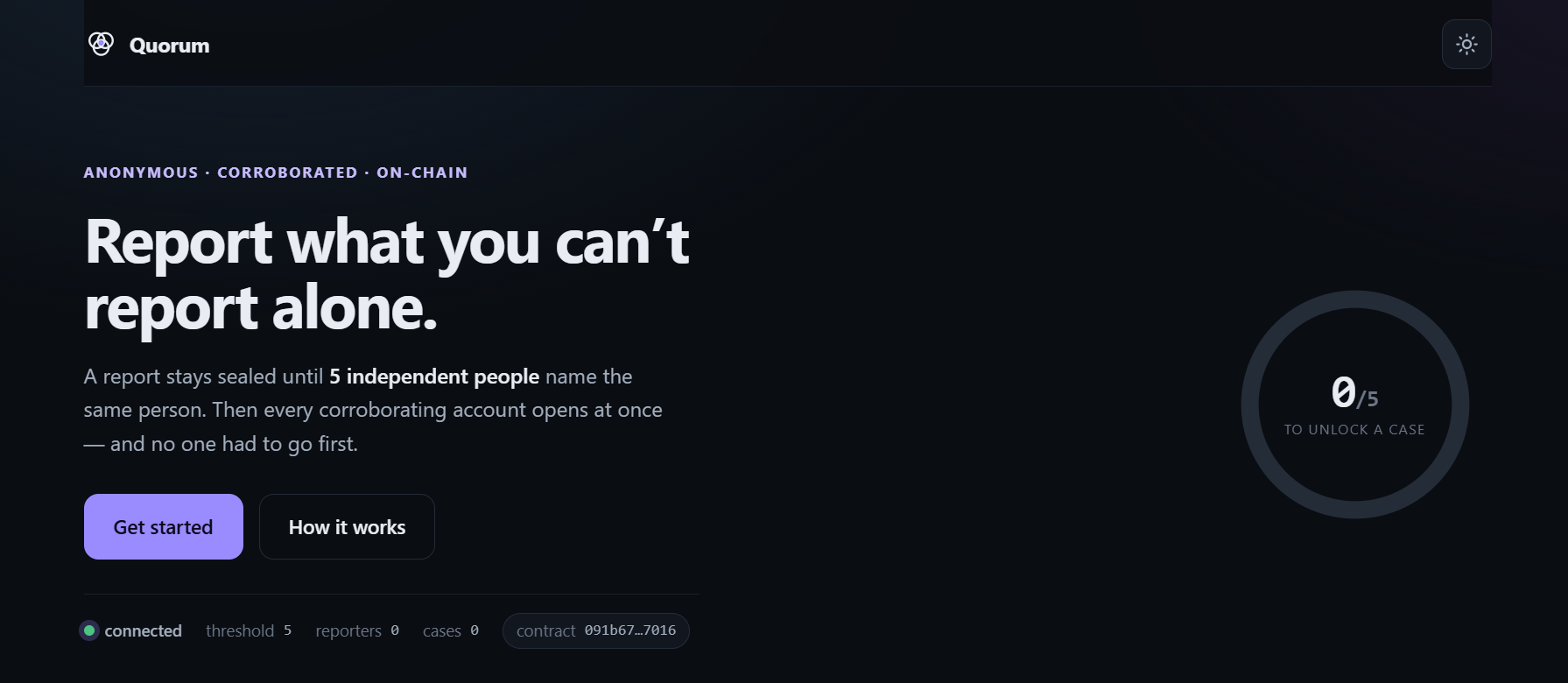
Anonymous allegation escrow on Midnight. A report against a person stays
sealed until threshold independent reporters name the same person — then, and
only then, the bodies unlock. Every reporter is anonymous; "independent" is
enforced in zero knowledge, not by trust.
Inspiration
Picture the room you're already in: a company of a few hundred people, or a single university department. Everyone who belongs there has a work email, and that list of emails is the entire world of people who could ever use this tool.
Then something happens. A manager who crosses a line in one-on-ones. A professor who retaliates against students who push back. A colleague whose "jokes" you've watched land on three different people. You're fairly sure you're not the only one who noticed. But "fairly sure" isn't something you can act on, because the first person to file a lone complaint carries all of the risk:
- If you're the only name on it, you're identifiable by process of elimination.
- One report against a senior person is easy to wave away as a personality clash.
- If it goes nowhere, you are now the person who complained.
So nobody goes first. The information exists — it's just spread across people who each individually can't afford to speak. This is the "I'm not the only one" problem, and it's why whisper networks exist and why so much misconduct stays an open secret for years.
The naive fix — a shared counter, "click here if it happened to you too" — dies instantly to a Sybil attack: one motivated person spins up ten identities and manufactures a fake quorum, or the accused does it to bury a real one. Midnight gave us the missing piece. With zero-knowledge proofs we can make the number on that counter mean something — "$N$ reporters" can be made to mean "$N$ distinct verified humans" while revealing nothing about who any of them is, or which report is whose. Quorum Escrow is a mechanism for going first safely, by making "going first" count for nothing until enough other people have independently done the same.
What it does
An operator — HR, an ombuds office, a student union, a department admin — seeds an allowlist of verified emails: exactly the people who belong in that room. That list is the only trust the operator holds.
From there, as a reporter:
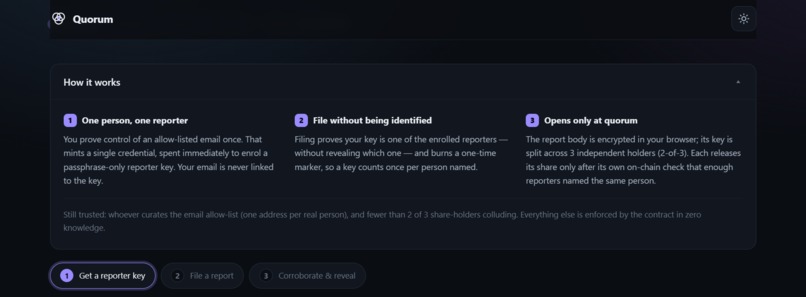
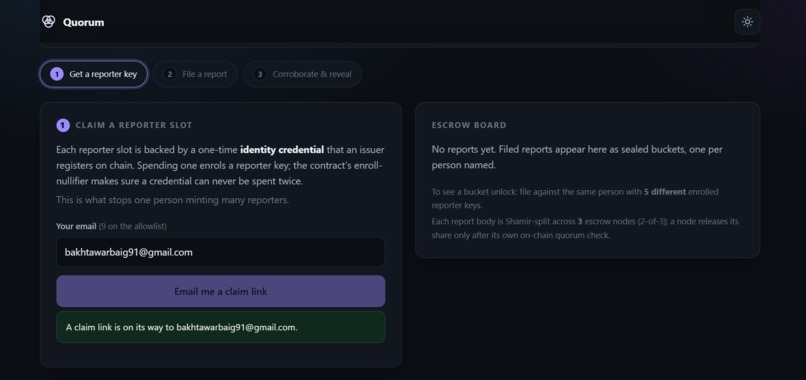
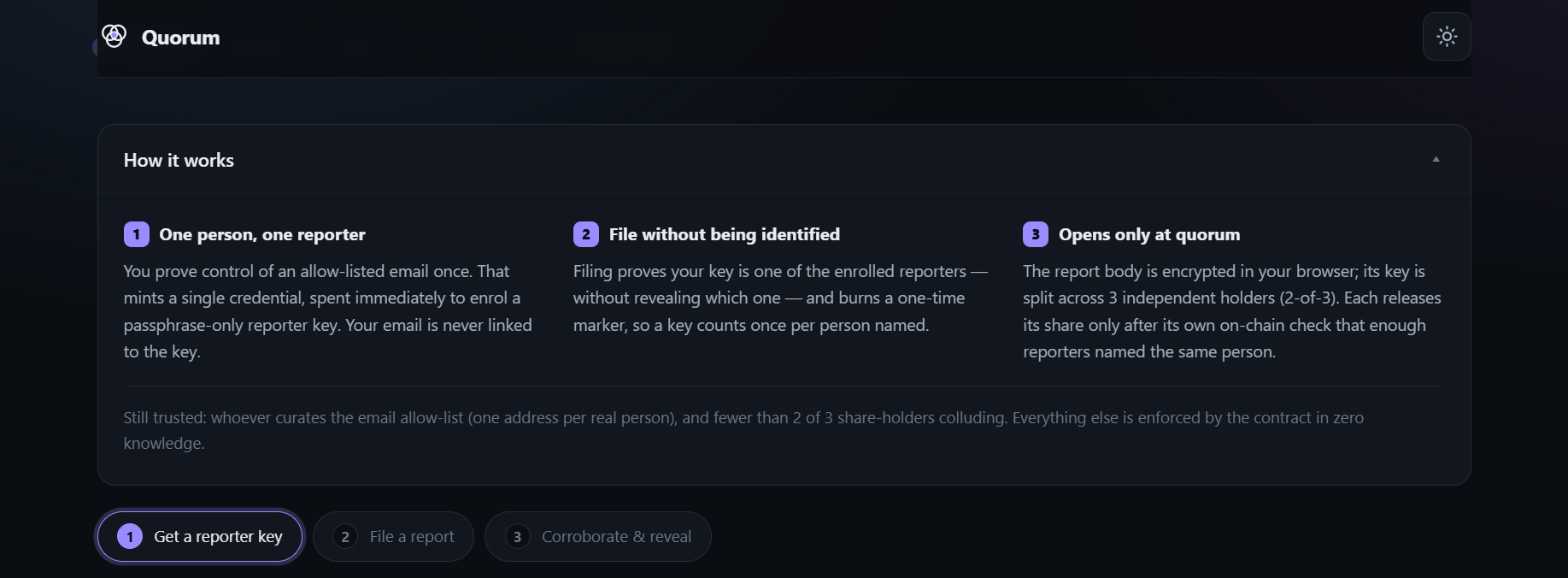
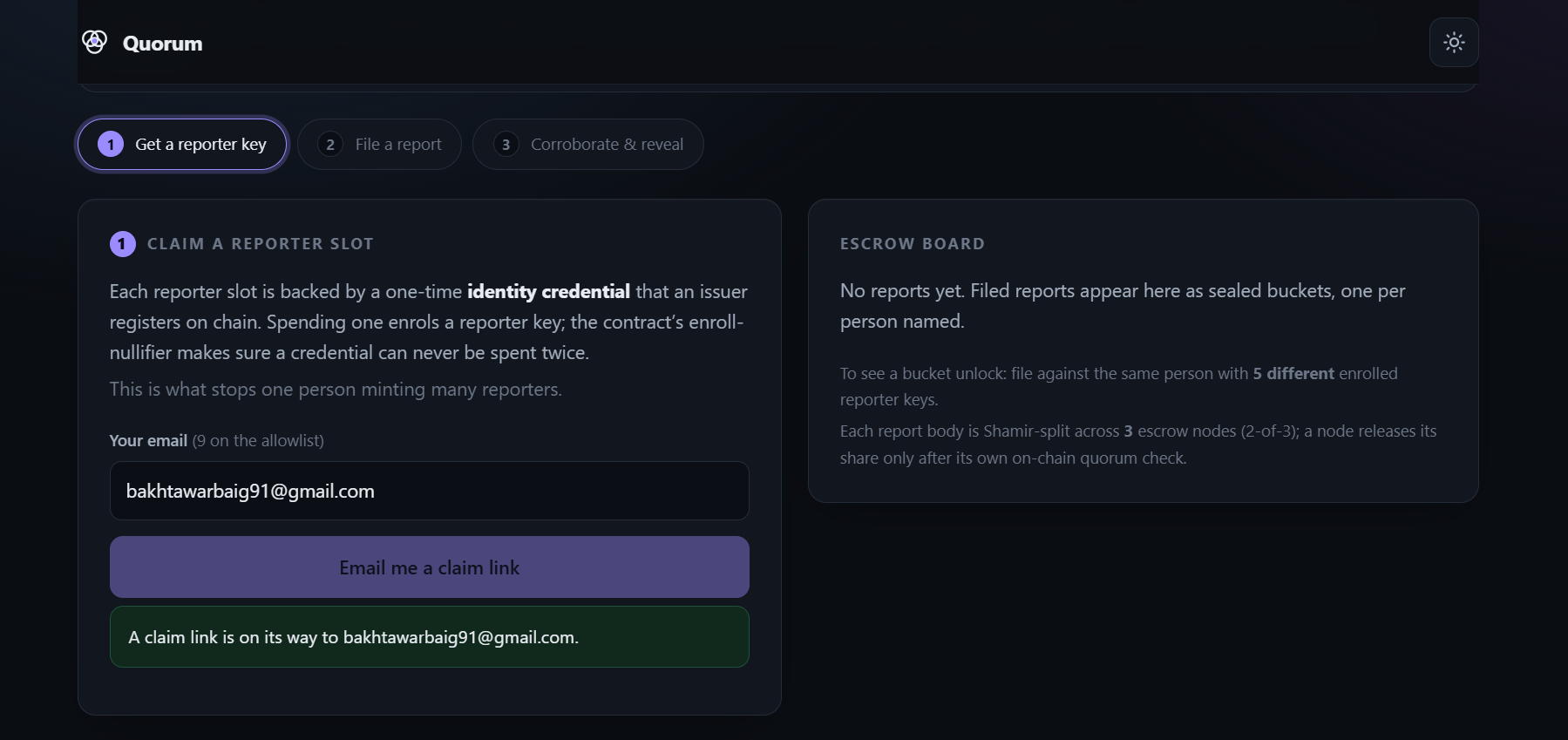
- Claim a slot. You verify your email once and get a single-use link. You pick a private passphrase; the server mints you a one-time credential and spends it to enroll a reporter key derived from that passphrase. One email, one enrollment, ever — and the server keeps no record of which key came from which email.
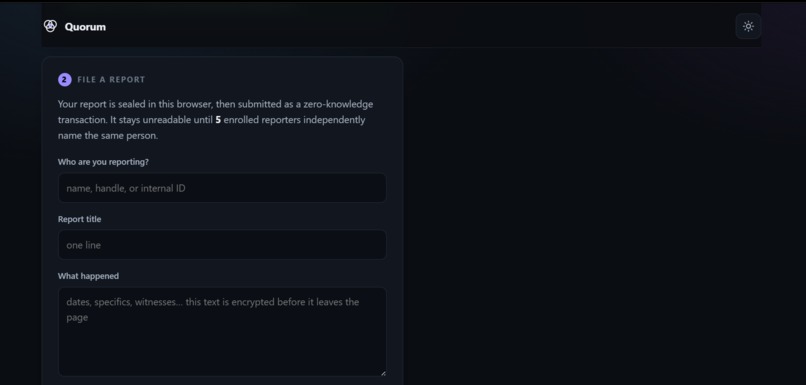
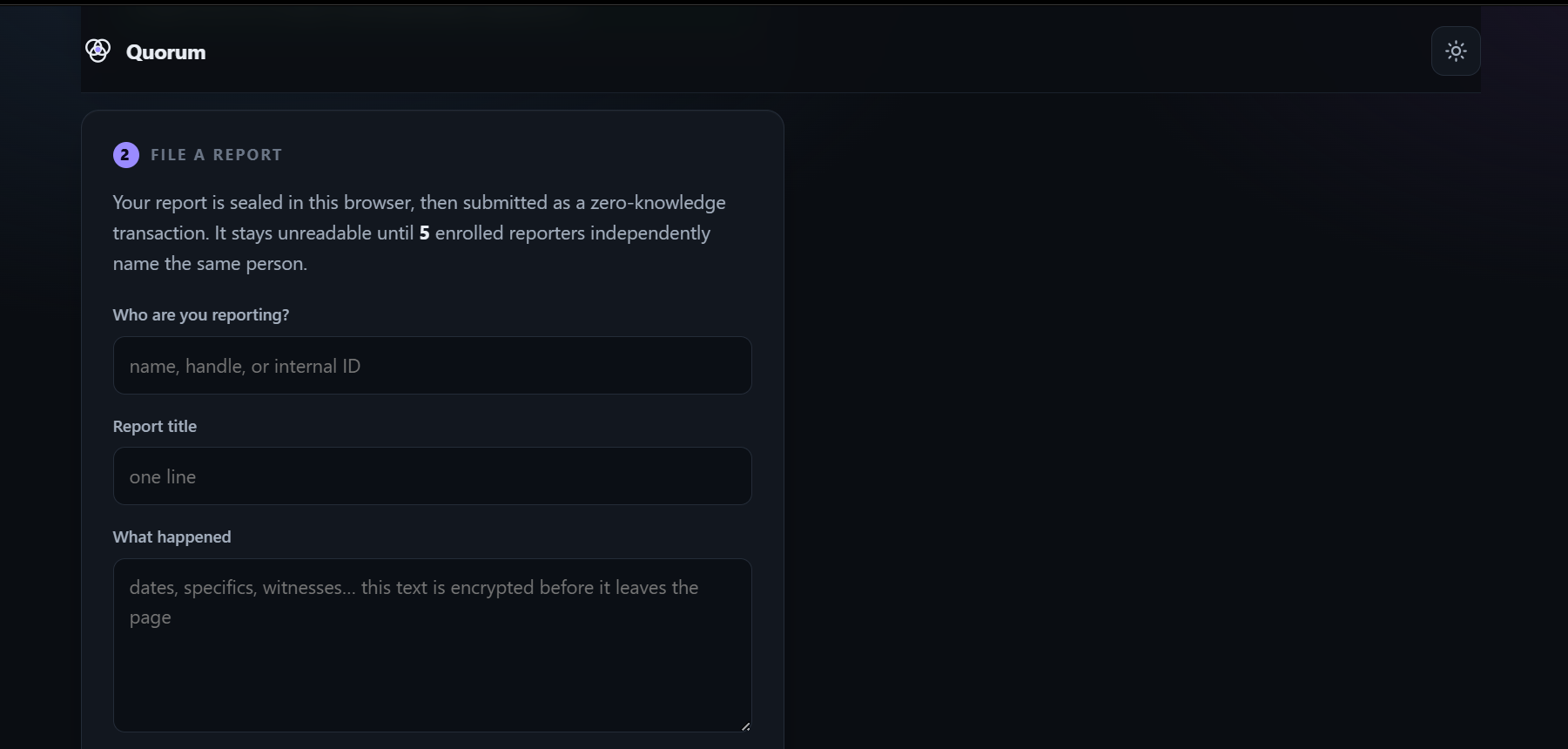
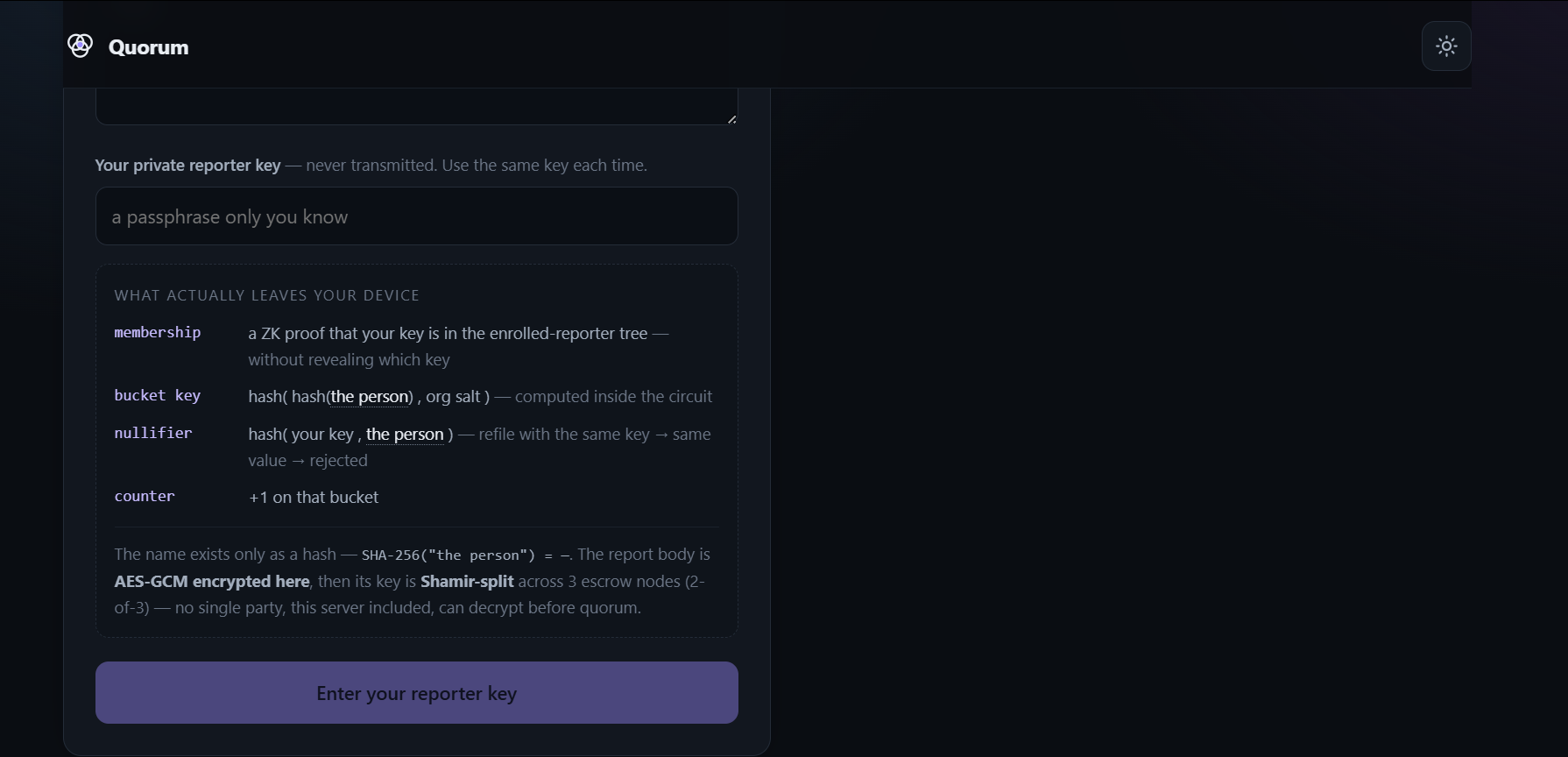
- File — once. You name a person and write down what happened. The report body is encrypted in your browser before it leaves your machine. On chain, all that lands is a single counter — keyed by a hash of the accused's identity — ticking up by one. You may file against a given person exactly once; a second attempt from your key is rejected before a transaction even exists.
- Nothing happens. No email goes out. Nobody — not the operator, not the accused, not the other reporters — learns that you filed or that the counter moved. The encrypted body sits in escrow, split into pieces, and every piece-holder refuses to hand its piece over.
- The quorum forms. Elsewhere, independently, other verified people file against the same person. When the counter reaches the threshold $t$ the operator fixed at deploy time (say $t = 3$), the bucket unlocks.
- Now the people who need to know, know. The escrow pieces release, the bodies decrypt, and a corroborated set of reports becomes visible at one moment — as a group finding, instead of one exposed individual's accusation. The reporters finally learn they were right.
Below threshold, Quorum Escrow is a sealed vault. At threshold, it's a filing cabinet that was already full.
What "independent" actually means
The whole design exists to make $N$ on the counter mean $N$ distinct human
beings. Three layers, all enforced in zero knowledge in
contracts/quorum.compact:
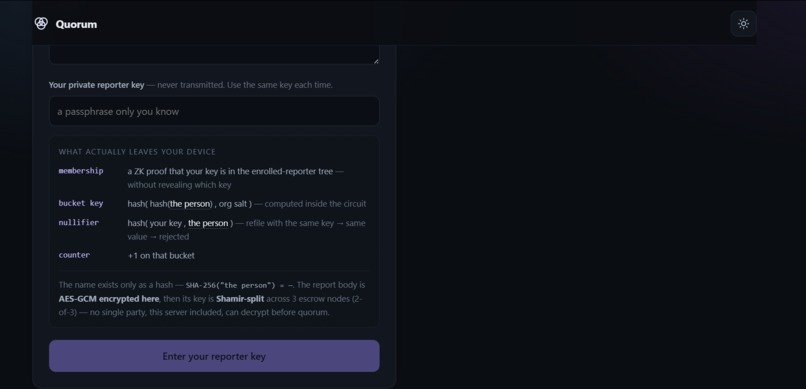
A · Nullifier — one key, one report per person. Filing publishes
$$\text{nullifier} = H(\texttt{"quorum:nullifier:v1"},\ \texttt{reporterSecret},\ \texttt{accusedID})$$
into an on-chain set. It's deterministic in your key and the accused, so a second attempt reproduces the same value and is refused — yet it's a one-way hash, so it links to neither.
B · Membership — only enrolled people can file, and nobody can tell which one
did. submitReport proves your reporter key is a leaf of a Merkle tree of
enrolled keys (HistoricMerkleTree<10>, up to $1024$ reporters) without
revealing which leaf. An outsider's key produces no valid proof at all.
C · Identity-bound enrollment — one verified identity, one key. A key becomes
a leaf only via enroll, which proves possession of a one-time identity
credential (itself a leaf of an issuer-published tree) and burns a per-identity
nullifier $H(\texttt{"quorum:enroll-null:v1"},\ \texttt{personSecret})$. One
issued credential → one enrolled key → one report per person. A lone actor can
raise a bucket's count by at most $1$ per credential the operator hands them.
Escrow · no early reveal, no single custodian. The body key is AES-256-GCM in the browser, then Shamir-split $t$-of-$k$ (default $2$-of-$3$) across independent escrow nodes. Each node re-checks the chain itself and releases its share only once $\texttt{buckets}[\text{bucketKey}] \ge \texttt{threshold}$.
We keep an explicit honesty boundary in SECURITY.md:
everything above is cryptographic. What remains trusted is the operator
registering one credential per real person — plus, in this demo, the signing
wallet and the fact that we run the escrow nodes.
How we built it
- Contract — Compact on Midnight.
pragma language_version >= 0.23, compiler0.31.1(language0.23.0,compact-runtime@0.16.0). Four circuits —registerIdentity,enroll,submitReport,isUnlocked— over a ledger of twoHistoricMerkleTree<10>s, two nullifierSets, aMap<Bytes<32>, Uint<64>>bucket counter, athreshold, and anissuerCommitment. All multi-input hashing is domain-separated with a padded tag (pad(32, "quorum:bucket:v1"), etc.) so a bucket hash can never collide with a nullifier. - Demo API (
server/index.ts, Express, ~900 lines): boots a Midnight wallet, deploys or rejoins the contract, serializessubmitReportcalls, drives the nine ZK witnesses, and runs email credential issuance. It never sees a plaintext body or a body key. - Escrow nodes (
server/escrow-node.ts): $k$ tiny independent services — no wallet, no proof server, just the public indexer and their own quorum check. The browser talks to them directly, so the main API never touches key material. - UI (
ui/, Vite + React + TS): passphrase → reporter key, browser-side AES-GCM seal, Shamir split, the claim / file / reveal flow, a live status board, and a light/dark design system. The "what actually leaves your device" panel spells out the proof, the bucket hash, the nullifier, and the+1before you submit. - Shamir (
ui/src/lib/shamir.ts): ~90 lines of $\mathrm{GF}(2^8)$ split/combine, browser-only, zero new dependencies. - Property test (
scripts/quorum-e2e.ts): deploy → enroll → Sybil attempts → quorum → unlock, ~13 real proofs against a local devnet in Docker.
We built it in milestones, each one closing a specific way to cheat the counter: M1 nullifier → M2 membership Merkle proof → M3 identity-bound enrollment → M4 distributed escrow → M5 service hardening (fail-closed config, rate limits, security headers, atomic writes, CI) → M6 email-allowlist issuance with random per-person secrets and single-use claim links.
Challenges we ran into
- Compact's information-flow analysis. Every circuit parameter is
private-until-declared-public, and taint is tracked through hashes — the
compiler will tell you a "ledger operation might disclose a hash of the witness
value." Every value entering a ledger op, including reads like
set.member(x)andmap.lookup(k), needs an explicitdisclose(). It's excellent discipline once it clicks, and a wall of (very precise) taint-path errors until it does. - Version-pinning hell. The compiler's runtime target,
compact-runtime, and a transitiveonchain-runtime-v3WASM module all have to agree to the patch version. npm floated one copy3.0.0 → 3.1.0, we ended up with two WASM instances, and stores failed with a crypticexpected instance of StateValue— theStateValueone instance built was rejected by the other. The fix was anoverridespin plusnpm dedupeto physically collapse the duplicate;npm installalone left two copies nested. - Merkle witnesses across the FFI. The generated TypeScript emits
goes_left(snake_case) where the runtime struct usesgoesLeft. And a non-member has no path at all, sofindPathForLeafreturnsundefined— you have to feed the circuit a bogus all-zero path of length 10 so the call still executes and the in-circuitcheckRootproduces a clean "you are not an enrolled reporter" rejection instead of a crash. - Swapping private inputs per call. There's no "set witness" API on a deployed
contract handle. The witness closures read a module-level
currentobject that the harness reassigns immediately before eachcallTx— race-free only because witnesses are invoked synchronously during the call. - Fresh-devnet DUST. The first transactions after deploy throw
Not enough Dustfor a few seconds while registered NIGHT starts generating DUST. Every tx is wrapped in a retry (10 × 5s). - The WSL2 dev loop. nvm-managed Node isn't on
PATHfor non-interactive shells; PowerShell →wsl→ bash triple-quoting mangles$(...);pkill -f 'server/index.ts'matches its own shell and kills it;setsid npmsilently fails wheresetsid npxworks. Most ofNOTES.mdis us not wanting to rediscover this at 3am. - Writing the trust boundary honestly. The hardest non-code work was stating, without hand-waving, exactly which guarantees are cryptographic and which are still "trust the operator" — and building the UI so a reporter sees that line too.
Accomplishments that we're proud of
- A counter where $N$ genuinely means $N$ distinct issued identities, proven in zero knowledge, revealing nothing about who reported or which report is whose.
- The full property test passes. Sybil attempts with fresh un-enrolled keys
are rejected and the bucket is never even created; a duplicate filing is
rejected locally, before any transaction exists — the network sees nothing
and no fee is paid; a late enrollment still works because the
HistoricMerkleTreekeeps older roots valid, so an in-flight proof built against a prior root still counts. Every rejection reason is distinct and asserted: "not the identity issuer" / "this identity already enrolled" / "credential not in the registry" / "already filed" / "not an enrolled reporter." - No single party — including us — can open a report body early. Browser AES-GCM, Shamir $2$-of-$3$ across nodes that each independently check the chain. Kill one escrow node and reveal still works.
- It's a runnable web app, not just a contract — claim, file, and reveal in the browser, with a live on-chain status board and an honesty note in the footer.
- Fail-closed production config, per-IP rate limiting, security headers, atomic store writes, and green CI (typecheck + UI lint/build) — for a hackathon build.
- Zero extra crypto dependencies. Shamir is ~90 lines of $\mathrm{GF}(2^8)$.
What we learned
- Zero-knowledge is less about hiding data and more about proving a predicate over data you refuse to reveal. "I am one of these people, and I have not done this before" is now a sentence you can enforce.
- How much of a privacy tool's integrity lives outside the circuit — identity issuance, key custody, transport security, and the honesty of the docs. The circuit was the tractable part.
- Historic Merkle trees are not a nicety. Without them, every new enrollment would invalidate a proof another reporter already built and hadn't yet submitted.
- Rejected ZK calls fail before proof generation. Both the nullifier and membership asserts surface during local scoped-transaction execution — near instant — so only accepted filings pay the ~30–60s proving cost, and the chain never sees a rejected transaction.
- A lot of concrete Midnight practice: witness FFI shapes,
withWitnesses,persistentHashvstransientHash, reproducing an in-circuit hash in TypeScript, indexer lag after a tx, and the dust-retry pattern.
What's next for Quorum Escrow
- Real wallet signing (Lace) instead of the local devnet genesis seed, and
deployment to a funded network (
preview/preprod). - Independently operated escrow nodes — different orgs or jurisdictions — plus
capability tokens on the escrow
/storeendpoint. - A database instead of flat JSON files, and rotating the issuer secret out of the app process.
- Full end-to-end in CI against an ephemeral devnet.
- A formal, auditable write-up of the issuance model, so an operator can be held to "one credential per human" by someone other than themselves.
- Product surface: time-bounded buckets, a retract/appeal flow, and a way to notify reporters that a quorum has formed without leaking who they are.
Built With
- aes-256-gcm
- bip39
- compact
- docker
- docker-compose
- express.js
- github-actions
- javascript
- lace-wallet
- leveldb
- merkle-trees
- midnight
- midnight.js
- node.js
- nodemailer
- react
- rxjs
- shamir-secret-sharing
- typescript
- vite
- web-crypto-api
- websockets
- wsl
- zero-knowledge-proofs
- zk-snarks

Log in or sign up for Devpost to join the conversation.