-
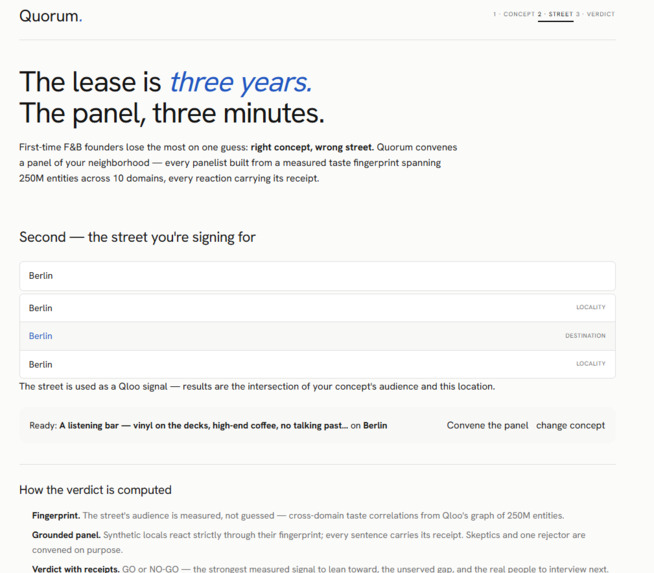
Street selection
-
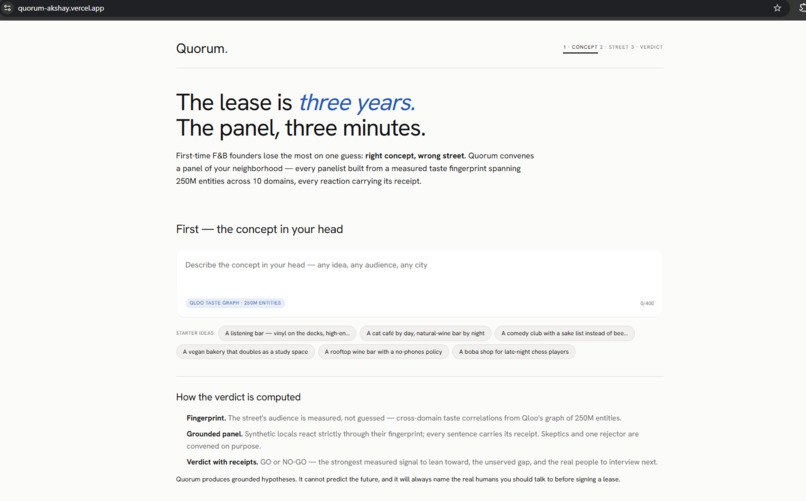
Concept planning, provision of ideas for verification
-
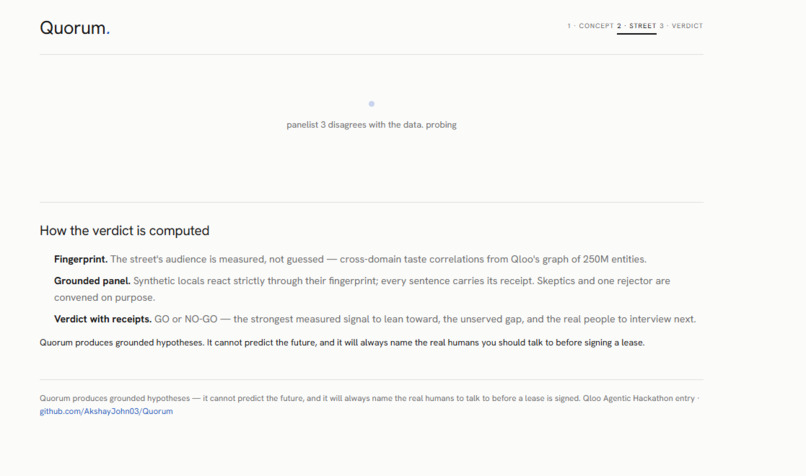
Loading and factorising the data
-
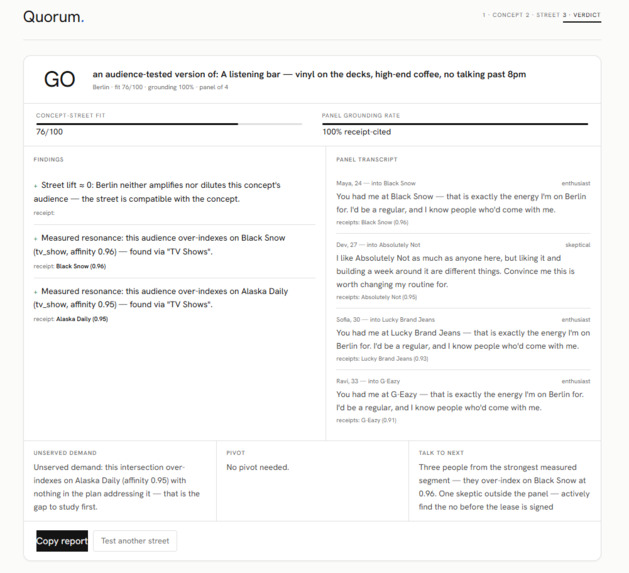
The report on the findings with QLOO API key
Inspiration
First-time brick-and-mortar and food-and-beverage founders often lose their savings on a single blind spot: the right concept on the wrong street. A traditional consumer focus group costs $10,000 to $40,000 and takes weeks to recruit. Meanwhile, asking a standard LLM to roleplay local customers produces sycophantic praise and ungrounded stereotypes.
We built Quorum to answer a high-stakes question in three minutes before a founder signs a three-year lease: how does a specific street's actual cultural taste fingerprint react to this concept?
What it does
Quorum is an agentic focus group in a box grounded in Qloo's 250M-entity cross-domain taste graph.
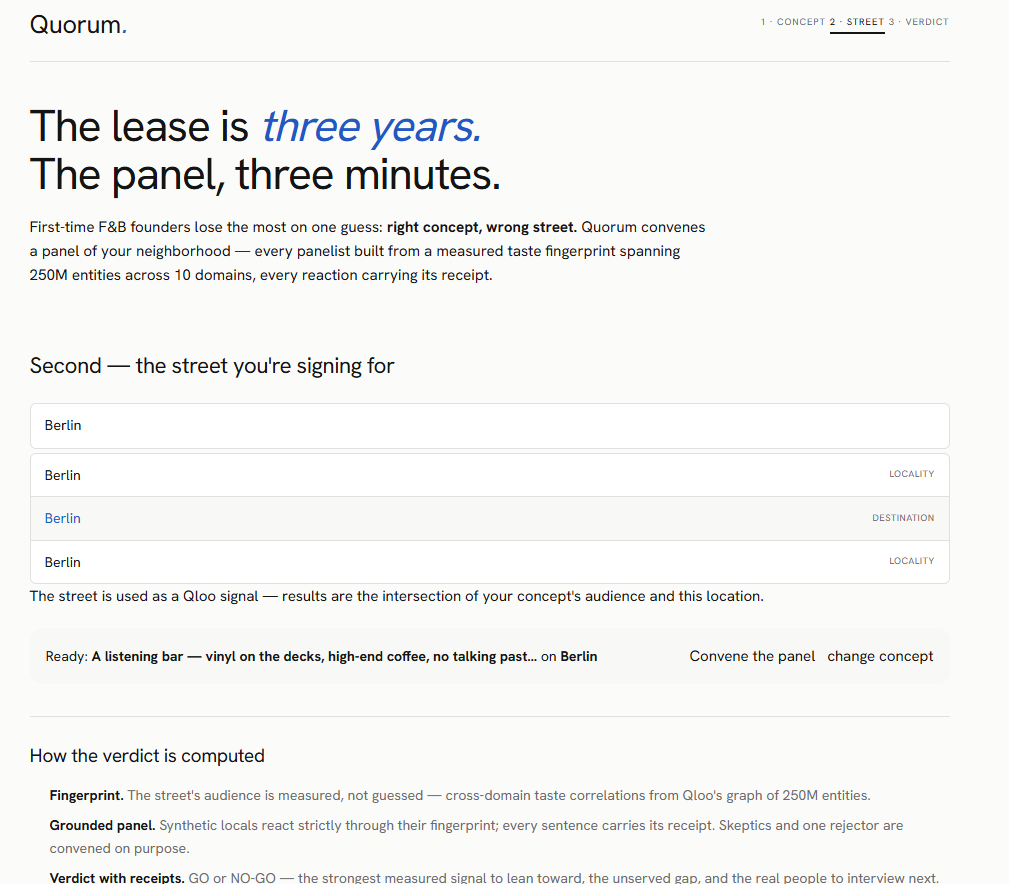
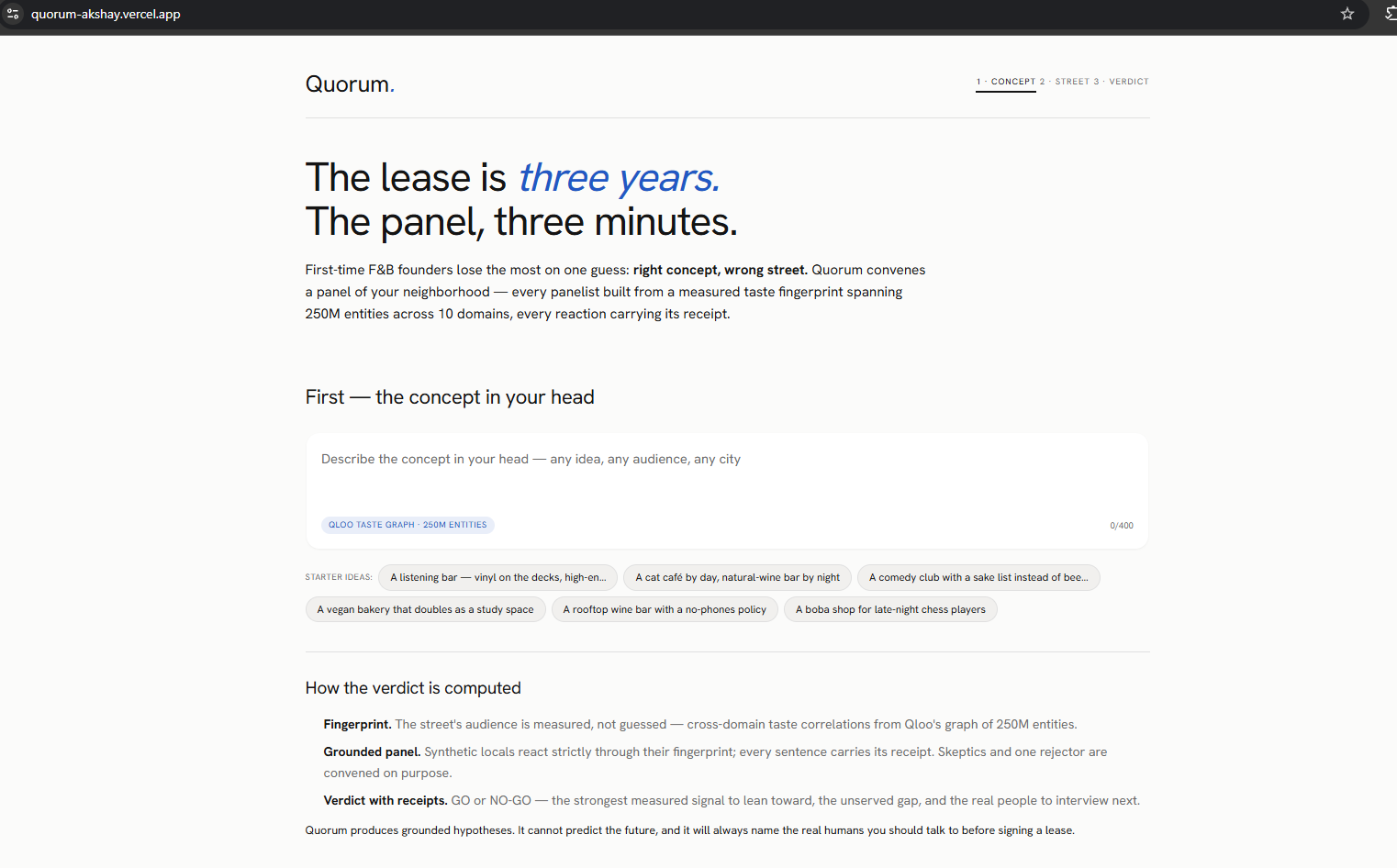
- Concept & Street Disambiguation: You describe a venue or product concept (for example, "a vinyl listening bar with natural wine, no talking past 8pm") and select a target neighborhood or city ("East Austin, Austin").
- 10-Domain Cultural Fingerprinting: Quorum queries Qloo across 10 cultural domains (places, music, film, dining, brands, books, TV, travel, fashion, and people) to construct a measured taste fingerprint of that specific intersection.
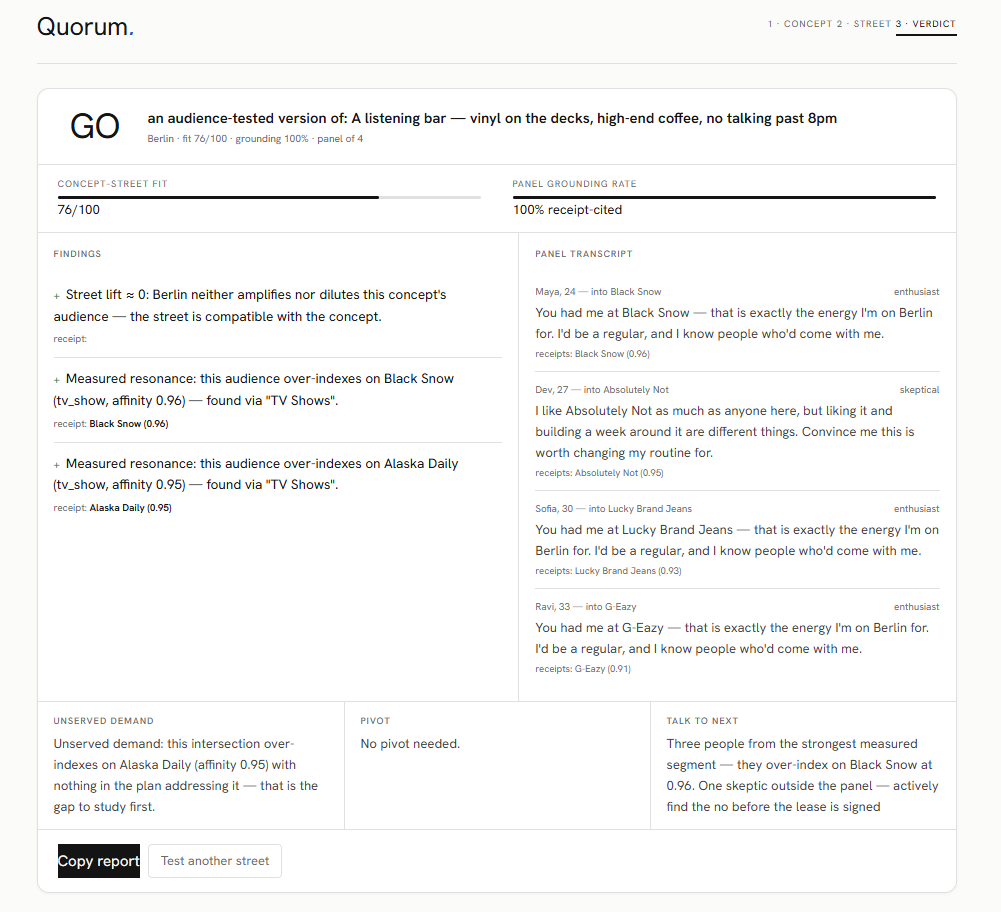
- Receipt-Cited Panel Reactions: Quorum convenes a panel of local archetypes whose stances (enthusiast, skeptical, or rejector) are derived directly from Qloo's returned affinity weights rather than hardcoded prompts. Every panelist statement must cite at least one real Qloo entity URN and affinity score from the fingerprint.
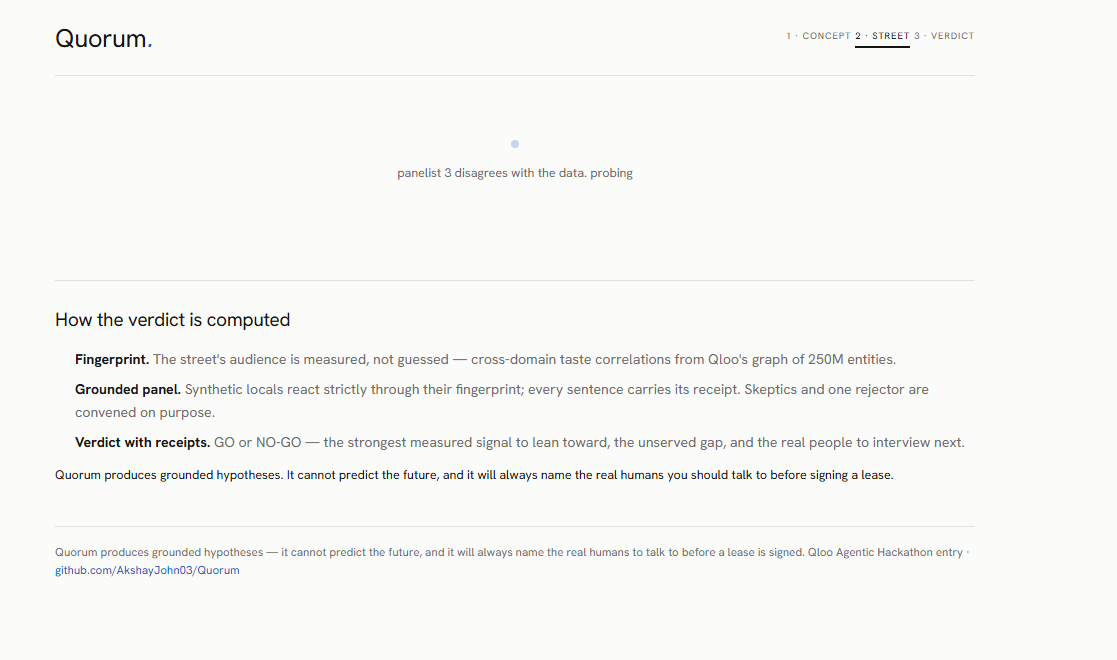
- Adaptive Agentic Probing: When a panelist pushes back or rejects a claim, the agent autonomously fires a follow-up Qloo query using unreferenced high-affinity signals from the neighborhood to uncover what the local audience prefers instead.
- Deterministic Binary Verdict (GO / NO-GO): Instead of letting an LLM guess a vague recommendation, Quorum runs a deterministic Street-Lift math engine that combines Baseline Affinity, Cross-Domain Cultural Contagion, and Skeptic Friction to lock a strict binary GO or NO-GO verdict.
- Grounded vs. Ungrounded Comparison Mode: Users can toggle a side-by-side comparison showing how an ungrounded LLM hallucinates generic feedback versus how Qloo's taste receipts anchor every critique in real local data.
Why it can only exist with Qloo
Quorum is designed around Qloo's load-bearing test. If you remove Qloo from Quorum, there are no cross-domain affinities, no entity URN receipts, no data-driven stance thresholds, and no adaptive alternative probes. Without Qloo's cross-domain graph connecting how a neighborhood's music taste correlates with its dining and retail preferences, a synthetic panel is just an LLM guessing in the dark.
How we built it
- Frontend: Next.js App Router, TypeScript, and Tailwind CSS styled as a warm editorial research desk (#FAF8F5) using Instrument Serif, DM Sans, and JetBrains Mono for high-density data readability.
- Qloo Taste Engine (
lib/qloo.ts): Server-side HTTP client targetinghackathon.api.qloo.com(/v2/searchand/v2/insightsacross all 10 Qloo entity domains) with a customscoreAndDisambiguateTagsranker to prevent homonym collisions, bounded batch concurrency (batches of 4), and exponential backoff with jitter. - Deterministic Street-Lift Engine (
lib/decision.ts): CalculatesStreetLiftScore = (BaselineAffinity * 0.60) + (CulturalContagion * 0.30) - (SkepticFriction * 0.15)in code prior to final synthesis, enforcing a hard binary gate at 65. - Zero-PII Gate & Caching (
lib/sanitizer.ts,lib/cache.ts): Pre-flight regex and entity sanitization strips emails, phone numbers, social handles, and personal names before any query reaches Qloo, backed by an in-memory server-side LRU cache for instant repeat evaluations.
Challenges we ran into
- Defeating Homonym Traps in Tag Search: Searching broad cultural terms like "Jazz" returns entities across sports teams, music genres, and brands. We built a domain-hint disambiguation ranker (
scoreAndDisambiguateTags) so the agent locks onto the right cultural entity URN before seeding the 10-domain scan. - Preventing Sycophantic LLM Drift: LLMs naturally try to be polite and hedge with "maybe" or "pivot" advice. We removed the middle option entirely, derived panelist stances mathematically from Qloo affinity thresholds (
>= 0.65for enthusiast,0.45 to 0.64for skeptical,< 0.45for rejector), and weighted outright rejections at1.0versus mild skepticism at0.35in our friction penalty. - Rate-Limit Resilience Across 10 Domains: Scanning 10 Qloo insight domains in parallel can trigger burst rate limits during heavy traffic. We implemented batched concurrency (
runInBatchesof 4) paired with jittered retry backoff and server-side LRU caching.
Accomplishments that we're proud of
- Achieving a high grounding rate where every synthetic panelist claim is auditable against a live Qloo entity URN and affinity score.
- Crafting a human-centered, print-inspired editorial interface that treats AI research like a rigorous financial and cultural decision instrument rather than a chat toy.
- Maintaining 100% server-side API isolation and automated Zero-PII scrubbing.
What we learned
Cross-domain cultural correlations are far more predictive of local product fit than single-category demographics. Seeing how Qloo connects a neighborhood's affinity for specific indie record labels with its appetite for natural wine bars or specialty retail proved that taste is a connected graph, not a set of isolated survey checkboxes.
What's next for Quorum
- Multi-Street Lease Comparison: Running parallel Quorum panels across three candidate neighborhoods simultaneously to rank lease options by Street-Lift score.
- Exportable Investment Memos: Generating W3C design-token-governed slide decks and PDF briefs so founders can attach verifiable Qloo demand receipts directly to landlord and investor pitches.
Built With
- agentic
- ai
- llms
- python
- qloo-api
