-
-
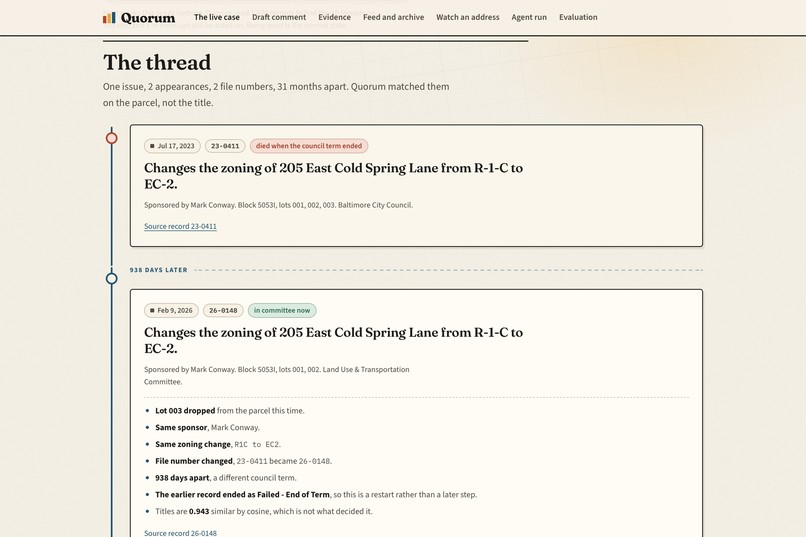
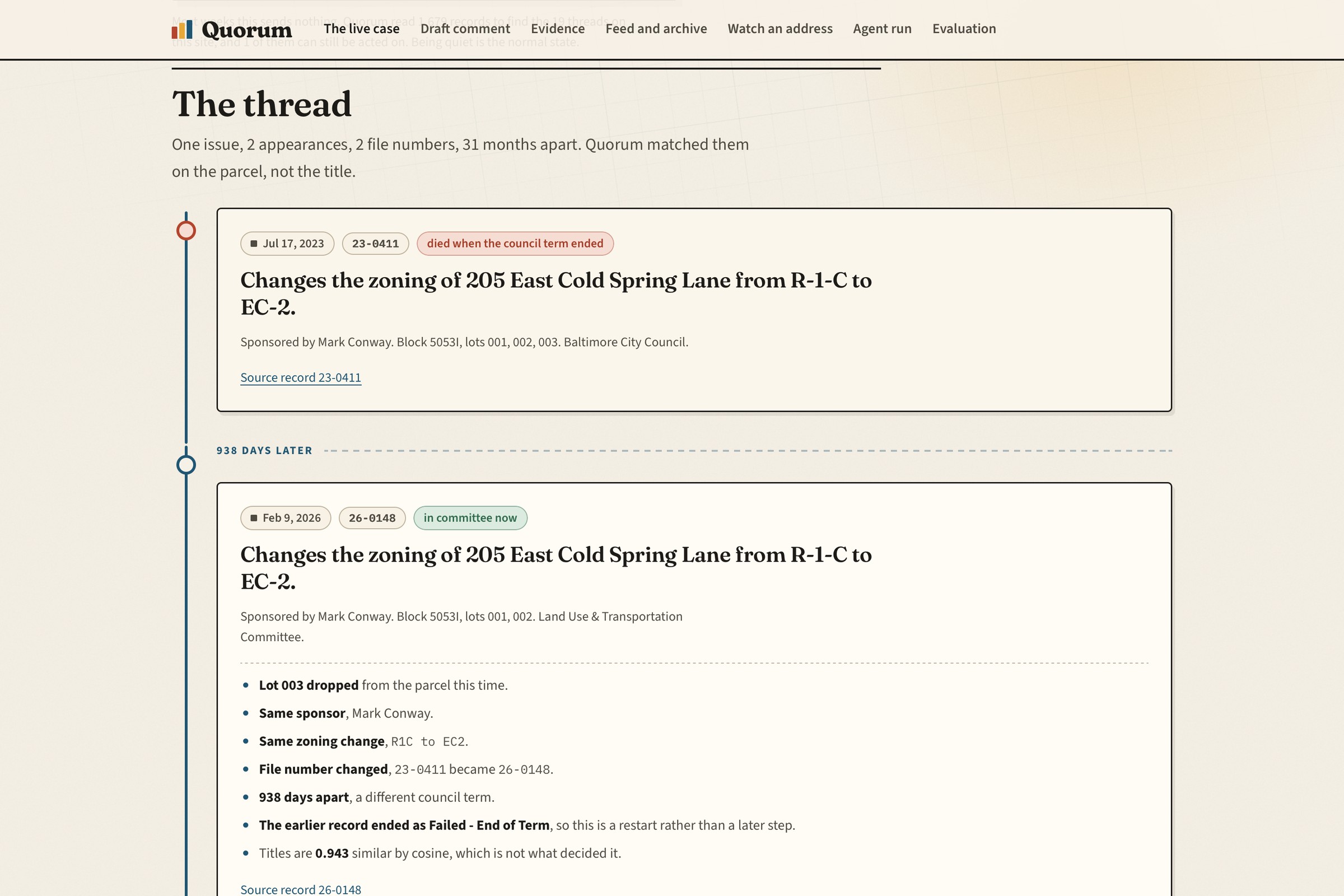
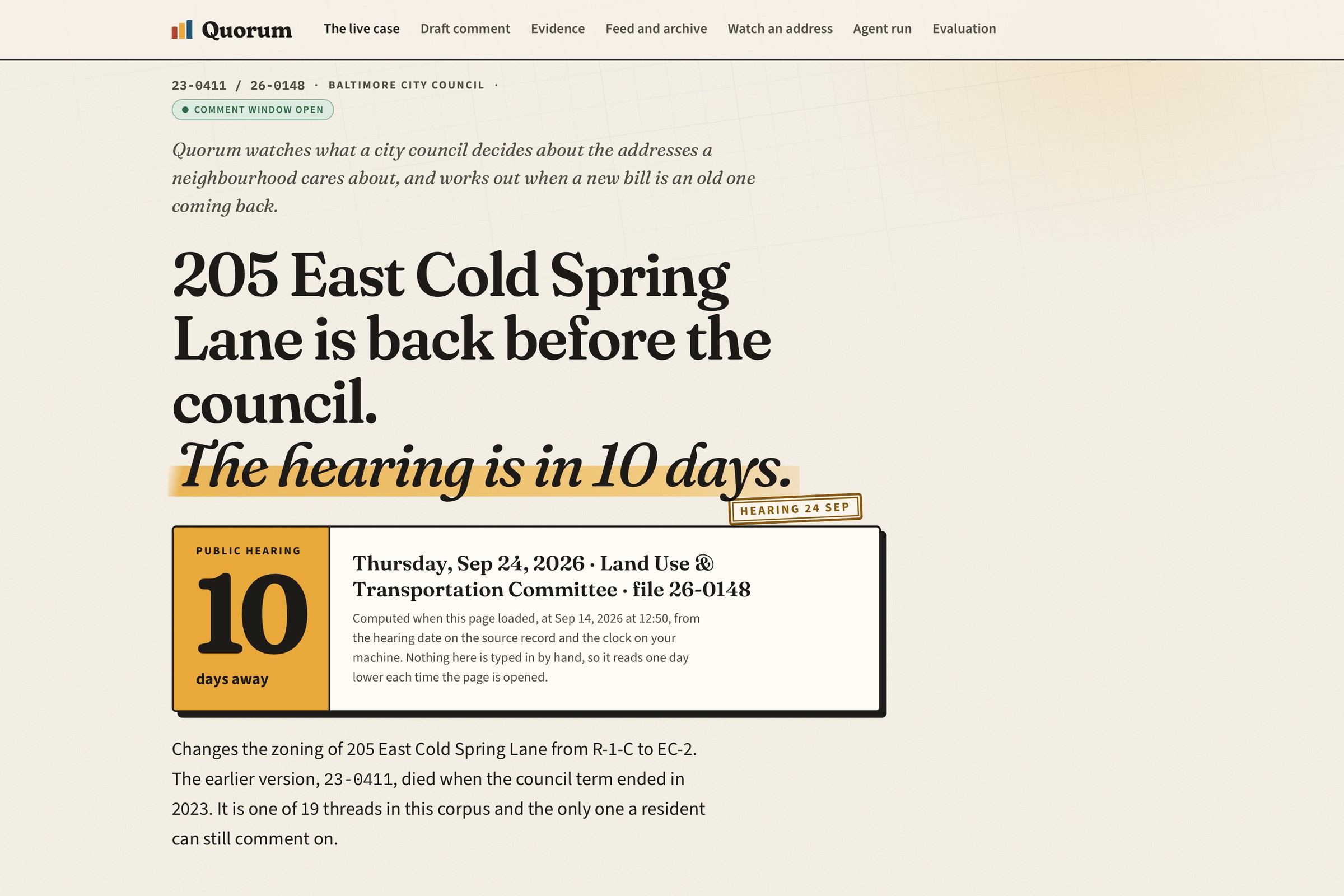
Bill 23-0411 died in 2023. Bill 26-0148 came back in 2026 with a new number and title. Same parcel, same sponsor, one lot dropped.
-
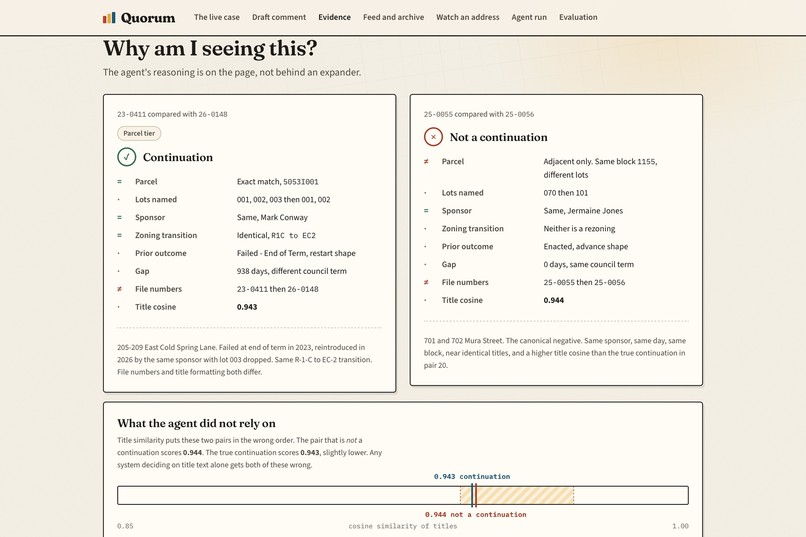
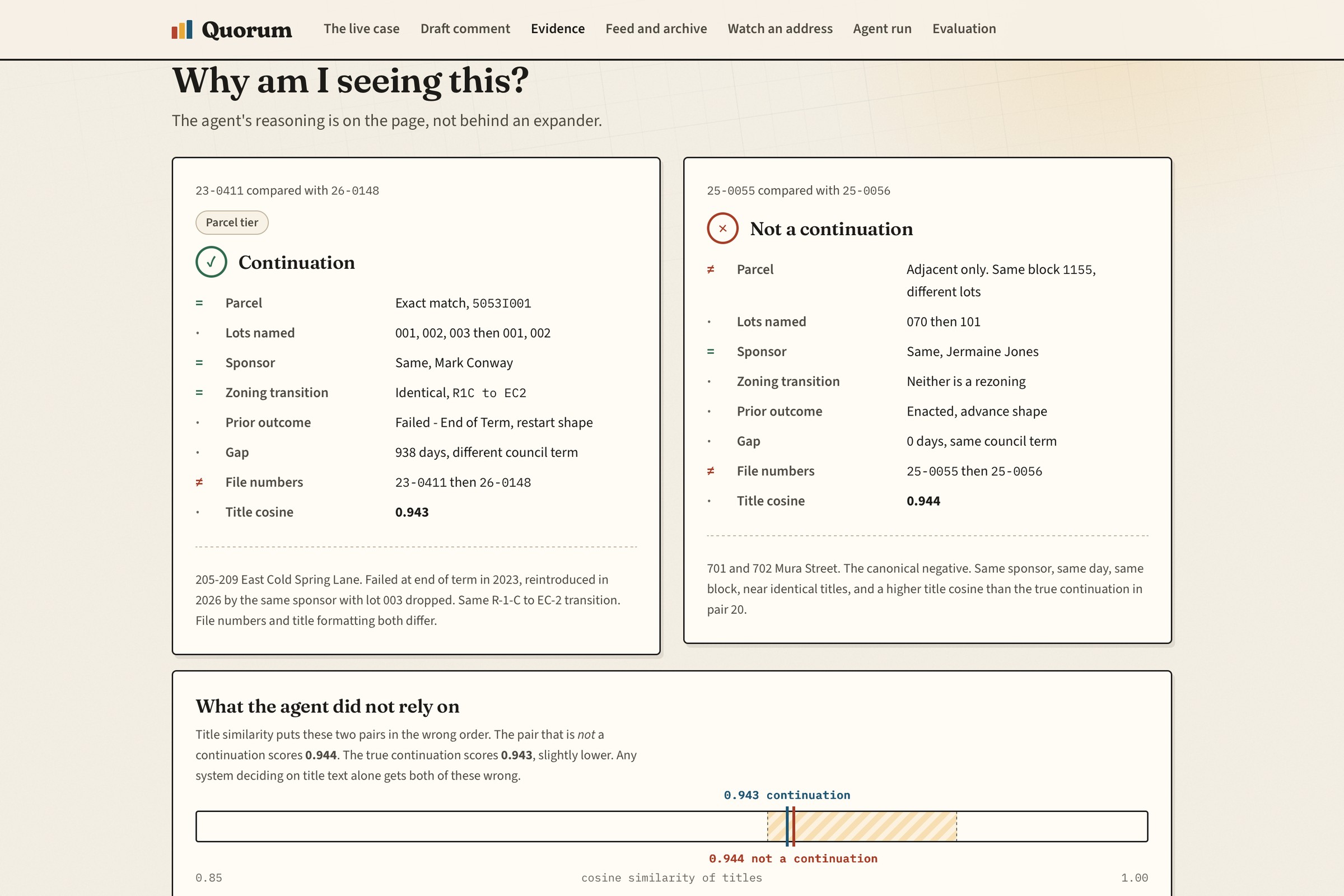
Why am I seeing this? Every decision shows what drove it and what the agent set aside, next to a lookalike pair it correctly rejected.
-
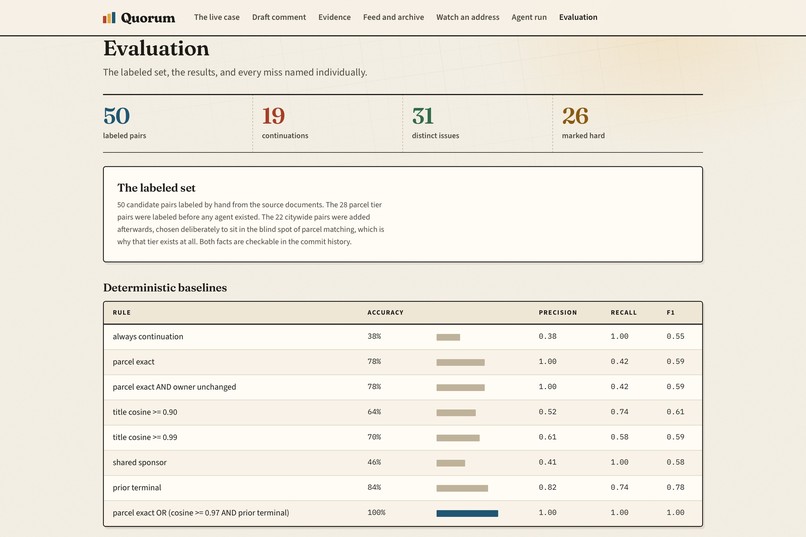
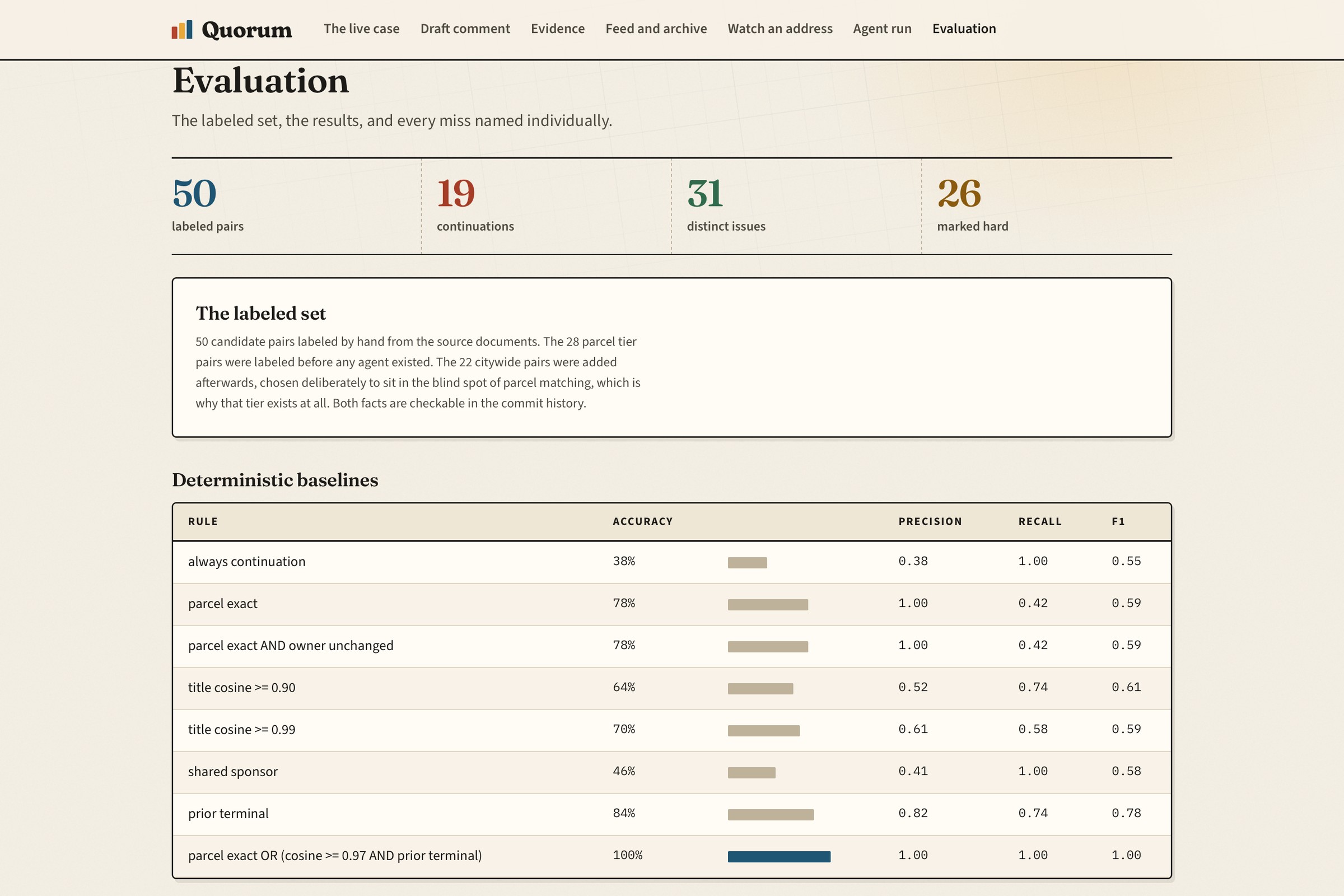
50 hand labeled pairs. A tuned two line rule ties the agent at 50/50, and we publish that, plus exactly where the rule breaks.
-
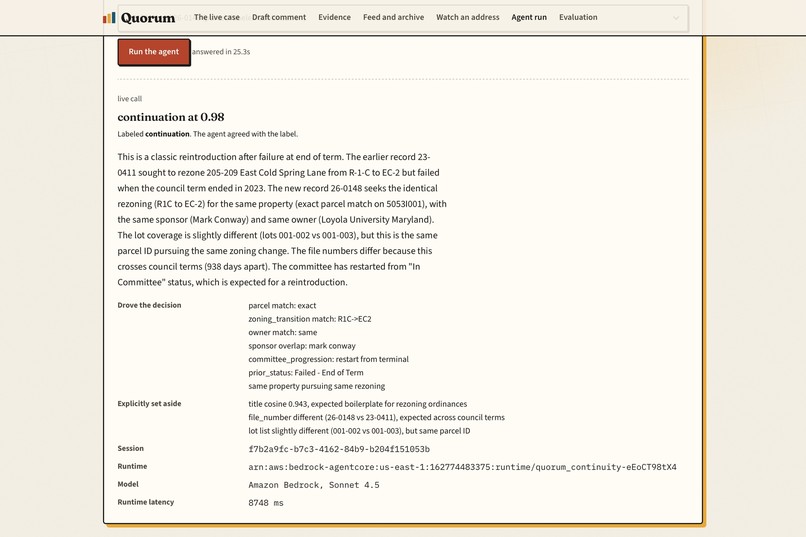
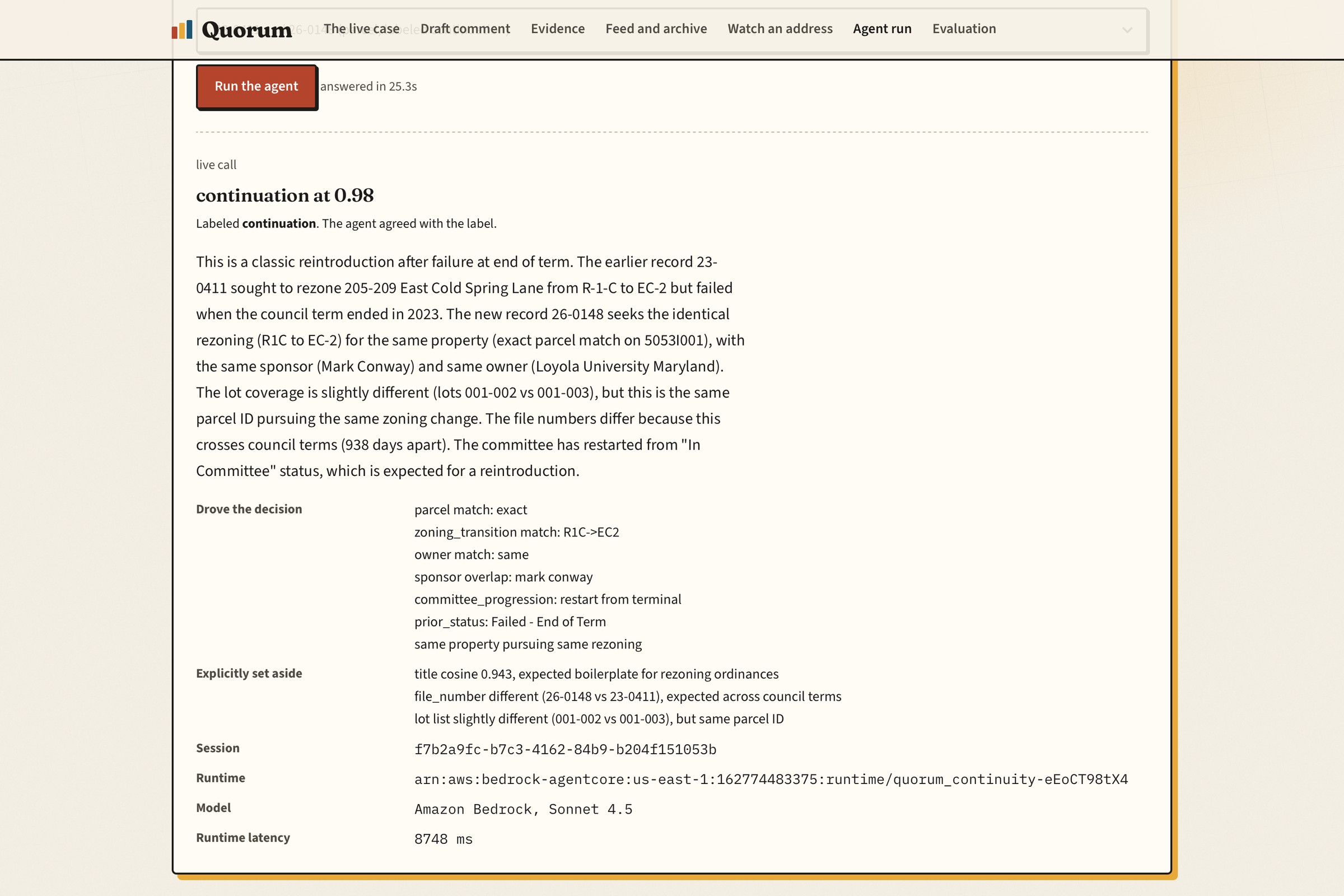
A real call to the agent on Bedrock AgentCore. It returns continuation at 0.98 with a fresh session id, so it is not a replay.
-
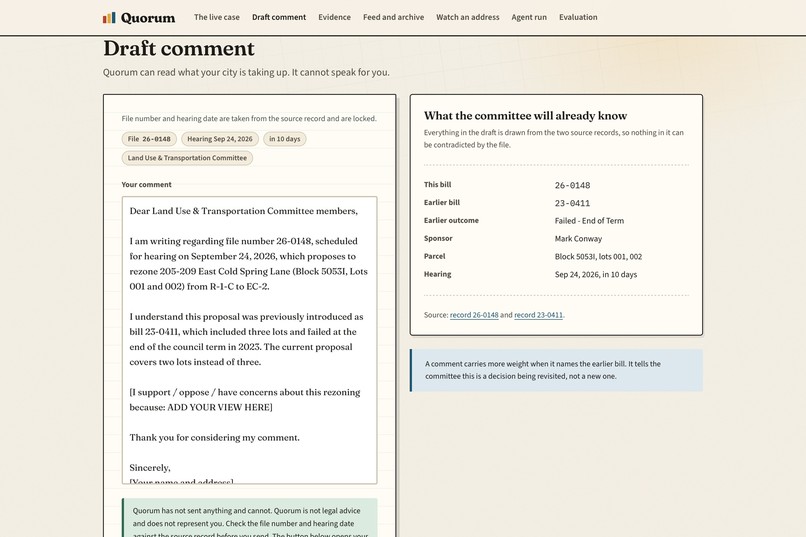
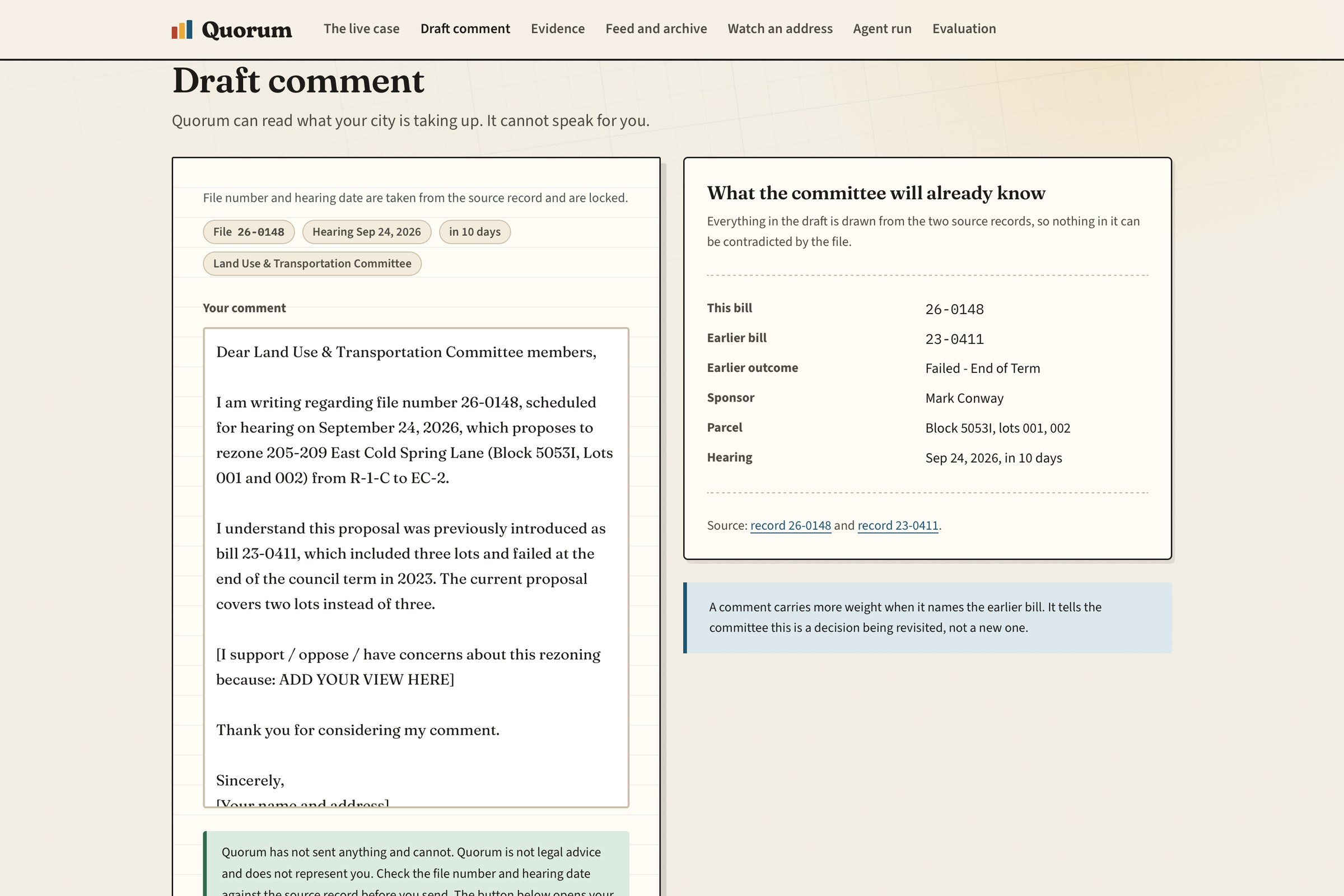
A draft comment with the file number and hearing date pulled from the record. Quorum never sends it. You do, from your own email.
-
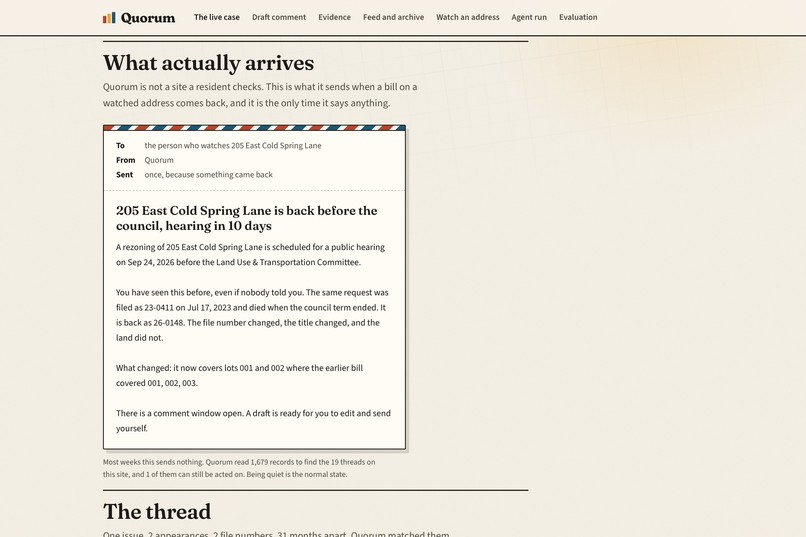
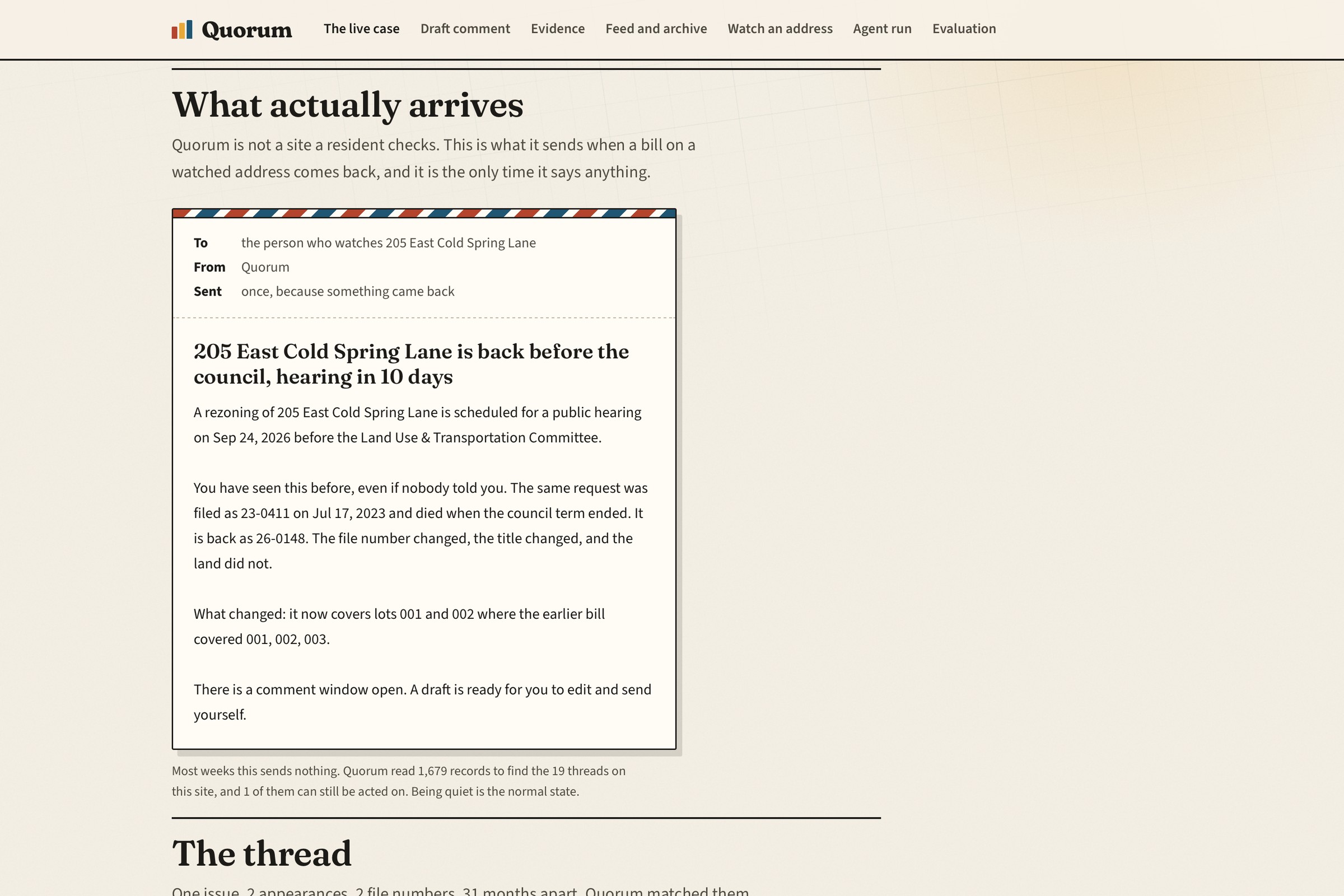
Quorum is not a site you check. This notice is what arrives when a bill on your street comes back, and the only time it speaks.
-
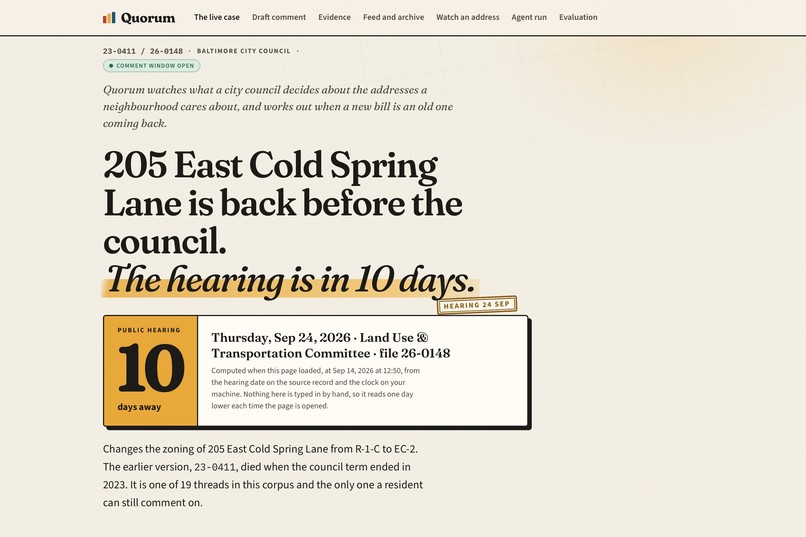
205 East Cold Spring Lane is back before Baltimore's council. The public hearing is September 24, 2026, inside the judging window.
-
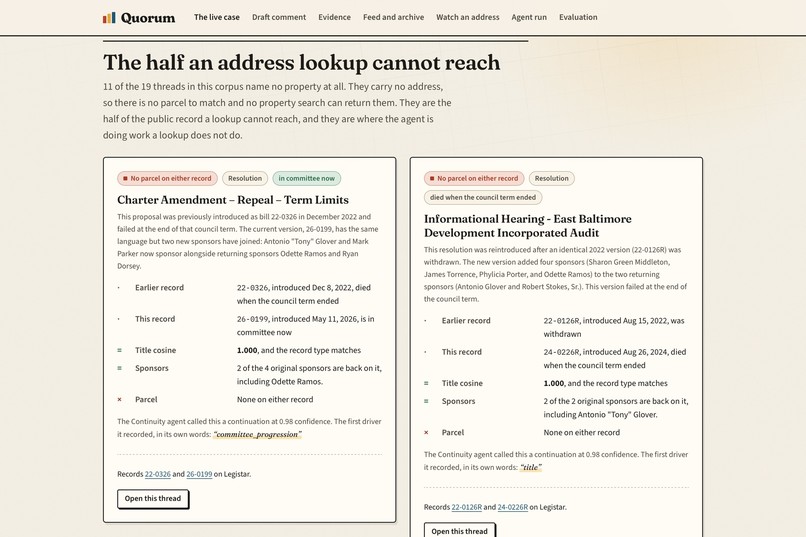
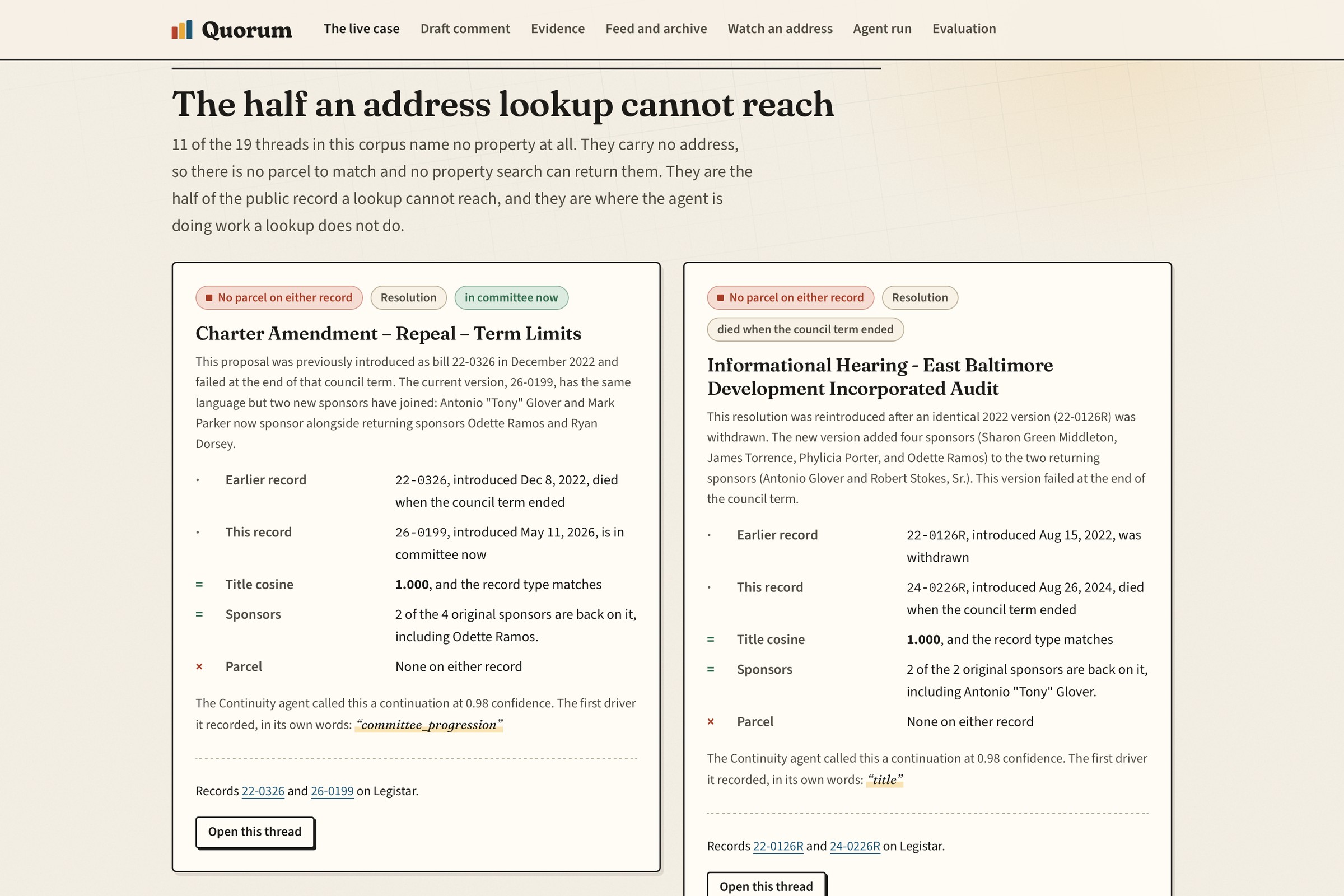
The half an address lookup cannot reach: 11 of 19 threads name no property at all, so matching by parcel finds none of them.
-
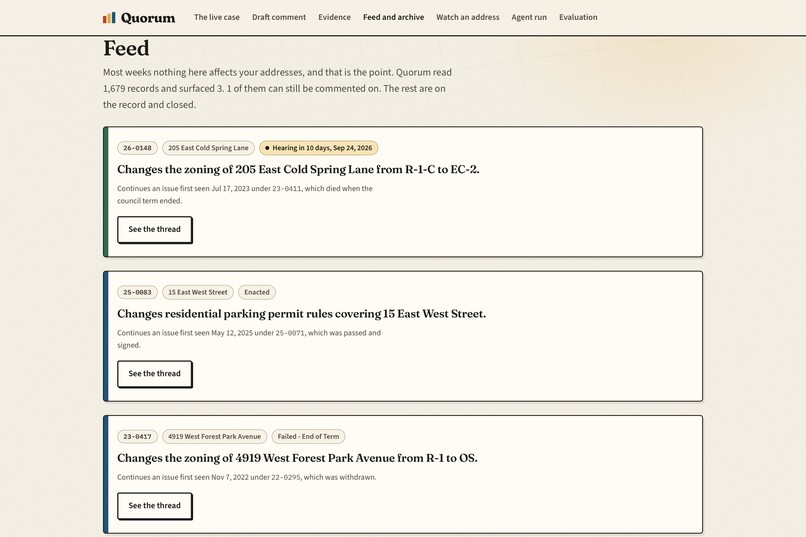
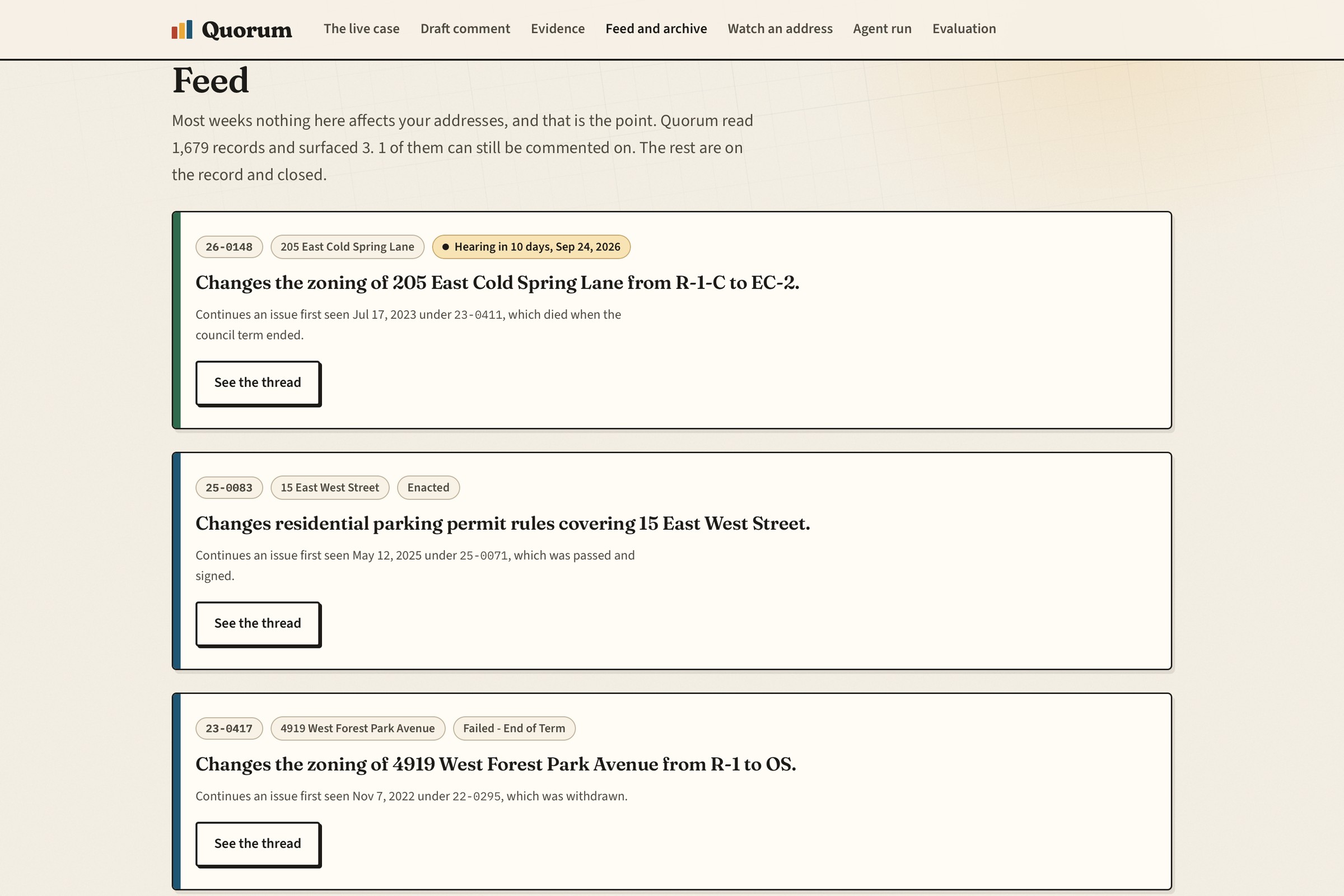
Most weeks nothing touches your address, and that is the point. Of 1,679 records, 3 surfaced and only 1 is still open for comment.
-
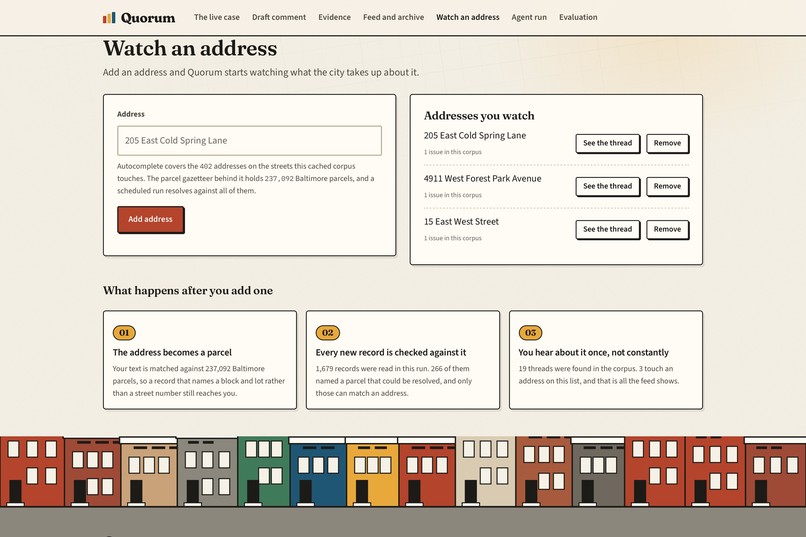
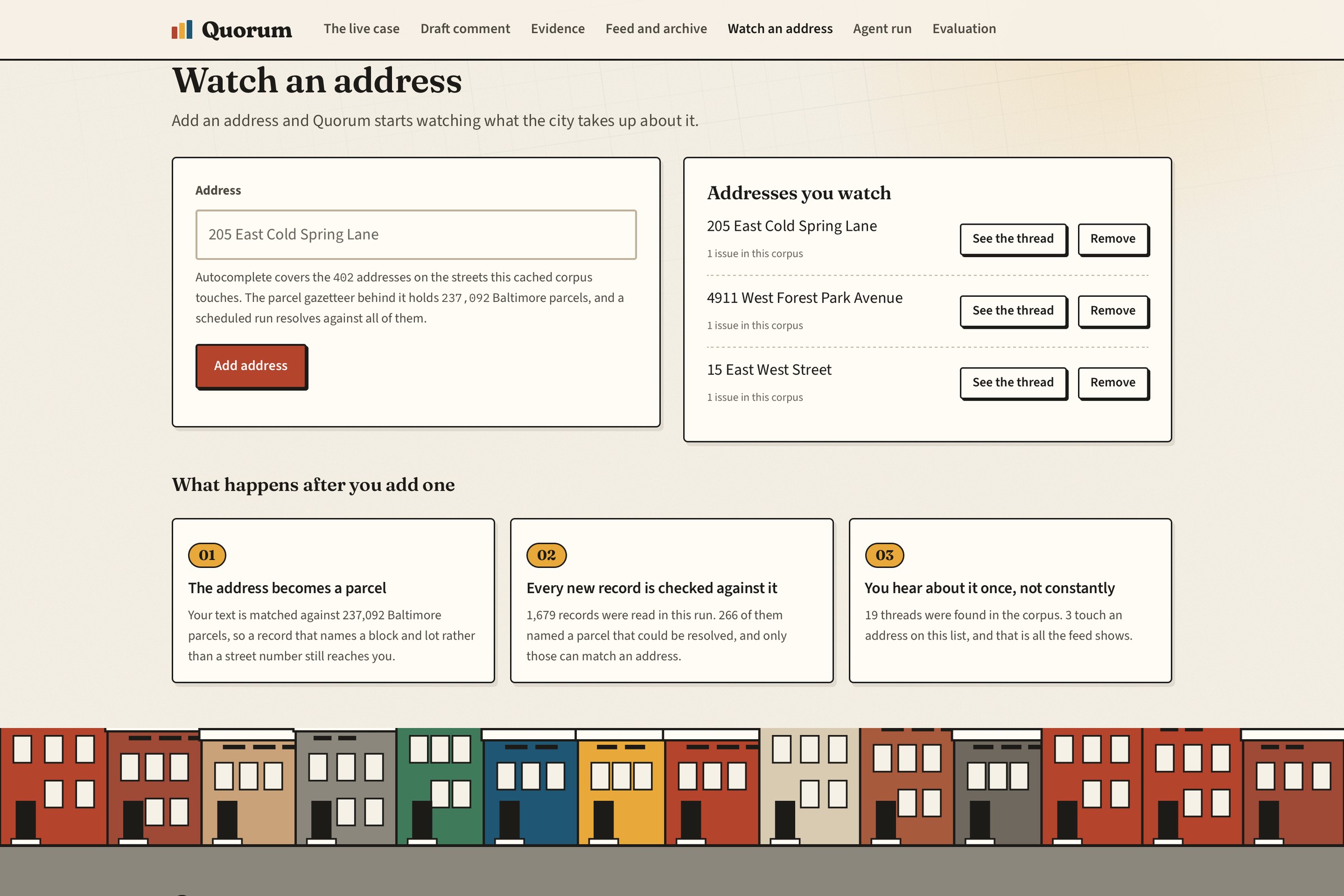
Add an address and Quorum matches it to one of 237,092 Baltimore parcels, then checks every new council record against it.
Demo video: https://www.youtube.com/watch?v=d4mJJAkWwK8
Build posts on builder.aws: One node with no model call · The evaluation that ties · Three AgentCore deploy bugs
Inspiration
I work with Baltimore communities through the digital navigator program, and I have watched people find out too late. Not because the information was hidden. Baltimore publishes everything. It is on Legistar, it has a file number, it is searchable.
They found out too late because the thing that affected them did not arrive in one piece. It arrived as a bill in 2023 that died quietly, and then again in 2026 under a different number, with a different title, about the same land. Nobody in the neighborhood connected the two, because connecting them requires somebody to be watching for two and a half years.
That is the whole idea. Cities do not decide things in one sitting. They decide slowly, across many meetings, under changing labels. Residents do not lose because they are apathetic. They lose because no one can hold the thread that long.
I wanted to find out whether an agent could hold it.
What it does
Quorum reads Baltimore City Council's published legislative record, resolves each item to a parcel, and decides whether a new record continues an issue it has already seen or starts a new one. When something on a watched address comes back, it explains what changed since last time and drafts a public comment carrying the correct file number and hearing date.
Then it stops. Quorum never submits anything on anyone's behalf. The button opens your own email client, and the interface says so.
The case it is built around is real and you can check it while you judge this. Bill 23-0411 proposed rezoning 205-209 East Cold Spring Lane in Baltimore in July 2023, and it failed at the end of the council term without a vote. In February 2026 the same sponsor filed it again as 26-0148, covering two lots where the first covered three. The public hearing is 24 September 2026. That date is after this deadline and inside the judging window. Open Legistar and look.
The file numbers share nothing. The titles differ in formatting. What links them is the parcel.
How we built it
Four Strands agents and one deterministic node, assembled as a Strands Graph and deployed to Amazon Bedrock AgentCore Runtime with OpenTelemetry tracing.
The node that is not an agent is the interesting one. Resolution turns the text of a record into a parcel identifier, and it makes no model call at all. Address normalization is a solved problem, and a hallucinated parcel identifier is the single error in this system a user could never detect. So it is code, inside the Graph, on the same orchestration surface as the agents.
The Continuity Agent is the one that matters. It does not get asked "are these the same?" It gets a comparison table computed deterministically in code, parcel match, sponsor overlap, zoning transition, committee progression, title similarity, and it has to say which of those drove its decision and which it explicitly set aside. That last part is the product. A similarity score cannot be interrogated. A decision that says "I used the parcel and the terminal status, and I ignored the title similarity of 0.943 because rezoning titles are boilerplate" can be checked line by line.
Everything runs on a cached, timestamped corpus: 1,679 council records and 237,092 parcels from the city's own open property layer. No demo fetches civic data live; the only live call is the agent itself on AgentCore.
Challenges we ran into
The evaluation nearly killed the project, and publishing that is the best thing in it.
I hand labeled 50 pairs and the agent got 50 of 50. Then I wrote the baselines, and a tuned two clause rule, parcel exact OR (cosine >= 0.97 AND prior terminal), also got 50 of 50. My own evidence said the agent was unnecessary.
So I went at it properly. A held out split with the threshold frozen on a tune half before touching the test half: it separates nothing, McNemar p = 1.0, and I report that as a null result rather than burying it. An ablation that strips every domain hint out of the prompt: 47 of 50, against 84% for the best single deterministic feature, so the model is reasoning from the evidence table rather than reciting the prompt. And a per tier breakdown, which is where the real answer was hiding: on the parcel tier a lookup is perfect, and on the citywide tier that same lookup finds 0 of 11 true continuations, because those records name no property at all. 58% of every real continuation in the set has no parcel.
The honest division of labor is a lookup where a lookup is exact, and a model where the alternative is a threshold I already showed is brittle.
The agent hallucinated a fact in the one paragraph that matters most. The drafted comment told a resident that EC-2 is "a commercial district that allows shops and apartments." It is not. EC-2 is Baltimore's Educational Campus district, and my own parcel table proves it: all 274 EC-2 parcels in the city belong to the State of Maryland, Loyola or Johns Hopkins. The real story is a university expanding its campus. That false sentence sat directly under a line claiming nothing in the draft could be contradicted by the file. I fixed it at the root by computing zoning facts from the parcel data and forbidding the agent from characterizing a district code it was not given facts for.
Three bugs existed only in deployment. Cold start exceeded AgentCore's 30 second limit because the module imported everything at load time. Path resolution assumed a repository layout that direct code deploy flattens. And direct code deploy packages only the entrypoint's own directory, so the corpus was never in the image. The fix made the design better: the runtime now ships a 347 KB bundle of exactly the 50 labeled pairs instead of a corpus it can never use.
The rate limiter on the public endpoint could not work. AgentCore isolates every invocation to its own container, so an in process counter never coordinates with anything. Measured worst case was roughly 760 dollars a day against an intended five. The real limits had to live outside the process: throttling at the API Gateway edge, and a shared daily counter in S3 written conditionally so two containers cannot claim the same slot.
Accomplishments that we're proud of
A judge can press a button on the site and run the agent themselves, on any of the 50 labeled pairs including ones I never discuss, against the deployed AgentCore runtime. The AgentCore session id is different on every call, which is how you know it is not a recording.
eval/RESULTS.md regenerates byte identically from a clean clone with no AWS credentials. Every number on it is produced by running code. When I found a hardcoded number sitting under a header promising otherwise, I replaced it with a function.
And I am proud of what the system refuses to do. It refuses to draft a comment on 18 of 19 threads, because their comment windows have closed and writing to a committee about a finished bill wastes the little standing a resident has. It refuses to name private individuals as property owners even though the public record does. It refuses to send.
What we learned
That the most valuable output of an evaluation is the result that embarrasses you.
My exhaustive search claimed the parcel population was complete. It was not, and the pair it missed was a genuine false positive: a skybridge franchise and an alley closing three miles apart matched because the parser read the phrase "a 10 foot alley" as a street called 10 Foot Alley. A search that finds something is worth more than one that finds nothing, so it is written up rather than quietly fixed.
I also learned where an agent belongs. The deterministic features do most of the work here. The model generalizes from them better than any single feature does, and the domain knowledge in the prompt buys exactly three cases: a liquor license matched to its own zoning approval, a charter amendment returning after a failed term, and one street condemnation split into two ordinances. That is a hybrid, and saying so is more useful than claiming the agent is doing magic.
What's next for Quorum
Neighborhood level watching. The parcel layer already carries a NEIGHBOR field, and a resident does not fear a rezoning of their own parcel so much as the one across the street.
Closing the loop. Quorum notices and drafts, but it never learns what happened at the hearing. Reading the minutes and the vote record afterwards would turn it from a monitor into something that finishes what it starts.
And more cities, carefully. Legistar serves hundreds of American municipalities on the same API, and the citywide tier, which is 11 of my 19 threads, needs no parcel gazetteer at all. The adapter generalizes. The claim will not be made until it is tested.
For now the honest scope is one city, deep, and a hearing on 24 September that somebody on that block now knows about.
Built With
- amazon-api-gateway
- amazon-bedrock
- amazon-web-services
- aws-lambda
- bedrock-agentcore
- claude-sonnet-4.5
- esri
- github
- javascript
- legistar-api
- opentelemetry
- python
- strands-agents
- three.js
- vercel

Log in or sign up for Devpost to join the conversation.