-
-

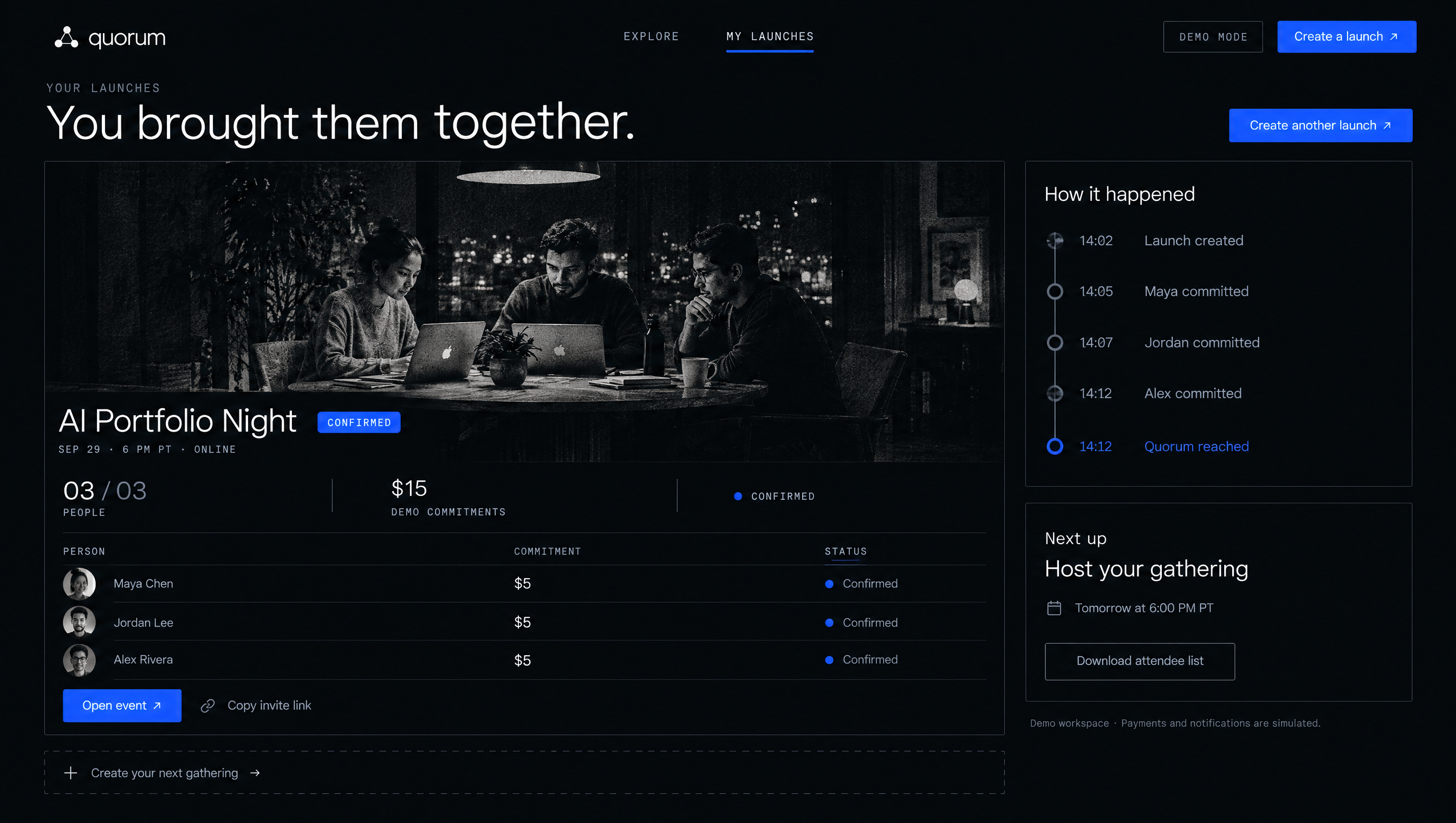
The final person commits, the gathering reaches quorum, and everyone knows it is officially happening.
-
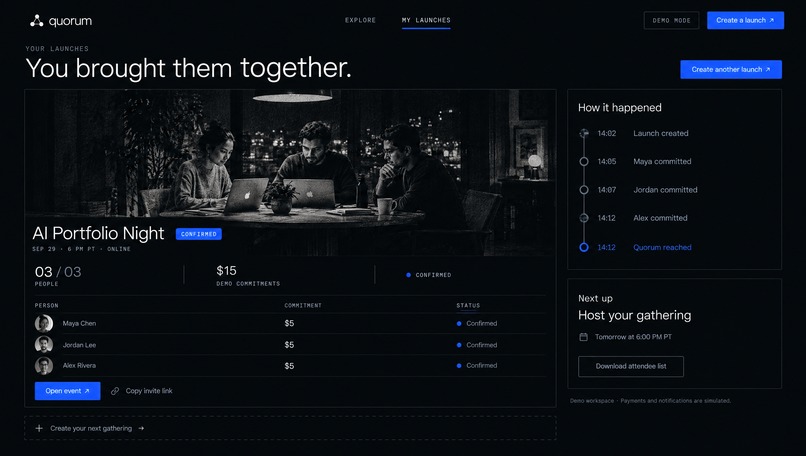
Track every commitment, participant, and milestone from one clear organizer dashboard.
-
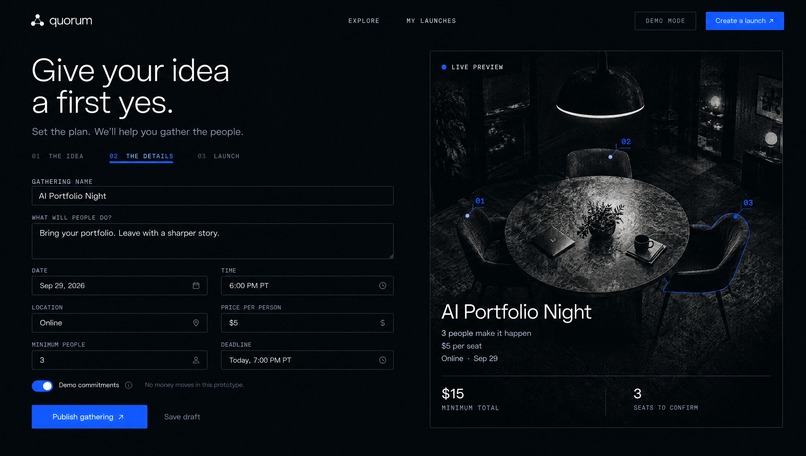
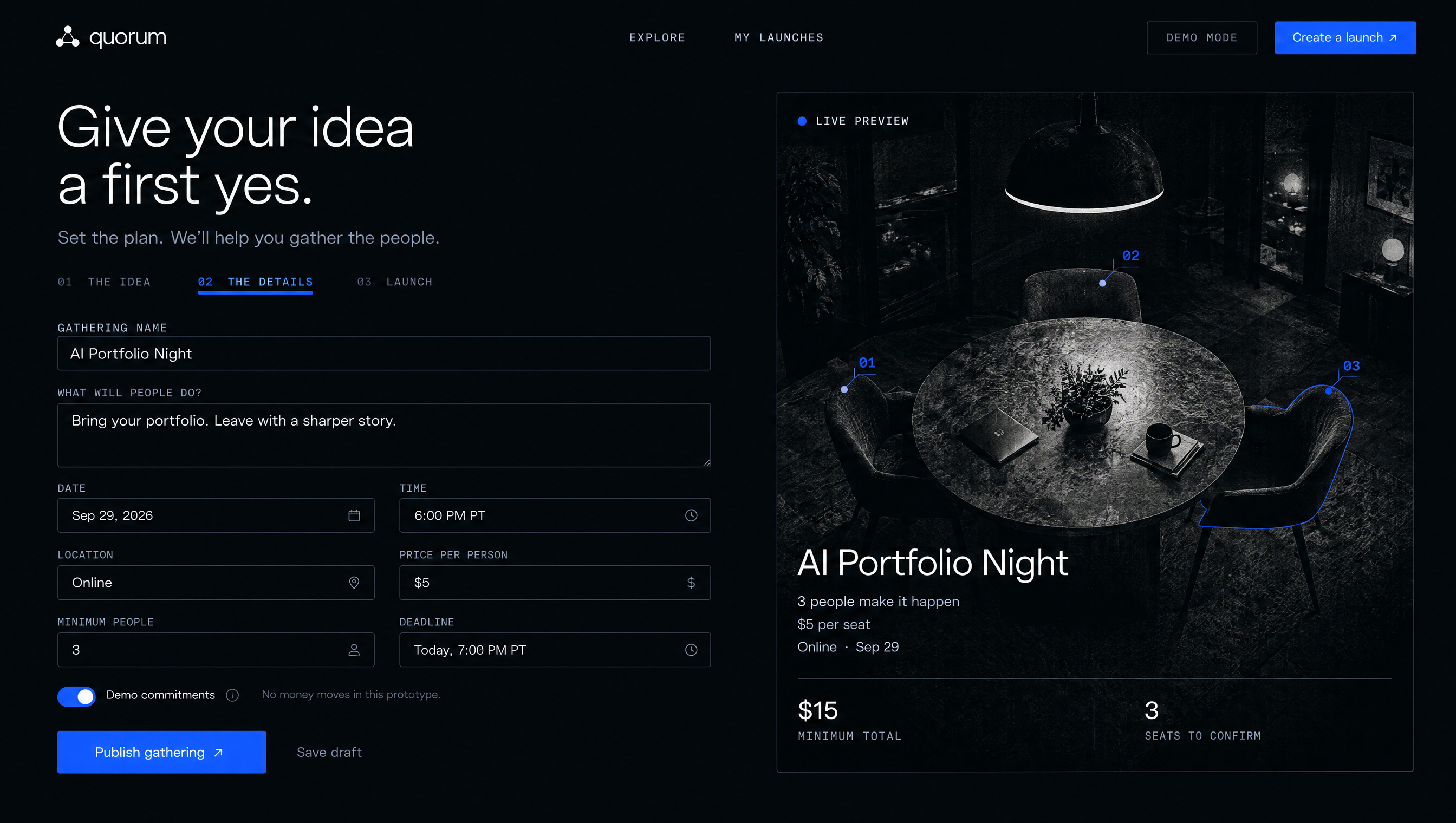
Turn an idea into a shareable gathering by setting the details, minimum group size, price, and deadline.
-

See the price, deadline, and people already committed, then take the seat that makes the plan real.
-
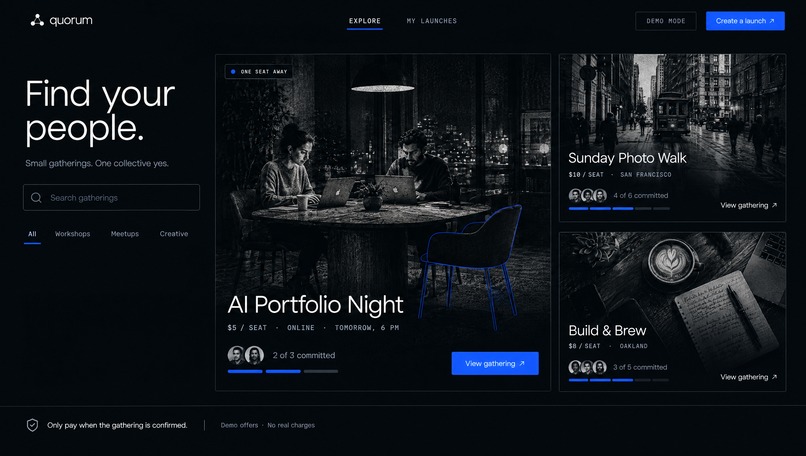
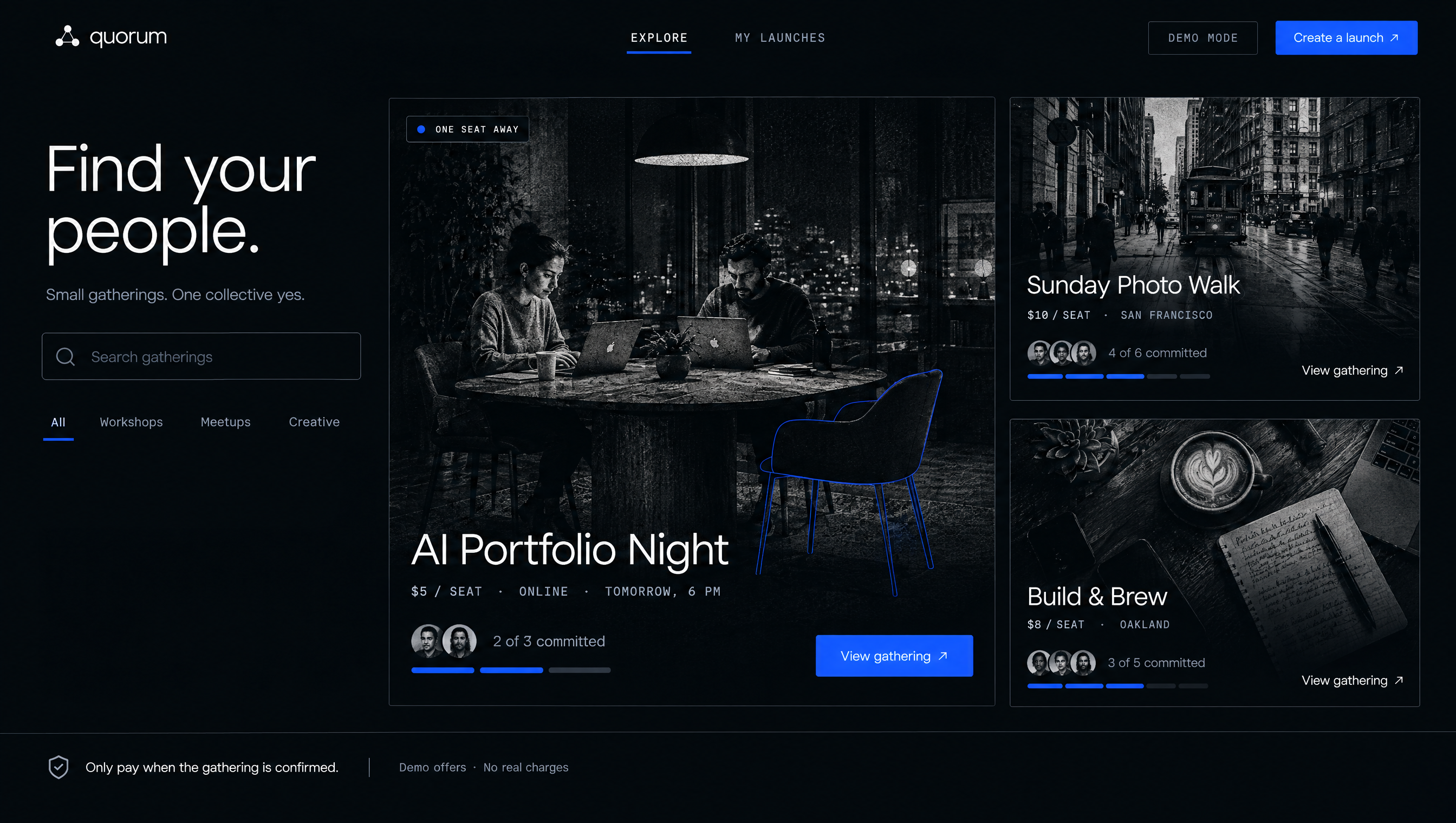
Discover gatherings worth making happen and see exactly how many more people each one needs.


Inspiration
Quorum started with a problem I kept seeing in my own friend groups. Someone would suggest a trip, dinner, workshop, or weekend plan, and everyone would reply, “I’m down.” Then nobody booked anything. As the date got closer, people cancelled, the organizer absorbed the risk, and the plan quietly disappeared.
I realized the problem was not a lack of interest. It was the gap between saying you are interested and actually committing. I wanted a simple way for a group to say, “This happens if at least five of us are truly in.”
What it does
Quorum helps people launch group plans with a clear minimum number of participants.
An organizer creates a gathering, sets the price, minimum group size, and commitment deadline, then shares one link. Participants can see exactly how many people are needed and commit to joining. If the group reaches its minimum before the deadline, the gathering is confirmed. If it does not, the plan simply does not go ahead.
For example, someone can offer a $20 photography walk that requires six people. Nobody has to wonder whether it will happen, and the organizer does not have to take the financial risk alone.
Our demo follows an “AI Portfolio Night” that needs three participants. Two people have already joined. When the third person commits, the counter reaches 3/3, the gathering is confirmed, and both the participant and organizer views update.
How we built it
We built Quorum as a responsive web application using React, TypeScript, and Tailwind CSS. The interface follows the entire journey from discovering a gathering to committing, reaching the minimum, and viewing the confirmed event.
The central state model tracks each gathering, its deadline, price, required group size, participants, and status. The commitment flow validates each submission, prevents duplicate commitments, updates the participant count, and confirms the event when the threshold is reached.
We used a dark, editorial visual system built around one recurring image: an empty chair outlined in blue. As commitments arrive, that empty seat becomes occupied. It gives the user an immediate visual explanation of what Quorum is waiting for.
For this MVP, payments and notifications are clearly simulated. The product demonstrates the commitment logic and confirmation experience without claiming that real money has moved.
Challenges we ran into
The hardest challenge was explaining the idea without making it feel like another event platform or waitlist.
A waitlist only records interest. Quorum represents a conditional commitment to a specific plan. We had to make the minimum group size, deadline, price, and outcome visible without overwhelming the user.
We also had to make the confirmation transition reliable. The participant count, total committed amount, progress indicator, event status, and organizer dashboard all need to change together. If one part updates early, the experience becomes confusing.
Finally, we had very limited time. We focused on one complete story that we could demonstrate clearly instead of building several shallow features.
Accomplishments that we're proud of
We are proud that someone can understand Quorum by watching the demo for less than a minute.
The organizer creates a gathering. Two people commit. A third person joins from another device. The event reaches quorum, the interface changes to “It’s happening,” and the organizer can see exactly how the gathering came together.
We are also proud of the empty-seat metaphor. It turns an abstract threshold into something human and easy to understand. You are not watching a percentage increase. You are seeing the one person who can make the plan real.
What we learned
We learned that vague interest creates very little useful information. A plan becomes actionable only when people know the exact offer, price, deadline, and condition for moving forward.
We also learned that conditional payments can do more than process transactions. They can help a group coordinate. The payment is evidence that someone intends to show up, while the threshold protects both the organizer and the participants from committing to a plan that cannot happen.
Most importantly, we learned that the product has to make both outcomes feel safe. Reaching the minimum should feel exciting. Missing it should feel clear and fair.
What's next for Quorum - Group plans that happen when enough people commit
The next step is to connect real payment authorization and capture. A participant’s payment method would be authorized when they commit, then charged only if the gathering reaches its minimum. If the deadline passes first, the authorization would be released.
We also want to add automatic calendar invitations, participant updates, organizer verification, cancellation rules, and integrations with platforms where groups already coordinate.
The larger vision is for Quorum to become a simple way to test whether any group idea has enough real demand to exist, from a three-person workshop to a community event, class, trip, or local service.
Built With
- 19
- animations
- css
- react
- router
- svg
- tailwind
- typescript
- v4
- vite
