-
-
Landing page
-
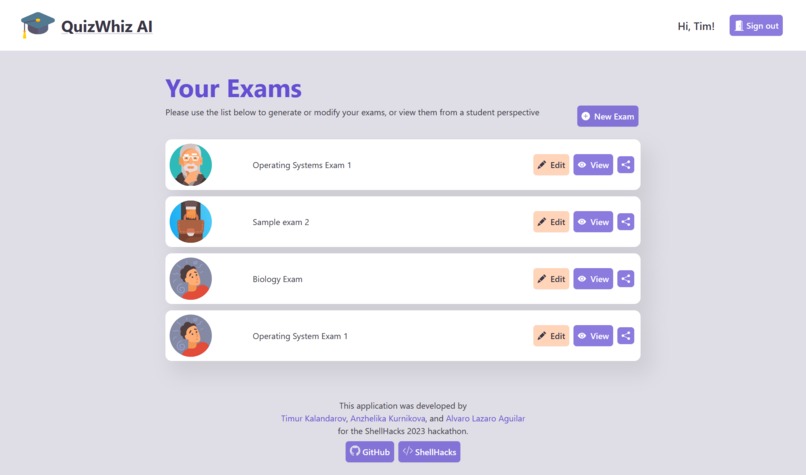
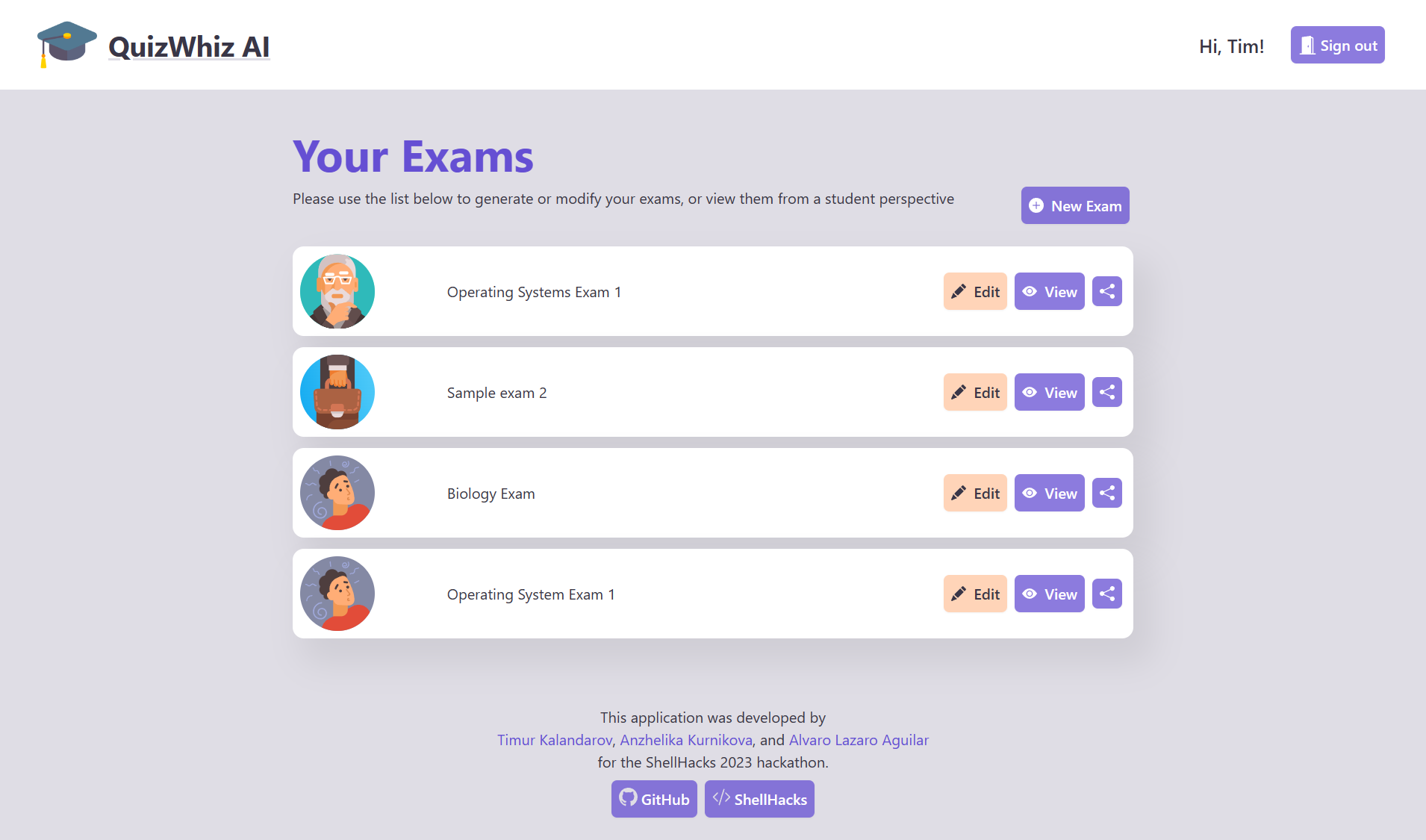
Exams list
-
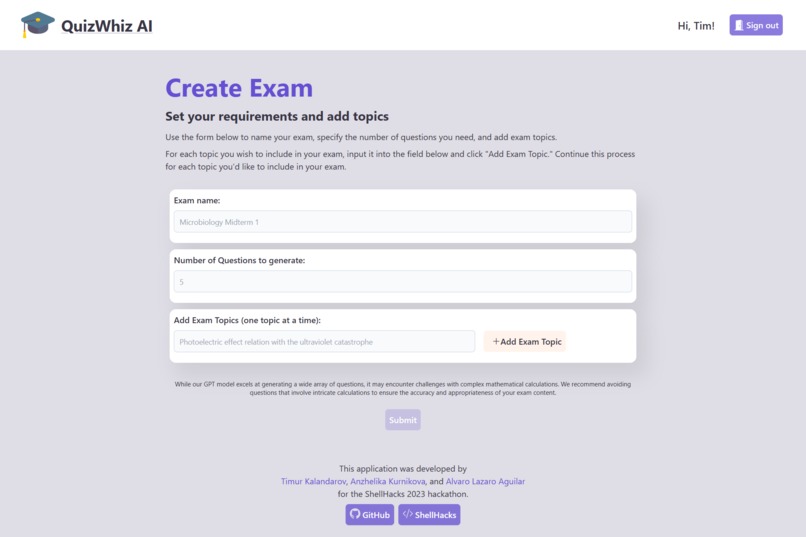
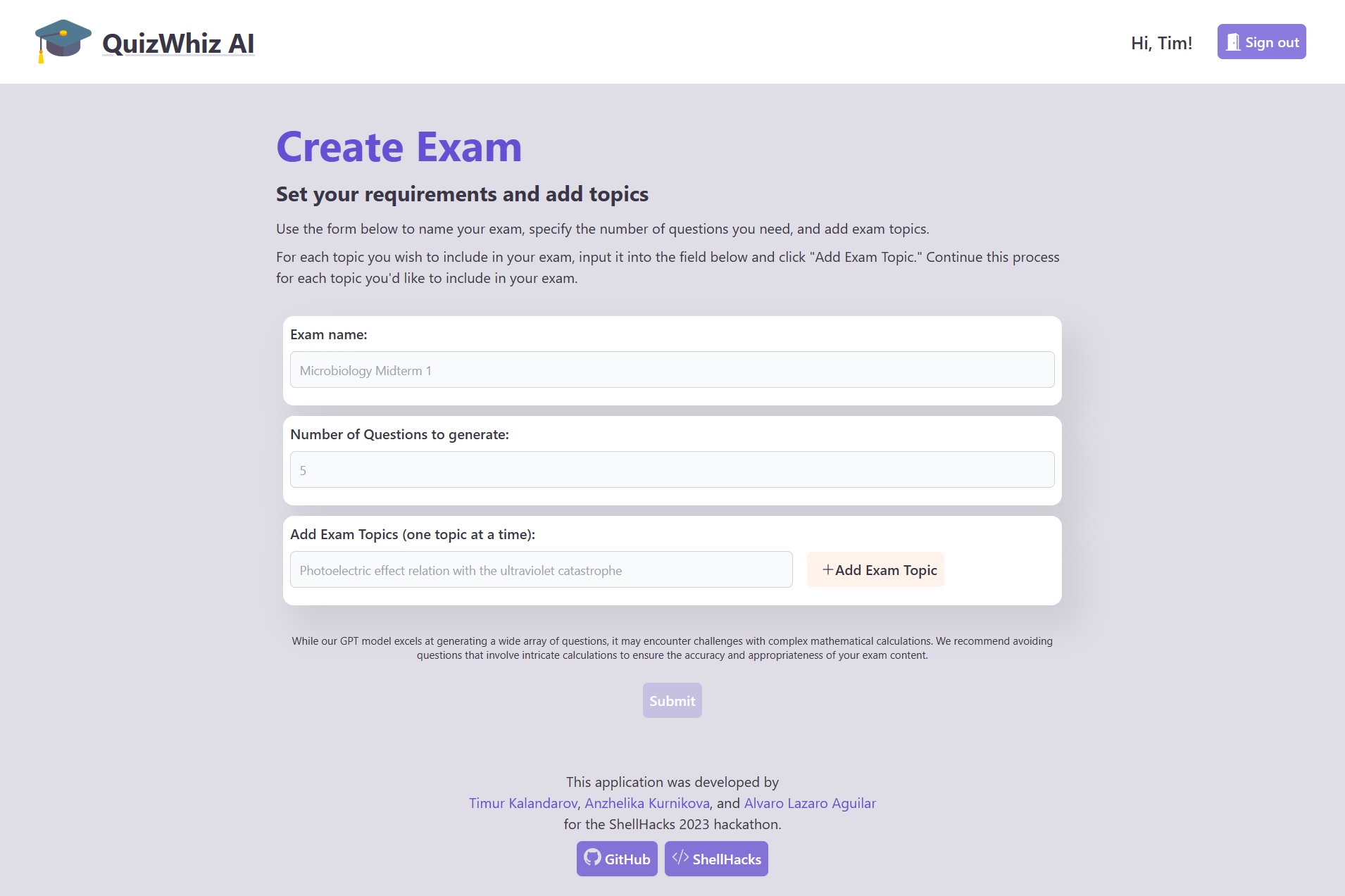
Create exam page
Inspiration
- We found ourselves frustrated with inadequately designed assignments and exams that often missed their teaching goals.
- This led us to believe we could devise a tool for educators that would not only streamline their tasks but significantly enhance the quality of their instruction.
- With the advent of generative AI, we realized we possessed the means to transform a basic set of inputs into comprehensive content for educators. The adaptability of generative AI further propelled our project by enabling an automated evaluation tool.
What It Does
Educational Content Generation: Our platform enables educators to simply log in, provide a brief set of topics tailored for students' evaluation, and in turn, it leverages GPT-4 to transform these inputs into a specified number of intricate questions.
Immediate Evaluation: Beyond question generation, our platform doubles as a student evaluation tool. Educators can distribute an AI-generated exam link to students who can complete it and promptly receive feedback.
How We Built It
Tech Stack:
- Backend: C#, ASP.Net, CockRoachDB
- Frontend: TypeScript, JavaScript, React.js, Tailwind
- Infrastructure: Docker
Challenges We Overcame
Database Hurdles: Initial challenges in database setup and management, particularly in storing exams and the AI's responses, were successfully navigated, leading to efficient operations.
Language Model Output: Ensuring the AI’s output met our standards and parsing that data for inter-system communication was a unique challenge. This required a blend of prompt engineering and the use of regular expressions.
Proud Achievements
We're thrilled to have developed a full-stack application that fulfills our dual aims: AI-driven exam generation and instant exam evaluation. In one of our test runs, we generated a compelling exam output, indicative of our project's potential:
"topics": ["Plato's idealism","Escapism vs plato's idealism"],
"generated_questions":[
  " A startup company, VirtuWorld, offers its customers a chance to live in a virtual world where they can craft their perfect surroundings and interactions. They market it as \"The Purest Form of Reality.\" Reflecting on philosophical notions, discuss how VirtuWorld parallels and deviates from ancient concepts of understanding reality and the pursuit of ideals.",
  " In a recent art exhibit, a series of photographs depict mundane everyday objects but with slight distortions to highlight specific features. The artist states they are attempting to showcase \"the true essence\" of the objects. Analyze the artist's approach in the context of traditional philosophies about the nature of reality and our perception of it."]
What we learned
Understanding Educator Needs: We delved deep into understanding the pain points of educators and realized that the traditional method of question formulation was tedious and time-consuming. By integrating AI, we learned that educators can be provided with more time for actual teaching, rather than spending their valuable time on administrative tasks.
AI Integration: Through this project, we gained a significant understanding of how advanced language models like GPT-4 operate. We learned the intricacies of prompt engineering, the importance of refining the outputs, and ensuring the quality of generated content.
Technical Skills: On the technical side, our team members got hands-on experience with React, .NET 6.0, and CockroachDB. Managing data and integrating various tech stacks taught us the importance of seamless collaboration between frontend, backend, and database operations.
Project Management: Building such a comprehensive tool in a limited timeframe taught us the significance of efficient project management, timely decision-making, and iterative development.
What's next for QuizWhiz AI
Customization: We plan to introduce a customization feature where educators can set the complexity level of the questions based on the student's grade and understanding.
Integration with Learning Management Systems (LMS): Our goal is to seamlessly integrate QuizWhiz AI with popular Learning Management Systems like Moodle, Blackboard, and Canvas. This will allow educators to sync generated questions directly to their LMS of choice.
Collaborative Features: We aim to add a feature where educators from different institutions can collaborate, share, and refine the generated questions. This will create a community-driven platform of quality questions.
Continuous Learning: We'll introduce a feedback loop system where educators can provide feedback on the AI-generated questions. This will be used to continuously train our model, ensuring better and more accurate question generation over time.
Expansion to Other Subjects: Initially, we have focused on a few subjects, but we plan to expand our platform to cater to a wider range of subjects, from science and mathematics to arts and humanities.
Mobile Application: Considering the increasing use of smartphones and tablets in education, we're looking forward to developing a mobile application for QuizWhiz AI, making it more accessible for educators on the go.


Log in or sign up for Devpost to join the conversation.