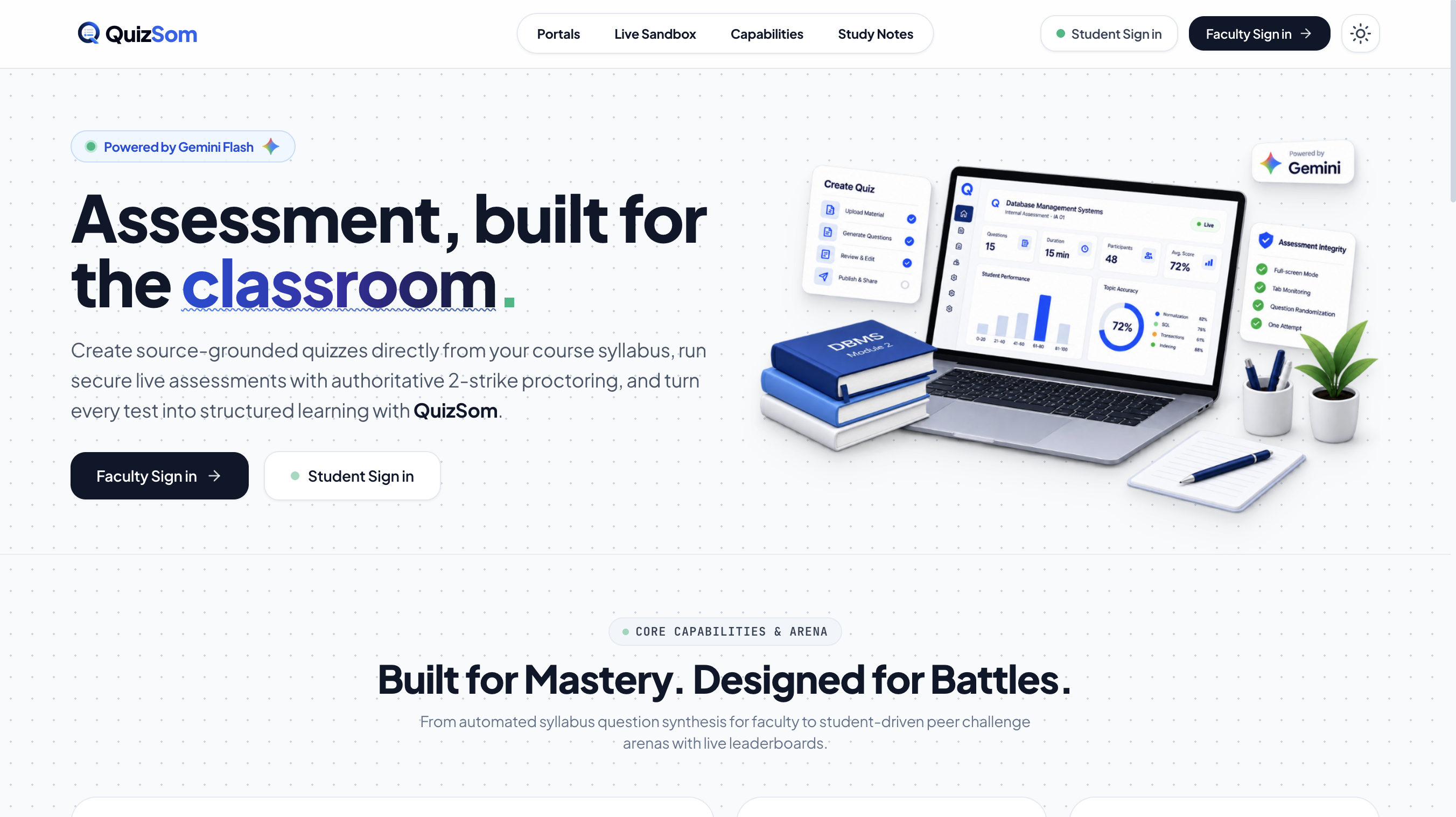
Inspiration QuizSom began with a problem we repeatedly noticed in education: assessments usually end with a score, but a score alone does not help a student improve. Faculty spend hours creating quizzes from lecture notes and textbooks. Generic AI quiz generators can reduce that effort, but they may introduce information that was never present in the syllabus. Students also struggle to identify exactly which topics they misunderstand and where they should revise them. We wanted to build more than an AI quiz generator. We wanted a continuous learning system where faculty material becomes a trusted knowledge source, every generated answer can be verified, and every student mistake becomes a new opportunity to practise. What it does QuizSom is a Gemini-powered, source-grounded assessment and adaptive learning platform. Faculty can upload PDFs, PPTX presentations, DOCX files, and text notes. QuizSom extracts and cleans the content, preserves page boundaries, divides it into focused chunks, and indexes those chunks using Gemini embeddings. Gemini then generates multiple-choice questions from the uploaded material. Every question includes a source citation, page number, section, explanation, and supporting excerpt. Before accepting a question, QuizSom verifies that the excerpt and complete correct answer actually exist on the cited page. Faculty can review the questions, publish an assessment, and create a live room. The examination system provides server-controlled timers, randomized questions and options, deterministic scoring, leaderboards, and integrity monitoring. Students receive:
- Question-by-question results
- Correct and incorrect answer analysis
- Topic-level strengths and weaknesses
- Source-grounded explanations
- Exact PDF page citations
- Access to the original source page
- Personalized weak-topic practice After an assessment, a student can select a weak topic and generate a new Battleground practice round from the same PDFs. After completing that round, QuizSom analyses the result again, allowing the student to practise repeatedly until their understanding improves. QuizSom also includes a private study assistant. It answers questions only from course material connected to assessments the student has joined and provides source evidence for every answer. How we built it QuizSom is built with Next.js 14, TypeScript, React, Tailwind CSS, Firebase Authentication, MongoDB Atlas, MongoDB GridFS, Google Gemini, and Vercel. Our document pipeline works as follows:
- The faculty member uploads a PDF, PPTX, DOCX, or TXT file.
- The original file is stored in MongoDB GridFS.
- Text is extracted page by page or slide by slide.
- Repeated headers, URLs, page numbers, encoding artifacts, and formatting noise are removed.
- The content is divided into approximately 350-word, page-safe chunks.
- Each chunk retains its document title, page number, section, token estimate, and owner.
- Gemini embeddings are generated for semantic retrieval.
- The indexed material is stored in MongoDB Atlas. For study chat, we use hybrid retrieval: 55% semantic vector similarity + 45% keyword overlap The system ranks relevant chunks, extracts the strongest evidence sentences, and sends only a few focused passages to Gemini. Gemini must return structured JSON containing short answer points and the IDs of the evidence passages used. For quiz generation, Gemini receives labeled blocks such as: [DOCUMENT: Database Systems | PAGE: 12 | SECTION: Normalization] The prompt restricts Gemini to the supplied material and requires a verbatim excerpt containing the correct answer. Generation uses a low temperature to reduce unnecessary variation. We then apply deterministic verification. A question is accepted only when:
- The cited document exists.
- The cited page exists.
- The excerpt appears on that page.
- The complete correct answer appears inside the excerpt.
- The answer also appears in the original source chunk. Gemini handles generation and explanation, while deterministic server code controls authentication, access, timers, scoring, negative marking, integrity events, submissions, and ranking. Challenges we ran into One major challenge was preserving trustworthy page citations. Basic PDF extraction often combines content from several pages, making citations unreliable. We changed the pipeline to extract pages separately and prevent chunks from crossing page boundaries. Another challenge was reducing hallucinations without making the system unusably restrictive. Prompt instructions alone were not enough, so we introduced server-side citation and answer verification. Handling context was also difficult. Sending an entire textbook to Gemini creates noisy, expensive prompts and can cause relevant information to be overlooked. We addressed this in study chat using page-aware chunks, Gemini embeddings, keyword matching, evidence ranking, and compact evidence selection. Deploying file uploads on Vercel presented another challenge. Vercel’s application filesystem is not persistent and cannot be used as permanent upload storage. We moved original documents to MongoDB GridFS and stored their processed knowledge representation in MongoDB Atlas. We also encountered a serverless persistence race: the first generation request could arrive before an uploaded document had finished saving. QuizSom now waits for MongoDB persistence before reporting a successful upload. Finally, designing both formal assessments and friendly student Battlegrounds required different integrity rules. Faculty assessments can use strict monitoring, while practice rooms intentionally provide a relaxed learning environment. Accomplishments that we're proud of We are proud that QuizSom does not blindly trust AI-generated output. Gemini proposes questions, but the application independently verifies their evidence. We are especially proud of:
- Exact page-level grounding
- Original PDF page previews
- Hybrid semantic and keyword retrieval
- Evidence-linked student chat
- Structured Gemini output
- Safe abstention when evidence is insufficient
- Server-side scoring and examination control
- Persistent PDF and presentation storage
- Student-created Battlegrounds
- Personalized weak-topic remediation
- The continuous assessment-to-practice learning loop Our biggest accomplishment is turning a quiz result into an actionable learning plan. Instead of only telling students that they were wrong, QuizSom shows what they misunderstood, where the correct information appears, and gives them an immediate way to practise it. What we learned We learned that reliable educational AI requires much more than a strong prompt. The quality of the result depends heavily on document extraction, chunk boundaries, metadata, retrieval, authentication, persistence, verification, and interface design. We also learned that RAG is most useful when retrieval results remain traceable. A citation should not be decorative; it should allow the user to inspect the exact original evidence. Another important lesson was to separate AI intelligence from academic authority. Gemini is excellent at synthesis and explanation, but grades, timers, permissions, and rankings should remain deterministic. We learned that preventing every possible hallucination cannot be guaranteed. A more responsible approach is to build a hallucination-resistant system using constrained context, low-temperature generation, structured output, deterministic verification, abstention, and human-verifiable evidence. Most importantly, we learned that personalization becomes genuinely useful when it is based on observed student performance rather than generic recommendations. What's next for QuizSom Our next step is to make assessment generation retrieval-first. Instead of applying a fixed context budget to each document, QuizSom will select balanced evidence across chapters and modules before asking Gemini to generate questions. We also plan to add:
- Long-term mastery tracking across multiple assessments
- Spaced-repetition scheduling for weak topics
- Difficulty that adapts to student performance
- Faculty-defined learning outcomes and Bloom’s Taxonomy levels
- Better support for diagrams, equations, and scanned documents
- OCR for image-based PDFs
- Multilingual question generation and explanations
- Voice-based study assistance
- More comprehensive grounded-retrieval evaluations
- Institution-level dashboards
- Collaborative Battleground tournaments
- Notifications when a weak topic is ready for revision
- Stronger retrieval reranking and chapter-coverage checks Our long-term vision is for QuizSom to become an evidence-driven learning companion: a platform that understands what students were taught, measures what they understood, shows exactly where they went wrong, and helps them improve one grounded practice round at a time.

Log in or sign up for Devpost to join the conversation.